Best Exhaust Setup for Track Day Use
For most track days, start with a stock exhaust or a resonated cat-back. Choose a valved cat-back only if you need quiet street use and a louder track setting, and fit a quiet insert only to clear a tight sound limit. Miss the noise rule and you risk black flags, session cuts, failed tech, and parts that cannot run on track. This guide compares stock, resonated cat-back, valved cat-back, and quiet insert setups by noise rule, power loss, and street legality.
Track-day noise limits


Track-day noise limits are set by the circuit, the organizer, the school, or the series, and the strictest rule applies. Some events measure at a fixed station beside the track, some use a static test, and some use both methods.
Static test vs fixed-station reading
A static test measures the car while stationary at a prescribed engine speed and distance. A fixed-station or drive-by reading captures the car as it passes a sensor beside the circuit. Those two methods do not reward the same exhaust behavior, so a setup that passes one can fail the other.
Weather, distance, direction, gearing, throttle position, packing condition, and nearby motorcycles can change the reading. A quiet exhaust at part throttle can still be flagged if the circuit’s meter sits in a reflective spot or the car passes in a lower gear than expected.
What the strictest rule means
Use the lowest published limit in the event packet, rather than a number from the car club or a previous season. If the circuit limit is around 98 dB and the organizer limit is around 95 dB, the lower limit usually governs setup choice. That is the limit that matters on arrival.
| Setup | Noise risk | Track performance | Drone risk | Install complexity | Street-legality risk |
|---|---|---|---|---|---|
| Stock exhaust | Low | Low to moderate | Low | Low | Low if emissions parts remain intact |
| Resonated cat-back | Moderate | Moderate | Low to moderate | Moderate | Moderate if catalytic converter and required emissions parts stay in place |
| Valved cat-back | Moderate to low, depending on valve position | Moderate to high | Moderate | High | Moderate to high if valve logic or hardware conflicts with road rules |
| Quiet insert or quiet core | Low when correctly sized and retained | Low to moderate | Low | Low to moderate | Moderate if the part is not approved for the muffler or local law |
Exhaust setup
The safest setup is a mechanically sound muffled system with the required catalyst and emissions equipment. That baseline gives you the least drama at tech, the fewest noise surprises, and the best chance of keeping the car legal on the road after the event.
Stock exhaust
Stock is the lowest-risk answer when the event has a tight sound limit or when the car must stay legal for the street with no surprises. It usually gives up some top-end flow compared with performance systems, but it also keeps the tuning and sound behavior predictable.
Resonated cat-back
A resonator controls drone frequencies and cuts cabin resonance in a dual-use exhaust design. A resonated cat-back is often a middle-ground option for many cars because it can help with flow while keeping steady-state cabin noise down on the way to and from the track.
That does not make it automatically quiet enough for every venue. A resonated system still needs a healthy muffler, tight joints, and the right catalyst arrangement for the car and the rules.
Valved cat-back
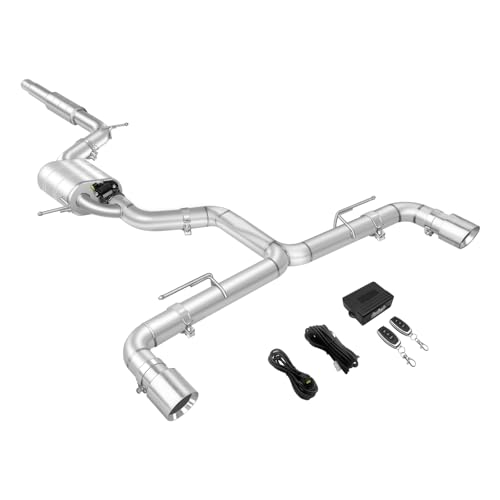
Exhaust valves can open or close based on rpm or control logic, and they need proper actuation and setup. A valved cat-back can make sense when you need the car quiet in traffic and louder on track, but it only works if the valves move as intended.
A stuck valve, bad vacuum line, failed actuator, or poor control map can leave the car too loud or too restrictive. That is why a valved system should be checked before departure, not assumed to work because the catalog says it can.
Quiet insert or quiet core
Only a manufacturer-approved removable sound-control option should be used. The insert or core must match the specific muffler and be securely retained. A makeshift insert that can detach is a track hazard, not a solution.
Use this option when you are close to the limit and need a temporary reduction in sound, not a permanent fix for a mismatched exhaust. If the system is already leaking or missing packing, an insert is a bandage on a broken setup.
Suppose a turbo coupe has a resonated cat-back and passes a static test by a small margin, but the same car fails a drive-by on a hot day with a tailwind. The fix is not guessing at louder or softer tip styles. Keep the resonator, repair any leaks, and use an approved insert only if the organizer allows it.
What exhaust setup is best for track day use?
For track days, the best setup is the one that clears the strictest sound rule without creating street-legality problems. For most naturally aspirated cars, stock or resonated cat-back is the cleanest answer. For turbocharged cars, a resonated system or a valved cat-back often gives the best balance of flow and noise control.
Naturally aspirated cars
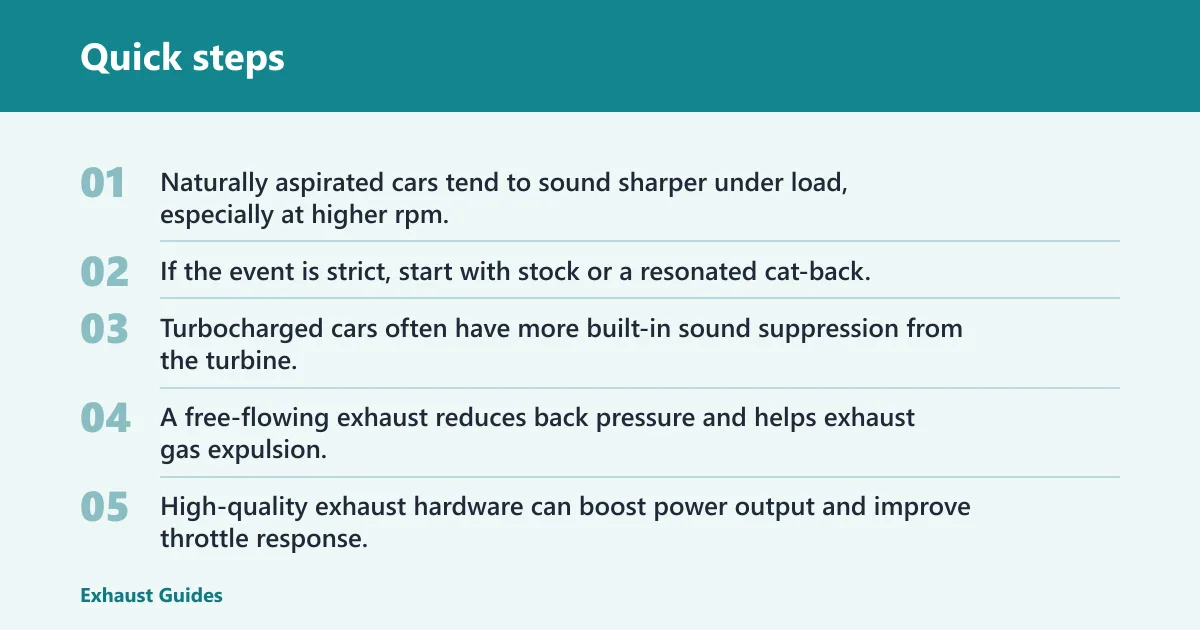
Naturally aspirated cars tend to sound sharper under load, especially at higher rpm. If the event is strict, start with stock or a resonated cat-back, because a straight-through system can be easy to hear at a fixed station even when the car feels modest from inside the cabin.
Turbocharged cars
Turbocharged cars often have more built-in sound suppression from the turbine, so they may tolerate freer-flowing exhaust hardware better. A free-flowing exhaust reduces back pressure and helps exhaust gas expulsion, but the sound gain can still be enough to trigger a borderline venue.
High-quality exhaust hardware can boost power output and improve throttle response. That said, a louder setup is not automatically a faster one on track, especially if it forces you to short-shift or lift to avoid a sound flag.
Street-driven cars that must stay legal
If the car must remain street legal, keep the catalytic converter where required and treat track approval as separate from road approval. Track-day pass does not make a race exhaust street legal. Federal anti-tampering rules and state noise or emissions laws may still apply in the United States.
A common first-timer mistake is assuming a part that clears tech will clear inspection on the drive home. A car can pass a noisy-track rule with an insert and still violate emissions law if the catalyst has been removed or replaced with a noncompliant part.
Do inserts, resonators, or valves help?
Yes, but they solve different problems. A resonator targets drone, a baffle or insert targets outright sound level, and valves target the tradeoff between street civility and track output. Pick the part that matches the failure mode you are trying to fix.
When a resonator is the right fix
Choose a resonator when the car is acceptable at wide-open throttle but tiring at cruise. Resonators are especially useful for dual-use cars that must sit on the highway for an hour before the session. They can cut cabin resonance without choking the system the way an improvised restriction can.
When a baffle or insert is the safer choice
Choose a manufacturer-approved insert when the car is only slightly too loud for the event. The insert is the right tool for a borderline static limit, provided it is the correct size, secure, and intended for that muffler. If it rattles, loosens, or changes shape, do not run it.
When exhaust valves make sense
Use valves when you want one car to act like two setups: quiet for the road, louder for the circuit. They are most useful on cars that have enough budget and packaging space for proper actuation. They are less useful if the event bans active exhaust modes or if the valve hardware is unreliable.
Will a cat-back exhaust hurt performance on track?
A cat-back exhaust does not automatically hurt track performance, but the wrong design can trade away low-end response, drone control, or compliance for a sound gain you do not need. A well-matched cat-back can improve flow; a poorly matched one can add noise without giving a useful lap-time benefit.
On turbo cars, a freer cat-back often helps the engine expel exhaust gas more easily. On naturally aspirated cars, the gain is usually more dependent on overall system tuning, including the catalyst, resonator, and muffler design. The loudest option is rarely the best option for lap consistency.
How do I make my exhaust quieter for a track day?
Start with the parts that fail most often: leaks, worn packing, loose hardware, and the wrong insert. Then work outward. A quiet exhaust usually comes from tight joints, healthy muffler packing, proper mounting, and a legal catalyst, not one oversized muffler alone.
Exhaust setup inspection checklist
- Check muffler packing and internal components for wear, damage, or looseness.
- Inspect headers, joints, oxygen-sensor ports, and springs for leaks; repair them before loading the car.
- Confirm every clamp is the correct size and torqued properly.
- Check hangers, brackets, and supports for cracks, sagging, or contact with the chassis.
- Verify any baffle or insert is manufacturer-approved and securely retained.
- Make sure the catalytic converter and required emissions parts are still installed where needed.
- Cycle exhaust valves through their full range if the car has them.
- Listen for metallic rattles at idle and during a brief throttle blip.
Backup-parts list for the paddock
- One spare approved baffle or insert for the exact muffler
- Extra clamps in the correct diameter
- Replacement springs for spring-hung joints
- Spare exhaust hangers or support bushings
- Exhaust gasket(s) for the most leak-prone flange points
- Hand tools for the fasteners used on your system
- Heat-resistant gloves for a hot swap after a sound warning
Say your car has a mild leak at the rear flange and a worn muffler core. Even a good insert may not save it, because the leak can raise the reading enough to fail a static test. Fix the seal first, then decide whether the insert is still needed.
Can a track-day exhaust still be street legal?
Yes, but only if the car still meets the applicable road rules. A track-day pass does not make a race exhaust street legal. Keep the required catalytic converter installed, keep any emissions equipment required by law, and confirm that any valved or removable parts do not violate local rules.
Catalytic converter rules
The catalytic converter must remain installed where street legality requires it. Track approval does not override road law. A high-flow catalytic converter may reduce restriction, and some guides claim reductions of 35–50% versus stock, but the part still has to be legal for the car and jurisdiction.
What to confirm before you leave the venue
Before you drive home, verify that the setup is still intact, the valves are in the correct mode, the insert is secure if it was fitted, and no clamp or hanger shifted during the session. A car that passes tech can still be illegal or unsafe if the system changed during the day.
Frequently asked questions
Should I run a baffle or insert for track days?
Run one only if it is manufacturer-approved, sized for the specific muffler, and securely retained. It is the right move for a borderline sound limit, not for a leaking or poorly packed exhaust. A loose insert can become a hazard and can fail tech on its own.
Do I need a high-flow catalytic converter for track days?
Not always. A high-flow catalytic converter can reduce restriction and may help a power-focused build, but the car still needs the correct emissions equipment for street legality where required. If the event is strict on noise, a catalyst change alone will not solve a bad muffler or leak.
How loud can my exhaust be at a track day?
There is no universal number. Limits vary by circuit and organizer, and testing may be static, fixed-station, or both. The reading can change with weather, distance, gearing, throttle position, packing condition, and nearby bikes, so the event’s strictest published rule is the one that matters.