Flex pipe repair cost by vehicle type: what to expect
Flex pipe repair can run from a lower price for clamp-in sections on compact cars to a higher price for welded repairs on larger vehicles, and can cost more on trucks or heavily rusted dual-exhaust setups. Ignore a torn flex pipe and you can get exhaust leaks, loud drone, failed emissions tests, and a bill that jumps if the flange or converter is damaged. This guide breaks down flex pipe repair cost by vehicle type, exhaust layout, and repair method so you can compare quotes before you call a shop.
What a flex pipe does and why it fails
![MHPCONT 2.5" Universal Exhaust Flex Pipe, 304 Stainless Steel [1 1/2"] ID x 17" Length Flexible Exhaust Tubing](https://m.media-amazon.com/images/I/31-9CJ2bJ5L._SL500_.jpg)

The flex pipe lets the engine rock on its mounts without cracking the rest of the exhaust. You see it often on transverse FWD cars, where the engine, exhaust, and subframe sit close together. When the braid, bellows, or pipe wall cracks or rusts through, exhaust leaks follow fast.
Typical signs are a cold-start tick, a louder exhaust note under throttle, soot near the joint, and a sharp exhaust smell under the car. Rust on the outer braid often means the section is weak, but the leak can come from a split right beside the flex pipe rather than the braid itself.
Why FWD packaging changes the repair approach
Transverse FWD cars often place the flex pipe near heat shields, steering parts, and the subframe. That tight packaging can turn a simple fix into a longer labor job. Trucks usually give better access under the vehicle, but the exhaust is often larger, heavier, and more likely to be rusted.
📊 Flex pipe repair total project cost can range from $150 to $900. Source: Flex Pipe Exhaust Repair Cost Guide.
How much does flex pipe repair cost by vehicle type?
Vehicle size matters because access, pipe diameter, and exhaust layout change the labor bill more than the part itself. A compact car with a small pipe and open access usually costs less than a truck with a 3.0-inch section, seized fasteners, or dual exhaust. The broad project range can be $150 to $900, but the vehicle type decides where you land inside that spread.
Compact car pricing
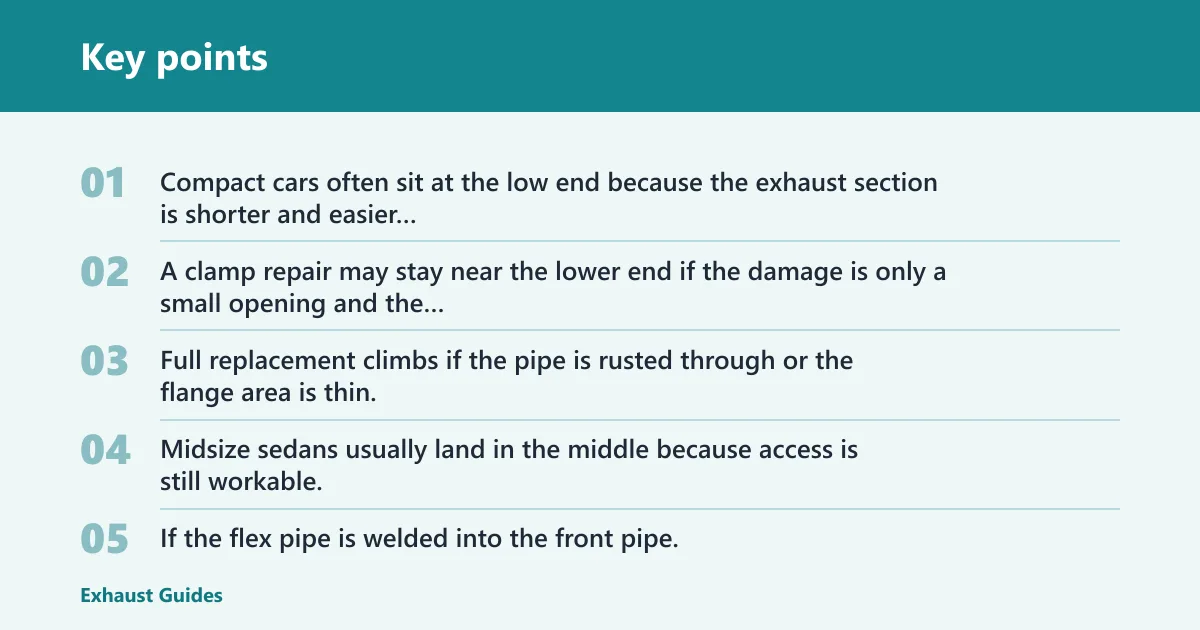
Compact cars often sit at the low end because the exhaust section is shorter and easier to reach. A clamp repair may stay near the lower end if the damage is only a small opening and the pipe around it is still solid. Full replacement climbs if the pipe is rusted through or the flange area is thin.
Midsize sedan pricing
Midsize sedans usually land in the middle because access is still workable, but the exhaust may run longer and take more labor to remove and align. If the flex pipe is welded into the front pipe, the shop may need to cut and fit a replacement section instead of bolting on a quick patch.
SUV and crossover pricing
SUV and crossover pricing tends to run higher than a sedan when the vehicle sits taller, the exhaust runs longer, or the underbody shields are more involved. All-wheel-drive packaging can also add removal steps. The part itself may not be wildly different, but labor often is.
Truck and larger-diameter exhaust pricing
Trucks and larger-diameter exhaust systems usually cost more because the pipe is bigger, the materials are heavier, and rusted underbody hardware is common. Dual-exhaust layouts can double the work if both sides need attention or if the shop has to match tubing and hangers on one side.
| Vehicle type | Clamp repair | Welded joint replacement | Full flex pipe replacement |
|---|---|---|---|
| Compact car | 0.5–1.0 labor hours; parts $40–$90; likely total $150–$250 | 1.0–1.5 labor hours; parts $60–$140; likely total $220–$380 | 1.5–2.5 labor hours; parts $90–$180; likely total $300–$500 |
| Midsize sedan | 0.75–1.25 labor hours; parts $50–$100; likely total $180–$300 | 1.0–2.0 labor hours; parts $70–$160; likely total $250–$450 | 2.0–3.0 labor hours; parts $120–$220; likely total $350–$650 |
| SUV/crossover | 0.75–1.5 labor hours; parts $50–$110; likely total $200–$350 | 1.5–2.5 labor hours; parts $80–$180; likely total $300–$550 | 2.5–3.5 labor hours; parts $140–$240; likely total $450–$750 |
| Truck or larger-diameter exhaust | 1.0–1.5 labor hours; parts $60–$130; likely total $250–$400 | 2.0–3.0 labor hours; parts $100–$220; likely total $400–$700 | 3.0–4.0 labor hours; parts $160–$260; likely total $550–$900+ |
These ranges reflect a practical split between simple repairs and the more common shop-installed replacements. A standard passenger car repair is often quoted inside the broader $150 to $900 range, and another guide places many repairs between $150 and $700.
What repair method changes the bill most?
The repair method changes the bill more than most drivers expect. Clamp-only fixes cost the least when the pipe is otherwise healthy, welded joint replacement costs more because it takes cutting and fitting, and full flex pipe replacement costs most when the section is rusted, split, or too thin to patch safely.
Clamp-only repair costs and limits
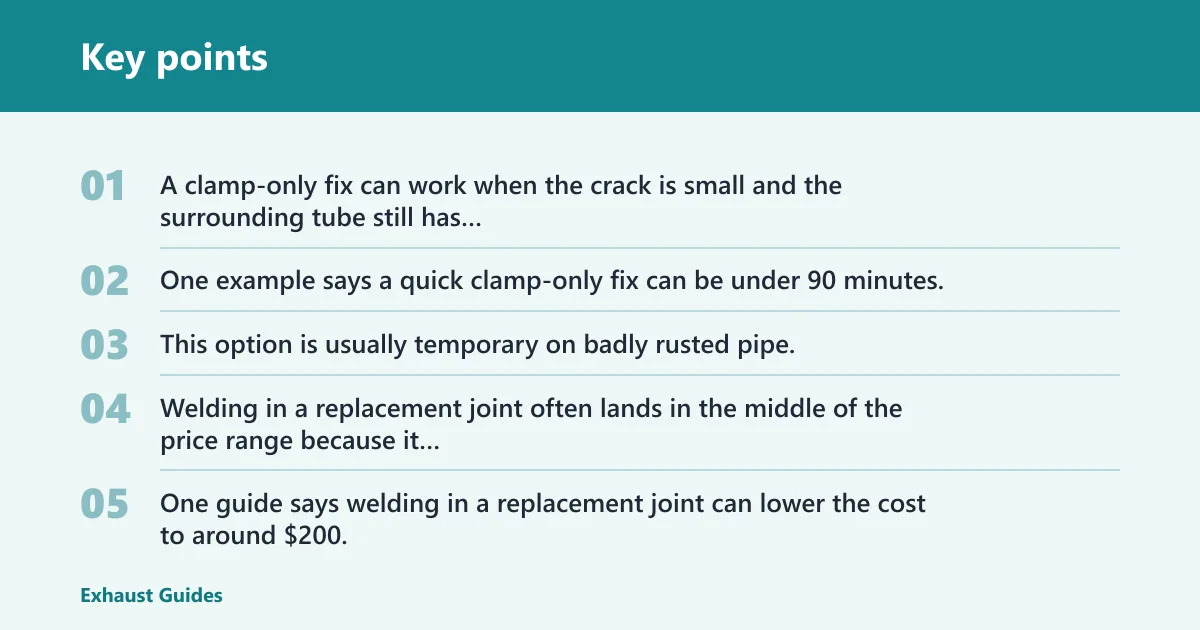
A clamp-only fix can work when the crack is small and the surrounding tube still has enough metal for a seal. One example says a quick clamp-only fix can be under 90 minutes. This option is usually temporary on badly rusted pipe, and it may not hold if the flex section has multiple weak spots.
Welded joint replacement pricing
Welding in a replacement joint often lands in the middle of the price range because it needs preparation, cutting, and careful fit-up. One guide says welding in a replacement joint can lower the cost to around $200, but the final number still depends on access, rust, and whether the old flex section must be removed first.
Full flex pipe replacement pricing
Replacing an entire flex pipe can cost around $400 in a straightforward case, and more when the vehicle has poor access or a larger diameter exhaust. This is the better call when the braid is split, the shell is rusted through, or the pipe has already been patched once.
When a joint-only repair is enough
A joint-only repair makes sense when the rest of the exhaust is solid and the leak is isolated to one end of the flex section. If the pipe is rusty across the middle or the flanges are warped, a patch can become false economy fast.
Why do labor, access, and rust change the price?
Labor is often the biggest swing factor. Typical labor time is 1 to 3 hours for many flex pipe repairs, but access and rust can push the job closer to 4 hours. Labor rates can vary by region and shop type, with some guides and shops listing lower or higher hourly ranges.
Shop rate versus mobile mechanic rate
Shop pricing and mobile mechanic pricing do not always match. A mobile repair can save towing, but it may cost more per hour or limit the repair methods available because welding setup, lift access, and rust cleanup are more constrained outside a full shop.
How corrosion and seized hardware add time
Rust adds time because bolts snap, clamps seize, and flanges may need heat or cutting to separate. If the flex pipe is buried above a splash shield or near a catalytic converter, the technician may spend more time on disassembly than on the actual repair.
How pipe diameter and materials affect parts cost
Pipe diameter matters because larger tubing uses more material and often costs more to source. Common sizes are around a few standard diameters, depending on the vehicle and exhaust setup. The jump from a small passenger-car pipe to a 3.0-inch truck section can raise the parts line even when the labor hours stay similar.
Parts that may appear on the invoice
- Flex pipe segment
- Clamps
- Couplings
- Gaskets
- Heat-resistant sealant
Parts often cost $40 to $260 depending on the repair scope. Some repairs need only a section and a clamp, while others need a full replacement pipe, new hangers, and a gasket at the flange. If the old hardware is too corroded, the invoice can also include replacement fasteners or a new clamp kit.
How much should you budget near you?
Budgeting by region is smarter than guessing from a single national average. Urban shops often charge more than rural shops, and West Coast and Northeast pricing is usually higher than Midwest pricing. For the same repair, labor rate differences alone can move the total by a meaningful amount.
Diagnostic fee and warranty line items
Diagnostic inspection may cost $40 to $160, though some shops waive that fee when you approve the repair. Other shops bill it separately. Warranty terms also vary; short shop warranty coverage may apply to the repair itself, but coverage length and what counts as a repeat failure differ by shop.
Suppose a compact sedan has a clean break near the front flex section and the shop can reach it easily. That may stay near the lower end of the range. Now picture a rusted truck with a 3.0-inch pipe, seized bolts, and a heat shield in the way. The estimate can climb quickly because labor, hardware, and pipe diameter all stack up.
- Ask whether the quote includes diagnosis, removal, and reinstallation.
- Confirm whether the repair is clamp-only, welded, joint-only, or full replacement.
- Check the pipe diameter and whether the quote is for one side or both sides.
- Ask if hangers, gaskets, or heat shields are extra.
- Compare the warranty term before approving the job.
What makes the price change between compact cars and full-size vehicles?
The main difference is packaging. Compact cars often have simpler access and smaller tubing, while full-size vehicles may have larger pipes, more rusted hardware, and more exhaust mass to support during the repair. That means more labor time, more materials, and a higher chance that the shop will need to replace related parts.
Hidden costs that can appear
Hidden costs usually come from nearby components rather than the flex pipe itself. Hangers may be worn, heat shields may need to be removed and refitted, and disposal or shop supplies may appear as small line items. If the flange or catalytic converter connection is damaged, the bill can jump well past the first quote.
What does labor add to a flex pipe repair bill?
Labor often adds as much as, or more than, the part. For many repairs, the part is relatively inexpensive, but the access time, cutting, welding, and reassembly set the final total. Labor plus diagnosis can run from $60 to $420 in one estimate, which helps explain why two quotes for the same part can differ sharply.
Typical labor hours and what stretches them
Most jobs take 1 to 3 hours, but rust, tight packaging, and broken fasteners can push the job longer. If the pipe is welded in place near other exhaust components, the technician may need to work around limited clearance and protect nearby parts from heat.
Can a flex pipe be repaired in place or does it need replacement?
Some flex pipes can be repaired in place if the damage is small and the surrounding pipe is still structurally sound. If the crack is long, the braid has separated, or corrosion has eaten into the tube wall, replacement is usually the safer option. The deciding factor is whether the remaining metal can hold a seal.
How to compare short-term savings with repeat repair risk
A cheap patch can make sense on an older car with limited remaining value. On a newer car, repeated leaks, exhaust odor, and failed inspections can turn the cheaper repair into the more expensive one over time. If the quote is approaching the cost of a clean replacement and the pipe is rusty, replacement is usually the better call.
Why is flex pipe repair more expensive on some cars than others?
Some cars cost more because the exhaust is harder to reach, the pipe diameter is larger, or the flex section is built into a longer front pipe assembly. Transverse FWD cars can be tight to work on, while trucks may be easier to access but heavier, larger, and more rust-prone. That changes labor first, then parts.
Do trucks and SUVs cost more to repair than sedans?
Usually yes, especially when the truck or SUV has larger tubing, more corrosion, or extra exhaust length. Sedans can be cheaper because the job is often shorter and the pipe diameter is smaller. Still, a rusted sedan can cost more than a clean SUV if access is worse.
Is it cheaper to replace the whole flex pipe or just the joint?
Just the joint is cheaper up front when the rest of the pipe is healthy, and welding in a replacement joint can bring the bill down near $200 in some cases. Full replacement is smarter when the pipe is rusted, thin, or already patched. If the surrounding metal is weak, the lower quote may not last.
Does welding make flex pipe repair more expensive?
Welding usually costs more than a clamp because it adds labor, equipment, and fit-up time. It is not always the most expensive option, though. A welded joint repair can still be cheaper than a full replacement when the pipe is otherwise solid and the shop can reach the section easily.
What hidden costs should I expect with exhaust flex pipe repair?
Expect possible charges for diagnostic inspection, extra hardware, hangers, heat shields, couplings, gaskets, and disposal. Emergency or after-hours service can add $80 to $320. If the repair is done at a mobile location, setup limits and travel time may also change the quote.
How much should I budget for a flex pipe repair near me?
For a local budget, start with the likely repair method, then add your area’s labor rate and any diagnostic fee. A compact car in a lower-cost region may stay near the bottom of the range, while a truck in an urban Northeast or West Coast market can move toward the top. If the quote is close to the cost of full replacement, ask for both options.
Frequently asked questions
Does welding make flex pipe repair more expensive?
Usually, yes, because welding adds prep and fit-up time. That said, a welded joint repair can still cost less than a full replacement. It is often the middle-ground option when the rest of the pipe is serviceable and the shop can access the leak without major disassembly.
What hidden costs should I expect with exhaust flex pipe repair?
Watch for diagnostic fees, extra clamps or couplings, gaskets, heat shields, hangers, and disposal charges. Emergency or after-hours service can also raise the bill. Ask whether the estimate includes these items before approving the work, because small line items can change the final total more than expected.
How much should I budget for a flex pipe repair near me?
Budget by local labor rate and vehicle layout, not by a single national average. Urban shops, especially on the West Coast and in the Northeast, often quote more than Midwest shops. A practical budget should include the repair, the diagnostic fee if it is not waived, and a margin for rusted hardware.