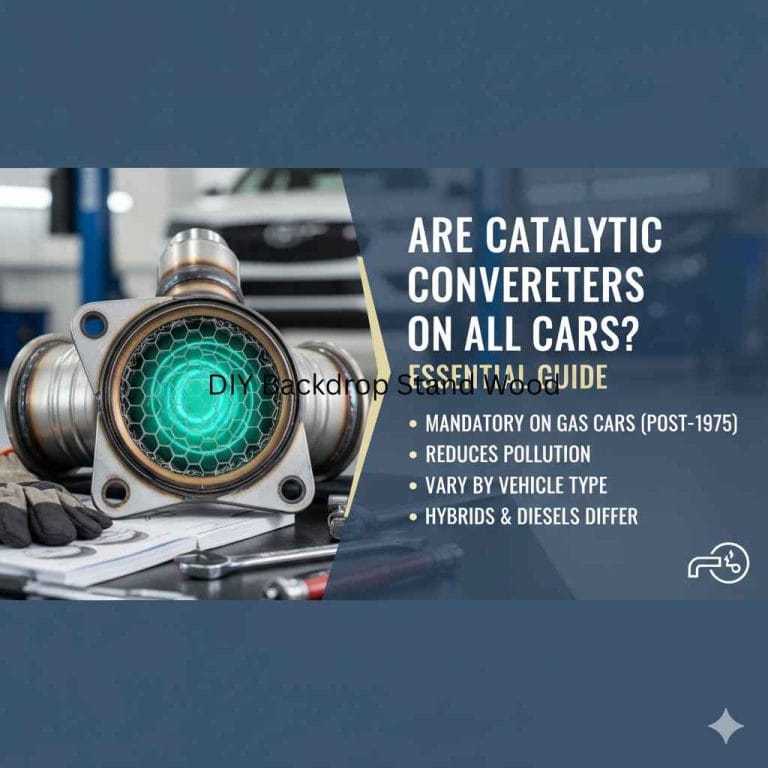
Are High Flow Catalytic Converters Legal In California? Essential
No, aftermarket high-flow catalytic converters are generally NOT legal for use on vehicles originally equipped with a California Air Resources Board (CARB) compliant system if they do not carry specific CARB Executive Order (E.O.) numbers. Using non-compliant parts in California is illegal and will cause your vehicle to fail smog checks. Always verify CARB legality before purchasing.
Upgrading your car’s exhaust system is exciting. Many enthusiasts look to high-flow catalytic converters for better performance and sound. But if you live in the Golden State, one huge question always comes up: Are high flow catalytic converters legal in California? This is a common point of confusion. California has some of the strictest emissions laws in the world, managed by the California Air Resources Board (CARB).
It’s frustrating to buy a part only to find out it violates state law. We want your ride to perform well and stay street-legal! Don’t worry. As your friendly automotive guide, I will break down the rules simply. We will explain exactly what you need to know about CARB compliance, performance, and legality so you can upgrade confidently.
Understanding the California Emissions Challenge
California sets the standards for vehicle emissions nationwide. Why? The air quality issues in major basins like Los Angeles require strict control measures. This means that nearly every component affecting how your engine cleans its exhaust gases must meet very high standards.
What is a Catalytic Converter?
Think of your catalytic converter like a tiny, very busy chemical factory right in your exhaust pipe. Its job is critical: it takes harmful pollutants—like carbon monoxide (CO), unburned hydrocarbons (HC), and nitrogen oxides (NOx)—and turns them into less harmful substances like water vapor and CO2 using precious metals (like platinum and palladium).
The Difference: Standard vs. High Flow
Standard converters are designed to meet EPA and CARB requirements perfectly, sometimes restricting flow a little to ensure maximum chemical reaction time. High-flow converters, on the other hand, are designed to allow exhaust gases to pass through much faster.
- Performance Benefit: Less restriction means your engine can “breathe” better, often resulting in a small horsepower gain and a throatier sound.
- The Trade-off: Because the gases move faster, the catalysts have less time to process the pollutants completely. This efficiency drop is why they often run into legal trouble in strict states.

The Definitive Answer: Legality in California
This is the core question. To answer it clearly, we need to use the official regulatory language, but we will keep it simple.
The CARB Executive Order (E.O.) Requirement
In California, any aftermarket component that replaces an original emissions control device (like a catalytic converter) must have written approval from CARB. This approval comes in the form of an Executive Order, or E.O. number.
If you buy an aftermarket catalytic converter, it must explicitly state it is CARB approved and list its specific E.O. number. If it doesn’t list an E.O. number, or if the number is not valid for your specific vehicle’s year, make, and model, then it is illegal for on-road use.
Why “Universal” Cats Don’t Work Here
Many performance catalytic converters sold online are labeled “For Off-Road Use Only” or are EPA-certified but not CARB-certified. These are perfectly legal in many states but are strictly prohibited in California for street-driven vehicles. Installing one guarantees you will fail your biennial smog inspection.
| Catalyst Type | CARB Approved (E.O.)? | Legal for Street Use in CA? |
|---|---|---|
| Original Equipment Manufacturer (OEM) Replacement | Yes (By design) | Yes |
| CARB-Legal High-Flow Aftermarket (With E.O.) | Yes (Requires specific E.O.) | Yes |
| Standard EPA-Only High-Flow Converter | No | No (Felony in CA if Tampering is Found) |
How to Find CARB-Legal Performance Converters
The good news is that performance and legality are not always mutually exclusive in California, though the options are much narrower. Manufacturers must spend significant time and money testing their specific high-flow designs to get the crucial E.O. number.
Step 1: Verify Your Vehicle Status
First, know your vehicle’s original equipment. Most vehicle models (especially those made from 1998 onwards) sold in California already came with highly efficient OEM catalysts. If your car was originally manufactured for sale in California (look at the VIN or under the hood sticker), it must always use a CARB-compliant replacement.
Step 2: Identify Reputable Brands
Only purchase catalytic converters from manufacturers that openly advertise their CARB compliance. These companies specialize in meeting California’s strict standards:
- MagnaFlow: They offer specific “CARB Compliant” lines, usually labeled with C.A.R.B. compliance markings.
- Eastern (Walker): Certain direct-fit aftermarket units carry the necessary approvals.
- OEM Replacements: While not “high-flow,” these are always 100% legal and often priced competitively now.
Step 3: Check the E.O. Number
This step is non-negotiable. If you are buying online, ask the seller for the specific E.O. number for that part number.
You can cross-reference this number directly on the official CARB website to ensure it covers your vehicle configuration. You can learn more about emission control system tampering prohibitions on the official California Air Resources Board website.
If a seller cannot provide a verifiable E.O. number, do not buy it for use in California. It’s not worth the massive potential fines or the headache of failing inspection.
The Risks of Using Non-Compliant Parts in California
Many car owners think, “I’ll just try to sneak it through smog testing.” This is a very risky game in California. The consequences go far beyond a simple failed smog check.
Failing Smog Inspection
The smog check technicians use sophisticated equipment. They don’t just look at the tailpipe; modern vehicles are often checked via their On-Board Diagnostics (OBD-II) system. If the computer detects that the emissions readings for the catalyst are outside the expected range for a factory system, or if a required emissions monitor is “Not Ready,” you fail immediately.
Tampering Fines and Enforcement
Removing or replacing a legally required emissions control device is considered “tampering,” which is a serious violation in California.
- Fines: Penalties for tampering with emissions systems can range from several hundred dollars to potentially thousands depending on the severity and repeat offenses.
- Enforcement: CARB has inspectors who actively monitor repair shops and even issue citations based on visual inspections during routine stops.
Warranty Issues
Installing a non-CARB-approved part often voids the warranty on any other related engine or exhaust components. If a sensor related to your exhaust fails later, the repair shop might point to the illegal aftermarket part as the cause, leaving you footing the entire bill.
When Can a High-Flow Converter Be Used? (Exceptions)
There are a few specific scenarios where using a non-CARB-approved high-flow converter might be permissible, but these usually do not apply to the average daily driver.
1. Competition/Race Vehicles
If your vehicle is exclusively used for closed-course competition (racing) and is never driven on public roads, it may be exempt from emissions control requirements. However, this requires specific registration and often involves removing the license plates entirely. This is a deep topic requiring specialized registration.
2. Vehicles Over a Certain Age (Pre-1975)
California emissions testing rules often exempt classic cars. Generally, any vehicle built before 1975 is exempt from the full smog inspection process.
Note: I always recommend checking the current California DMV guidelines as these dates can change.
3. Vehicles Registered Outside of California
If your car is registered in a state with less stringent EPA regulations and you move to California, you have a grace period, but eventually, you must bring the vehicle into full compliance with California standards to register it permanently.
The Beginner Owner’s Guide to Smog Checks and Exhaust Mods
If you love tinkering but live in California, you need a strategy. Maintaining performance while staying legal is achievable if you plan ahead.
Essential Steps Before Buying Any Exhaust Part
Follow this simple decision tree:
- Identify Your Vehicle: Note the exact year, make, model, and engine size (e.g., 2010 Honda Civic Si, 2.0L).
- Determine Original Emissions Standard: Was the car originally sold in CA or a 50-state/CARB state? (If yes, you must use CARB-approved parts).
- Check the Part Description: Does the aftermarket converter explicitly say “CARB E.O. Number [Insert Number Here]”?
- If No E.O. Number: Do not buy it for street use in California. Period.
- If Yes E.O. Number: Contact the seller or manufacturer to confirm the E.O. covers your specific vehicle configuration before purchasing.
This due diligence will save you headaches down the road. It might mean spending a little more money upfront for a CARB-legal option, but that small extra cost is far less than the cost of a hefty fine or having an inoperable car.
Understanding the Smog Check P-Flag: Monitors Not Ready
One very common problem that arises after installing any new exhaust component—even a legal one—is tripping a “P-flag” or having an emissions monitor show as “Not Ready” during the smog check, leading to a failure before the test even starts.
When you replace a catalytic converter, you might need to drive a specific “drive cycle” so the car’s computer can re-learn its baseline efficiency levels.
The Drive Cycle Basics
A drive cycle mimics real-world driving conditions to test all systems. To ensure all monitors are “Ready” for your smog test:
- Drive at varying highway and city speeds.
- Ensure the engine has been run several times while cold and hot.
- Allow the fuel tank to reach about half full.
- Avoid letting the car idle for too long before the test.
If you are unsure how to complete a drive cycle for your specific model, reputable repair shops often have specialized scanners that can check the monitor status before heading to the official testing station.

FAQ: Beginner Questions About CA Exhaust Laws
Q1: If I have an EPA-only high-flow cat on my car, can I just swap it back to the OEM one for smog testing?
A: Yes, this is a common, temporary fix, often called “swapping back.” However, continually swapping emissions components can sometimes trigger tampering codes or cause issues with the vehicle’s sensors, potentially leading to a check engine light. It’s a hassle and can sometimes be flagged by experienced inspectors.
Q2: Do aftermarket manifolds (headers) need CARB approval to be legal in California?
A: Yes. Any component that replaces or alters the exhaust path ahead of the catalytic converter, especially headers that change the runner design, must also have an E.O. number if they interact with or replace factory emission equipment.
Q3: How much money can I expect to pay for a CARB-legal high-flow cat versus a cheap EPA-only one?
A: CARB-legal cats are significantly more expensive, often costing two to three times more than universal EPA-only units. This higher price reflects the extensive R&D and rigorous testing required to obtain the E.O. approval.
Q4: If my vehicle is older than 2000, do I still need a CARB-approved replacement cat?
A: The rules get slightly less strict for very old cars, but if your car was originally sold in California, it must retain the original emissions features or use an approved replacement. For vehicles built before 1975, exemptions usually apply, but you must confirm the exemption date with your local smog station.
Q5: What if I live right near the border and mostly drive out of state?
A: If your vehicle is registered in California, the law applies to you 100% of the time, regardless of where you drive it. You must maintain compliance for the vehicle’s home registration state.
Q6: Are metallic substrate high-flow cats better than ceramic ones for legality?
A: The substrate material (metal vs. ceramic) does not determine legality; only the E.O. number does. Manufacturers often use metallic substrates in high-flow designs because they heat up faster, which helps them meet emissions standards more quickly once the car starts running.
Conclusion: Performance Wisely in the Golden State
Navigating exhaust upgrades in California can feel like walking through a minefield, but the core principle is clear: If it’s not factory original, it must have a California Air Resources Board (CARB) Executive Order (E.O.) number to be legal for on-road use.
If you are seeking that extra hint of performance that a high-flow converter promises, you must commit to buying a unit explicitly tested and approved by CARB. While these options cost more and are harder to find than their EPA-only brethren, they are the only path to achieving better flow without risking steep fines or failing your smog check.
Stick to verified brands, always ask for the E.O. number, and you can confidently enjoy your vehicle’s power in California. Keep making smart choices under the hood, and you’ll always stay on the right side of the road and the law!