Flex Pipe Function and Symptoms of Failure
A flex pipe absorbs engine movement and heat expansion while keeping the exhaust sealed. When it fails, expect exhaust leaks, rattles, vibration, or a drone that often changes with engine load. If you ignore it, you can waste fuel, let fumes enter the cabin, and turn a small exhaust repair into a larger exhaust or catalyst job. This guide shows the function, the symptom pattern, and how to tell flex-pipe failure from bad mounts, hangers, or manifold leaks.
What does a flex pipe do?

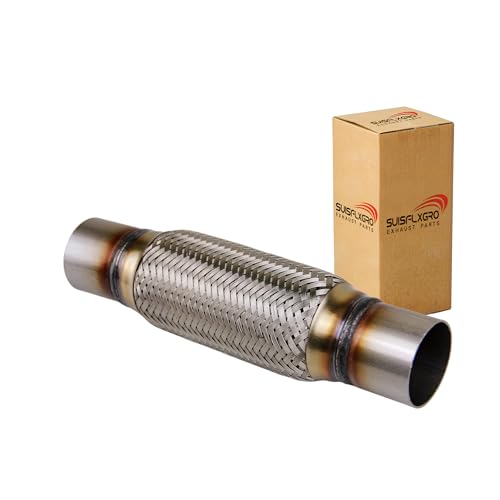


The flex pipe is the flexible section in the front of the exhaust path, often between the exhaust manifold and the catalytic converter. It absorbs engine vibration, allows engine and chassis movement, and takes up thermal expansion so the rest of the exhaust does not crack or pull apart.
Why that location matters
That front section sees the most movement on many transverse front-wheel-drive layouts because the engine rocks relative to the body while the exhaust stays fixed underneath. When the manifold, mounts, or hangers move too much, the flex section carries the extra load and wears faster.
Why symptom patterns differ
Not every failed flex pipe looks the same from the outside. A frayed braided outer layer often means the protective shell has started to separate, while an internal bellows or interlock failure can rattle, leak, or collapse with little visible damage at first.
Interlock designs use a high-strength stainless strip spirally interlocked inside. That structure reduces flow resistance and turbulence, and it also helps reduce exhaust noise and vibration. If that inner section separates, the outer braid may still look intact for a while.
What are the symptoms of a bad flex pipe?
The most common symptoms are exhaust noise, vibration, fumes, and visible damage. You may hear a hiss on cold start, a rattle when hot, feel the floor shake at idle, smell burnt exhaust, or spot soot near a weld. Some vehicles also set a check engine light.
Outer braid damage versus internal failure
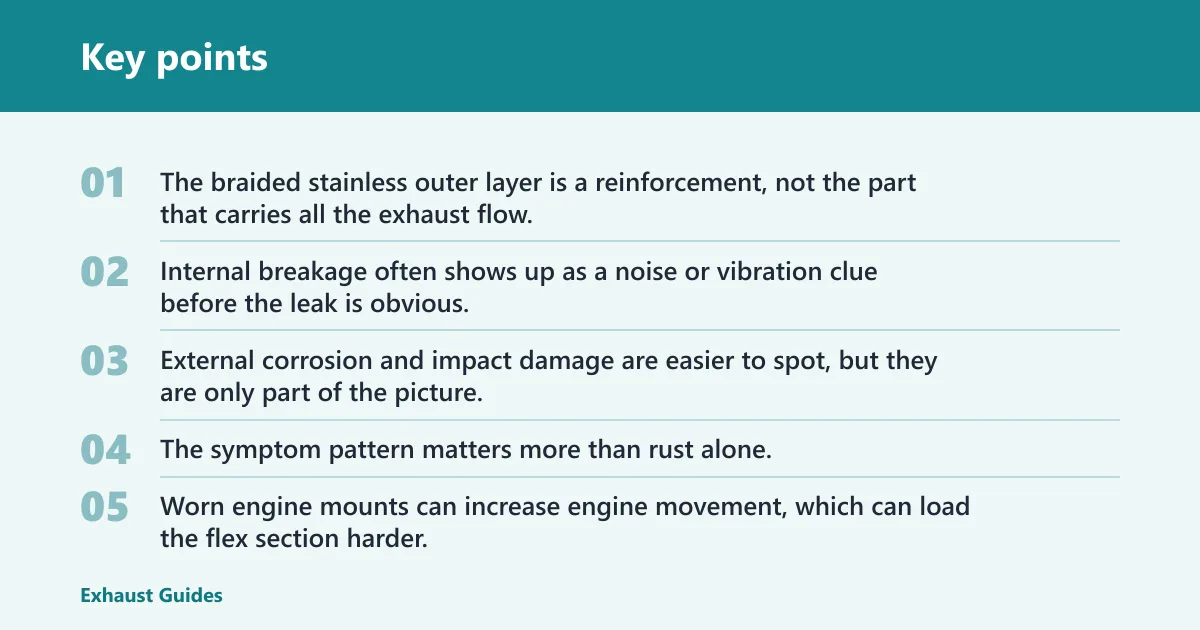
The braided stainless outer layer is a reinforcement, not the part that carries all the exhaust flow. Visible fraying or popped strands point to flex-section stress, but the real failure may be inside the bellows or interlock core. That is why a shiny braid alone does not prove the part is sound.
Internal breakage often shows up as a noise or vibration clue before the leak is obvious. External corrosion and impact damage are easier to spot, but they are only part of the picture. The symptom pattern matters more than rust alone.
Why mounts and hangers change the pattern
Worn engine mounts can increase engine movement, which can load the flex section harder. Broken or sagging exhaust hangers can do the same thing by letting the exhaust swing and tug at the pipe. Those failures can mimic a flex pipe problem or shorten flex-pipe life.
Say your car idles with a steady floor shake at a stoplight, but the exhaust is quiet on the road. That points more toward engine mounts or a support issue than a simple hole in the flex section, because the symptom tracks engine movement more than exhaust flow.
Why front-wheel-drive layouts get stressed
On many front-wheel-drive transverse engines, the exhaust outlet, flex section, and catalytic converter sit close together near the front of the car. The engine rocks fore and aft under load, so that front flex section works harder than it does on many longitudinal layouts.
| Symptom | Likely flex-pipe failure mode | Likely false lead | Quick check | Next action | Why it matches flex-pipe failure or why the false lead is common |
|---|---|---|---|---|---|
| Cold-start hiss | Small crack or leak at the flex section | Exhaust manifold gasket leak | Listen near the front exhaust on a cold engine; look for soot lines | Run a soapy-water leak test and inspect upstream joints | Cold starts raise exhaust pressure and make small front-exhaust leaks easier to hear. Manifold leaks are common because they sit in the same front area and can sound almost identical. |
| Hot rattle | Internal bellows break or separated interlock | Loose heat shield | Tap nearby shields and listen for a change when the engine blips | Inspect for internal collapse or separation | Heat and load can open an internal failure enough to rattle only when hot. Loose shields are a common false lead because they also buzz near the same exhaust section. |
| Floor vibration at idle | Flex section cannot absorb engine motion | Worn engine mounts | Watch engine rock with the hood open while the car idles | Check mounts and hangers before replacing the flex section | A flex pipe is designed to isolate movement, so vibration under load or idle fits its failure pattern. Bad mounts are a frequent false lead because they create the extra motion that overloads the pipe. |
| Burning smell | Hot exhaust leaking onto nearby parts | Oil leak dripping on the exhaust | Look for discoloration and smell direction under the car | Repair the leak promptly and check for residue on shields | A flex leak can direct hot exhaust at the floor or shield and create a sharp burnt smell. Oil leaks are common because they also produce a hot odor in the same underbody area. |
| Soot near welds | Leak at a cracked seam or flex-to-pipe joint | Tailpipe soot from rich running | Wipe the area clean, then recheck after a short run | Confirm the exact leak point before welding | Soot marks are strong proof of escaping exhaust at the front seam. Rich-running soot can be blamed because black residue is visible at the tailpipe and can confuse the source. |
| Underbody fumes | Exhaust escaping before the catalyst | Cabin air intake issue | Inspect under the car with the engine running in a safe, open area | Stop driving if fumes are strong and visible | Upstream exhaust leaks can send fumes under the cabin before they are cleaned by the catalyst. Intake complaints are common because the smell enters the cabin and gets blamed on ventilation. |
| Lean code / check engine light | Upstream exhaust leak can upset oxygen sensor readings | Vacuum leak or bad sensor | Listen for hissing near the manifold and flex section on cold start | Check for exhaust leaks before replacing sensors | An upstream leak can pull fresh air into the exhaust stream before the oxygen sensor sees it, which can look like a lean condition. Vacuum leaks and sensor faults are common because they create similar codes. |
| Visible braid fraying | Outer layer separation with likely internal wear | Only cosmetic surface wear | Look for strand lift, broken wires, or a flattened section | Inspect the core; plan replacement if the damage is widespread | Frayed braid usually means the section has been flexing too much or has already lost support. Cosmetic wear is a common false lead because the outer layer can look worse than the inner core at first. |
How do you check for a leak?
Start with a cold-engine visual inspection, then confirm with a soapy-water leak test if the engine layout allows safe access. Listen for a hiss, tick, or light rattle near the front exhaust. If the leak is upstream of the catalytic converter, the noise often changes with throttle and may leave soot at the seam.
Visual signs to look
Check the braided outer layer for popped strands, crushed sections, rust scaling, or dark soot marks at the welds. Also look at the exhaust manifold, nearby flanges, hangers, and the first section before the catalytic converter, because a manifold leak can sound like a flex pipe leak.
Cold-engine soapy-water leak test
- Park on level ground. Let the engine cool fully, then raise the vehicle only if you can do so safely and support it correctly. A cold engine reduces burn risk and helps the leak show up as bubbles instead of steam.
- Mix a light soap solution. Put the solution in a spray bottle and wet the suspected flex section, welds, and nearby joints. Use enough to coat the seam without soaking electrical parts or hot surfaces.
- Start and watch closely. Run the engine at idle and look for bubbles or a pulsing soap film at the leak point. A steady bubble pattern is useful because it separates an active leak from surface rust.
- Recheck surrounding parts. Inspect the manifold joint, hangers, and heat shields if the flex section stays dry. That helps avoid replacing the wrong part when the symptom comes from an upstream leak.
What the sound tells you
A sharp hiss often points to a small crack or seam leak. A metallic rattle that changes with rpm suggests internal breakage or a loose shield. If the noise is louder under throttle but fades at steady cruise, the leak may be opening as the pipe flexes under load.
Suppose a sedan has a cold-start tick that fades after two minutes, plus black soot around the front weld. That pattern fits a small exhaust leak better than a bad mount, because the noise follows exhaust pressure and the soot marks the gas path.
Can a flex pipe cause a check-engine light?
Yes, a leaking flex pipe can trigger the check engine light in some situations, especially if the leak is upstream of the oxygen sensors. The extra air can skew sensor readings and lead to a lean code. That said, an upstream manifold leak or vacuum leak can create similar codes.
When the flex pipe is the real source
If the leak is at the flex section before the catalytic converter, the engine control system may read extra oxygen in the exhaust stream and may react as if the mixture is lean. That can suggest a lean condition even when fuel delivery is fine. The warning is useful, but it does not prove the flex section is the only fault.
When it is a false lead
A manifold leak, a cracked flange, or an air leak elsewhere in the intake can produce the same code family. If the car has a lean code and a hiss near the front exhaust, check the manifold, gasket surfaces, and sensor wiring before replacing the flex pipe alone.
Repair or replace the flex pipe?
Welding a local crack can make sense when the damage is small, the surrounding metal is solid, and the leak sits in one reachable spot. Full replacement is often the better call when rust is spread out, the braid is badly frayed, or the inner core is broken, especially if the part is commonly sold as a complete section.
When welding is enough
If the leak is confined to one seam and the pipe around it still has sound metal, a skilled weld repair can restore sealing. This works best when corrosion has not thinned the tube and when the flex section still moves normally without pulling the weld apart.
When full replacement is better
Choose replacement when the flex pipe is crushed, the braid has opened up over a long section, or the leak is tied to internal separation. If the flex section is integrated with nearby pipe shape or the catalytic converter layout, a complete assembly may save labor and reduce the chance of another failure soon after.
Material grade and service life
Stainless steel grade matters. 304, 321, and 409 are common choices, and lower-grade stainless may survive fewer thermal cycles before corrosion and cracking show up. In salt-heavy climates, material quality matters as much as fit, because corrosion shortens life even when the part looks new.
A common first-timer mistake is replacing a flex pipe because the braid looks ugly, then leaving broken hangers in place. The new part takes the same extra movement, and the next failure comes early. Check the supports first, then choose the repair.
What causes flex pipe failure?
Heat cycles, vibration, road salt, impact damage, corrosion, and poor support are the main causes. A flex pipe can crack from repeated engine movement, rust through in salty climates, or fail internally after a hard hit. Bad engine mounts and worn hangers raise the load and speed up the damage.
Why supports matter as much as the pipe
The flex section is designed to move, but not to carry the whole exhaust system by itself. If mounts let the engine rock too far, or hangers let the pipe swing, the flex section bends beyond its intended range and fatigue starts earlier.
What to check before buying parts
Look at the manifold connection, the first pipe after the flex section, the catalyst inlet, and every nearby hanger. That quick inspection tells you whether the flex section is the cause or only the part that finally gave up under a broader support problem.
How much does flex pipe repair cost?
Repair cost depends on whether the pipe can be welded or must be replaced as a section. Welding a small leak is usually less expensive than replacing the flex pipe assembly, while integrated exhaust pieces and rusted hardware push the job higher. Labor also rises when access is tight.
What changes the price?
Cost is affected by rust, location, whether the pipe is separate from the converter, and whether the failure also damaged hangers or nearby joints. If the flange area is thin or the flex section is welded into a larger assembly, replacement becomes more likely than a patch repair.
Why quotes vary so much
Two cars can show the same symptom but need different work. One may only need a weld repair, while another needs a full front exhaust section because corrosion has spread. The more the shop has to remove, align, and reseal, the more the repair usually costs.
Is a flex pipe the same as a flex joint?
Not always. A flex pipe is the whole flexible exhaust section, while a flex joint is the flexible part inside it. In casual use, people often say the terms interchangeably, but the joint is the internal mechanism and the pipe is the full assembly around it.
Why the distinction matters
The outer braid can look fine even when the inner flex joint has failed. That is why diagnosis should focus on symptoms, leak location, and movement, not just surface appearance. A damaged joint can leak, rattle, or lose flexibility before the outer shell looks dramatic.
Frequently asked questions
What does a flex pipe do: it absorbs engine movement?
It absorbs engine movement and thermal expansion while keeping the exhaust sealed. That protects rigid piping from cracking as the engine rocks and the exhaust heats and cools. On many cars, it sits between the exhaust manifold and the catalytic converter.
What are the symptoms of a bad flex pipe: common symptoms include louder exhaust?
Common symptoms include louder exhaust noise, hiss or tick sounds, floor vibration at idle, a burning smell, soot near the welds, underbody fumes, and sometimes a lean code or check engine light. The exact pattern depends on whether the outer braid or inner core has failed.
Can a flex pipe cause a check engine light: yes, if the leak?
Yes, if the leak is upstream of the oxygen sensors, the extra air can make the engine computer think the mixture is lean. That said, manifold leaks and intake leaks can do the same thing, so the flex section should not be blamed without checking nearby joints.
How do I know if my flex pipe is leaking?
Look for soot, frayed braid, hissing on cold start, and bubbles during a soapy-water test on a cold engine. Then compare the noise to the manifold, hangers, and heat shields. If the leak changes with engine load, the flex section or an upstream joint is a strong suspect.
What does a cracked flex pipe sound like?
It often sounds like a hiss, tick, or raspy exhaust leak near the front of the car. If the inner section is broken, you may also hear a rattle that changes with rpm or engine load. The sound is usually louder during cold start or hard acceleration.
Should I replace the whole flex pipe or weld it?
Weld a small, localized crack only if the surrounding metal is still solid and the rest of the flex section is in good shape. Replace the whole section if the braid is badly frayed, corrosion is widespread, the inner core is damaged, or the part is already thin around the leak.