How to Inspect a Catalytic Converter for Clogging
Inspect a catalytic converter for clogging by checking for heat discoloration or damage, reading live O2 and fuel-trim data, and measuring exhaust backpressure; a healthy converter usually won’t exceed about 1.5 psi at roughly 2,500 rpm. Missing a true clog can lead to power loss, heat damage, and unnecessary parts replacement. This guide covers visual checks, sensor clues, and restriction tests that separate converter blockage from misfires, leaks, or bad sensors.
Catalytic converter basics
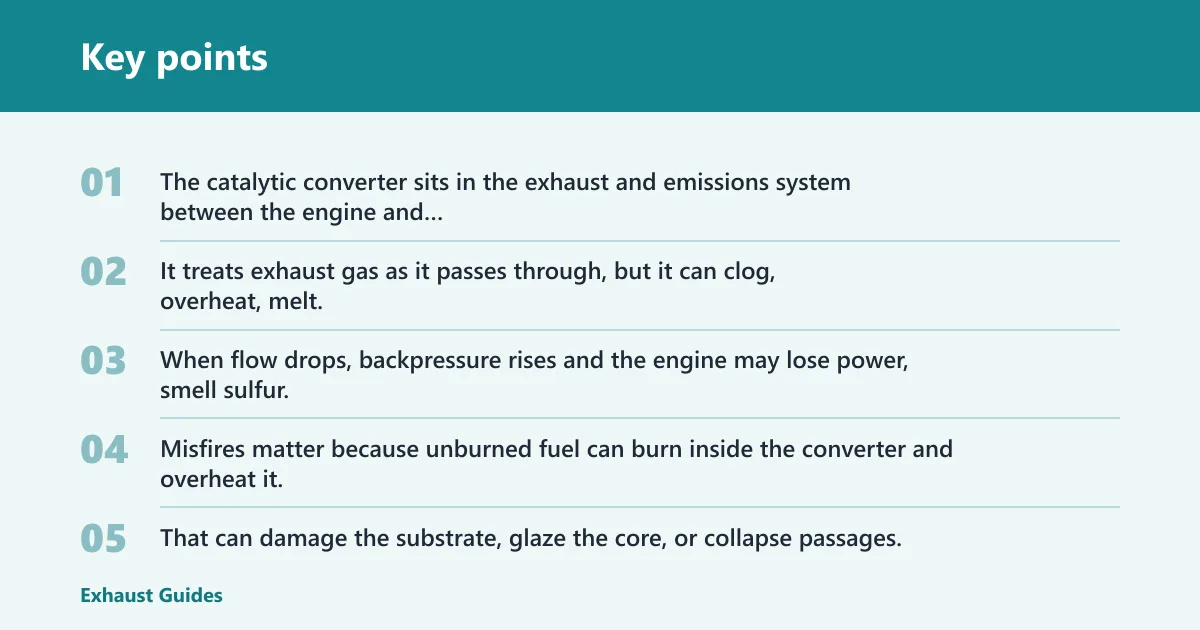


The catalytic converter sits in the exhaust and emissions system between the engine and the tailpipe. It treats exhaust gas as it passes through, but it can clog, overheat, melt, or become contaminated internally. When flow drops, backpressure rises and the engine may lose power, smell sulfur, or set a check engine light.
Misfires matter because unburned fuel can burn inside the converter and overheat it. That can damage the substrate, glaze the core, or collapse passages. A converter can also look guilty when the real problem is upstream: a leak at the exhaust manifold, a bad oxygen sensor, or a misfire that changed the exhaust data.
What clogging changes inside the converter
A clogged converter usually does two things at once: it restricts exhaust flow and traps heat. That combination can make acceleration weak, increase fuel use, and leave the housing hotter than normal. Severe restriction can also cause rattling if the internal substrate breaks apart.
Common causes of restriction and heat damage
Repeated misfires are a common cause of heat damage because fuel keeps burning in the converter. Oil burning, coolant contamination, and long-term rich operation can also foul the substrate. Physical impact can crack the core, then broken pieces shift and block flow further downstream.
Symptoms that point to exhaust blockage
Common symptoms include a check engine light, weak fuel mileage, a sulfur or rotten egg smell, and rattling underneath the vehicle. Weak acceleration under load is a stronger clue than a symptom at idle. None of these proves clogging by itself.
Start with a safe visual check, then move to OBD2 data, then confirm restriction with temperature and backpressure tests. That order matters because many converter complaints come from another fault nearby. You want evidence that flow is restricted, not just a code or a smell.
Start with a safe visual check
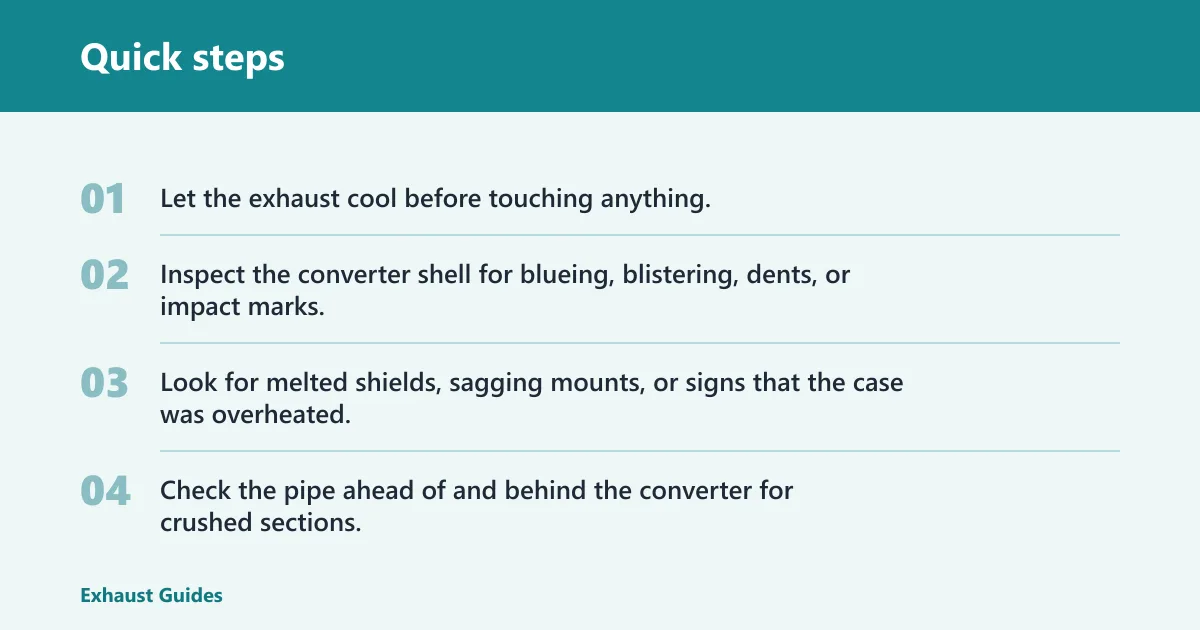
- Let the exhaust cool before touching anything.
- Inspect the converter shell for blueing, blistering, dents, or impact marks.
- Look for melted shields, sagging mounts, or signs that the case was overheated.
- Check the pipe ahead of and behind the converter for crushed sections.
If the housing is severely discolored, warped, or split, that points to heat stress or impact damage. A converter that is melted inside may not show much externally, so a clean-looking shell does not clear it.
Look for heat, dents, and rattles
A light tap on the cooled housing can reveal a loose internal substrate if you hear a rattling or gravel-like sound. That sound means the core may be broken, and loose pieces can move enough to block flow intermittently. A melted core may not rattle at all.
Check for nearby exhaust leaks first
Inspect the exhaust manifold and gasket area before condemning the converter. A leak upstream can skew oxygen-sensor readings and set P0420 even when the converter still flows normally. Also inspect the muffler and resonator, since either can create a downstream restriction that looks like converter clogging.
Picture a 2.4-liter sedan with sluggish passing power, a sulfur smell, and a check engine light. If the manifold gasket leaks ahead of the converter, the O2 data can mislead the diagnosis until that leak is fixed. The converter may be fine.
P0420 and sensor clues
P0420 is a catalyst system inefficiency code, not proof of clogging. It is a useful clue when combined with flow, temperature, and oxygen-sensor checks. An upstream leak or a misfire can create the same code pattern without a blocked converter.
Why P0420 is only a clue
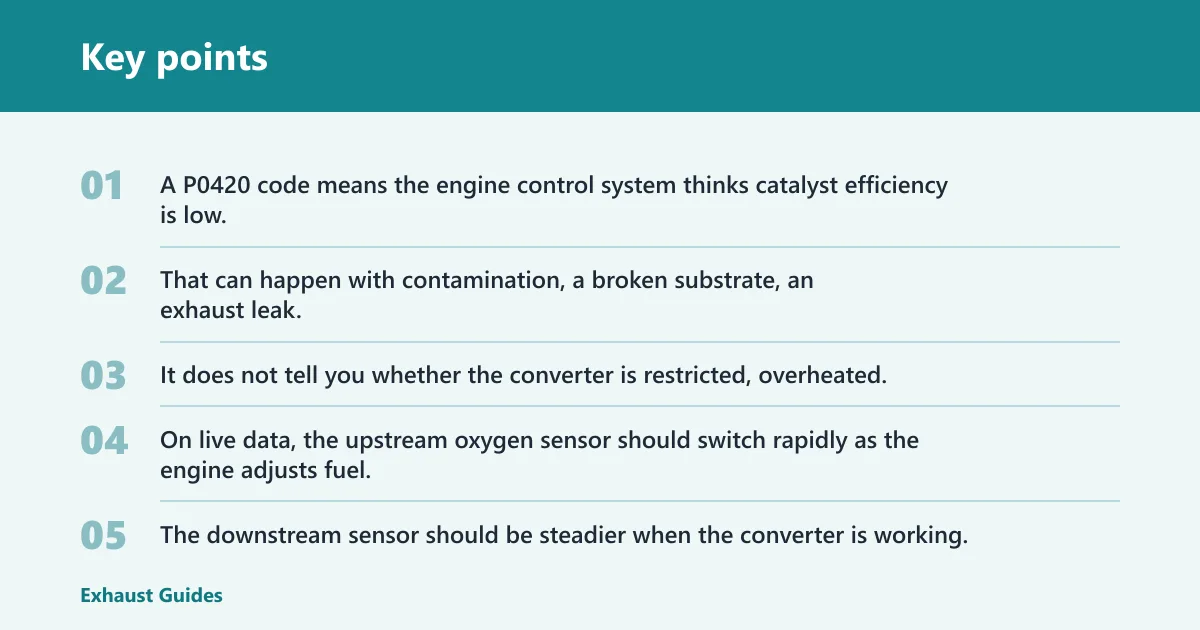
A P0420 code means the engine control system thinks catalyst efficiency is low. That can happen with contamination, a broken substrate, an exhaust leak, or faulty sensor behavior. It does not tell you whether the converter is restricted, overheated, or simply reporting bad data.
What upstream and downstream O2 patterns can suggest
On live data, the upstream oxygen sensor should switch rapidly as the engine adjusts fuel. The downstream sensor should be steadier when the converter is working. If both sensors act nearly the same, that can suggest poor converter function, but it still does not prove blockage.
A common first-timer mistake is to assume any unstable downstream reading means a bad converter. A leaky exhaust manifold, misfire, or bad sensor can distort the pattern first. Diagnose those before replacing the part.
How a multimeter supports sensor checks
A multimeter can help with oxygen sensor screening, but only when used with live-data interpretation. It can show whether a sensor signal is active, stuck, or implausible. It cannot prove a clogged converter by itself, and it cannot replace a scan tool that shows upstream and downstream behavior together.
For a quick home check, compare the sensor signal behavior with engine speed changes. If the upstream sensor never responds, or the downstream sensor mirrors the upstream signal too closely, suspect a sensor fault, wiring issue, or exhaust leak before condemning the converter.
How to read temperature differences
Use an infrared thermometer on the inlet and outlet as a screening test, not a final verdict. A healthy converter often shows a hotter outlet than inlet once fully warm, because reactions inside the unit release heat. Equal readings, or an inlet much hotter than the outlet, need further checks.
Using an infrared thermometer on inlet and outlet
Keep the engine at a steady idle first, then raise speed to about 2,500 rpm if conditions allow; measure the pipe just ahead of the converter and just behind it after the engine has reached normal operating temperature. Surface readings can shift with distance and target angle, so keep the aim consistent.
What normal, hot, and suspicious readings mean
Converters can exceed 1,000 degrees Fahrenheit during normal operation. That means a very hot housing is not automatically a problem. What matters is the pattern: a warmer outlet than inlet often suggests normal catalyst activity, while a hot inlet with a cooler outlet can suggest restriction or an internal breakdown.
Suppose the inlet reads much hotter than the outlet after the system is fully warm and the engine falls flat under load. That combination deserves a backpressure check. If the outlet is warmer and power is normal, the converter is less likely to be blocked.
Why surface temperature alone is not proof
Infrared readings only describe the surface, not the flow through the core. Exhaust leaks, shield reflections, and cooling airflow can distort the numbers. Treat the thermometer as one layer of evidence, then confirm with OBD2 data and a restriction test.
Catalytic converter diagnostic table
This table ties symptoms to test results so you can separate a clogged converter from lookalike faults. Use it after the visual check, sensor review, and restriction test.
| Symptom | Test result | Likely cause | Stop test and refer to a shop |
|---|---|---|---|
| Weak acceleration under load | Backpressure rises above the normal range at 2,500 rpm; outlet gets hotter than inlet by a small margin | Blocked converter or crushed pipe upstream of the test point | Yes, if pressure climbs fast or the engine cannot hold rpm |
| Hot inlet, cool outlet | Infrared check shows unusual heat retention at the inlet and little temperature rise past the converter | Restriction or melted internal substrate | Yes, if the housing is glowing, smoking, or smelling burned |
| High backpressure | Gauge shows elevated pressure at idle and higher pressure at raised rpm | Severe exhaust restriction, often converter-related | Yes, because severe restriction can overheat the engine and exhaust |
| Rattling substrate | Loose internal sound when the cooled housing is tapped | Broken catalyst core, possibly partly blocked | Yes, if pieces are loose or the case is damaged |
| Normal converter but bad upstream sensor | Upstream O2 signal is stuck, flat, or implausible while backpressure stays normal | Sensor fault, wiring issue, or exhaust manifold leak | No, inspect the sensor circuit and manifold first |
Can you clean or replace it?
Mild contamination can sometimes improve if the root cause is fixed and the converter is still structurally sound. A melted, broken, or heavily restricted converter is a replacement case, not a cleaning case. Cleaning cannot restore collapsed passages or reattach broken substrate.
When mild contamination might respond to cleaning
If the converter is only lightly contaminated and the engine problem that caused it has been corrected, a cleaning attempt may help with flow and efficiency. That is most reasonable when readings are borderline, the housing is intact, and there is no rattle or severe backpressure.
When clogging means replacement
If the converter has melted, rattles internally, or causes strong backpressure, replacement is generally the correct fix. Severe heat damage usually means the substrate has failed physically. Cleaning will not reopen a collapsed core or repair a cracked shell.
Matching an EPA-compliant replacement to the vehicle
When replacement is needed, choose an EPA-compliant replacement catalytic converter that matches the vehicle application and emissions requirements. Direct-fit options exist for specific vehicles, but the part still has to match engine family, pipe layout, and emissions equipment. An incorrect unit can create more diagnostic trouble later.
Frequently asked questions
How to test a catalytic converter for blockage with multimeter
A multimeter can screen the oxygen sensor circuit, but it cannot confirm blockage on its own. Use it to check whether the upstream sensor is switching and whether the downstream sensor is behaving differently. If the readings are abnormal, pair that result with backpressure and temperature checks before deciding the converter is clogged.
How can u tell if your catalytic converter is clogged?
You can tell by combining symptoms with test results, not by symptoms alone. A blocked converter often causes poor power, a sulfur smell, and sometimes rattling. Strong evidence comes from elevated backpressure, abnormal temperature patterns, and sensor behavior that still makes sense after upstream leaks and misfires are addressed.
Can a clogged catalytic converter be cleaned?
Sometimes, but only when contamination is mild and the converter is not melted or broken. Cleaning may help if the root cause was corrected and the core is still intact. If the unit has a rattle, warped case, or high backpressure, replacement is the better answer.
How long does it take for a catalytic converter to clog?
There is no fixed timeline. A converter can clog slowly from oil burning or long-term rich running, or it can overheat quickly after repeated misfires. The key factor is the condition that feeds it contamination or excess heat, not mileage alone.