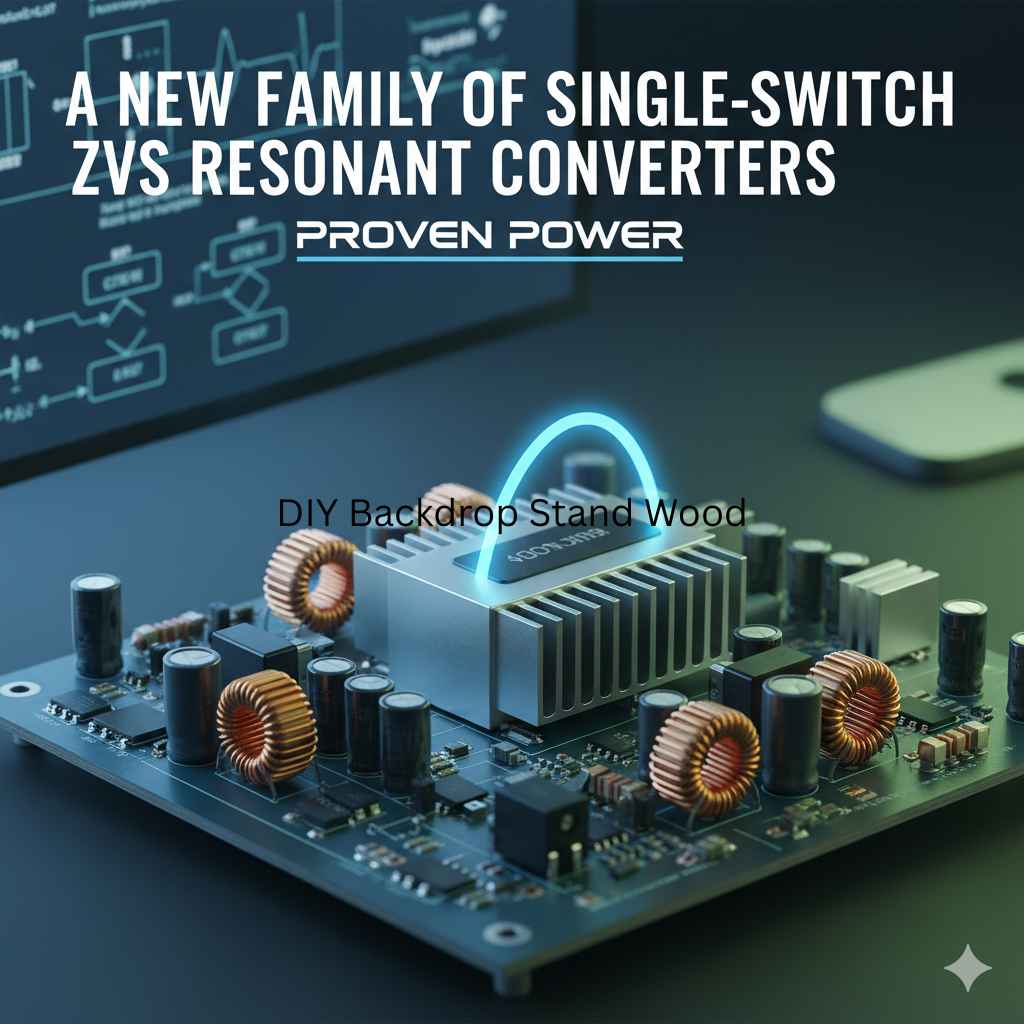
A New Family Of Single-Switch ZVS Resonant Converters: Proven Power

Nintendo
Animal Crossing: New Horizons - Nintendo Switch
- Build your community from scratch on a deserted island brimming with possibility; Create your personal getaway and customize your…
- Collect materials to construct everything from furniture to tools. Then, use what you create to give your island a personal touch
- Watch as the time of day and seasons match real life—even your hemisphere. Each day holds potential for surprises and discoveries
As an Amazon Associate I earn from qualifying purchases.
Get ready for a breakthrough in power conversion! A new family of single-switch ZVS resonant converters offers proven efficiency and performance, simplifying your power supply designs with smart, reliable technology. Discover how these innovative converters can boost your projects.
Powering up your electronics can sometimes feel like a complex puzzle. You want your devices to run smoothly, efficiently, and reliably, but the heart of that power delivery – the converter – can seem a bit mysterious. If you’ve ever felt a little lost when thinking about power conversion technology, you’re not alone! The world of electronics is always evolving, and staying on top of the latest advancements can be a challenge. But what if there was a way to get incredible power performance without all the fuss? We’re excited to introduce you to a brand-new generation of power converters that are changing the game. Get ready to explore a family of single-switch ZVS (Zero Voltage Switching) resonant converters that are not only innovative but also incredibly proven in their ability to deliver exceptional power. Let’s dive in and see what makes them so special!
Understanding the Basics: What are ZVS Resonant Converters?
Before we get to the exciting new family, let’s quickly touch on what makes these converters tick. Think of a power converter as the traffic cop for electricity in your device. It takes the power from the wall (or battery) and changes it into the specific type your device needs. An ‘SMPS’ or Switched-Mode Power Supply does this by rapidly switching power on and off. Fancy, right?
Now, ‘ZVS’ is a clever trick that makes this switching much more efficient. ZVS means the power switch turns on or off exactly when the voltage across it is zero. Imagine switching a light on and off when the electricity flow is momentarily paused – virtually no energy is wasted as sparks or heat during the switch. This makes the converter run cooler and use less power, which is great for your device and the planet.
‘Resonant’ means there’s a bit of a musicality to the circuit, using components like inductors and capacitors to create natural oscillations. This resonance helps achieve that smooth ZVS switching.
Why “Single-Switch” Matters for Simplicity and Performance
Traditionally, achieving ZVS in a converter often required more complex circuits with multiple switches. This could add to the cost, size, and complexity of the power supply.
A “single-switch” design, as the name suggests, uses just one main power switch. This is a big deal because:
Simpler Design: Fewer components mean a more straightforward circuit. This can lead to easier manufacturing and troubleshooting.
Smaller Size: With fewer parts, the overall converter can be made more compact. This is crucial for modern, space-constrained electronics.
Lower Cost: Fewer components often translate to a lower bill of materials, making the end product more affordable.
Improved Reliability: With fewer potential points of failure, a single-switch design can be inherently more reliable over time.
So, when you hear “single-switch ZVS resonant converter,” think of a smart, efficient, and streamlined way to manage power.
Introducing the New Family: Proven Power, Modern Design
This new family of single-switch ZVS resonant converters represents a significant leap forward. Engineers have cleverly combined established ZVS principles with cutting-edge circuit designs to create converters that are not just theoretically good, but practically outstanding. They are designed to offer:
High Efficiency Across Load Ranges: No matter if your device is using a lot of power or just a little, these converters maintain impressive efficiency. This means less wasted energy and longer battery life for portable devices.
Excellent Dynamic Response: When your device suddenly calls for more power (like when a processor speeds up), these converters can react quickly and smoothly, preventing performance dips.
Reduced Electromagnetic Interference (EMI): The resonant ZVS operation helps to naturally suppress electrical noise. This means fewer headaches with components interfering with each other and simpler filtering requirements.
Wide Input Voltage Range: Many of these new designs can handle a broad spectrum of input voltages, making them versatile for applications with different power sources.
Simplified Control: While the underlying physics is complex, the way you control these converters is made more accessible, often requiring fewer external components for stable operation.
These converters are built on a foundation of proven power conversion techniques but enhance them with modern innovation. They are truly designed to make life easier for engineers and deliver superior performance for end-users.
Key Features and Advantages of This New Converter Family
Let’s break down why these converters are creating a buzz in the power electronics world. They aren’t just incremental improvements; they offer tangible benefits that can redefine what’s possible in power supply design.
Superior Efficiency
One of the hallmarks of this new family is their exceptional efficiency, even when operating at lighter loads. Traditional converters can sometimes droop in efficiency as power demand decreases. These new ZVS resonant converters are engineered to maintain high efficiency across a much wider range of operating conditions.
Reduced Heat Generation: Higher efficiency means less energy is lost as heat. This can lead to smaller heatsinks or even fanless designs, reducing system cost and noise.
Extended Battery Life: For battery-powered devices like laptops, portable medical equipment, or wireless sensors, improved efficiency directly translates to longer operating times between charges.
Lower Operating Costs: In applications where devices run 24/7, even a few percent improvement in efficiency can lead to significant energy savings over time.
Remarkable Dynamic Performance
Modern electronics are dynamic. They can have rapid shifts in their power demands. The ability of a power converter to respond quickly and stably to these changes is critical for overall system performance.
Stable Operation Under Transient Loads: When a CPU or GPU suddenly ramps up its power draw, these converters can deliver the required current almost instantaneously without significant voltage drops.
Fast Response Time: This allows for faster system boot-ups, quicker wake-up times from sleep modes, and a more responsive user experience.
Simplified Output Filtering: Their inherent stability can sometimes reduce the need for extensive output filtering components, saving space and cost.
Minimized Electromagnetic Interference (EMI)
EMI can be a persistent headache in electronic design. It can cause unpredictable behavior in sensitive circuits and requires careful shielding and filtering, adding complexity and expense.
Smooth Switching Waveforms: The resonant ZVS operation naturally creates smoother voltage and current transitions compared to the hard switching found in many conventional designs. This significantly reduces the generation of high-frequency noise.
Reduced Need for Extensive Filtering: Because less noise is generated at the source, designers often need less elaborate and costly EMI filters. This is a significant advantage for compact and cost-sensitive products.
Easier Compliance: Meeting stringent EMI regulations can be more straightforward with these types of converters, saving valuable design and testing time.
Robustness and Reliability
The ZVS switching inherently stresses the power switches far less than traditional hard-switching methods.
Longer Component Lifespan: The reduced stress on the main power switch can contribute to a longer operational life for the converter and the system it powers.
Tolerance to Variations: These converters often exhibit a greater tolerance to variations in input voltage and load conditions, contributing to overall system stability.
Proven Power Delivery: The solid foundation of resonant converter principles, combined with modern enhancements, ensures that this family delivers reliable, “proven power.”
Applications Where These Converters Shine
The versatility and performance characteristics of this new family of single-switch ZVS resonant converters make them ideal for a wide array of applications. Anywhere efficient, reliable, and compact power is needed, you’ll find a strong case for their use.
Consumer Electronics
Laptops and Tablets: Extending battery life and enabling thinner designs.
Smart TVs and Displays: Efficiently powering advanced features and maintaining sleek profiles.
Gaming Consoles: Providing stable, high-current power for demanding processors and graphics chips.
Audio Equipment: Delivering clean power for high-fidelity sound reproduction, minimizing noise.
Industrial and Communication Systems
Server Power Supplies: Improving energy efficiency and reducing cooling requirements in data centers.
Telecommunications Equipment: Ensuring reliable power for critical network infrastructure.
Industrial Automation: Providing robust and efficient power for control systems and machinery.
LED Lighting Drivers: Enabling efficient and flicker-free illumination.
Automotive Electronics
Infotainment Systems: Delivering clean and stable power for complex displays and processors.
Advanced Driver-Assistance Systems (ADAS): Providing reliable power to sensors and control units.
Electric Vehicle (EV) Charging Systems: Potentially improving efficiency in on-board chargers. Researchers at institutions like IEEE are actively exploring resonant converter applications for EVs.
Medical Devices
Portable Diagnostic Equipment: Maximizing battery life for crucial portable medical instruments.
Patient Monitoring Systems: Ensuring uninterrupted and reliable power for vital signs monitoring.
For a deeper dive into the technical specifications and design considerations, you might find resources from organizations like the IEEE Power Electronics Society (PELS) invaluable. They often publish cutting-edge research and standards related to power conversion technologies.
Design Considerations for Implementing These Converters
While these new converters simplify many aspects of power supply design, there are still some key considerations to keep in mind to get the most out of them. Think of it like tuning up your car – knowing the ins and outs makes the ride smoother.
Component Selection is Key
The performance of any resonant converter is heavily influenced by the quality and characteristics of its passive components.
Resonant Inductor: The inductance value is critical for achieving the desired resonant frequency and operating mode. It needs to be designed to minimize losses at the operating frequency.
Resonant Capacitor: This capacitor, along with the inductor, sets the resonant tank’s characteristics. It should have low Equivalent Series Resistance (ESR) and Equivalent Series Inductance (ESL) for optimal performance.
Transformer (if applicable): For isolated designs, the transformer acts as the energy transfer element. Careful design regarding winding techniques and core material is essential to minimize losses and manage leakage inductance. Manufacturers like Infineon (formerly EPCOS) offer design tools and components crucial for these types of circuits.
Layout Matters for Efficiency and Noise
In any high-frequency power circuit, the physical layout of components on the Printed Circuit Board (PCB) can have a significant impact.
Minimize Loop Areas: Keep high-current switching loops as small as possible to reduce parasitic inductance and EMI.
Proper Grounding: Use a solid ground plane to provide a low-impedance return path for currents.
Component Placement: Place resonant tank components close to the switching element and decouple input/output capacitors nearby to handle rapid current demands.
Thermal Management: Even with high efficiency, some heat will be generated. Ensure adequate copper area or heatsinking for the primary switching components.
Understanding Operating Modes
These ZVS resonant converters can often operate in different modes depending on the load and input voltage conditions.
Variable Frequency Control: Many designs use variable frequency to regulate output voltage. Understanding the f_min and f_max limits is important.
Discontinuous Conduction Mode (DCM) vs. Continuous Conduction Mode (CCM): While ZVS is often associated with CCM, some designs can smoothly transition between modes.
Light Load Efficiency: Some ZVS circuits employ techniques like burst mode or frequency foldback to maintain efficiency at very light loads.
For a deeper technical understanding, consulting datasheets and application notes from the chip manufacturers is highly recommended. Resources from leading semiconductor companies often provide detailed insights.
Comparison of Single-Switch ZVS Resonant Converters vs. Traditional Converters
To truly appreciate the advancements, let’s compare these new converters to their more traditional counterparts. This table highlights the key differences you’ll encounter when designing or choosing power solutions.
| Feature | Single-Switch ZVS Resonant Converter | Traditional Buck/Boost (Hard Switching) | Other Resonant Topologies (e.g., LLC) |
|---|---|---|---|
| Switching Loss | Very Low (Zero Voltage Switching) | High (Switching occurs at non-zero voltage/current) | Low (Can achieve ZVS or ZCS) |
| Efficiency | High, especially across wide load ranges; excellent light load efficiency | Good at nominal load, drops significantly at light loads | High, but can be optimized for specific load points |
| EMI | Naturally low due to smooth switching | Higher, requires more filtering | Moderate to low, depending on implementation |
| Component Stress | Lower stress on switches | Higher stress on switches | Moderate stress on components |
| Complexity | Moderately complex resonant tank, but single switch simplifies control | Relatively simple control, multiple switches can increase complexity in some topologies | Can be complex, often requiring multiple switches and resonant components |
| Dynamic Response | Good, can be very fast with appropriate control | Can be very fast, but susceptible to switching losses | Can be slower to respond to rapid load changes due to resonant tank dynamics |
| Cost | Potentially lower system cost due to fewer components and simpler filtering | Generally mature and cost-effective for simple solutions | Can be higher due to more components and design effort |
This comparison helps to illustrate why the single-switch ZVS resonant converter is becoming a preferred choice for many designers seeking a balance of performance, efficiency, and cost.
Pros and Cons: A Balanced Viewpoint
Every technology has its strengths and weaknesses. Understanding these helps in making the best choice for your specific project.
Pros:
Exceptional Efficiency: As highlighted, this is a major advantage, leading to energy savings and reduced heat.
Reduced EMI: Simplifies board design and compliance testing.
Higher Power Density: Can lead to smaller power supply modules, fitting into constrained spaces.
Improved Reliability: Less stress on components can mean longer product life.
Single Switch Simplicity: Reduces BOM cost and design complexity compared to multi-switch resonant topologies.
Cons:
Design Complexity of Resonant Tank: Requires careful calculation and selection of inductor and capacitor values.
Potential for Narrower Operating Range: Some ZVS designs can be optimized for a specific input voltage or load range, though newer families are improving this.
Learning Curve: While simpler than some alternatives, understanding the resonant behavior and control can still require some specialized knowledge.
Component Sensitivity: Performance can be very sensitive to the characteristics (ESR, ESL, tolerance) of passive components.
Frequently Asked Questions (FAQ)
Here are some common questions beginners might have about this new family of converters.
Q1: What does “ZVS” actually mean for my device?
A1: ZVS stands for Zero Voltage Switching. It means the main power switch inside the converter turns on or off when there’s virtually no voltage across it. This makes switching much more efficient, generating less heat and wasting less energy. For your device, this usually means better performance, longer battery life, and a smaller, cooler design.
Q2: Is a “single-switch” converter less powerful than one with multiple switches?
A2: Not necessarily! A single-switch design with ZVS is often chosen for its efficiency and simplicity. While some very high-power applications might still use multi-switch topologies, modern single-switch ZVS resonant converters are powerful and efficient enough for a vast range of demanding applications, often outperforming older multi-switch designs in key areas like efficiency and EMI.
Q3: Do I need special knowledge to use these converters?
A3: While a basic understanding of power electronics is helpful, these new families are engineered to be more user-friendly. Manufacturers provide detailed datasheets and application notes that guide you through the design process. You’ll need to select the right passive components and consider PCB layout, but the core control is often simplified.
Q4: How can I tell if my existing device uses this type of converter?
A4: It can be difficult to tell without opening a device and examining the internal components, and even then, identifying a ZVS resonant converter requires some expertise. They are typically found in newer, high-efficiency electronics like modern laptops, premium industrial power supplies, and advanced communication gear.
Q5: Will using a ZVS resonant converter make my device more expensive?
A5: It can often lead to a lower* overall system cost. While the specialized controller IC might be slightly more, the higher efficiency means less wasted energy. Plus, the reduced EMI often lowers the cost of filtering components and simplifies compliance testing, potentially making the final product more competitive.
Q6: Are these converters suitable for battery-powered devices?
A6: Absolutely! Their high efficiency, especially at light loads, is a huge advantage for battery-powered devices. This means longer run times between charges, allowing for more portable and convenient electronics.
The Future of Power Conversion is Here
We’ve journeyed through the exciting world of single-switch Zero Voltage Switching (ZVS) resonant converters. From understanding the core principles of ZVS and why “single-switch” is a game-changer, to exploring the tangible benefits like superior efficiency, reduced EMI, and enhanced reliability, it’s clear why this new family of converters is making such an impact.
Related pick: Check today's price on Amazon