How to Tell If an Exhaust Gasket Is Leaking
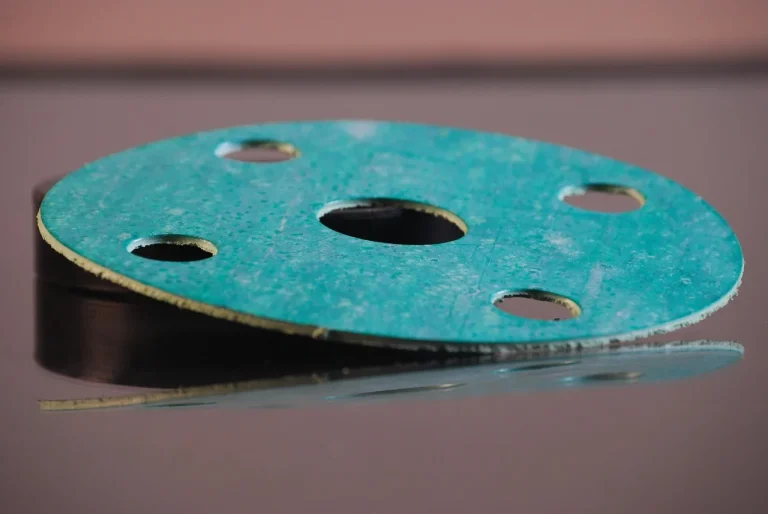
An exhaust gasket leak usually makes a sharp ticking or puffing sound that changes with rpm, leaves black soot at the flange, or sends exhaust odor into the cabin; if the noise stays metallic and constant, check the valve train, a cracked pipe, or a loose heat shield first. Ignoring it can burn the gasket, warp a flange, waste fuel, and expose you to exhaust fumes. This guide shows how to separate a gasket leak from valve train noise, a cracked pipe, or a heat shield rattle.
What an exhaust gasket leak sounds like
A true exhaust gasket leak often sounds like a sharp tick, hiss, or puff that tracks engine speed. It is often easiest to hear on cold start, when idle is higher and the metal is still contracted. As the pipe heats, the sound may fade, then return later on the next cold start.
Cold-start ticking and why it stands out
Listen on a cold start first, because a worn flange gasket can make the leak and the ticking much easier to hear. Drivers often notice a sharp tick on cold start from a flange leak. The higher idle and unexpanded metal make the escape point louder, especially near the front of the car.
If the tick appears only for a minute or two after startup, that does not rule out a leak. It often means the gap is smallest when cold and changes as the parts warm.
Why the noise can speed up with rpm
Exhaust pressure rises with engine speed, so a leak can tick faster or sound more urgent as rpm climbs. The sound can resemble a lifter tick, cracked manifold, or loose heat shield. A leak that gets sharper under light throttle or on a hill deserves more attention than a random rattle.
Suppose the noise is quiet at idle, then becomes a fast tick during a 2,000 rpm driveway hold. That pattern points away from a loose interior trim piece and toward a leak that responds to exhaust pulses.
Why a leak may quiet down after warm-up
A leak may quiet down after about five minutes as the pipe warms. Metal expands as it heats, which can narrow the leaking gap. That quieter warm idle does not mean the problem is fixed. It often means the opening has shrunk, not disappeared.
Where the leak is most likely coming
An exhaust gasket seals a joint at a manifold, pipe flange, or header flange. The leak point matters because each location leaves a different trail. A manifold gasket leak often announces itself with front-of-engine ticking, while a pipe flange leak often leaves soot near one side of the joint.
Manifold gasket clues
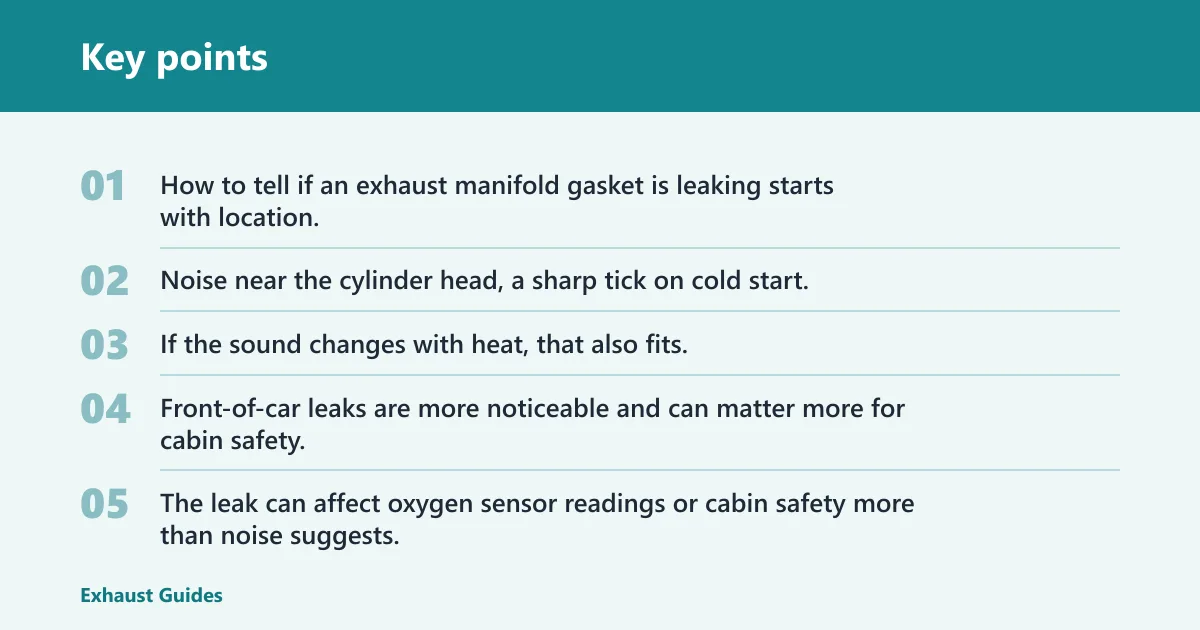
How to tell if an exhaust manifold gasket is leaking starts with location. Noise near the cylinder head, a sharp tick on cold start, and a smell that rises near the hood or front wheel area fit a manifold-side leak. If the sound changes with heat, that also fits.
Front-of-car leaks are more noticeable and can matter more for cabin safety. The leak can affect oxygen sensor readings or cabin safety more than noise suggests.
Pipe flange clues
An exhaust pipe flange has two flat mating surfaces pulled together by bolts, with a gasket between them. If that gasket fails, dark soot often appears near one side of the joint. The leak may be easiest to hear from under the car or near the floor, especially at idle or stoplights.
Because the gasket is crushed between the flanges, a warped flange or loose hardware can mimic gasket failure. Broken studs can also leave one side uneven, which creates a leak that looks like a gasket issue until you inspect the fasteners closely.
Header flange clues
Header flange leaks can sound similar to manifold leaks, but they often show up where aftermarket parts meet the head or the collector. If the noise is high in the engine bay and follows engine speed closely, inspect the flange, studs, and nearby welds before blaming the valve train.
Rusted hardware can turn a simple gasket swap into a broken-bolt repair, especially in road-salt regions. That matters for diagnosis because broken hardware may make the leak worse than the gasket alone would suggest.
Exhaust gasket diagnostic checklist
This checklist separates strong clues from weak ones. Use it as a quick decision tree before you replace parts. A single symptom can mislead you, so look for combinations.
| Symptom | What it usually means | How strongly it points to an exhaust gasket leak |
|---|---|---|
| Cold-start ticking | Exhaust leak at a manifold, header, or flange that is loudest before warm-up | Strong |
| Soot at the flange | Escaping exhaust at the joint, often from a crushed or failed gasket | Very strong |
| Exhaust smell at idle | Fumes escaping near the front of the car or entering the cabin | Strong |
| Noise changing with heat | Metal expansion is changing the gap at the leak point | Strong |
| Noise increasing with rpm | Leak pulse getting louder with exhaust pressure | Moderate to strong |
| One-sided soot patterns | Leak at one edge of a flange, warped mating surface, or broken stud | Very strong |
Strong clues versus weak clues
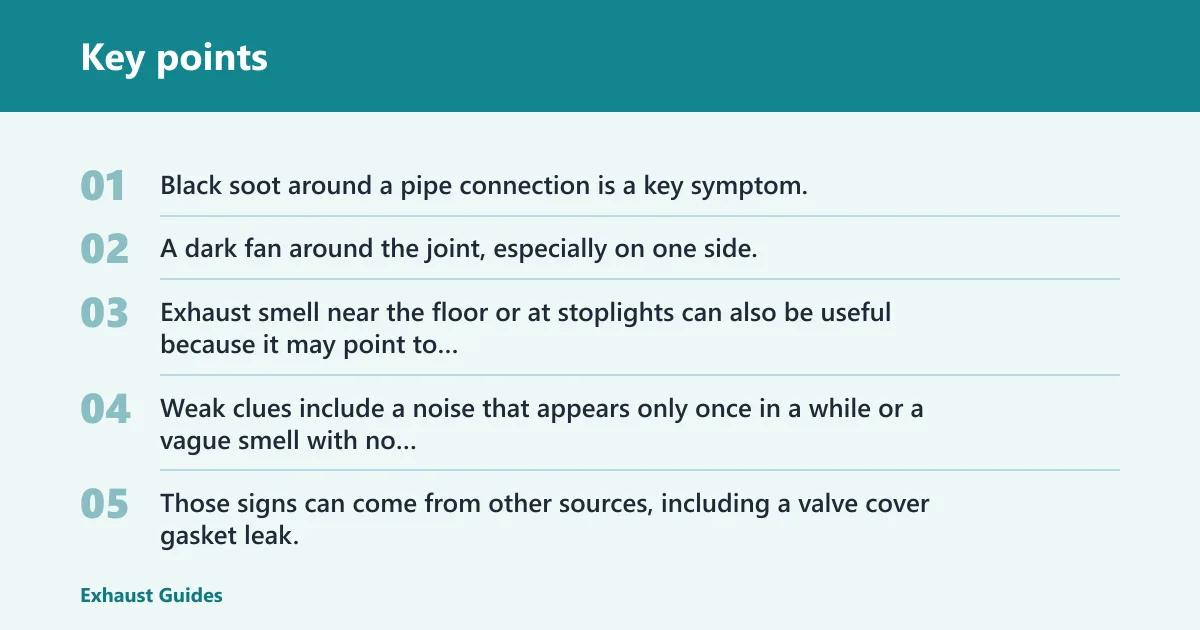
Black soot around a pipe connection is a key symptom. A dark fan around the joint, especially on one side, is stronger evidence than sound alone. Exhaust smell near the floor or at stoplights can also be useful because it may point to fumes escaping where they should not.
Weak clues include a noise that appears only once in a while or a vague smell with no visible trace. Those signs can come from other sources, including a valve cover gasket leak, which can cause a burning oil smell and light smoke under the hood. Oil leaks can also cause misfires if oil reaches ignition components.
When the evidence points away from the gasket
If the sound stays metallic, constant, and mostly unchanged with rpm or temperature, another source should be checked first. A cracked pipe or cracked weld can tick or hiss, but it usually leaves a visible split in the tubing or weld bead rather than soot concentrated at a flange.
A loose heat shield often rattles more than it ticks. It may buzz over bumps or resonate at certain road speeds, then go quiet at idle. That pattern is different from a pressure leak that changes with engine load.
How do you tell it from valve train noise?
The fastest way to separate them is by location, timing, and response to throttle. Exhaust gasket noise often comes from the side or bottom of the engine, changes with heat, and may get sharper under load. Valve train noise usually stays higher in the engine and follows internal engine speed more consistently.
Tick location and timing
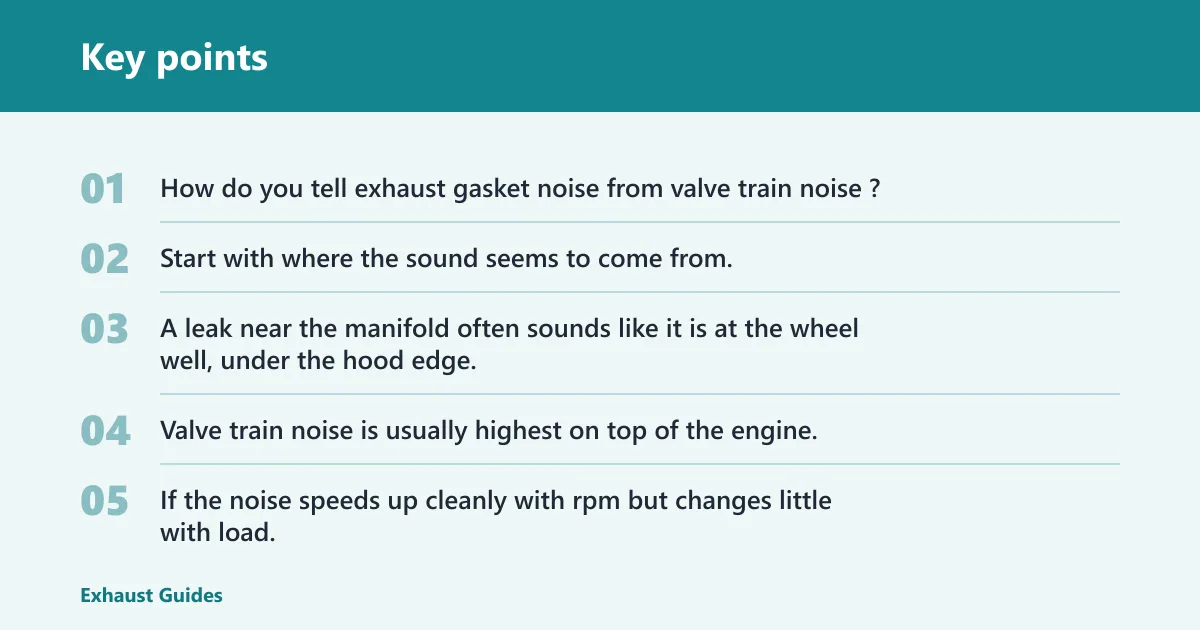
How do you tell exhaust gasket noise from valve train noise? Start with where the sound seems to come from. A leak near the manifold often sounds like it is at the wheel well, under the hood edge, or low near the firewall. Valve train noise is usually highest on top of the engine.
Noise that follows rpm
If the noise speeds up cleanly with rpm but changes little with load, the source may be internal. If it becomes louder during acceleration, climbs a hill, or snaps on cold start, a leak is more likely. The loudest leak is not always the worst one, so follow the pattern rather than the volume.
A common first-timer mistake is hearing a tick from the front of the engine and assuming lifters immediately. That guess can miss a gasket leak that is only obvious during the first minute of a cold start.
Heat shield and loose hardware clues
Loose shields often buzz, rattle, or ring against the body or exhaust. The sound may change when you tap the shield lightly or when road vibration changes. By contrast, a gasket leak tends to sound more like a sharp pulse or puff that matches engine firing.
If the sound disappears when the engine warms but returns at the next cold start, it can indicate a leak and should not be dismissed as harmless. That pattern often fits heat expansion narrowing the gap, not repair of the leak.
Is black soot around the flange a sign?
Yes, black soot around the flange is one of the strongest signs of a leak, especially if it forms a dark fan around the joint or concentrates on one side. It means pressurized exhaust is escaping before it reaches the muffler. Soot alone is not proof, but soot plus ticking is hard to ignore.
One-sided soot patterns
One-sided soot often points to an uneven seal. That can come from a worn gasket, warped flange, loose bolts, or broken studs that let one side open first. A pipe flange leak often leaves a darker trail on the side nearest the weak clamp point.
Dark fan marks around the joint
A dark fan spreading away from the joint usually means escaping exhaust has been blowing in one direction for some time. If the mark is fresh and dry, it often helps confirm the leak point. If the soot is old and smeared with road grime, inspect more closely before drawing a conclusion.
What soot does not prove
Soot does not prove the gasket is the only failed part. A cracked pipe, cracked weld, warped flange, or broken stud can all leave similar residue. Use soot as a location clue, then confirm whether the leak is at the gasket surface or in the surrounding hardware.
Can an exhaust gasket leak quiet down when the engine warms up?
Yes. A leak may quiet down after warm-up because metal expands as it heats, which can narrow the leaking gap. That change can reduce the tick at warm idle even though the gasket, flange, or stud problem is still there. The next cold start often brings the sound right back.
Heat expansion and changing gap size
Heat expansion changes how tightly the joint seals. A worn flange joint can leak at startup, then seem quieter at warm idle. That is why cold start often gives the clearest diagnosis. It is also why a quick warm idle check can miss a real leak.
Why warm-up does not clear the problem
Warm-up may reduce the noise, but it does not restore the gasket material or straighten a warped flange. If the leak is at the manifold, flange, or header surface, the underlying fault remains. Heat only changes the size of the opening for a while.
Why the leak can return on the next cold start
As the metal cools, the joint contracts again and the opening can return. That is why the sound may be strongest on the first start of the day and weaker after a short drive. A leak that behaves this way still needs confirmation and repair planning.
What should you do next?
Check the system in a short order: listen cold, inspect the joint, look for soot, then compare the sound against the valve train and shields. If the clue set points to a gasket, do not ignore it. If the evidence is mixed, confirm before replacing parts.
- Start the engine cold and listen near the manifold, pipe flange, or header flange.
- Look for black soot at the joint, especially one-sided dark marks.
- Check whether the sound changes with rpm or fades as the engine warms.
- Compare the noise with nearby shields, covers, and other fasteners.
- Inspect the hardware for rust, broken studs, or a warped flange before ordering parts.
If rusted hardware is severe, what looks like a gasket job may become a broken-stud repair. That is common in road-salt regions. In that case, the right next step is to confirm the exact failure point before removing more parts.
If the car makes a sharp tick on cold starts, the sound gets faster with rpm, and there is a dark fan of soot on one side of the flange, that pattern often points to a gasket leak. That combination strongly favors a gasket leak. If instead the sound is a steady metallic tick with no soot and no smell, check valve train noise or a loose shield first.
Frequently asked questions
How can you tell if your exhaust is leaking?
Start with a cold engine and listen for a sharp tick or puff near the manifold, pipe flange, or header flange. Then check for black soot, exhaust smell near the floor, and a sound that changes with rpm or heat. One clue alone is weak; several together are much stronger.
What does an exhaust gasket leak sound like?
It often sounds like a fast tick, tap, or puffing hiss that follows engine speed. Many drivers mistake it for a lifter tick, cracked manifold, or loose heat shield. The sound is usually clearest on cold start and may soften after a few minutes of warm-up.
Can a leaking exhaust gasket cause a ticking sound?
Yes. A worn flange gasket can create exhaust leaks and ticking noises, especially on cold start when the metal is contracted and idle is higher. The tick can speed up with rpm and may return under load on a hill. That pattern fits a pressure leak more than a random rattle.
Is black soot around the flange a sign of a leak?
Yes, black soot around a pipe connection is a key symptom. A dark fan around the joint, or soot on one side of a flange, strongly suggests escaping exhaust. It is still best to confirm the source, because a warped flange or broken stud can produce the same residue.
How to tell if an exhaust manifold gasket is leaking
Listen for a sharp tick near the manifold on cold start, look for soot at the flange, and check for exhaust smell near the front of the car or cabin entry points. If the noise changes with rpm or heat, the manifold gasket moves higher on the list than valve train noise or a loose shield.