Catalytic Converter Symptoms Every Driver Should Know
A clogged catalytic converter is most likely when two or more signs show up together: loss of power, rotten-egg exhaust smell, rattling, and a glowing check-engine light. Ignore it, and exhaust heat can climb, the car can leave you stranded, and the engine or oxygen sensors can take damage. This guide separates cosmetic symptoms from urgent stop-driving warnings and shows how to sort catalyst trouble from upstream engine faults.
What a catalytic converter does


The catalytic converter is an exhaust emissions control device that cuts harmful tailpipe gases. It uses platinum, palladium, and rhodium to speed oxidation of carbon monoxide and unburned hydrocarbons, plus reduction of nitrogen oxides, so the exhaust leaving the tailpipe is cleaner.
It needs heat before it works at full efficiency. Modern cars also use oxygen sensors before and after the converter so the engine control module can compare exhaust content on both sides and judge whether the converter is doing its job.
That matters because the same part can fail in different ways. Efficiency loss means it still flows exhaust but does not clean it well. Clogging raises backpressure. Contamination coats the catalyst surface. Breakage means the internal substrate cracks or crumbles.
📊 The Drive says converters can be good for at least 100,000 miles. Source: Thedrive.
Catalytic converter symptom matrix
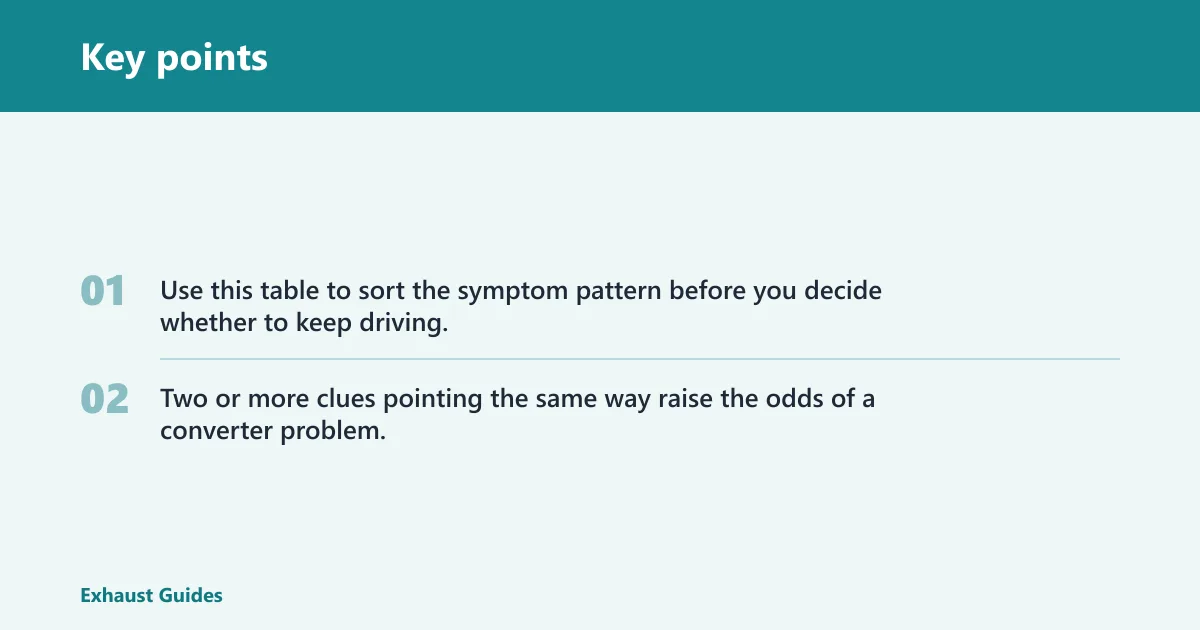
Use this table to sort the symptom pattern before you decide whether to keep driving, book service, or stop now. A single clue is weak evidence. Two or more clues pointing the same way raise the odds of a converter problem.
| Symptom | Likely cause | What else it could be | Severity | Driver action |
|---|---|---|---|---|
| Check engine light with P0420 | Catalyst efficiency below expected threshold | Exhaust leak, aging oxygen sensor, misfire, rich running, oil burning | Moderate | Schedule service soon; scan live data if available |
| Check engine light with P0430 | Downstream catalyst bank appears inefficient | Bank-specific misfire, sensor fault, exhaust leak, engine issue upstream | Moderate | Schedule service soon |
| Loss of power on acceleration | Backpressure from a restricted converter | Fuel delivery fault, turbo problem, transmission slip, ignition misfire | High | Limit driving; inspect promptly |
| Weak highway power or surging under load | Exhaust flow restriction or heat-related converter failure | Clogged muffler, poor fuel trim, ignition problem, failing fuel pump | High | Schedule service very soon; avoid long trips |
| Rough idle with misfires | Upstream engine fault damaging the converter, or a restricted exhaust | Spark plugs, coils, vacuum leak, injector issue | High | Do not ignore; diagnose the engine first |
| Rotten egg or sulfur odor | Sulfur compounds are not being converted normally | Rich mixture, fuel quality issue, engine misfire, overheating catalyst | Moderate to high | Schedule service; stop if odor comes with smoke or power loss |
| Rattling under the vehicle | Broken or fragmented substrate inside the converter | Heat shield rattle, loose exhaust clamp, broken hanger | Moderate to high | Schedule service; stop if the rattle turns into loss of power |
| Worsening fuel economy | Combustion control problem, restricted exhaust, or both | Underinflated tires, dragging brakes, bad oxygen sensor, dirty air filter | Moderate | Monitor, then diagnose if it persists with other symptoms |
| Failed emissions inspection | Converter efficiency problem or engine fault upstream | Oxygen sensor issue, misfire, evaporative fault, exhaust leak | Moderate | Repair before reinspection; registration may be blocked in some states |
| Cabin headache, dizziness, or exhaust smell | Exhaust leak with possible carbon monoxide intrusion | Cracked exhaust pipe, leaking manifold, tailpipe leak, body seal issue | Critical | Stop driving now; get fresh air and arrange a tow |
What are the first signs of a bad catalytic converter?
The first signs are usually subtle. A common early pattern is a check engine light with P0420 or P0430, a slight drop in power, and fuel economy that gets worse over time. A rotten-egg smell or a light rattle may appear later, or earlier if breakage is already present.
Symptoms that often show up together
Two or more symptoms together matter more than any one clue. Power loss plus a sulfur smell points toward a converter that is overheating, contaminated, or unable to process exhaust normally. Power loss plus a rattle points more toward internal breakage or a loose substrate.
Suppose a sedan starts taking longer to merge onto a highway, and a few days later the check engine light comes on with P0420. That is a stronger catalyst clue than either symptom alone, but an upstream misfire or exhaust leak still needs to be ruled out before the converter gets blamed.
Signs that point away from the converter
If the engine stalls only when cold, or only at idle with no other exhaust symptoms, look first at ignition, air leaks, fuel delivery, or sensor issues. If the car runs normally at steady speed and only the light is on, efficiency loss is possible, but the converter may not be the first fault to fix.
Can a catalytic converter go bad without a check engine light?
Yes. A converter can sometimes lose efficiency, begin to clog, or start to rattle before the ECM sets a code. The lamp may lag behind the symptom, especially if the failure is gradual, the trip is short, or the sensor readings are still borderline.
P0420 and P0430 are generally diagnostic clues rather than final diagnoses. They tell you the ECM sees a catalyst performance problem, often by comparing the upstream and downstream oxygen sensors, but they do not prove the converter itself is the only bad part.
When scan data is more useful than the lamp
If the light is off but the car feels flat, look at live fuel trim, misfire counts, and oxygen sensor switching. A converter problem often appears with a heat-soak or highway-load pattern, while an upstream engine fault usually shows up in the data first.
- Check whether the symptom happens cold, hot, idling, or under load.
- Look for a check engine light and any stored codes.
- Listen for rattling and note whether power drops on hills or highway merges.
- Smell for sulfur only after confirming there is no obvious exhaust leak.
- Decide whether the car needs a scan, a repair appointment, or a tow.
Why power and fuel economy drop
Power drops when exhaust cannot leave the engine freely. Backpressure rises in a clogged converter, which makes it harder for cylinders to empty on the exhaust stroke. That can reduce acceleration, dull highway passing power, and in severe cases contribute to repeated stalling.
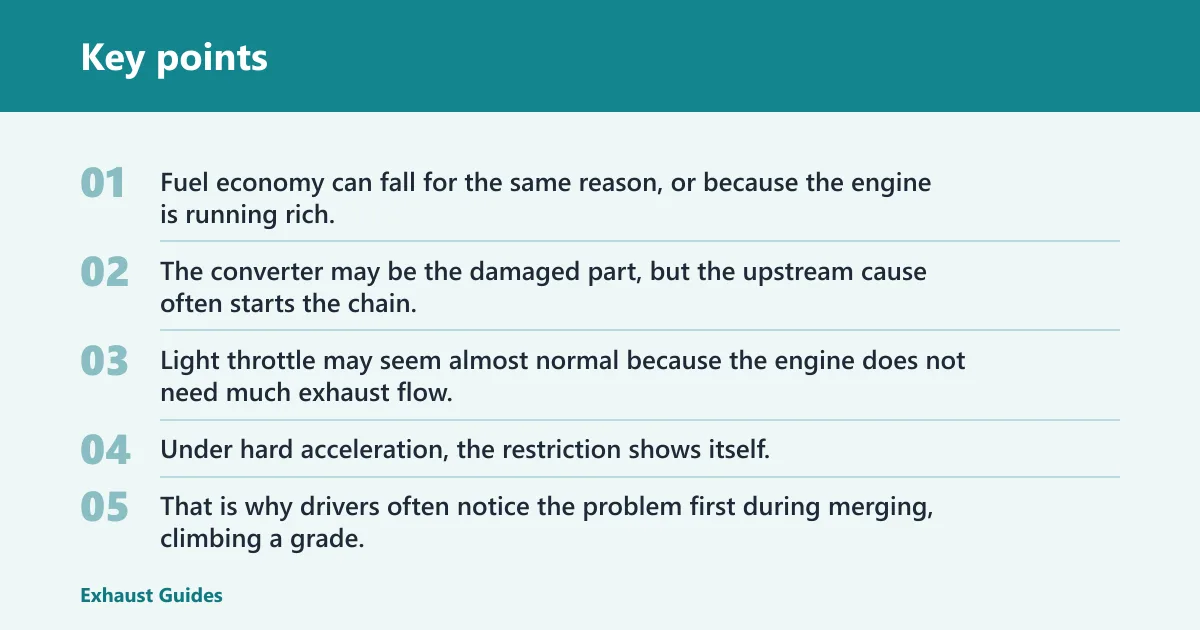
Fuel economy can fall for the same reason, or because the engine is running rich, misfiring, or compensating for bad sensor data. The converter may be the damaged part, but the upstream cause often starts the chain.
Why a clogged converter feels worse under load
Light throttle may seem almost normal because the engine does not need much exhaust flow. Under hard acceleration, the restriction shows itself. That is why drivers often notice the problem first during merging, climbing a grade, or carrying passengers.
A common first-timer mistake is assuming the car is “fine” because it idles in the driveway. A restricted converter can still pass that test and fail badly on the road.
Smell, rattle, and noise clues
A rotten egg or sulfur odor is a useful clue, but it is not proof by itself. It matters most when it appears with power loss, misfires, or a catalyst code. A strong sulfur smell can point to an overloaded or overheated converter, but it can also come from rich running or engine faults upstream.
Rattling under the car is a stronger mechanical clue. It often means the substrate inside the converter has broken apart and is moving around. That debris can shift with bumps, then block flow more badly as the car moves.
How substrate damage changes the symptom pattern
Broken substrate often starts as a light rattle and then turns into restriction. That is one reason a car can go from “annoying noise” to “won’t accelerate” after a few more trips. If the rattle comes with heat, smell, or a loss of power, the risk goes up fast.
When should you stop driving?
Stop driving now if the car loses power severely, stalls repeatedly, shows cabin exhaust exposure, or smells strongly of exhaust inside the vehicle. Those signs can point to a clogged converter, a broken exhaust, or both. Cabin carbon monoxide intrusion is rare, but it is urgent.
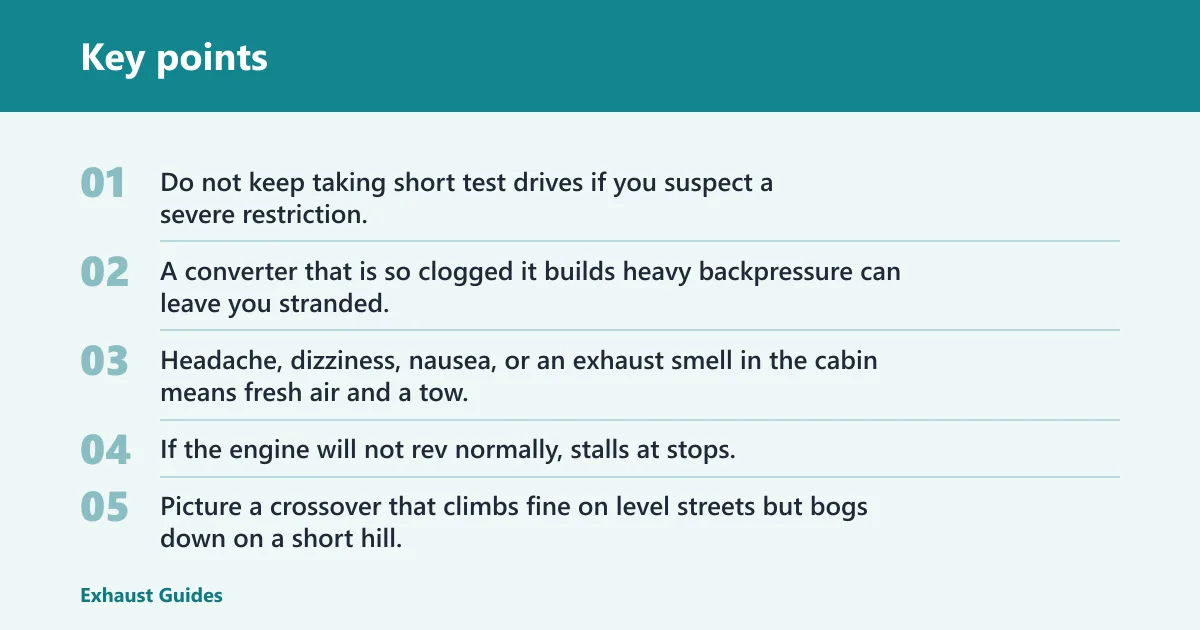
Do not keep taking short test drives if you suspect a severe restriction. A converter that is so clogged it builds heavy backpressure can leave you stranded, and an exhaust leak can put the occupants at risk before the engine quits.
Red-flag symptoms that need immediate action
Headache, dizziness, nausea, or an exhaust smell in the cabin means fresh air and a tow, not another drive around the block. If the engine will not rev normally, stalls at stops, or the check engine light flashes with misfires, the safest move is to stop and diagnose the cause before more damage spreads.
Picture a crossover that climbs fine on level streets but bogs down on a short hill, then starts smelling like hot sulfur. That combination is not a cosmetic nuisance. It is a strong sign that exhaust flow or combustion control is failing enough to justify immediate service.
What usually causes early failure
A converter often fails early because something upstream is wrong. Misfires dump raw fuel into the exhaust. Oil burning and coolant burning can contaminate the catalyst surface. Rich running and ignition problems can overheat the converter and shorten its life. Those faults can also trigger P0420 or P0430 before the converter itself is fully damaged.
High-mileage vehicles are more likely to show efficiency loss, while turbocharged engines can be harder on the converter when fueling or ignition is off. Hybrids can also mask symptoms because the engine stops and starts often, so a problem may show up as an intermittent light or a strange smell rather than constant power loss.
Many converters are good for at least 100,000 miles, but that number is not a guarantee. Short trips, repeated misfires, rich fueling, and oil consumption can shorten that span significantly.
Frequently asked questions
Does a rotten egg smell always mean the catalytic converter is failing?
No. The smell is a strong clue, but it can also come from rich running, misfires, or fuel-quality issues. It becomes more meaningful when it appears with power loss, a code such as P0420, or a hot exhaust that smells worse after highway driving.
Why does my car lose power when the catalytic converter is bad?
A restricted converter increases backpressure, so exhaust cannot leave the engine normally. That hurts cylinder emptying and reduces acceleration and highway power. In severe cases, the restriction can get bad enough to cause repeated stalling or a no-start condition.
Can a bad catalytic converter cause rough idle or misfires?
It can, but rough idle and misfires more often point to the engine problem that damaged the converter in the first place. Spark, fuel, air leaks, or compression faults usually need attention first. A converter that is already clogged can make the engine feel worse.
What does a P0420 code mean for the catalytic converter?
P0420 is a common catalyst-efficiency code. It means the ECM thinks the converter is not storing and converting exhaust gases as expected, based on oxygen sensor readings. It is a diagnostic clue, not a final diagnosis, because exhaust leaks and upstream faults can trigger it too.
When should I stop driving if I suspect the catalytic converter is clogged?
Stop driving if power falls sharply, the engine stalls repeatedly, the cabin smells like exhaust, or you feel headache or dizziness. Those signs can mean severe restriction or an exhaust leak with carbon monoxide risk. In that case, a tow is safer than another trip.