o2 Sensor Cost Chevy Trax
A Chevy Trax oxygen sensor replacement is commonly reported at about $180 to $550 per sensor at a shop, with upstream sensors often around $250 to $550 and downstream sensors about $180 to $350. Guessing the wrong sensor can waste money and leave the check engine light on. This guide breaks down out-the-door cost by sensor position and gives a diagnosis-first checklist so you buy the right part.
What you will pay for parts, labor, and diagnosis


For most Trax repairs, the bill has three parts: the sensor itself, labor, and a diagnostic charge. The total changes a lot because Trax fitment varies by year and engine, and the upstream sensor usually sits in a hotter, tighter spot than the downstream unit.
OEM part price vs aftermarket part price
OEM sensors usually cost more because they match the exact connector, calibration, heater circuit, and thread spec listed for a given Trax engine and model year. Aftermarket parts can save money, but the match has to be exact, especially on connector style and upstream versus downstream position.
For a single Chevy Trax O2 sensor, a common parts-only range is about $90 to $220 for OEM and $50 to $150 for aftermarket. Wideband air-fuel sensors, when used in the upstream position on some applications, often sit at the higher end of that range.
Labor, diagnostic fee, and total bill
Labor is often around 0.7 to 1.8 hours for one sensor, depending on location, rust, and how much exhaust hardware has to come apart. Shops also add a diagnostic fee, often $100 to $160, if the code has not already been confirmed with scan-tool data.
That puts the out-the-door total in a realistic range of about $180 to $550 per sensor. Upstream repairs usually land higher because they can be harder to reach and more expensive to buy, while downstream repairs often stay lower unless corrosion or broken fasteners slow the job.
Upstream vs downstream cost range
| Sensor position | OEM part price | Aftermarket part price | Labor hours | Diagnostic fee | Estimated total repair range |
|---|---|---|---|---|---|
| Upstream, pre-catalyst | $140 to $220 | $90 to $150 | 1.0 to 1.8 | $100 to $160 | $250 to $550 |
| Downstream, post-catalyst | $90 to $170 | $50 to $120 | 0.7 to 1.2 | $100 to $160 | $180 to $350 |
Which sensor is the problem?
The Trax usually has one upstream sensor before the catalytic converter and one downstream sensor after it, but exact placement depends on engine and model year. The upstream sensor feeds fuel-control data. The downstream sensor mainly checks catalyst performance, so it often has less effect on driveability.
Upstream sensor and fuel trims
The upstream sensor, also called the pre-catalyst sensor, influences how the engine control module adjusts fuel mixture. If it reads slowly, sticks lean or rich, or loses heater function, the engine may run poorly and fuel trims may drift. That makes it the higher-urgency sensor in many Trax cases.
Suppose a 1.4L Trax sets a P0131 code and short-term fuel trim stays high at idle. That points more toward an upstream sensor, an air leak, or a fueling issue than a downstream sensor fault. Replacing the wrong sensor would not fix the trim problem.
Downstream sensor and catalyst monitoring
The downstream sensor sits after the catalytic converter and watches how well the catalyst smooths exhaust oxygen swings. A fault here often triggers catalyst-efficiency codes or sensor-heater codes rather than a rough-running engine. Driveability impact is usually lower than with an upstream failure.
Bank and sensor numbering on the Trax
Most Trax engines in this size class are inline three- or four-cylinder layouts, so they usually have Bank 1 only. Sensor 1 means upstream. Sensor 2 means downstream. Before ordering, match the code, the catalog listing, and the connector shape to the exact engine family.
O2 sensor cost chevy worksheet
Use this worksheet to separate parts cost, labor, and diagnosis before you buy anything. It keeps the estimate grounded in the actual position of the fault and helps avoid paying for two sensors when only one needs attention.
| Line item | Upstream estimate | Downstream estimate |
|---|---|---|
| OEM part price | $140 to $220 | $90 to $170 |
| Aftermarket part price | $90 to $150 | $50 to $120 |
| Labor hours | 1.0 to 1.8 | 0.7 to 1.2 |
| Shop labor cost range | $100 to $250 | $70 to $170 |
| Diagnostic fee | $100 to $160 | $100 to $160 |
| Total repair range | $250 to $550 | $180 to $350 |
- Read the code and note the exact fault number, such as P0131, P0135, P0141, or a catalyst-efficiency code.
- Confirm whether it names Bank 1 Sensor 1 or Bank 1 Sensor 2.
- Check live data for switching speed, heater activity, and fuel trims.
- Inspect the wiring and connector for melted insulation, corrosion, broken locks, or oil contamination.
- Check for exhaust leaks before the sensor, plus leaks around the manifold or flex section.
- Order only the sensor that matches the VIN, engine, connector, and thread spec.
What else can trigger the code?
A code by itself does not prove the sensor has failed. Exhaust leaks, wiring damage, connector mismatch, or a catalyst problem can all set O2-related codes or make a good sensor look bad on a scan tool.
Exhaust leaks before the sensor
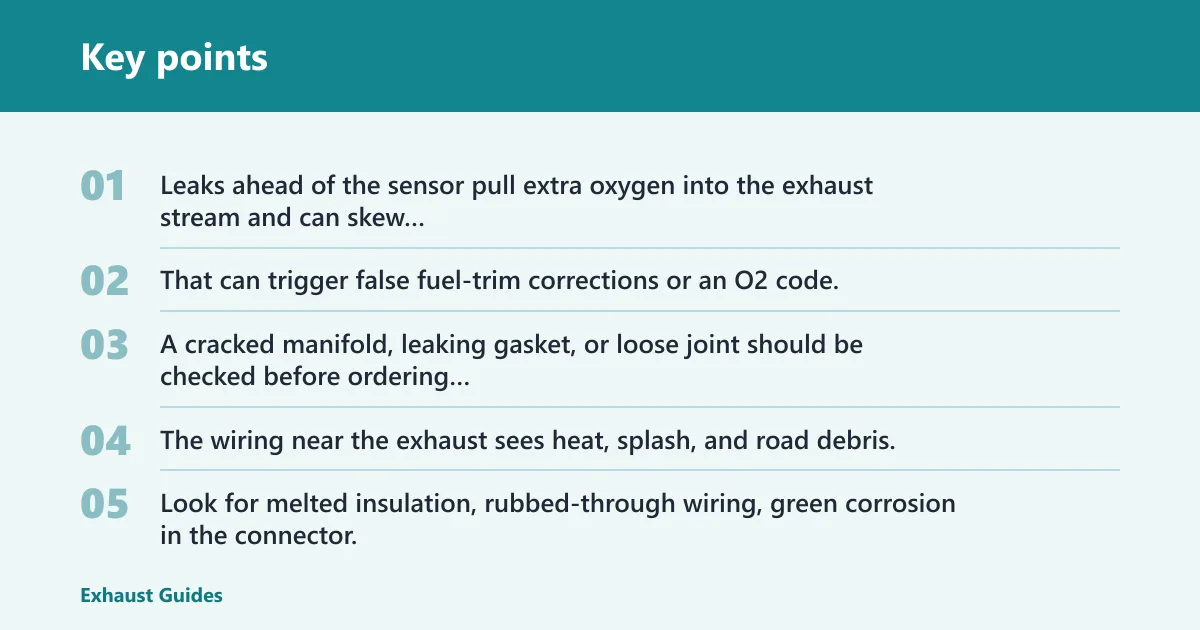
Leaks ahead of the sensor pull extra oxygen into the exhaust stream and can skew readings lean. That can trigger false fuel-trim corrections or an O2 code. A cracked manifold, leaking gasket, or loose joint should be checked before ordering parts.
Wiring harness and connector damage
The wiring near the exhaust sees heat, splash, and road debris. Look for melted insulation, rubbed-through wiring, green corrosion in the connector, and damaged terminal locks. Connector mismatch matters too; a sensor can look similar but still be wrong for the Trax engine and year.
A common first-timer mistake is replacing the sensor because the code says “O2,” then finding the old connector had heat damage near the manifold. The new sensor will not cure a wiring fault. That leaves the warning light on and doubles the cost.
Scan-tool and live-data checks
Use a scan tool to confirm the fault, then review live data. Watch upstream switching behavior, downstream response, fuel trims, and heater status. A smoke test can help find intake or exhaust leaks that would otherwise make the sensor look defective.
Cross-counts matter. If the upstream sensor stays flat while trims swing hard, the sensor may be lazy. If both fuel trims and O2 readings look abnormal, the problem may sit elsewhere and need more diagnosis before replacement.
Fitment by year and engine
Trax fitment changes by model year and engine family, so ordering by trim name alone can miss the mark. Use the VIN, engine code, and the exact sensor position to confirm connector style, thread size, and whether the vehicle uses a narrowband O2 sensor or an upstream air-fuel sensor.
VIN lookup before ordering
Look up parts by VIN whenever possible. That cuts down on mistakes tied to engine swaps, mid-year updates, and catalog overlap. A sensor listed for one Trax model year can still be wrong if the connector, heater circuit, or calibration changed.
Thread and connector match
Thread pitch, body shape, and wiring length must match the original part. The right sensor also needs the correct connector keying so it plugs into the factory wiring without strain. If the plug does not match cleanly, stop and verify the catalog number.
Sensor type differences
Some upstream applications use an air-fuel ratio sensor rather than a simple narrowband O2 sensor. Parts stores sometimes group them together, but they are not interchangeable. The wrong sensor may fit the bung and still report data the module cannot use correctly.
Can you keep driving with a bad sensor?
You can sometimes keep driving a Trax with a downstream sensor fault for a short time, but an upstream fault can change fuel control and raise fuel use or drivability problems. If the engine runs rough, surges, stalls, or sets heater-related codes, diagnose first instead of buying a sensor blindly.
Upstream faults and mileage
An upstream sensor problem can push the mixture rich or lean enough to hurt fuel economy. That does not mean every sensor replacement will improve mileage, though. If the root cause is a leak or wiring issue, mileage will not return until that fault is fixed.
Downstream faults and urgency
A downstream sensor usually affects catalyst monitoring more than day-to-day drivability. The vehicle may still feel normal, but the check engine light stays on and emissions readiness can fail. That makes it less urgent than an upstream fault, but it still deserves proper diagnosis.
When to stop and diagnose first
Stop and test first if the code returns quickly after clearing, if the wiring shows heat damage, or if fuel trims look abnormal in more than one direction. That pattern often means the sensor is reporting a real problem elsewhere.
Frequently asked questions
How much does an O2 sensor cost on a Chevy Trax?
A single Chevy Trax O2 sensor usually costs about $50 to $220 for the part, depending on aftermarket versus OEM and whether the upstream unit is an air-fuel sensor. Installed at a shop, the total commonly lands between $180 and $550 after labor and diagnosis.
What does it cost to replace the O2 sensor on a Chevy Trax?
Most replacements fall in the $180 to $550 range per sensor. Upstream jobs generally cost more because the part is pricier and access can be tighter, while downstream jobs are often cheaper unless rusted fasteners or heat damage add labor time.
Can I drive my Chevy Trax with a bad O2 sensor?
Sometimes, but not for long if the upstream sensor is affected. An upstream fault can skew fuel trims and hurt fuel economy or smoothness. A downstream fault is usually less urgent, though the check engine light and emissions readiness problem will remain.
How do I know which O2 sensor on my Chevy Trax is bad?
Match the exact code to Bank 1 Sensor 1 or Bank 1 Sensor 2, then confirm with live data. An upstream fault usually affects fuel trims and response. A downstream fault usually shows up in catalyst monitoring. Exhaust leaks and wiring damage must be checked too.
Is the upstream O2 sensor more expensive than the downstream sensor?
Usually yes. The upstream sensor often costs more because it may be a wider-band air-fuel sensor, and it can be harder to reach. It also tends to matter more for fuel control, so shops spend more time confirming the diagnosis before replacement.
How long does it take to replace an O2 sensor on a Chevy Trax?
Typical labor time runs about 0.7 to 1.8 hours for one sensor. Downstream replacements can be quicker if the exhaust hardware is clean and accessible. Rust, heat, and a stubborn connector can add time fast, which is why diagnosis and fitment checks save money.
Should I use an OEM or aftermarket O2 sensor on a Chevy Trax?
OEM is the safer pick when the Trax uses a sensor with a specific connector, heater spec, or air-fuel calibration. Aftermarket can work well if the catalog match is exact. Either way, verify by VIN and engine, not just by model name.
Is the O2 sensor the same as the A/F sensor on a Chevy Trax?
Not always. Some Trax engines use an air-fuel ratio sensor in the upstream spot and a conventional O2 sensor downstream. They can look similar in a catalog, but they are not interchangeable. Ordering by exact position and VIN is the safest approach.