Band Clamp vs U-bolt Clamp for Exhaust Repairs
For most exhaust repairs, choose a band clamp for a tighter seal and less pipe distortion; use a U-bolt clamp or saddle clamp only for a cheap, temporary fix on overlapping pipe. A poor clamp choice can leave leaks, crush thin tubing, and make later disassembly harder. This guide compares seal quality, pipe preservation, fitment, and when each clamp suits a temporary or permanent repair.
| Factor | Band clamp | U-bolt clamp | Saddle clamp | Winner |
|---|---|---|---|---|
| Seal quality | Wraps fully around the pipe for a full circumferential seal; best on lap and butt joints | Can seal an overlapping joint, but the contact is more localized | Uses a curved saddle under the pipe for a simple overlap seal, but pressure is still concentrated | Band clamp |
| Pipe distortion | Lower risk of ovalizing or pinching the tube | Higher risk of crushing thin, rusted, or already oval pipe | Higher risk of flattening thin wall pipe than a band clamp, especially on worn slip joints | Band clamp |
| Service access | Easier to remove later when the joint needs future service | Simple bolt-on fixing, but removal can be less forgiving on damaged tubing | Simple bolt-on fixing, but can leave a harder pinch mark on reuse | Band clamp |
| Cost and simplicity | Usually the more refined repair choice | Lower-cost, simple bolt-on fixing | Low-cost, simple bolt-on fixing with a saddle clamp profile | U-bolt clamp |
| Typical fit | Lap joint and butt joint exhaust repairs where a circumferential seal matters | Standard automotive, generator, tractor, forklift, and industrial exhaust systems | Overlapping pipe joints where a simple saddle clamp can compress a round section without welding | Tie |
Seal quality versus pipe distortion
Band clamps win when the repair needs a tight seal around the whole joint. U-bolt clamps and saddle clamps can work on sound, overlapping tubing, but they concentrate force at two points and may deform a weak pipe. That difference matters most on thin wall exhaust tubing, rust-thinned sections, and joints with poor edge shape.
Why band clamps seal better
A band clamp wraps fully around the pipe. That full wrap can help when you are trying to stop a leak at a lap joint or butt joint, because the clamp pressure is spread around the circumference instead of being driven through a saddle and plate.
A 4-inch lap joint exhaust muffler clamp band is a good example of the style used on joints that need leak-free compression. That is the kind of joint where a band clamp earns its place: the pipe ends overlap cleanly, and the clamp can compress the joint without forcing a deep crease into the tubing.
Why U-bolt clamps can deform pipe
A U-bolt clamp uses a U-shaped bolt and mounting plate. That design is simple and durable, but the force path is narrower. On rusted or ovalized pipe, the clamp can pull the metal inward before it truly seals the leak.
A common first-timer mistake is to tighten a U-bolt clamp on a pipe that is already thin at the edge. The clamp may feel snug while the leak remains, because the damaged metal bends instead of sealing. The same warning applies to a saddle clamp when the wall thickness is too light to tolerate point loading.
Is a band clamp better than a U-bolt clamp?
When the repair goal is a full circumferential seal and the joint condition is decent, a band clamp is often the better choice. It is also the safer pick when you want to preserve pipe shape and keep the joint serviceable later. A U-bolt clamp still makes sense for a quick, cheap repair on overlapping pipe that is sound enough to take clamping force. A saddle clamp falls in the same temporary category when cost and simplicity matter more than perfect sealing.
When the joint needs a full seal
Band clamps are the better match for lap joints and butt joints where the leak path runs around the circumference. That includes repairs where you want the clamp to compress evenly, not squeeze only at two points.
Say your exhaust has a 4-inch lap joint where the pipes overlap cleanly but hiss at idle. A band clamp fits that goal better than a U-bolt clamp or saddle clamp, because the leak path is circumferential and the pipe edges are still usable.
When future removal matters
If the joint may need to come apart later, a band clamp is usually the cleaner choice. It is less likely to leave a pinch mark that later fights removal or causes a repeat leak after the parts are reassembled.
That matters on systems where a clamp sits between service intervals, not as a permanent weld substitute. A U-bolt clamp or saddle clamp can be fine for a simple bolt-on repair, but it is less forgiving when the joint will be opened again.
When should you use a U-bolt clamp?
Use a U-bolt clamp when the exhaust system is standard, the pipe overlap is sound, and the goal is a simple bolt-on repair at low cost. It is common on automotive, generator, tractor, forklift, and industrial exhaust systems, especially where the joint does not need the more even seal of a band clamp.
Standard systems and simple fixes
U-bolt exhaust clamps are commonly sold from 54mm (2 1/8in) up to 130mm (5 1/8in). That range covers many ordinary exhaust jobs, and the format is simple: a U-shaped bolt and mounting plate clamping the overlap together.
A 3-inch U-bolt clamp made from 304 stainless steel shows the same size class can exist in different clamp styles. That matters because the right style is not just about diameter; it is also about whether the joint can tolerate concentrated load.
Temporary fixes on sound pipe
Choose a U-bolt clamp when you need a temporary roadside repair and the tubing still has enough wall thickness to hold shape. Mild steel versions are the lower-cost option and are common on standard U-bolt clamps, while 304 stainless steel versions are used where corrosion resistance matters more.
Suppose a tractor exhaust joint has a clean 2 1/2-inch overlap and needs to get back to service quickly. A U-bolt clamp can be acceptable if the pipe is round, not rust-thinned, and not already split at the edge.
Will a U-bolt clamp crush an exhaust pipe?
Yes, it can. The risk rises when the pipe is thin, rusted, ovalized, or already distorted at the clamp point. A U-bolt clamp does not automatically crush tubing, but it is more likely than a band clamp to deform a weak pipe because the load is concentrated where the bolt and plate pull hardest.
Thin wall and rust make the difference
If the pipe wall has thinned from corrosion, the clamp can pinch the tube before it seals. That is especially likely at the edge of an old slip joint, where rust has already reduced stiffness and the metal no longer springs back.
Ovality matters too. A pipe that is no longer round gives the clamp a bad surface to work against, and the clamp may tighten the high spots while leaving the leak path open.
How clamp shape affects deformation
Band clamps spread force around the joint, so they are less likely to leave a flat spot or crease. U-bolt clamps and saddle clamps focus pressure along the saddle and plate, which is fine on sound tubing but less forgiving on damaged pipe.
That is why a U-bolt clamp should be viewed as acceptable on a good overlap, not as a cure for every leak. If the tube is already weakened, a clamp that squeezes harder is not a repair strategy.
Clamp comparison table
| Repair condition | Band clamp | U-bolt clamp | Saddle clamp | Recommended pick |
|---|---|---|---|---|
| Clean lap joint with enough overlap | Best chance of a full seal | Works, but more local pressure | Works, but is less even than a band clamp | Band clamp |
| Butt joint that needs a circumferential seal | Better match | Poorer fit for the seal path | Poorer fit for the seal path | Band clamp |
| Sound round pipe on a standard system | Acceptable, though more than needed in some cases | Simple and adequate | Simple and adequate if the joint is truly round | U-bolt clamp |
| Thin, rusted, or oval pipe | Lower distortion risk | Higher crushing risk | Higher crushing risk | Band clamp |
| Temporary roadside fix | Good if the right size is on hand | Lower-cost, quick fix | Lower-cost, quick fix with a saddle clamp profile | U-bolt clamp |
Repair decision table
| Pipe condition | Pipe OD / overlap guidance | Recommended clamp type | Expected seal quality | Torque guidance | Risk of pipe crushing | Temporary or permanent |
|---|---|---|---|---|---|---|
| Clean overlap, round pipe, enough engagement | 2 1/4- to 4-inch OD with at least 1 1/2 inches of overlap | Band clamp | High | Tighten evenly to the clamp maker’s spec; commonly 35-60 in-lb for small clamps and 60-120 in-lb for larger bands | Low | Permanent |
| Standard exhaust pipe, sound wall, simple overlap | 2 1/8- to 3-inch OD with 1 1/4 to 2 inches of overlap | U-bolt clamp | Moderate | Snug the hardware evenly; a common working range is 70-120 in-lb, stopping before the tube starts to flatten | Moderate | Temporary |
| Thin wall, rusted edge, or ovalized pipe | Any OD if the wall is visibly thinned below about 16-gauge equivalent or the overlap edge is scalloped | Band clamp | Moderate to high | Use only enough torque to seal; over-tightening on weak pipe can cause new leaks | Low to moderate | Permanent if the joint still holds |
| Damaged edge, split flange, or poor overlap | Less than 1 inch of usable overlap, or any OD with split or burned-through edges | Neither clamp is ideal; repair the pipe first | Low | Do not rely on clamp torque to compensate for bad metal | High with U-bolt | Neither should be treated as final |
| Service joint that may need removal later | 2 1/2- to 5-inch OD with clean, even overlap and room for reassembly | Band clamp | High | Evenly tighten to the clamp’s range, then recheck after a heat cycle | Low | Permanent with future access |
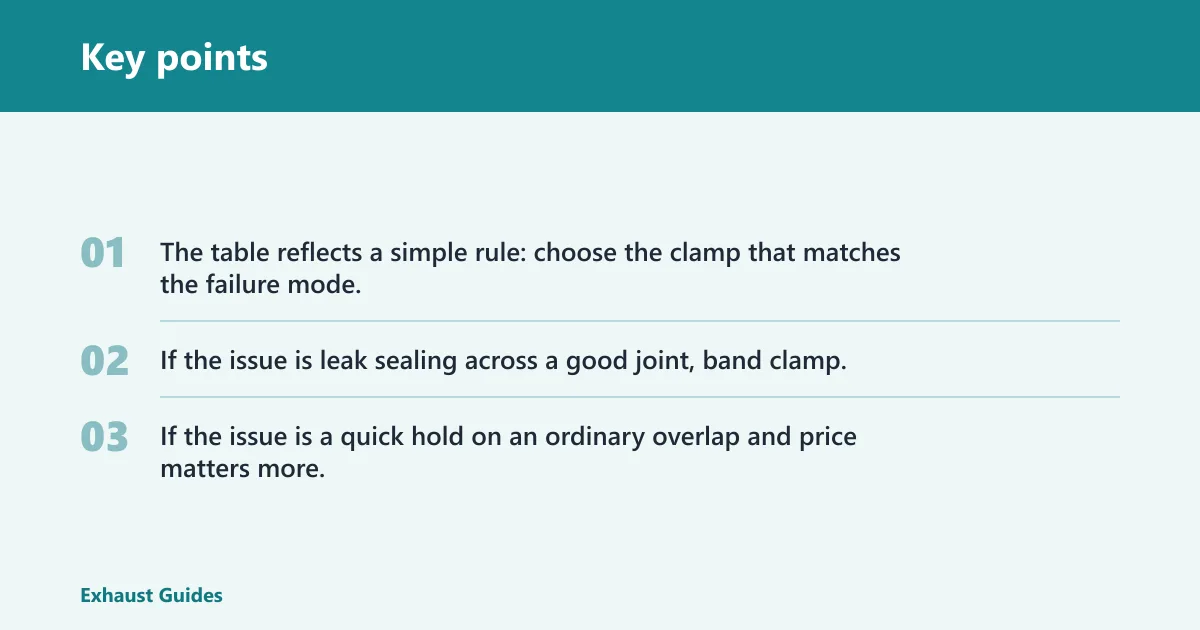
The table reflects a simple rule: choose the clamp that matches the failure mode. If the issue is leak sealing across a good joint, band clamp. If the issue is a quick hold on an ordinary overlap and price matters more, U-bolt clamp or saddle clamp.
Material and size fitment
304 stainless steel resists corrosion better than mild steel, so it is the better choice for longer service life and harsher weather exposure. Mild steel is the lower-cost option and is common in standard U-bolt clamps. Stainless does not fix a bad fit, but it usually lasts longer once the fit is right.
Do not treat nominal clamp size as identical to actual pipe outside diameter. Match the clamp to the pipe OD and the joint style, then confirm that the clamp can fully cover the overlap without bottoming out or leaving the band too loose. A 5-inch clamp, for example, may be listed as stainless or zinc plated depending on the product line, but the material does not change the need for correct OD match.
Examples that matter in the catalog
A 4-inch lap joint exhaust muffler clamp band is a useful example of the style used on joints that need leak-free compression. A 3-inch U-bolt clamp in 304 stainless steel shows the same size class can exist in different clamp styles. Those examples underline the key point: OD and joint style must both fit the repair.
A 5-inch stainless steel exhaust clamp and a 5-inch zinc plated muffler clamp are also commonly listed side by side in catalogs. That kind of listing is a reminder that material choice and size are separate decisions.
Can I use a U-bolt clamp on stainless exhaust pipe?
Yes, if the joint is sized correctly and the pipe is strong enough to take the load. The material of the pipe does not ban the clamp style. The real concern is fit and force: stainless tubing can still distort if it is thin, damaged, or mismatched to the clamp.
For a stainless exhaust pipe, a 304 stainless steel clamp usually makes more sense than mild steel because it resists corrosion better. The better clamp material does not erase poor overlap or bad pipe edges, though. If the joint is weak, the clamp style still matters more than the metal name on the package.
Choose Band clamp if… / Choose U-bolt clamp if…
Choose Band clamp if you want the best seal on a lap joint or butt joint, the pipe is still round, you want less distortion, or the joint may need future service access. It is also the better choice when the overlap is decent but the repair should last without pinching the tube.
Choose U-bolt clamp if you need a lower-cost, simple bolt-on fix on standard exhaust tubing, the pipe is sound, and the repair is temporary or near-term only. It is reasonable on standard automotive, generator, tractor, forklift, and industrial systems when the joint can tolerate concentrated clamping force. A saddle clamp belongs in the same bucket when the pipe is round, the overlap is adequate, and the goal is a quick hold rather than the cleanest seal.
For a permanent repair, band clamp is the safer default. For a temporary roadside fix, U-bolt clamp is the practical compromise, provided the pipe is not rusted thin or already ovalized.
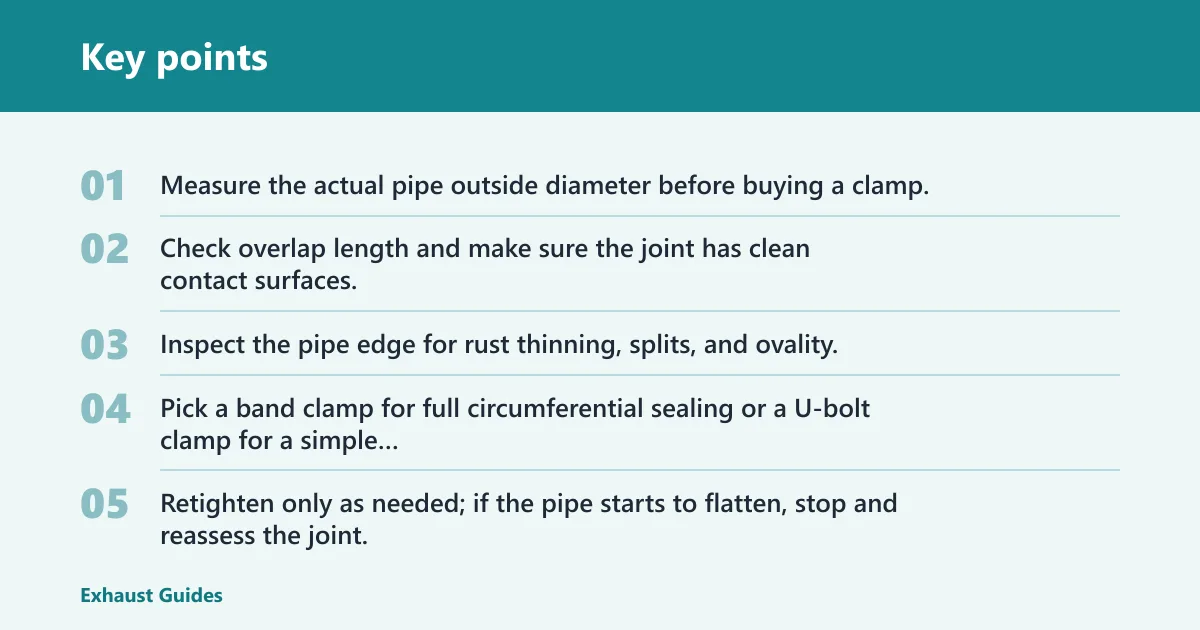
- Measure the actual pipe outside diameter before buying a clamp.
- Check overlap length and make sure the joint has clean contact surfaces.
- Inspect the pipe edge for rust thinning, splits, and ovality.
- Pick a band clamp for full circumferential sealing or a U-bolt clamp for a simple temporary hold on sound pipe.
- Retighten only as needed; if the pipe starts to flatten, stop and reassess the joint.


Frequently asked questions
Is a band clamp better than a U-bolt clamp for exhaust repairs?
Usually yes, if the goal is a better seal with less pipe distortion. Band clamps wrap fully around the pipe, which suits lap and butt joints that need even compression. U-bolt clamps still work on sound, overlapping pipe, but they are less forgiving on weak tubing.
When should you use a U-bolt clamp instead of a band clamp?
Use a U-bolt clamp when the exhaust is a standard system, the pipe is round and strong, and you want a simple, low-cost repair. It is most useful for temporary fixes on overlapping pipe where future disassembly is not the main concern.
Do band clamps seal exhaust leaks better than U-bolt clamps?
Yes, in most repair cases. A band clamp gives a full circumferential seal, which helps on joints that leak around the entire overlap. A U-bolt clamp can seal a good joint, but it is more likely to leave a leak path if the pipe is damaged or ovalized.
Can I reuse a band clamp or U-bolt clamp after removing it?
Sometimes, but only if the clamp is not bent, stretched, or corroded and the hardware threads still run cleanly. Reuse is more reasonable on a clean clamp than on one that has been over-tightened. If the clamp deformed during removal or installation, replace it.
What size exhaust clamp do I need for my pipe?
Match the clamp to the actual pipe outside diameter, not just the nominal label on the box. The clamp must cover the joint properly and still tighten without bottoming out. If the pipe is 3-inch, for example, a 3-inch clamp is the relevant starting point, but the joint style still has to fit.
Are stainless steel exhaust clamps worth it?
Often yes, if you want longer service life and better corrosion resistance. 304 stainless steel is the better durability choice than mild steel, especially on exposed underbody exhaust parts. Stainless still needs the right size and joint condition to work well.
What is the difference between a lap joint clamp and a U-bolt clamp?
A lap joint clamp is a band-style clamp meant to seal overlapping pipe with even pressure around the joint. A U-bolt clamp uses a U-shaped bolt and mounting plate, which makes it simpler and cheaper but less even in how it loads the pipe. Lap joint clamps are the better sealing tool.
Which exhaust clamp is best for a temporary repair?
A U-bolt clamp is usually the better temporary repair choice if the pipe is sound and the overlap is decent. It is lower cost, simple to fit, and common on standard exhaust systems. If the pipe is weak or the leak path is around the whole joint, a band clamp is the safer temporary option.