Best Exhaust Paints for Rust Prevention (2026): We Compared
Best exhaust paint for rust prevention is the highest-heat coating your part needs: use lower-heat paint for tips and rear mufflers, 1,200°F-class coating for pipes, and 2,000°F-rated coating for manifolds and headers. Wrong heat rating means flaking, smoke, and rust that spreads fast. This guide explains which coating fits each exhaust location and failure mode.
Quick comparison
| Product | Badge | Best for | Price | ||
|---|---|---|---|---|---|
 | VHT SP102-6PK Flameproof Coating Very High Heat Spray PaintVHT | Our pick | 11 oz · flameproof · black flat | $94.99 Price as of 26 Oct 2026 | View |
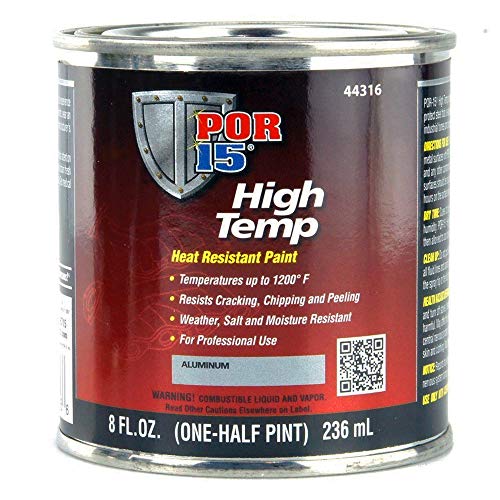 | POR-15 High Temperature Paint, High Heat Resistant Paint,POR-15 | Upgrade pick | 8 fl oz · high temp · aluminum | $30.00 Price as of 26 Oct 2026 | View |
 | Eastwood High Temperature Resistant Factory Gray ExhaustEastwood | Budget pick | 11.75 oz · factory gray · 2 pack | $59.99 Price as of 26 Oct 2026 | View |
 | KBS Coatings 65305 Cast Iron Grey Xtreme TemperatureKBS Coatings | Pair with it | 1 pint · cast iron grey · brush/spray | $33.99 Price as of 26 Oct 2026 | View |
Use the table to separate cosmetic tip paint from true undercar protection. The right choice depends on where the part sits, how hot it runs, and whether salt, soot, or moisture is the main problem.
How we chose
Selection here is based on four things: temperature rating, rust-defense claims, cure workflow, and where each coating fits on an exhaust system. The goal is not the biggest number on the label. It is the right coating for the part, with prep and curing that match the job.
Regular paint fails on exhaust because heat, soot, moisture, and repeated expansion and contraction break the film down quickly. Coat over active rust, oily residue, or loose soot, and the finish bonds to contamination instead of metal.
VHT Flameproof Coating: best for headers and manifolds
- Made for exhaust systems and headers
- Very high heat coating
- Requires curing after application
VHT Flameproof Coating fits headers and manifolds where heat spikes are severe and repeated. It is described as a ceramic-style high-heat coating with capability in the 1300–2000°F range, and it is made for exhaust systems rather than cosmetic touchups.
It fits the hottest gas flow. That makes it the right kind of product for cast-iron manifolds, shorty headers, and other pieces that would overwhelm lower-rated paint.
The drawback is that this is not a casual spray-and-forget coating. It requires curing, and the prep has to be clean and even. Skip staged heat cycles, and the finish can fail early, especially near welds and sharp edges.
Rust-Oleum Automotive High Heat Spray Paint 248903: best all-around spray
Rust-Oleum Automotive High Heat Spray Paint 248903 is the broadest fit for DIY exhaust work because it is rated up to 2000°F, uses a Stops Rust formula, dries to touch in 30 minutes, and covers up to 10 square feet per can. That combination makes it a strong first pick for mixed exhaust work and spot repairs.
Use it when one aerosol has to cover more than a tip but you do not want a brush-on workflow. For rear sections, mid-pipes, and parts that need corrosion defense as much as heat tolerance, it goes on more evenly than many thicker coatings.
The drawback is that 2000°F is more than many rear exhaust sections need, so the rating can be overkill for mufflers and tail sections. It also does not replace prep; wire brushing or sanding, degreasing, and thin coats still matter.
POR-15 High Temperature Paint: best for moisture-prone parts
- Rated for extreme heat
- Designed to protect metal from corrosion
- Made for clean, prepared surfaces
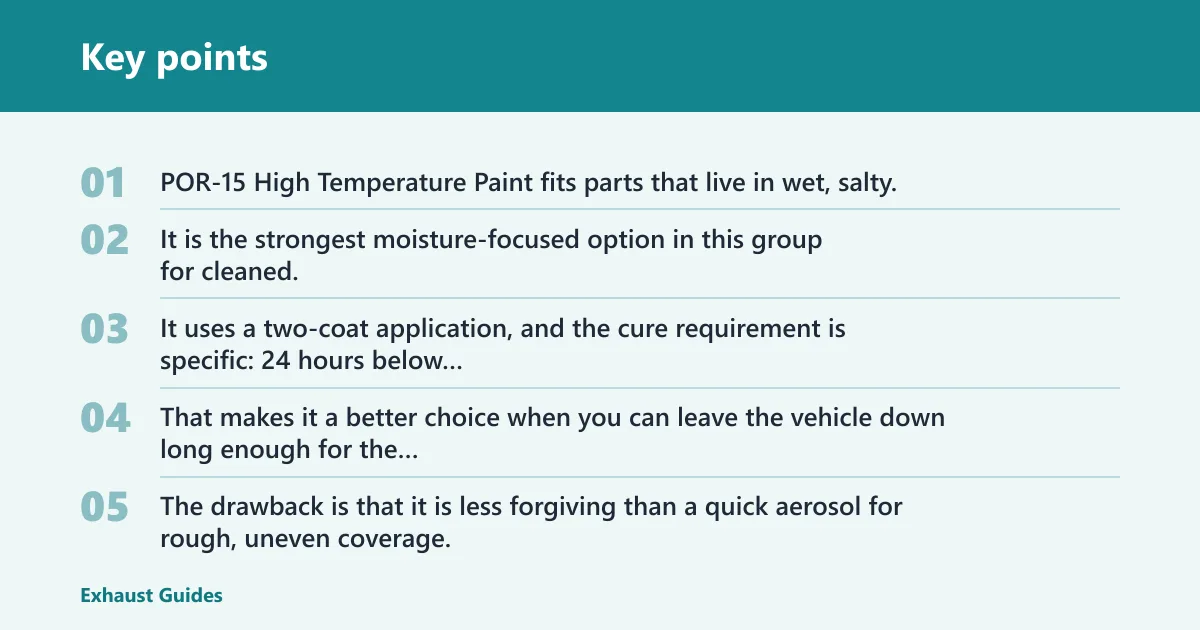
POR-15 High Temperature Paint fits parts that live in wet, salty, or slush-prone conditions, because it is rated to 1200°F and is designed to protect metal from corrosion. It is the strongest moisture-focused option in this group for cleaned, prepared exhaust parts.
It uses a two-coat application, and the cure requirement is specific: 24 hours below 300°F before higher heat exposure. That makes it a better choice when you can leave the vehicle down long enough for the coating to harden properly.
The drawback is that it is less forgiving than a quick aerosol for rough, uneven coverage. It is also not the first choice for heavily rusted surfaces that have not been cleaned back to sound metal.
Seymour 16-1201 Hot Spot High Heat Spray Paint: best for exhaust pipes
Seymour 16-1201 Hot Spot High Heat Spray Paint is a good fit for exhaust pipes because it withstands up to 1200°F and is described as giving a porcelain-like finish. It is also sold as resisting peeling and blistering, which matters on long tube sections that heat-cycle often.
This is a practical choice for mid-pipes and pipe sections where you want a cleaner finish without stepping all the way up to a header-only coating. It is a spray, so coverage is simpler than a brush-on product.
The drawback is that 1200°F is not enough margin for manifolds and many header locations. It matches pipes better than the hottest front-end exhaust parts.
Rust-Oleum High Heat Enamel Spray 7778830: best budget option
Rust-Oleum High Heat Enamel Spray 7778830 is the budget pick here. It is rated up to 1000°F and comes in satin or flat finish options, so it works best for light-duty exhaust use where appearance and basic heat resistance matter more than maximum margin.
It fits rear exhaust pieces, tail sections, and cosmetic jobs where you want a low-cost can and a simple finish. For an owner refreshing visible pipe sections without buying a specialty coating, it keeps the job straightforward.
The drawback is the lower temperature limit. On hotter parts, especially manifolds and headers, 1000°F is too close to the failure zone and can lead to early discoloration or breakdown.
Exhaust coating decision matrix
This matrix ties the coating to the part, the heat load, and the failure mode. Salt exposure matters because road spray and de-icing residue keep wet film on the metal longer, which speeds rust at chips, seams, and fasteners.
| Exhaust location | Typical heat load | Salt exposure | Surface condition | Recommended coating type | Minimum temp rating | Primer needed? | Prep and cure |
|---|---|---|---|---|---|---|---|
| Tips | Low to moderate | High if road spray hits the rear | Light rust or discoloration | Cosmetic high-heat spray | 1000°F | No | Wire brush or sand, degrease, apply thin coats, then cure with staged heat |
| Rear mufflers | Moderate | High in salt-belt use | Sound metal with surface rust | Rust-resistant high-heat spray or moisture-focused coating | 1000°F to 1200°F | No | Remove loose rust, clean soot, degrease well, and avoid one thick pass |
| Mid-pipes | Moderate to high | Moderate | Cleaned metal or light scale | High-heat spray or brush-on coating | 1200°F | Usually no | Prep to bare sound metal where possible, then cure in heat stages |
| Manifolds and headers | Very high | Lower direct salt, but moisture still reaches them | Clean, prepared metal only | Ceramic-style or very high-heat coating | 2000°F | Usually no; use only if the coating system calls for it | Wire brush or sand, degrease completely, use thin coats, and follow the full cure cycle |
Say your daily driver in a snow state gets crusty rear mufflers but the headers are still clean. A 1200°F coating may be the right middle ground for the rear section, while a 2000°F coating belongs only on the hotter front parts. The point is to match the part, not copy the same can everywhere.
A common first-timer mistake is painting over orange rust and oily residue because the part “looks dry.” It is not enough. If the surface still sheds soot when wiped, the coating bonds to contamination instead of metal and fails sooner.
Which one should you buy?
If you want one product for mixed exhaust work, start with Rust-Oleum Automotive High Heat Spray Paint 248903. It has the broadest temperature margin in this group, a Stops Rust formula, and a fast touch-dry time, so it fits many DIY jobs without forcing a brush-on workflow.
For headers and manifolds, choose VHT Flameproof Coating. Those parts see the highest heat, and a 2,000°F-class coating is the right filter when the front of the exhaust is the problem.
For salt-belt cars, POR-15 High Temperature Paint makes the most sense when the metal is properly cleaned first. Its moisture resistance matters more than a fancy finish when winter spray keeps the underbody wet and salty.
For exhaust tips, you can spray paint them, but they do not need the same temperature rating as a manifold.
For a brush-on option on cleaned metal, POR-15 is the most useful. For a spray can that covers exhaust pipes well, Seymour 16-1201 is the simpler fit. For a lower-cost cosmetic job, Rust-Oleum 7778830 is the easiest place to save money.
How to prevent exhaust from rusting
Rust prevention starts before any paint goes on. Remove loose scale with wire brushing or sanding, degrease the part so oil and soot are gone, and apply thin coats rather than one heavy coat. Then cure the coating with the heat steps the maker specifies.
- Let the exhaust cool fully.
- Wire brush or sand until loose rust and flaky coating are gone.
- Degrease the surface and let it dry completely.
- Mask off nearby parts that should not be coated.
- Apply thin, even coats.
- Follow the cure cycle with staged heat exposure.
How paint prevents rusting is simple: it blocks oxygen, water, road salt, and grime from reaching bare steel. The problem is that heat cycles expand and contract the metal, so the coating must stay bonded while the part gets hot, cools down, and gets wet again.
Do not use primer as an automatic step on exhaust parts. On hot sections, primer can become a weak layer if the coating system was not designed for it. On some jobs, bare, properly prepared metal is the better starting point.
How to paint exhaust tips
Start with clean tips. Remove soot, road film, and any surface rust before spraying. Tip paint is usually a cosmetic job first, so you can choose a lower temperature rating than you would for a header, as long as the can is still exhaust-safe.
Can you spray paint exhaust tips? Yes, if you use a high-heat product and prep the metal properly. Tips heat up, cool down, and collect moisture, but they do not need the same rating as manifolds unless they are unusually close to the hottest exhaust flow.
Keep the coats thin. Heavy paint near the edge of the tip often blisters first because that edge sees fast heat change and direct water spray.
Do you need primer before painting exhaust?
Usually no. Many exhaust coatings are intended for clean metal without primer, and adding an extra layer can create a failure point if the primer is not rated for the same heat. Use primer only if the coating system specifically calls for it.
On very hot parts, primer can cook off before the topcoat fully settles. That is why cleaning and proper cure matter more than adding another layer. The goal is not more material. It is a stable film on sound metal.
How long does exhaust paint need to cure?
Cure time depends on the product and the heat cycle, not just the dry-to-touch number. Rust-Oleum 248903 dries to touch in 30 minutes, but that is not a full cure. POR-15 requires 24 hours below 300°F before higher heat exposure, and VHT Flameproof also requires curing.
Follow the staged heat cycle the label specifies. If you jump straight to full exhaust temperature, the coating can flash, discolor, or lose adhesion before it hardens.
Frequently asked questions
What is the best exhaust paint for rust prevention?
The best exhaust paint for rust prevention is the coating that matches the part’s heat load and exposure. For many DIY jobs, Rust-Oleum Automotive High Heat Spray Paint 248903 is the best all-around pick because it is rated up to 2000°F, uses a Stops Rust formula, and is easy to apply on cleaned metal.
How to prevent exhaust from rusting: prevent rust by removing loose
Prevent rust by removing loose scale, sanding or wire brushing the surface, degreasing it fully, and coating it with a high-heat product that fits the part. Salt-belt cars need extra attention because road salt keeps moisture on the metal and speeds corrosion at seams, chips, and fasteners.
How to paint exhaust tips: clean the tips first
Clean the tips first, then apply thin coats of an exhaust-safe high-heat paint. Tips usually need less temperature margin than headers or manifolds, so you do not need the highest-rated product unless the tip sits unusually close to hotter exhaust flow.
Can you spray paint exhaust tips?
Yes. Spray paint works well on exhaust tips if the metal is clean, dry, and free of soot or oil. The common failure is coating over residue, which keeps the paint from bonding and leads to early peeling or discoloration at the tip edge.
Do you need primer before painting exhaust: usually not?
Usually not. Most exhaust coatings are meant for bare, prepared metal, and primer can become a weak layer on hot parts if it is not part of the coating system. Clean the surface, remove rust, and use thin coats instead of adding unnecessary layers.
How long does exhaust paint need to cure: cure time depends?
Cure time depends on the product. Rust-Oleum 248903 is dry to touch in 30 minutes, but that is not full cure. POR-15 needs 24 hours below 300°F before higher heat exposure, and other coatings may require staged heat cycles before normal driving.