Best Catalytic Converter Shield Options for SUVs: We Compared
For SUVs, a catalytic converter shield should match the underbody layout, leave room for service work, and cover the most exposed attack path. Poor fit can leave gaps, rattle, or block service access, while weak shields still let thieves cut the cats. This guide organizes shield types by fitment risk, theft resistance, install difficulty, and maintenance access.
Quick comparison
| Product | Badge | Best for | Price | ||
|---|---|---|---|---|---|
 | FOMIUZY Universal Catalytic Converter Security ProtectorFOMIUZY | Our pick | Universal · Stainless Steel · Cable Lock Device | $75.99 Price as of 26 Oct 2026 | View |
 | Suitable for Heavy-Duty Alloy Steel Front Skid Plate forGeneric | Also great | Alloy Steel · Ford Explorer · Front Skid Plate | $148.88 Price as of 26 Oct 2026 | View |
The safest short list is the shield that matches your SUV’s underbody layout, leaves room for service work, and closes the easiest attack paths.
Dual-converter SUVs, low-clearance crossovers, and body-on-frame trucks do not need the same shield shape. That difference can decide whether you need a one-piece plate, a wraparound cable design, or a model-specific panel with factory mounting points.
How we chose
Fitment confidence came first. A shield only matters if it matches the converter location, the mounting points, and the space around the exhaust.
The next filter was attack resistance by method. A good shield should slow cutting access, pry access, and fastener tampering, not only one of them.
Install complexity mattered too. Some SUVs can use factory mounting points and skip drilling, while others need more hardware and more time under the vehicle.
Service access and clearance closed the ranking. A shield that blocks oil changes, transmission work, or exhaust repairs can create the next problem.
SUV shield decision matrix
This matrix is a quick way to match shield style to SUV layout. Start with converter visibility and how much of the exhaust sits open under the vehicle, then check whether the shield changes maintenance access or ground clearance.
| Vehicle layout | Converter visibility | Material | Install complexity | Service access impact | Theft resistance | Best-use case |
|---|---|---|---|---|---|---|
| Body-on-frame SUV with open underbody | High, often easy to reach from the side | Stainless steel or thick steel | Medium if factory points line up | Moderate; can add time to exhaust or transmission work | Good against cutting and pry tools | Daily drivers that park outside |
| Crossover with tight packaging | Moderate to low, but access can be awkward | Aluminum with venting or lighter stainless | Low to medium if the kit is shaped for the chassis | Low to moderate; vented layouts help with heat | Good if the shield closes the direct attack line | Owners who want lower weight and less service drag |
| Low-clearance SUV or crossover | Often easy to target from curb height | Aluminum or slim stainless | Medium; clearance checks matter | Moderate; watch driveway scraping and lift points | Strong if fasteners are hidden and edge gaps are tight | Urban parking and winter road salt use |
| Dual-converter layout | High, because there are two targets | Stainless or steel with broad coverage | High if the shield must bridge both sides | High; service access is harder to preserve | Very good when both converters are fully covered | SUVs where thieves can reach either side easily |
| Off-road SUV with exposed skid area | High from below | Thick steel | Medium; skid plate geometry helps | Moderate to high if the plate overlaps service points | Strong against cutting and pry access | Trail use and underbody protection in one part |
RULLINE universal security anti-theft shield: best stainless pick
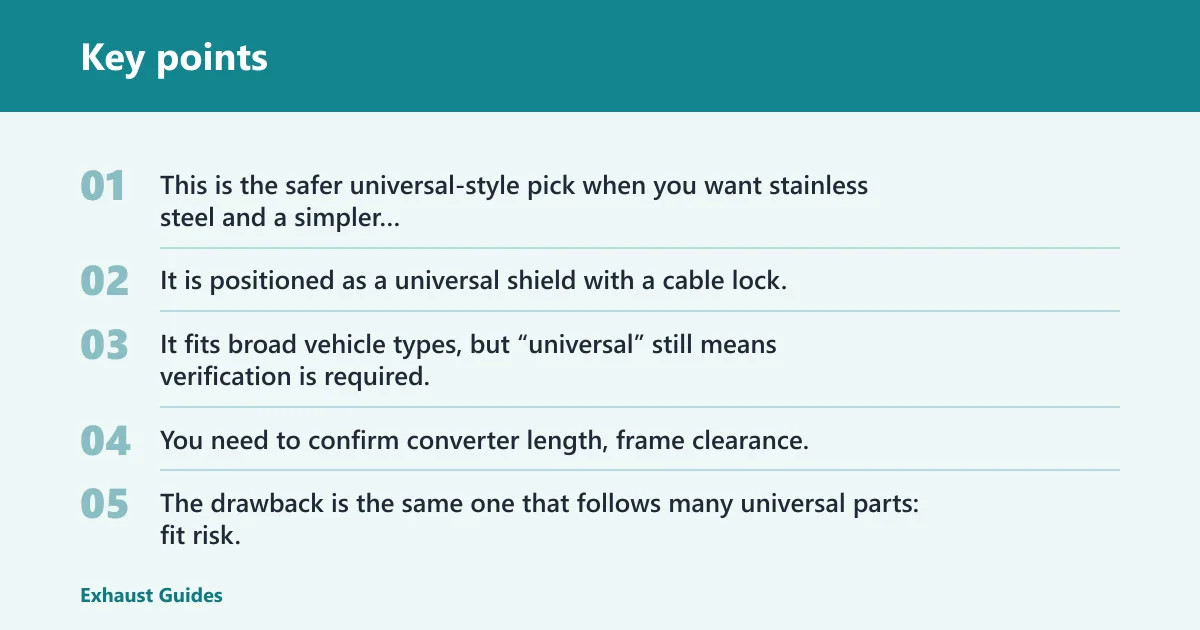
This is the safer universal-style pick when you want stainless steel and a simpler install path. It is positioned as a universal shield with a cable lock, which makes it useful for owners who want corrosion resistance without a long shop visit.
It fits broad vehicle types, but “universal” still means verification is required. You need to confirm converter length, frame clearance, and whether the mounting path clears the SUV’s heat shields, exhaust hangers, and splash panels.
The drawback is the same one that follows many universal parts: fit risk. If the shield sits too low, it can become the next scrape point; if it sits too high, thieves may still reach the edge or the fasteners.
Why it fits this roundup
Stainless steel is the better material when winter road salt is part of the story. It is also the safer bet when you want a shield that resists corrosion across more than one season.
For many SUVs, especially those with open underbodies, a stainless shield gives a stronger balance of durability and service life than a thin universal plate.
Fitment checks before you buy
Measure the converter length and the side-to-side space around it. Then confirm that the shield does not interfere with the transfer case, front differential, or exhaust routing.
Factory mounting points help a lot, because they reduce drilling and lower the chance of misalignment. If the listing does not spell out how it attaches to your SUV, treat that as a warning sign.
Install and service access notes
A no-drill install is the main appeal here, but no-drill does not mean no-check. You still need room for socket access, future inspection, and any exhaust repair that may follow.
Expect the shield to help against cutting access and some pry attacks. It will not stop a thief who can work around an exposed edge or reach an unprotected second converter.
FOMIUZY universal catalytic converter security protector: best lightweight option
This is the lighter universal choice for owners who want a broad fit and less weight under the vehicle. The product is listed as universal, and the product materials and hardware style are intended to provide a simple deterrent.
That lighter build can make sense on crossovers and lower-clearance SUVs where every pound and every inch of ground clearance matters. Vented design also helps airflow, which matters when you do not want to trap heat around the exhaust tunnel.
The drawback is attack resistance. Lighter materials are generally easier to defeat than heavier steel, so the shield’s value depends heavily on fit, vent layout, and how well the fasteners and cable lock actually block access.
Reinforced aluminum and venting
Aluminum is lighter and usually easier to live with on daily-driven SUVs. Vented panels can help heat dissipation, especially when the converter sits close to a floor pan or splash shield.
That lighter weight can also reduce the chance of suspension sag or extra scrape risk on low rides, though fit still matters more than weight alone.
When a direct replacement style makes sense
This style works best when the SUV has a clean mounting path and the converter sits in a predictable location. If the underbody is crowded with braces, heat shields, or transmission hardware, the simpler shape may be the better call.
Picture a crossover that parks on city streets and sees winter salt. A lighter aluminum shield with venting is easier to live with there than a heavy plate that complicates routine service.
SUV fitment risks to verify
Check whether the SUV has a single converter or dual converters. A universal shield that only covers one target leaves the other side exposed.
Also confirm cable routing and fastener reach. If the clamp or strap path crosses brake lines, fuel lines, or exhaust hangers, the part is not a fit even if the title says universal.
Pop & Lock CAT-RAP PL9800: best easy-install stainless option
This is the easiest stainless option to consider when install time matters. It is presented as a universal stainless design with a 30-minute setup claim, so it targets owners who want quick protection and lower corrosion risk.
The main advantage is straightforward installation on vehicles where the underbody gives enough room for the shield and hardware. The drawback is that universal fit still depends on your SUV’s frame shape and converter exposure.
What the 30-minute install claim means
That claim should be read as a best-case install window, not a guarantee for every SUV. If the vehicle has rusted fasteners, tight packaging, or odd exhaust routing, the job takes longer.
Factory mounting points can keep the install cleaner. Without them, a universal shield may need more hardware alignment and more time under the vehicle.
Universal fit limits on SUVs
Universal designs work best on SUVs with clear underbody access and a simple converter layout. They are weaker choices for dual-converter systems or vehicles with irregular heat shields.
One practical check: make sure the shield does not cover drain points, service panels, or any routine access needed for oil changes.
Where stainless helps most
Stainless steel is the better call in road-salt regions and for owners who keep the SUV outdoors. It also holds up better when frequent washing is not realistic.
It still needs a clean fit. Stainless will resist corrosion, but it will not rescue a shield that leaves a pry gap or hangs too low.
Rough Country catalytic converter shield: best for off-road SUVs
This is the strongest fit for SUVs that already need underbody protection. Rough Country’s shield uses 14-gauge steel and a skid plate style, which makes it more useful when the vehicle sees rocks, ruts, or other trail contact.
The tradeoff is weight and access. A skid plate style can cover more of the underside than a thinner shield, and that may slow oil service or exhaust repairs.
14-gauge steel and skid plate style
Steel gives more resistance to cutting than thin aluminum, especially when a thief tries to create an opening with a saw or wheel. The skid plate shape also helps spread impact loads across the underbody.
For body-on-frame SUVs, that is often a better match than a narrow wraparound guard. The vehicle already has more open space under it, so the larger plate can fit without feeling excessive.
Ground clearance and trail use
On an off-road SUV, the shield should not become the lowest point. Check approach, breakover, and departure concerns if the plate hangs below the factory skid line.
Say your SUV already scrapes a drive ramp at home. A heavy shield that drops another half inch can make that problem worse, even if it adds protection.
Service access tradeoffs
Expect more work during oil changes and during transmission or exhaust repairs. A strong skid-style shield can force extra removal steps before a technician reaches the components behind it.
That is the tradeoff for stronger coverage. If you value quick service more than trail strength, a lighter, more focused shield may fit your use better.
Which one should you buy?
Start with the SUV’s layout, not the brand name. The best shield is the one that covers the vulnerable pipe path without creating a new service problem.
Best for a daily-driven crossover
Pick the FOMIUZY-style lightweight universal shield if you want less weight and a cleaner fit on a crossover with modest underbody exposure. Choose the RULLINE-style stainless shield instead if salt corrosion is a bigger concern than added mass.
Best for a body-on-frame SUV
Choose the Rough Country-style steel shield if the SUV already has room for a skid plate and you want stronger cut resistance. That is the better fit when the vehicle sees rough roads or dirt use.
Best if you want no-drill installation
Choose the RULLINE or Pop & Lock style if the listing confirms factory mounting points or a no-drill path on your specific SUV. Do not assume “universal” means bolt-on for every chassis.
Best if winter corrosion is the main concern
Stainless steel is the better bet. The RULLINE and Pop & Lock options are the better material match when road salt, slush, and repeated washing are part of the use case.
When to skip a shield and add other theft deterrents
If your SUV has dual converters, very tight clearance, or exposed fasteners that a shield cannot fully cover, add more than one deterrent. Parking in a locked garage, choosing better-lit spaces, using an alarm, and adding etched VIN marking all help.
A shield slows the attack. It does not stop every method, especially when a thief can work from a different angle or target the hardware instead of the pipe.
5-step fitment checklist
A common first-timer mistake is buying by vehicle class instead of checking the exact underbody. Use this list before ordering.
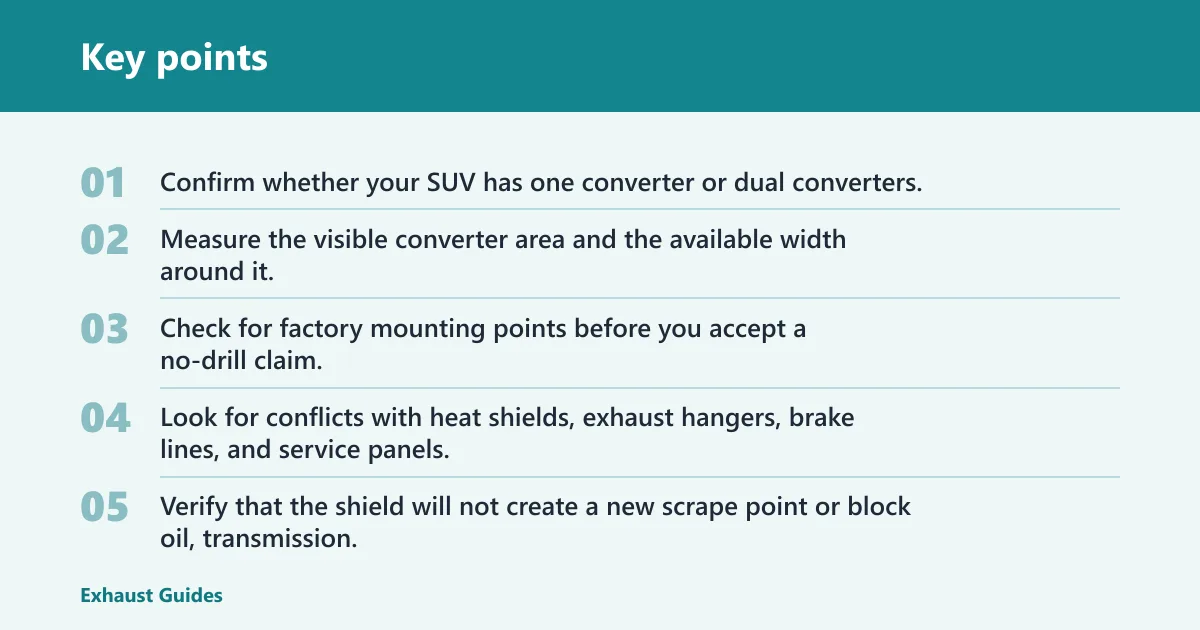
- Confirm whether your SUV has one converter or dual converters.
- Measure the visible converter area and the available width around it.
- Check for factory mounting points before you accept a no-drill claim.
- Look for conflicts with heat shields, exhaust hangers, brake lines, and service panels.
- Verify that the shield will not create a new scrape point or block oil, transmission, or exhaust service.
Red flags for bad fits
Skip a shield if the listing never names your SUV platform or gives no mounting detail. That is especially risky on crossovers with crowded underbodies.
Watch for a shield that covers only one converter on a dual-exhaust SUV, or one that depends on drilling near sensitive lines. Also avoid any part that hangs below the existing underbody line.
What is the best catalytic converter shield for an SUV?
The best shield for an SUV is usually a vehicle-specific stainless or thick aluminum plate that fits the underbody layout and uses factory mounting points when possible. That combination lowers fit risk and improves theft resistance without creating avoidable service problems.
Do universal catalytic converter shields fit SUVs?
Sometimes, but not automatically. Universal shields can work on many SUVs if the converter location, frame shape, and mounting path line up, but you still need to verify clearance, fastener access, and whether the design covers all exposed converters.
Which is better for SUV theft protection, aluminum or stainless steel?
Stainless steel usually gives better cut resistance and better corrosion resistance, which helps in winter road-salt use. Aluminum is lighter and often easier to manage on low-clearance SUVs, but it can be easier to defeat if the fit leaves gaps or weak edges.
How hard is it to install a catalytic converter shield on an SUV?
Difficulty ranges from straightforward to moderately involved. A no-drill shield with factory mounting points is much easier than a universal part that needs alignment around exhaust braces, heat shields, or rusted hardware.
Will a catalytic converter shield affect heat or ground clearance?
Yes, both can change. Vented shields help airflow and heat dissipation, while thick plates or skid-style designs can reduce clearance or add scrape risk if they hang below the existing underbody line.
Which SUV catalytic converter shield works without drilling?
Look for a model that uses factory mounting points and is made for your exact SUV platform. No-drill claims are most believable when the listing names the mounting method, not just the material or the universal fit label.
What should I check before buying a catalytic converter shield for my SUV?
Check converter count, underbody layout, mounting points, ground clearance, and service access first. Then confirm whether the shield covers the visible attack path, uses tamper-resistant hardware, and leaves room for routine maintenance.
Are there catalytic converter shields made for specific SUV models?
Yes. Vehicle-specific shields exist for some SUV platforms, and they are often the cleaner fit because they follow the factory mounting layout. They are usually the safer pick when you want less drilling, fewer gaps, and better control over service access.