Best Exhaust Manifolds for Noise Reduction (2026): We Compared
For the quietest, longest-lasting choice, buy a thick-wall cast-iron or ductile-iron manifold with OE-style fitment and a multi-layer steel gasket; if cracking is your main concern, avoid thin tubular headers. Bad fit or thin tubing can create tick, drone, leaks, and premature failure. This guide compares materials, thickness, flange design, and fitment so you can pick the best exhaust manifold for your noise and durability target.
Quick comparison
| Product | Badge | Best for | Price | ||
|---|---|---|---|---|---|
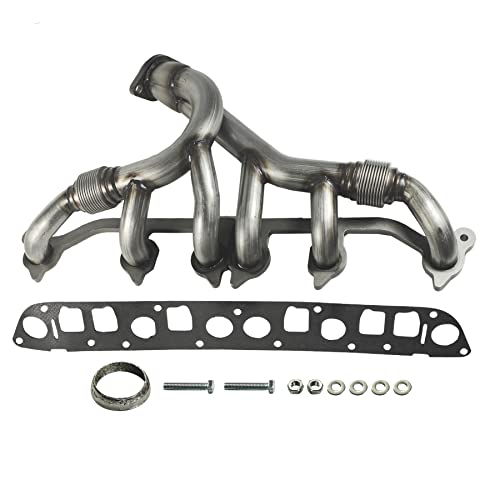 | JDMSPEED New Stainless Steel Exhaust Manifold & Gasket KitJDMSPEED | Our pick | Jeep 4.0L · stainless steel · direct replacement | $95.58 Price as of 18 Oct 2026 | View |
 | Exhaust Pipes For Ford 4" 2011-2023 Super Duty 6.7LTEYOLIAO | Also great | Ford 6.7L · 304 stainless · low-tone note | $269.99 Price as of 18 Oct 2026 | View |
 | BD Diesel 1041463 Exhaust Manifold Kit Dodge/RamBD | Also great | Ram Hemi · ductile iron · gasket kit | $481.96 Price as of 18 Oct 2026 | View |
 | BD Diesel 1043007 Exhaust Manifold Kit Incl. Manifold/CrossBD | Upgrade pick | Vehicle-specific · manifold kit · black coated | $494.00 Price as of 18 Oct 2026 | View |
 | Durable Cast Iron Exhaust Manifold Set for Ford 6.4LEast Coast Diesel | Upgrade pick | Ford 6.4L · ductile iron · coated set | $560.10 Price as of 18 Oct 2026 | View |
Cast iron is the best all-around pick for most daily drivers. Its mass cuts pulse noise, and its thickness holds up better than thin tubular pieces under heat and vibration. Stainless steel makes more sense when rust is the bigger threat than noise, especially in salt-heavy climates.
How we chose
We compared options on five buyer priorities: noise control, heat resistance, crack risk, fitment difficulty, and cost. We also separated daily-driver use from towing, turbo, and diesel duty, because the quietest part choice is not always the best part for repeated high-load heat cycling.
Fitment matters just as much as material. A part can look durable on paper and still leak at the flange, touch an accessory, or force a stretched stud setup that creates noise after the first heat cycle.
Exhaust manifold matrix
This table gives a simple buyer-grade read on the main material families. A higher score means better performance for that column.
| Material | Cabin noise | Thermal durability | Crack resistance | Fitment difficulty | Cost | Best for |
|---|---|---|---|---|---|---|
| Cast iron | 5 — heavy wall mass and heat retention reduce pulse harshness and tick noise. | 5 — withstands high temperatures and repeated thermal cycling well. | 5, resists warp and crack failure better than thin tubular options. | 4, usually OE-like, with fewer header-style clearance issues. | 4, often lower cost than premium stainless kits. | Daily drivers, diesel applications, buyers chasing quiet durability. |
| Ductile iron | 4, similar mass benefits, though design varies by casting and vehicle. | 5, strong under heat load and commonly used in heavy-duty kits. | 5, better toughness than brittle castings in many applications. | 4, often direct-fit, but stud and gasket details still matter. | 3, usually costs more than basic cast iron. | Towing trucks, tuned street trucks, durability-focused upgrades. |
| T304 stainless steel | 3, corrosion resistant and durable, but not always the quietest under load. | 4, heat resistant and better against rust than plain steel. | 3, can last well, but thin-wall or poor weld quality raises crack risk. | 3, more variation in routing, welds, and clearance than OE cast pieces. | 2, typically higher cost than cast iron. | Rust-prone climates, buyers prioritizing corrosion resistance. |
| Tubular manifold | 2, lighter structure can transmit more pulse noise and resonance. | 3, can handle heat, but wall thickness and weld quality decide lifespan. | 2, more likely to crack from thermal cycling and vibration. | 2, fitment and clearance are often harder than OE-style cast parts. | 2, quality pieces usually cost more than basic replacements. | Turbo builds, performance-first setups, owners who accept more noise. |
Best noise pick: cast iron. Best corrosion pick: T304 stainless steel. Best budget-safe durability pick: cast iron or ductile iron, as long as fitment is OE-like and the gasket surface is flat.
What is the best exhaust manifold for noise reduction and durability?
For most buyers, the best exhaust manifold for noise reduction and durability is a cast iron or ductile-iron OE-style manifold. The mass helps damp exhaust pulse noise, the wall thickness resists warp, and the design usually seals more predictably than thin tubular headers. That combination is hard to beat for daily driving.
Noise reduction at the manifold level is not the same as exhaust muffling downstream. Here, quieter operation comes from tuned internal geometry, a larger and smoother gas path, and a structure that does not turn heat cycling into a ticking leak. Downstream resonators still matter, but the manifold is where leak noise often starts.
Suppose a 5.7L Ram is used for school runs and short commutes. A quieter manifold with OE-style routing and a solid gasket surface will do more to keep cabin harshness down than a louder tubular part that flows well but leaves you chasing a flange leak later.
T304 stainless manifold: best for rust-prone climates
T304 stainless steel is the corrosion-resistant choice, and it also handles heat well. That makes it a smart pick where road salt, winter moisture, or long-term rust are bigger threats than absolute quietness. It is often used in quieter resonator-style exhaust components for the same reason: corrosion resistance plus heat resistance.
The tradeoff is cost. T304 stainless usually costs more than cast iron, and a stainless manifold is not automatically quieter under load. If the wall is thin, the welds are uneven, or the collector design is aggressive, you can still get resonance, leak noise, or crack risk.
Before buying, check weld quality, flange flatness, and whether the kit is built for your exact engine and side. If the listing does not clearly state driver or passenger side, sensor routing, and flange dimensions, assume you still need to verify them against the vehicle.
Two-piece diesel manifold: best for Cummins upgrades
Two-piece manifolds are worth a close look on 2003–2007 Dodge Ram 5.9L Cummins applications because they help manage heat and can support durability-focused upgrades. A split design can reduce stress concentration as the manifold expands and contracts, which matters under towing and repeated load.
The advantage is not only temperature control. A direct-bolt-on two-piece design can simplify installation when it is built for the correct Cummins fitment, and that lowers the chance of a leak that turns into ticking noise. A strong manifold that seals correctly is quieter than a “better flowing” part that does not line up cleanly.
BD Diesel’s 1043007 kit is a useful example of the kind of package buyers look for here: it includes a manifold, cross-over tube, and EGR port, and it uses a high-temperature black coating for added protection. Coating does not replace correct fitment, but it can help with longevity where heat exposure is severe.
How do you stop cracking and warping?
Start with material thickness and heat resistance, then check the fit. Cracking and warping usually come from thermal cycling, vibration, and a flange that is forced into position. If the part runs hot, cools unevenly, or is held in a stressed alignment, the leak risk goes up fast.
Use this checklist before installation:
- Confirm the exact engine code, model year range, and left or right side layout.
- Check flange thickness and compare it to the old manifold or factory spec if available.
- Measure stud length and confirm the new kit does not need unusual spacer stacking unless the application calls for it.
- Verify sensor routing, EGR port location, and clearance to the firewall, turbo, steering shaft, and accessories.
- Inspect the gasket surface for flatness and make sure the mating face is clean and free of distortion.
- After the first heat cycle, recheck for ticks, soot trails, or a puffing sound at idle.
High-temperature coating is useful when the part will live near extreme heat, especially on diesel manifold kits. It helps protect the surface finish and can slow surface corrosion, but it does not cure a poor casting or bad alignment. Heat resistance is still the core issue.
A common first-timer mistake is tightening a manifold that does not sit naturally against the head. That can create a tiny gap at one runner, and the result is a sharp tick at idle that gets louder as the engine heats and expands. If that happens, stop and verify the flange before you chase the gasket.
Which one should you buy?
Best pick for most budgets: cast iron or ductile iron. It gives the best mix of low noise, warp resistance, and long service life without pushing cost into premium stainless territory.
Best pick for daily driving: cast iron. The mass and heat retention make it the quietest practical option for many street vehicles, especially where the goal is less tick noise and fewer gasket problems.
Best pick for towing and diesel duty: a heavy-duty cast or ductile-iron manifold, ideally with a high-temperature coating if the kit includes one. Repeated high-load heat cycling is where thickness and sealing matter most.
Best pick for turbo builds and rust resistance: T304 stainless steel if corrosion is the bigger concern, or a vehicle-specific two-piece diesel manifold if the application calls for it. Turbo and performance setups often trade some quietness for flow and heat handling.
For buyers focused on a known fit, the BD Diesel 1041463 manifold kit for Ram 1500/2500/3500 09-22 5.7L Hemi stands out because it uses high-silicon ductile iron, includes gaskets and fasteners, and includes longer fasteners with spacers. The drawback is cost, and it is more specialized than a universal-style part.
JDMSPEED stainless Jeep 4.0L kit: best for Jeep replacements
- Stainless steel pipes for added corrosion resistance
- Includes gaskets, downpipe hardware, and heat shield
- Exact-fit kit for listed Jeep 4.0L applications
This kit suits Jeep owners replacing a worn factory manifold on listed 1991-1999 4.0L applications. The stainless steel pipes add corrosion resistance, and the kit includes gaskets, downpipe hardware, and a heat shield, which makes it a practical direct-replacement choice for vehicles that need a clean, complete install.
The drawback is that stainless on its own does not guarantee the quietest result. If your main goal is maximum noise reduction, cast iron still has the edge for mass and heat retention, so this is better for corrosion resistance and exact-fit replacement than for absolute hush.
TEYOLIAO Ford Super Duty 6.7L manifold: best for low-tone diesel sound
- 304 stainless steel construction for durability
- Tuned for a low-frequency exhaust note
- Plug-and-play fitment for listed Super Duty models
This is aimed at 2011-2023 Ford Super Duty 6.7L diesel owners who want a plug-and-play fit and a lower-frequency note. The 304 stainless construction helps with durability and corrosion resistance, and the tuned low-tone character makes it relevant for buyers who want a more controlled sound than a thin aftermarket piece.
The honest drawback is price. It sits above cast-iron replacement territory, and the note may still be more noticeable than a heavy OE-style manifold under load. Buyers chasing the quietest cabin should still compare it against a cast-iron option first.
BD Diesel Ram Hemi ductile iron kit: best for quiet durability
- High-silicon ductile iron construction
- Includes all gaskets and fasteners
- Longer fasteners with spacers included
This is the clearest fit for buyers who want durability without giving up OE-style behavior. The high-silicon ductile iron construction supports heat resistance and crack resistance, and the included gaskets and fasteners make it a more complete install. The longer fasteners with spacers are also a practical fitment detail for listed applications.
The drawback is cost, which is higher than many basic replacements.
BD Diesel coated manifold kit: best for heat-soak protection
- Vehicle-specific fitment for compatible applications
- Includes the exhaust manifold
- High-temp black coated finish
This kit is for buyers who want a heat-management upgrade with a vehicle-specific fit and a high-temperature black coated finish. The included manifold, cross-over tube, and EGR port make it a more complete package for compatible applications, and the coating is a real plus where heat soak and surface protection matter.
The drawback is that coating is not the same as better base material. If the rest of the exhaust system is misaligned, coating will not stop a leak or a cracked flange, and the price is still firmly in premium territory.
East Coast Diesel Ford 6.4L set: best for heavy-duty gauge prep
- High-silicon ductile iron construction
- Includes gaskets and six up-pipe studs
- Pre-drilled for pyrometer and pressure gauges
This set is aimed at Ford 6.4L PowerStroke owners who want a strong, vehicle-specific replacement with extra installation hardware. The high-silicon ductile iron construction, included gaskets, and six up-pipe studs make it relevant to owners who care about sealing and long-term durability. Pre-drilling for pyrometer and pressure gauges adds utility for monitored diesel setups.
The drawback is that it is application-specific and not a universal quieting answer. It is also one of the pricier options here, so it makes sense mainly for owners who need the exact 2008-2010 F-250/F-350/F-450/F-550 fit.
Frequently asked questions
Should I choose cast iron or stainless steel for exhaust manifold durability?
Choose cast iron when you want the best resistance to warping and crack noise under repeated heat cycling. Choose T304 stainless steel when corrosion resistance matters more, especially in rust-prone climates. Stainless can last well, but it usually costs more and is not automatically quieter under load.
Which exhaust manifold material is quietest under load?
Cast iron is usually the quietest practical choice under load because its mass and heat retention reduce pulse harshness and resonance. Ductile iron is close behind in many applications. Thin tubular manifolds often transmit more sound and are more likely to develop leak noise if the flange or welds move.
How do I stop exhaust manifold cracking and warping?
Use a material built for heat resistance, then confirm flange flatness, stud length, and clearance before installation. A good gasket and correct torque sequence matter, but the real fix is preventing stress at the flange and avoiding parts that force the manifold into a bent position. Recheck after the first heat cycle.
What fitment details matter before buying an exhaust manifold?
Check the exact engine code, model year, left or right side, flange thickness, sensor routing, and nearby clearance to accessories or the firewall. A manifold that is close but not exact can create leak noise, hardware problems, or a fitment fight that ends with a stressed gasket surface.
Do performance exhaust manifolds make more noise than stock?
Often, yes. Performance pieces that use thinner walls or more aggressive collector design can make the exhaust note louder and can increase drone or tick noise if the fit is not perfect. A well-made stainless part may sound controlled, but stock-style cast iron is usually quieter for daily driving.