Does A 1994 F150 5.0 Have 2 Oxygen Sensors? Vital Facts
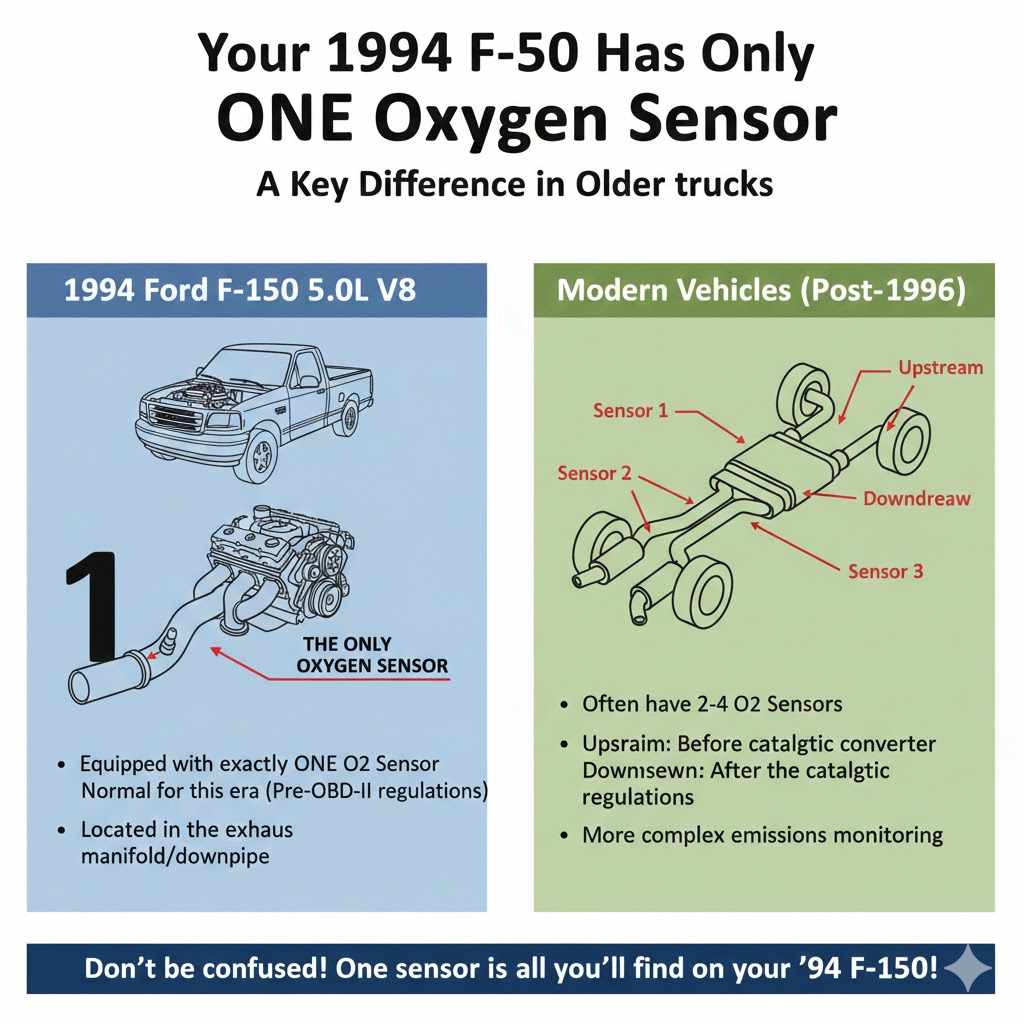
A 1994 Ford F-150 with a 5.0L V8 engine has only one oxygen sensor. This is because it uses the older On-Board Diagnostics I (OBD-I) system. Models from 1996 and newer switched to the OBD-II system, which requires two or more sensors to monitor both engine performance and catalytic converter efficiency.
If you own a classic 1994 Ford F-150, you know it’s a reliable workhorse. But sometimes, a simple question can cause a lot of confusion. Many truck owners wonder about the number of oxygen sensors, especially when a check engine light pops on. It can feel frustrating trying to find a clear answer online.
You’re in the right place. I’m Monowar Shohag, and I’m here to make your truck’s exhaust system easy to understand. We’ll clear up the confusion about your F-150’s oxygen sensors. This guide will give you the simple facts, show you where to find the sensor, and even walk you through how to replace it. Let’s get you back on the road with confidence.
The Simple Answer: One Sensor Is All You’ll Find
Let’s get straight to the point. Your 1994 Ford F-150 with the 5.0-liter engine is equipped with exactly one oxygen sensor. You won’t find a second one, no matter how hard you look. This is completely normal for a truck of this era.
Many people get confused because modern vehicles have multiple oxygen sensors, sometimes as many as four. But the technology in your 1994 F-150 was different. Understanding this difference is key to properly diagnosing and repairing any issues you might have. So, if you’re planning a replacement or just trying to learn more about your truck, rest assured that you only need to worry about a single sensor.
Why Just One? Understanding OBD-I vs. OBD-II
The reason your truck only has one oxygen sensor comes down to two acronyms: OBD-I and OBD-II. These stand for On-Board Diagnostics, which is the system your truck’s computer uses to monitor its own performance and health.
Your 1994 F-150 uses the OBD-I system. This was the first generation of on-board diagnostics. It was designed to monitor the basic functions of the engine and emissions system. The single oxygen sensor in an OBD-I system is placed “upstream,” meaning it’s located in the exhaust pipe before the catalytic converter.
What Does the Single OBD-I Sensor Do?
This lone sensor has a very important job. It constantly measures the amount of unburned oxygen in the exhaust gas coming from the engine. It then sends this information to the engine control unit (ECU), which is your truck’s brain. The ECU uses this data to adjust the air-fuel mixture. If there’s too much oxygen, the ECU adds more fuel. If there’s too little, it reduces the fuel. This constant adjustment helps your engine run efficiently, produce less pollution, and achieve optimal fuel economy.
The Shift to OBD-II
In 1996, the U.S. government mandated that all new cars and light trucks sold must be equipped with the next generation system, OBD-II. This was a major upgrade. According to the Environmental Protection Agency (EPA), OBD-II was designed to provide more comprehensive monitoring of the emissions system.
A key part of this new mandate was monitoring the health of the catalytic converter itself. To do this, manufacturers had to add a second oxygen sensor “downstream,” or after the catalytic converter. By comparing the readings from the upstream sensor to the downstream sensor, the ECU can determine if the catalytic converter is working correctly. If the readings are too similar, it means the converter isn’t cleaning the exhaust, and it will trigger a check engine light.
This distinction is the entire reason your 1994 F-150 has one sensor, while a 1996 F-150 has at least two. Your truck’s computer is only responsible for monitoring the engine’s air-fuel ratio, not the converter’s efficiency.
| Feature | OBD-I System (Your 1994 F-150) | OBD-II System (1996 and Newer) |
|---|---|---|
| Number of O2 Sensors | Usually one (upstream only) | At least two (upstream and downstream) |
| Primary Purpose | Monitors air-fuel ratio for engine efficiency | Monitors air-fuel ratio AND catalytic converter efficiency |
| Diagnostic Port | Vehicle-specific port, often under the hood | Standardized 16-pin port, usually under the dashboard |
| Emission Monitoring | Basic monitoring of key components | Comprehensive, real-time monitoring of the entire system |
Where to Find the Oxygen Sensor on Your 1994 F-150
Now that you know you’re looking for just one sensor, finding it is much easier. You don’t need to be a master mechanic to locate it. You’ll just need to safely get a look underneath your truck.
The single oxygen sensor on your 1994 F-150 with a 5.0L engine is located in the exhaust system’s “Y-pipe.” This is the section of the exhaust where the pipes coming from the left and right sides of the engine (the exhaust manifolds) join together into a single pipe.
Follow these simple steps to find it:
- Look under the passenger side: The sensor is typically on the passenger side of the truck.
- Follow the exhaust pipe: Start at the engine and trace the exhaust pipe as it goes toward the back of the truck.
- Find the merge point: You will see two pipes coming down from the engine that merge into one. The oxygen sensor is screwed into this junction, right before the catalytic converter.
- What it looks like: You are looking for a small, spark-plug-like device with a wire coming out of the top. This wire leads to an electrical connector attached to the truck’s wiring harness.
Finding it is the first step. Once you know where it is, you’ll feel much more confident about diagnosing problems or even replacing it yourself.
Is Your Oxygen Sensor Going Bad? Telltale Signs
An oxygen sensor doesn’t last forever. Over time, it can become coated with carbon, oil, or other contaminants, which makes it slow and inaccurate. When this happens, it sends bad information to your truck’s computer, leading to a host of problems. If you notice any of the following symptoms, a failing oxygen sensor could be the culprit.
Common Symptoms of a Failing O2 Sensor:
- Poor Fuel Economy: This is the most common sign. If your truck is sending incorrect data, the computer might enrich the fuel mixture, meaning you’ll be burning more gas than necessary. If you’re suddenly making more trips to the pump, your O2 sensor is a prime suspect.
- Rough Idling or Stalling: An incorrect air-fuel mixture can cause your engine to run poorly at idle. It might feel shaky, sputter, or even stall out completely when you come to a stop.
- Check Engine Light: Your truck’s OBD-I system can still detect a problem with the oxygen sensor circuit. If the sensor fails or its signal is out of range, it will trigger the Check Engine Light on your dashboard.
- Failed Emissions Test: The primary job of the emissions system is to keep pollution low. A bad O2 sensor leads to an inefficient burn, which dramatically increases harmful emissions. This is often an automatic failure at an inspection station.
- Sluggish Performance: Does your truck feel weak or slow to respond when you press the gas pedal? An engine that isn’t getting the right air-fuel mixture won’t produce its full power, leading to poor acceleration and a general lack of performance.
| Symptom | What’s Likely Happening Inside Your Engine |
|---|---|
| Worse Gas Mileage | The bad sensor is telling the computer the engine is running lean (too much air), so the computer adds extra fuel you don’t need. |
| Rough Idle | The air-fuel mixture is fluctuating wildly, causing the engine’s RPMs to become unstable when you’re not moving. |
| Check Engine Light | The truck’s computer has detected a signal from the sensor that is out of the expected range, indicating a fault. |
| Sluggish Acceleration | The engine is not getting the precise fuel mixture it needs to produce power efficiently, making the truck feel slow and heavy. |
Step-by-Step Guide: Replacing the O2 Sensor on Your 1994 F-150 5.0L
Replacing the oxygen sensor on your truck is a very achievable DIY project. It can save you a good amount of money and give you the satisfaction of fixing your own vehicle. With the right tools and a little patience, you can get this done in about an hour.
Safety First!
Before you start, always prioritize safety. Working on a vehicle can be dangerous if you don’t take proper precautions.
- Let it Cool: The exhaust system gets extremely hot. Park your truck and let it cool down completely for at least a few hours before you begin.
- Work on a Level Surface: Always work on flat, solid ground.
- Use Jack Stands: If you need to lift the truck for better access, use a proper jack and always secure the vehicle with jack stands. Never work under a vehicle supported only by a jack.
- Disconnect the Battery: Before working on any electrical components, disconnect the negative terminal of your battery to prevent any accidental shorts.
- Wear Protection: Always wear safety glasses and gloves. Rust and dirt can fall from under the truck, and penetrating oil can irritate your skin.
Gathering Your Tools
Having the right tools makes the job go smoothly. You don’t need a professional-grade workshop, just a few key items.
- A New Oxygen Sensor: Make sure you buy the correct sensor for a 1994 Ford F-150 with a 5.0L engine.
- Oxygen Sensor Socket: This is a special socket with a slot cut down the side to accommodate the sensor’s wire. You can often rent one from an auto parts store for free.
- Ratchet and Extension: A standard 3/8-inch drive ratchet will work perfectly. An extension can help you reach the sensor more easily.
- Penetrating Oil: Oxygen sensors can get seized in the exhaust pipe due to heat and rust. A good penetrating oil (like PB Blaster or WD-40 Specialist Penetrant) is essential.
- Anti-Seize Compound: Most new sensors come with anti-seize already applied to the threads, but it’s good to have some on hand just in case. This prevents the new sensor from getting stuck in the future. Check out a trusted brand like Permatex for this.
- Wire Brush: To clean the threads in the exhaust pipe before installing the new sensor.
The Replacement Process (Step-by-Step)
Follow these steps carefully, and you’ll have that new sensor installed in no time.
- Park and Cool Down: Park the truck on a level surface, engage the parking brake, and wait for the exhaust to become completely cool to the touch.
- Disconnect the Battery: Use a wrench to loosen the nut on the negative battery terminal and remove the cable from the post.
- Locate the Old Sensor: Slide under the truck on the passenger side and find the sensor in the Y-pipe, just as we described earlier.
- Apply Penetrating Oil: Generously spray penetrating oil on the base of the oxygen sensor where its threads go into the exhaust pipe. Let it soak for at least 15-20 minutes. If it’s really rusty, you may need to apply it again and wait longer.
- Unplug the Electrical Connector: Follow the wire from the top of the sensor to the electrical plug. Carefully unplug it. There might be a small plastic tab you need to press to release the clip. Don’t pull on the wires themselves.
- Remove the Old Sensor: Place the oxygen sensor socket over the sensor, making sure the wire fits through the slot. Attach your ratchet and extension. Turn the ratchet counter-clockwise to loosen the sensor. It may take some force to break it free.
- Clean the Threads: Once the old sensor is out, use a wire brush to clean the threads in the exhaust pipe. This ensures the new sensor will screw in easily and seal properly.
- Prepare the New Sensor: Check if your new sensor has anti-seize compound on the threads. It usually looks like a silver or copper paste. If not, apply a small amount to the threads, being careful not to get any on the sensor tip.
- Install the New Sensor: Carefully thread the new sensor into the exhaust pipe by hand. This prevents cross-threading. Once it’s hand-tight, use your socket and ratchet to tighten it until it’s snug. Don’t over-tighten it; check the new sensor’s packaging for specific torque specs if available.
- Reconnect the Electrical Plug: Plug the new sensor’s connector into the truck’s wiring harness. You should hear a “click” when it’s securely connected.
- Reconnect the Battery: Reattach the negative battery cable and tighten the nut.
- Start the Truck: Start the engine. The Check Engine Light might still be on initially. It can take a few driving cycles for the computer to recognize the new, functioning sensor and turn the light off. You can also have the codes cleared with a scanner.
The Payoff: Why a New Oxygen Sensor Matters
Going through the effort of replacing a bad oxygen sensor is well worth it. It’s not just about turning off an annoying light on your dashboard. A new, functioning sensor brings several tangible benefits that you’ll notice right away.
- Restored Fuel Economy: Your engine’s computer will once again receive accurate data, allowing it to create the perfect air-fuel mixture. This means you’ll stop wasting gas and start saving money at the pump.
- Smoother Engine Performance: With a balanced air-fuel ratio, your engine will idle more smoothly and accelerate without hesitation. Your truck will feel more responsive and powerful, just like it’s supposed to.
- Lower Emissions: A healthy O2 sensor is crucial for a clean-running engine. By ensuring a complete burn of fuel, you’ll significantly reduce harmful pollutants, helping protect the environment and making it much easier to pass emissions tests.
- Protects Your Catalytic Converter: Running with a bad O2 sensor can cause an overly rich fuel mixture, which sends unburned fuel into the exhaust. This can overheat and damage your expensive catalytic converter over time. Replacing the sensor is cheap insurance against a much costlier repair.

Frequently Asked Questions (FAQ)
How often should I replace my oxygen sensor?
There’s no strict replacement schedule, but older-style sensors like the one in your 1994 F-150 typically have a lifespan of 50,000 to 80,000 miles. It’s best to replace it whenever you notice symptoms of failure rather than as preventative maintenance.
Can I clean an old O2 sensor instead of replacing it?
While some people attempt to clean oxygen sensors, it’s generally not recommended. The delicate internal components can be easily damaged, and cleaning often provides only a temporary fix, if any. Given their importance and relatively low cost, replacement is the most reliable solution.
What is the difference between an upstream and downstream O2 sensor?
An upstream sensor (like the one in your truck) is located before the catalytic converter and measures the raw exhaust from the engine to control the air-fuel mixture. A downstream sensor (on 1996+ vehicles) is located after the catalytic converter and its main job is to monitor the converter’s efficiency.
Will a bad O2 sensor cause permanent damage?
If left ignored for a long time, a bad oxygen sensor can lead to more serious issues. The most significant risk is damage to the catalytic converter from an overly rich fuel mixture, which can be a very expensive repair. It can also cause carbon buildup on spark plugs and internal engine components.
Do I really need a special O2 sensor socket?
Yes, it’s highly recommended. While you might be able to fit a regular deep-well socket over some sensors after cutting the wire, the specialized socket is designed to work around the wire, allowing you to remove the old sensor and install the new one without causing damage. They are inexpensive and often available through tool loaner programs at auto parts stores.
Is it hard to replace an O2 sensor myself?
For most beginners, this is a very manageable job. The biggest challenge is usually just breaking the old, rusty sensor free from the exhaust pipe. With patience and a good dose of penetrating oil, it’s a straightforward task that doesn’t require complex mechanical skills.
Your Truck, Your Confidence
So, there you have it. The simple, clear answer is that your 1994 Ford F-150 5.0L has just one oxygen sensor, a product of its time and its reliable OBD-I system. Understanding this small fact removes a huge piece of the puzzle when you’re troubleshooting or planning repairs.
More importantly, you now know that tackling this job is well within your reach. You can identify the symptoms of a failing sensor, locate it under your truck, and follow a clear set of steps to replace it. Taking control of your vehicle’s maintenance isn’t just about saving money; it’s about building confidence and deepening the connection you have with your classic F-150. With this knowledge, you’re better equipped to keep your truck running strong, clean, and efficiently for many more years to come.