Can a Bad Oxygen Sensor Damage the Catalytic Converter?
A bad oxygen sensor usually does not hurt a catalytic converter right away, but if it contributes to rich running, misfires, or fuel wash over time, the converter can overheat and fail. That can turn a sensor job into a catalytic converter bill, a failed emissions test, and worse fuel economy. This guide maps the failure path, the warning signs, and the point where you need to fix the sensor before the converter takes damage.
What an oxygen sensor tells the PCM
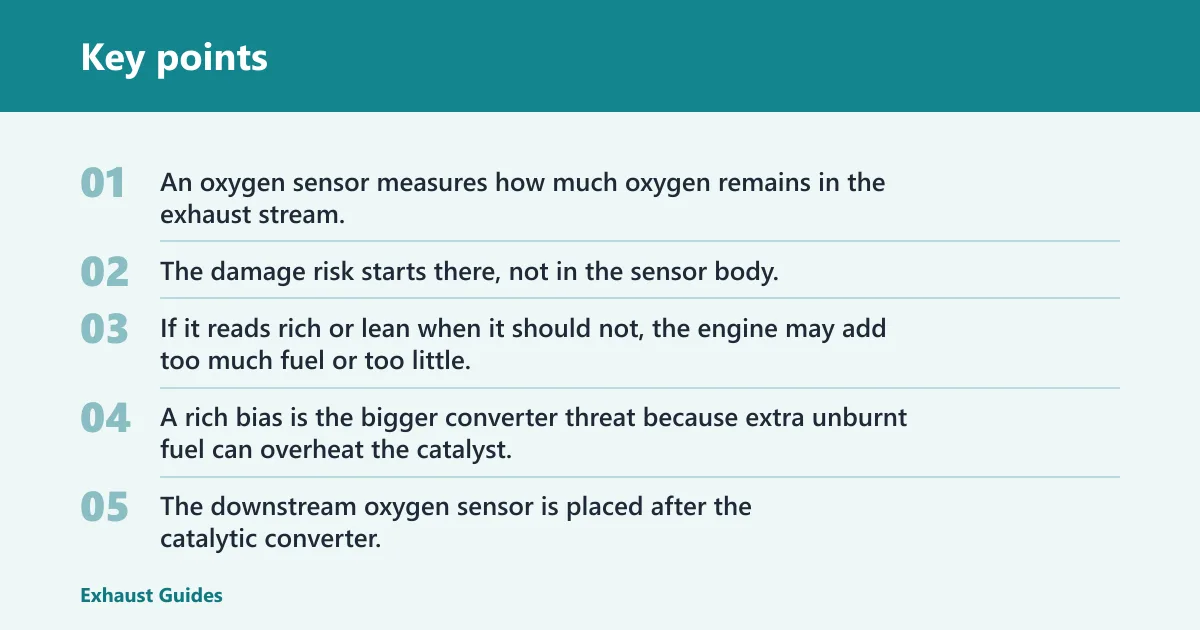


An oxygen sensor measures how much oxygen remains in the exhaust stream. The Powertrain Control Module (PCM) uses O2 sensor input to set the air-fuel mixture, so a bad signal can push fueling off target. The damage risk starts there, not in the sensor body.
Upstream oxygen sensor
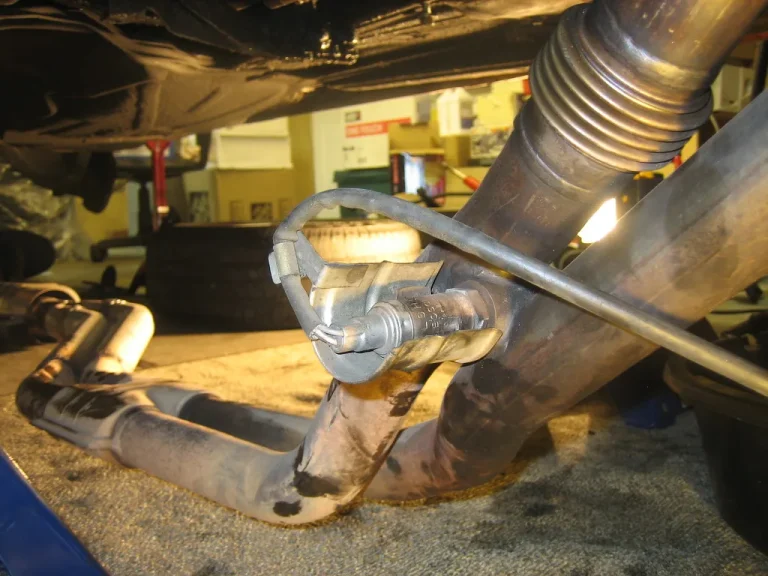
The upstream oxygen sensor is located before the catalytic converter and is commonly the one the PCM uses for fuel trim. If it reads rich or lean when it should not, the engine may add too much fuel or too little. A rich bias is the bigger converter threat because extra unburnt fuel can overheat the catalyst.
Downstream oxygen sensor
The downstream oxygen sensor is placed after the catalytic converter. Its main job is to watch catalyst efficiency for emissions diagnostics, not to control fuel trim directly. A downstream code often points to catalyst monitoring or wiring issues, and it does not carry the same immediate converter-damage risk as an upstream fueling fault. (Firestonecompleteautocare)
How fuel trim changes when the signal is wrong
O2 sensor output is a low-level voltage between 0.1 and 0.9 volts. A reading above 0.45 volts means the fuel is burning rich, and a reading below 0.45 volts means the fuel is burning lean. If the PCM trusts a bad signal, it can correct in the wrong direction and create rough idle, hesitation, or stalling.
Say your upstream sensor starts reading rich while the engine is actually normal. The PCM may pull fuel and make the engine run lean, which can hurt drivability without damaging the converter at once. If the same sensor reads lean while the engine is already rich, the PCM may add even more fuel, and that is the path that can overheat the catalyst.
📊 Oxygen sensors typically last between 30,000 and 100,000 miles. Source: Firestonecompleteautocare.
Can a bad oxygen sensor damage the catalytic converter?
Yes, a faulty oxygen sensor can damage the catalytic converter, but usually only after the engine runs rich long enough for extra fuel to reach the exhaust. The sensor is the trigger, not the part that cooks the converter. The converter is most at risk when misfires, fuel wash, or late diagnosis let unburnt fuel build up.
The short answer
A bad O2 sensor can damage the catalytic converter if it leads to prolonged rich running. It is less likely to kill the converter quickly through a lean bias alone. Lean operation often causes drivability complaints, poor performance, and emissions issues first, while rich operation can overheat the converter and shorten its life.
When damage becomes likely
Damage becomes more likely when the check engine light is ignored and the engine keeps running rich, misfiring, or stalling. Extra fuel can burn inside the catalytic converter and raise its temperature. If that condition lasts long enough, the converter can melt or lose efficiency.
Why prolonged rich running is the main risk
A rich mixture means there is not enough oxygen in the engine mixture. That can cause black smoke, a rotten egg smell, and fuel smell at the tailpipe. Extra unburnt fuel can overheat the catalytic converter, and a bad oxygen sensor can be the reason the PCM keeps feeding the engine too much fuel.
Bad oxygen sensor damage decision matrix
Use this as a quick triage tool, not a final diagnosis. The same code can have a different cause on a different vehicle, so match the symptom pattern before you replace anything.
| Symptom | Likely sensor type | Short-term risk | Converter risk | Immediate action |
|---|---|---|---|---|
| Rich running | Upstream O2 sensor or related fueling fault | Fuel smell, black smoke, poor mileage | High if it continues | Stop extended driving and diagnose at once |
| Lean running | Upstream O2 sensor, vacuum leak, or exhaust leak | Hesitation, rough idle, loss of power | Lower right away, but still needs prompt diagnosis | Limit driving and inspect for leaks or misreads |
| Misfire | Often ignition, fuel, or upstream sensor related | Rough engine operation, flashing CEL possible | High because raw fuel can enter the converter | Stop hard driving and check immediately |
| Exhaust leak | Can affect upstream or downstream readings | False lean signal, noisy exhaust, driveability complaints | Moderate if it masks a rich condition | Inspect and repair before replacing sensors |
| Upstream sensor heater fault | Upstream O2 sensor | Slow closed-loop operation, poor fuel control on cold start | Moderate if fueling stays off target | Diagnose wiring and heater circuit soon |
| Downstream sensor code | Downstream O2 sensor | Emissions-monitoring fault, usually mild drivability impact | Low by itself | Confirm catalyst condition before replacement |
| Intermittent CEL | Either sensor, wiring, or catalyst efficiency issue | Intermittent poor mileage or none at all | Depends on whether fueling is rich or misfiring | Scan codes and look for symptom pattern |
How to tell a sensor fault from converter trouble
Start with the symptom pattern, not the parts catalog. An OBD-II trouble code can point to a sensor, a wiring issue, an exhaust leak, a misfire, or catalyst inefficiency. Replace parts only after the code, fuel-trim behavior, and exhaust symptoms line up.
Misfire and rich-running clues
Rough idle, poor acceleration, misfires, stalling, black smoke, and a rotten egg smell all raise concern for extra fuel entering the exhaust. Those signs make converter damage more plausible than a code alone. A bad oxygen sensor can be part of that chain, but it is rarely the whole story.
Exhaust leak clues
An exhaust leak before the upstream sensor can pull in extra oxygen and make the PCM think the engine is running lean. That can lead to unwanted fuel corrections and confusing codes. A leak can also make a good sensor look bad, which is why diagnosis has to separate airflow problems from sensor failure.
Catalyst-efficiency code clues
A downstream O2 sensor code often points to the converter monitor, not the fueling command. A bad catalytic converter can trigger oxygen sensor suspicion or related codes because the downstream waveform no longer looks different enough from the upstream signal. That does not prove the downstream sensor is bad.
- Read the codes first. Pull the OBD-II trouble codes and note whether they point to the upstream sensor, downstream sensor, misfire, or catalyst efficiency. Do not replace a sensor on the code alone, because the code is a clue, not a verdict.
- Match the symptom pattern. Check for rich or lean behavior, fuel smell, black smoke, rough idle, hesitation, or stalling. Those details tell you whether the engine is likely hurting the converter or simply reporting a sensor issue.
- Separate sensor from cause. Look for exhaust leaks, ignition misfires, or fuel-control faults that could create the same code. If the engine is misfiring or running rich, the converter risk is higher than it is with a lone downstream code.
- Decide on driving exposure. If the car only has a mild drivability complaint and no rich smell, a short drive to a shop may be reasonable. If it is misfiring, belching smoke, or stalling, stop driving and diagnose immediately.
Can you keep driving with a bad oxygen sensor?
Sometimes, for a short trip to a repair shop, yes. A bad oxygen sensor is more dangerous when it causes rich running, misfires, or major drivability problems. If the engine still runs normally and the fault is limited to emissions monitoring, short driving is usually lower risk than repeated long trips.
Short trip versus stop-driving situations
A short drive is more acceptable when the CEL is steady, the engine runs smoothly, and there is no black smoke, fuel smell, or severe hesitation. Stop driving if the light flashes, the engine misfires heavily, or the exhaust smells strongly of raw fuel. Those are the conditions that can hurt the converter fast.
When gas mileage and drivability get worse
A bad oxygen sensor can hurt gas mileage even before it harms the converter. It can also cause rough idle, poor acceleration, misfires, and stalling. Oxygen sensors typically last between 30,000 and 100,000 miles, so a tired sensor can create symptoms long before the converter fails.
When the converter may be at risk
The converter is most at risk when fuel trim stays wrong for too long. A rich mixture can make the exhaust hot enough to cook the catalyst, and extra fuel can clog the converter with residue. That is the point where a sensor problem can become an expensive emissions-system failure.
Can a bad catalytic converter trigger O2 sensor codes?
A bad catalytic converter can lead to oxygen sensor suspicion because the downstream sensor may no longer see the exhaust pattern the PCM expects. In that case, the sensor may be reporting correctly while the converter is not cleaning the exhaust well enough. That is why downstream codes need confirmation, not assumption.
Why downstream sensor data can mislead diagnosis
The downstream sensor sits after the catalytic converter, so it monitors how well the converter is working. If the converter is inefficient, the downstream signal can look too active and set a code that resembles a sensor problem. Swapping the sensor first can miss the real fault.
How converter inefficiency can mimic a sensor fault
When the converter loses storage or conversion ability, the downstream oxygen pattern starts to resemble the upstream pattern more closely. That can make the PCM suspect the sensor or set a catalyst efficiency code. The fix depends on whether the root problem is the converter, the sensor, or the engine condition that damaged both.
Frequently asked questions
Can a faulty oxygen sensor damage the catalytic converter?
Yes, but usually only indirectly. The sensor can push the PCM into rich fueling or let misfires continue, and that is what overheats the converter. A bad sensor by itself does not instantly destroy the catalyst; the risk grows when bad fueling lasts long enough to send extra fuel into the exhaust.
Does a bad O2 sensor affect the catalytic converter?
Yes. An upstream sensor can change fuel trim, which affects how much unburnt fuel reaches the converter. A downstream sensor mainly affects catalyst monitoring, so its fault usually points to emissions diagnosis rather than direct overheating. The converter risk is much higher when the engine runs rich for a long time.
Will a bad oxygen sensor hurt gas mileage?
Yes. A bad oxygen sensor can lead to poor gas mileage because the PCM may correct fuel trim in the wrong direction or stay in a poor fallback strategy. Fuel economy often drops before the converter is damaged, so a mileage change can be an early warning sign, not a late one.
Can you drive with a bad oxygen sensor?
Sometimes, for a short distance to get diagnosed, but not if the engine is misfiring, stalling, or running rich. A steady light with mild symptoms is less urgent than a flashing light, black smoke, or strong fuel smell. Those signs mean the converter may already be under heat stress.
What damage can a bad oxygen sensor cause?
A bad oxygen sensor can cause poor fuel economy, rough idle, hesitation, misfires, stalling, and failed emissions monitoring. If the fault drives prolonged rich running, it can also overheat the catalytic converter. The damage is usually indirect, but it can become expensive if the warning signs are ignored.
Can a bad catalytic converter cause an O2 sensor to fail?
Yes. A failing catalytic converter can make the downstream sensor look suspicious or set related codes because the exhaust composition after the converter no longer changes the way the PCM expects. That is why a downstream code does not automatically mean the sensor is bad; the converter may be the real fault.
Does a faulty oxygen sensor damage the catalytic converter?
A faulty oxygen sensor can damage the catalytic converter if it causes rich fueling, misfires, or delayed repair. The converter is usually harmed by the engine condition the bad sensor allows, not by the sensor body itself. If the engine stays rich long enough, the converter can overheat.
Does a faulty oxygen sensor does not cause damage to the catalytic converter?
That statement is too absolute. A faulty oxygen sensor often does not damage the catalytic converter right away, but it can do so when it leads to prolonged rich running or repeated misfires. The safe rule is to treat the code as a warning and confirm the cause before more driving.