How to Check Exhaust Pipe Rust Damage Before It Fails
Check exhaust pipe rust by inspecting seams, tapping for soft spots, and looking for soot trails, hangers, and pinholes; treat any flaking, brittle, or perforated section as a fail. Ignoring it can mean a louder exhaust, fumes under the car, and a pipe that breaks sooner than expected. This guide shows where rust matters most, how soot points to leaks, and a simple pass/fail rule for deciding what needs repair.
What bad exhaust rust looks like
Surface rust is common on exhaust systems, especially on mild steel pipes after wet or winter driving. It is usually a brown or red film on the outside that has not eaten through the metal. Structural corrosion is different: the scale lifts, fresh metal shows through, or the pipe starts to thin, crack, or perforate.
Mild steel rusts fastest. Aluminized steel usually lasts longer because of its coating. Stainless steel resists rust better, but welds, clamps, and joints can still corrode first.
Surface rust versus structural corrosion
Rust becomes dangerous when it changes the shape or strength of the pipe. Flaking layers, pinholes, visible perforation, cracks, or wall loss mean the metal is no longer just discolored. If the pipe flexes more than the surrounding section or crumbles when brushed, it is beyond cosmetic corrosion.
Why seams, bends, and welds fail first
Seams, bends, welds, clamps, hangers, and low points trap heat, moisture, and road salt. Short-trip driving makes this worse because condensate stays inside the system longer. Rear sections fail early too, especially mufflers and resonators, where water can sit and where end caps and hanger points rust from the inside out.
What you’ll need
- Flashlight for underside inspection, ideally with daylight plus garage lighting
- Jack stands rated for the vehicle, used on level ground at factory jack points
- Wheel chocks
- Gloves and eye protection, preferably cut-resistant gloves for flaky rust
- Rubber mallet or a gloved hand for a gentle tap test
- OBD-II scan tool to check related codes from leak effects
How should you inspect the exhaust?
Inspect the exhaust from front to back with the system cold, supported safely, and lit from below. The goal is not to find every stain. It is to separate normal surface oxidation from thin, leaking, or breaking metal.
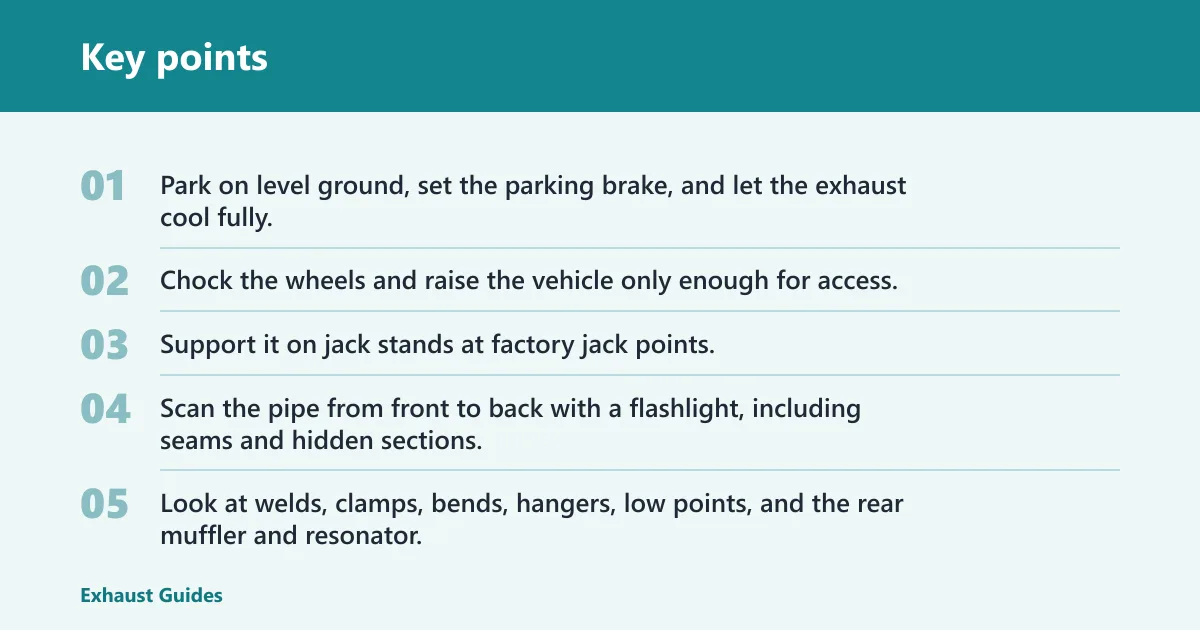
- Park on level ground, set the parking brake, and let the exhaust cool fully.
- Chock the wheels and raise the vehicle only enough for access.
- Support it on jack stands at factory jack points; never work under a car held up only by a jack.
- Scan the pipe from front to back with a flashlight, including seams and hidden sections.
- Look at welds, clamps, bends, hangers, low points, and the rear muffler and resonator.
- Check for soot streaks, black staining, pinholes, flaking scale, and fresh metal under blistered rust.
- Tap suspect spots gently with a rubber mallet or gloved hand; a dull, brittle change may indicate weak metal.
- Start the engine cold and listen for a tick or hiss, then recheck the joints and rear section for soot.
Say your sedan has orange rust on the outer tube but no flakes, no soot, and no smell in the cabin. That is usually a monitor item. Suppose your sedan has flaky orange rust near the muffler joint, a damp-looking patch under the pipe, and a dull tapping sound over bumps. That moves it into repair planning fast.
How do you check for exhaust leaks without a lift?
You can do a useful check without a lift if you can safely reach the underside. Use a flashlight from both sides of the car, then listen at cold start while watching the suspected joint. Soot near a seam, clamp, or hole is a stronger clue than rust color alone.
Pay close attention to the floor area under the cabin and the rear seats. Exhaust smell inside the car matters more than isolated rust on an exposed outer surface. If the leak is near the cabin floor, rear floor pan, or trunk area, treat it as higher risk.
Exhaust rust checklist
| Inspection location | What to look for | Action threshold |
|---|---|---|
| Outer pipe surface | Light red or brown rust without flakes, no soot, metal still firm | Monitor |
| Seam or weld | Rust at the line, blistering, thin edge, or fresh metal under lifted scale | Plan replacement |
| Bend or low point | Scaling, pitting, or a section that flexes or sounds dull on a tap test | Plan replacement |
| Clamp or hanger | Rust around the bracket, sagging pipe, missing support, or cracked attachment | Stop driving if the pipe is loose or dragging |
| Pinhole or visible perforation | Light through the metal, soot streaks, ticking or hissing on cold start | Stop driving |
| Muffler or resonator end cap | Rust at the cap seam, wet soot, flaking metal, or a weak hanger point | Plan replacement or stop driving if leaking into the cabin |
| Cabin smell or rear-seat smell | Exhaust odor inside the vehicle, especially with windows up or at idle | Stop driving |
Monitor versus plan replacement versus stop driving
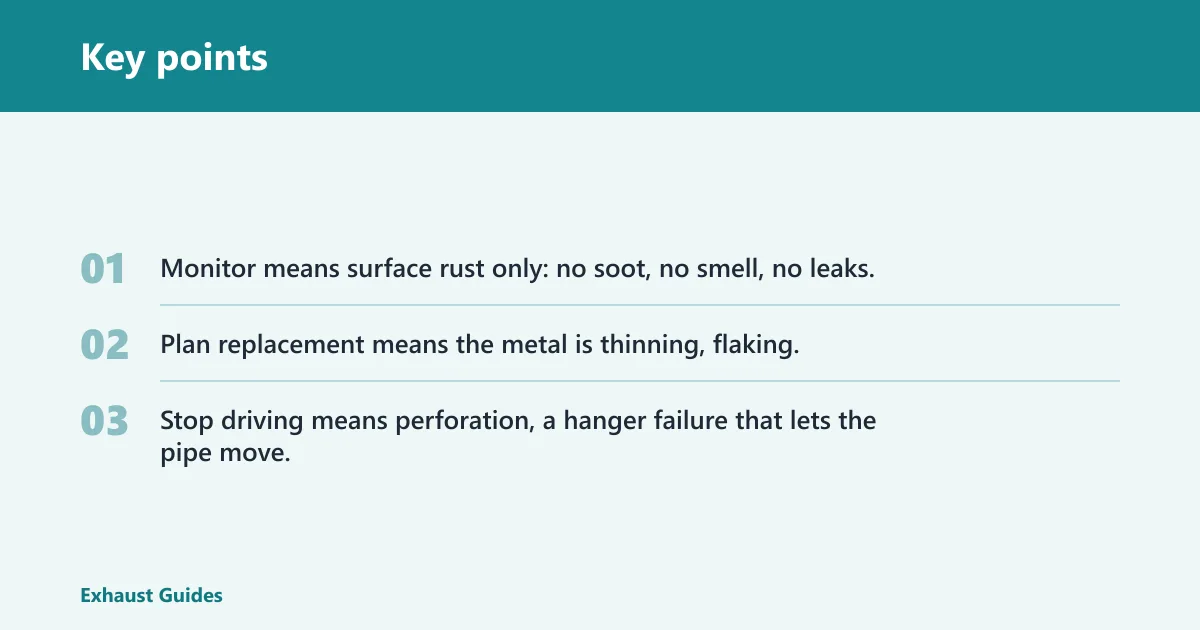
Monitor means surface rust only: no soot, no smell, no leaks, and no weak metal when tapped. Plan replacement means the metal is thinning, flaking, or starting to open at a seam or weld, even if it is not noisy yet. Stop driving means perforation, a hanger failure that lets the pipe move, or any exhaust smell in the cabin.
Can you drive with rust on your exhaust?
Yes, sometimes. Surface rust alone is usually not an immediate safety problem. You should not ignore it, though, because rust on seams, bends, welds, clamps, and hangers can become through-wall damage quickly, especially in salt-belt or winter-use vehicles.
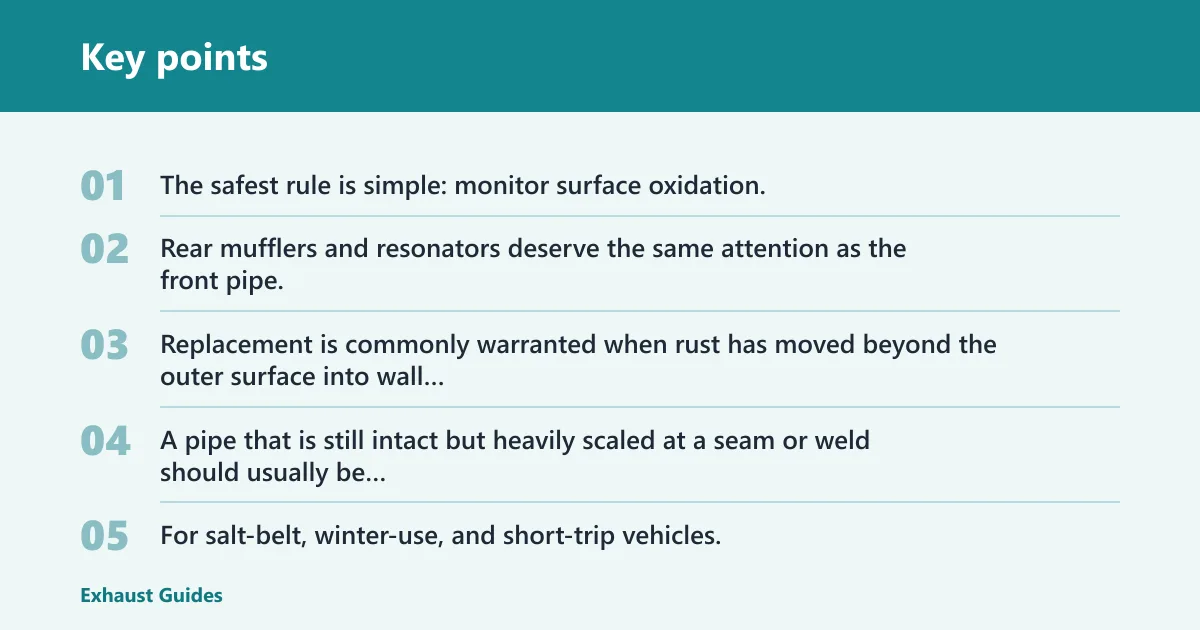
The safest rule is simple: monitor surface oxidation, plan replacement for flaking or pinholes, and stop driving if the exhaust is loose, leaking into the cabin, or hanging by a weak bracket. Rear mufflers and resonators deserve the same attention as the front pipe.
When does rust on an exhaust pipe mean replacement?
Replacement is commonly warranted when rust has moved beyond the outer surface into wall loss, pinholes, cracks, visible perforation, or brittle sections that crumble. A pipe that is still intact but heavily scaled at a seam or weld should usually be scheduled for replacement before it opens up.
For salt-belt, winter-use, and short-trip vehicles, internal corrosion can advance even when the outside looks only moderately rusty. Condensate and road salt speed that process. If a rear section is rusty and the muffler or resonator is also scaling, nearby pipe damage is often close behind.
Can an OBD-II scan tool help?
An OBD-II scan tool does not detect rust. It can help confirm related effects, such as misfire codes or oxygen sensor codes that appear after an exhaust leak starts. Use it as supporting evidence, not as proof of pipe damage.
Common mistakes
One mistake is calling every brown exhaust pipe “bad.” Surface oxidation is common and often harmless by itself. The real warning signs are soot, thin metal, flaking scale, pinholes, cracks, and a weak tap response.
Another mistake is ignoring the rear section because it looks less important. Mufflers and resonators often fail first from condensate and road salt. Another is skipping the soot check around joints, which can miss a leak that has already opened.
Never inspect under a vehicle supported only by a jack. Use jack stands on level ground. Also wear gloves and eye protection when brushing or tapping rusty parts, because flakes are sharp and exhaust parts can still be hot long after shutdown.
A common first-timer mistake is seeing orange rust on a 2-inch pipe and assuming it is fine because there is no hole yet. If a gentle tap turns up a brittle patch near a weld, or if a black soot line sits beside that rust, the pipe is already moving toward failure.
Frequently asked questions
How can I tell if exhaust pipe rust is dangerous or just surface rust?
Surface rust stays on the outside and leaves the metal firm. Dangerous rust shows scale that flakes off, pinholes, cracks, or soft spots that change under a gentle tap. If soot, ticking, or cabin smell joins the rust, treat it as a leak, not cosmetic oxidation.
What does bad exhaust rust look like before the pipe fails?
Bad rust often starts as blistering paint-like scale, then exposes fresh metal as the layer lifts. You may also see brown or black staining around a seam, clamp, or weld. Before failure, the pipe can look thin, uneven, or rough enough to crumble when brushed.
Where should I inspect an exhaust pipe for rust holes?
Start at seams, welds, clamps, hangers, bends, and low points. Check the rear muffler and resonator too, especially the end caps and hanger points. Rust holes show up where moisture sits or where road salt collects, not only in the most visible straight sections.
Can I safely drive with rust on my exhaust pipe?
Yes, if it is only surface rust and there is no leak, smell, soot, or weak metal. Do not keep driving if the pipe is perforated, the hanger has failed, or exhaust odor enters the cabin. Those signs call for immediate repair before the pipe worsens.
What tools do I need to inspect exhaust rust at home?
You need a flashlight, jack stands, wheel chocks, gloves, eye protection, and a rubber mallet or gloved hand for a gentle tap test. An OBD-II scan tool can help if you also want to check for misfire or oxygen sensor codes tied to a leak.