
Exhaust System Part Names for Beginners
Common exhaust system parts, in order from engine to tailpipe, are often described as exhaust manifold or header, gasket, oxygen sensor, catalytic converter, flex pipe, resonator, muffler, tailpipe, hangers, and sometimes a diesel DPF or SCR unit. Misidentifying one can send you to the wrong shelf, keep you chasing leaks, or damage emissions hardware. This guide shows each part’s location, shape, and job so you can tell similar pieces apart under the car.
What an exhaust system does
An exhaust system moves combustion gases away from the engine and through emissions and noise-control parts before the tailpipe. On many vehicles, the flow starts at the engine, passes through hot front-end parts, then moves through pipes and sound-control pieces before exiting at the rear.
The basic flow from engine to tailpipe
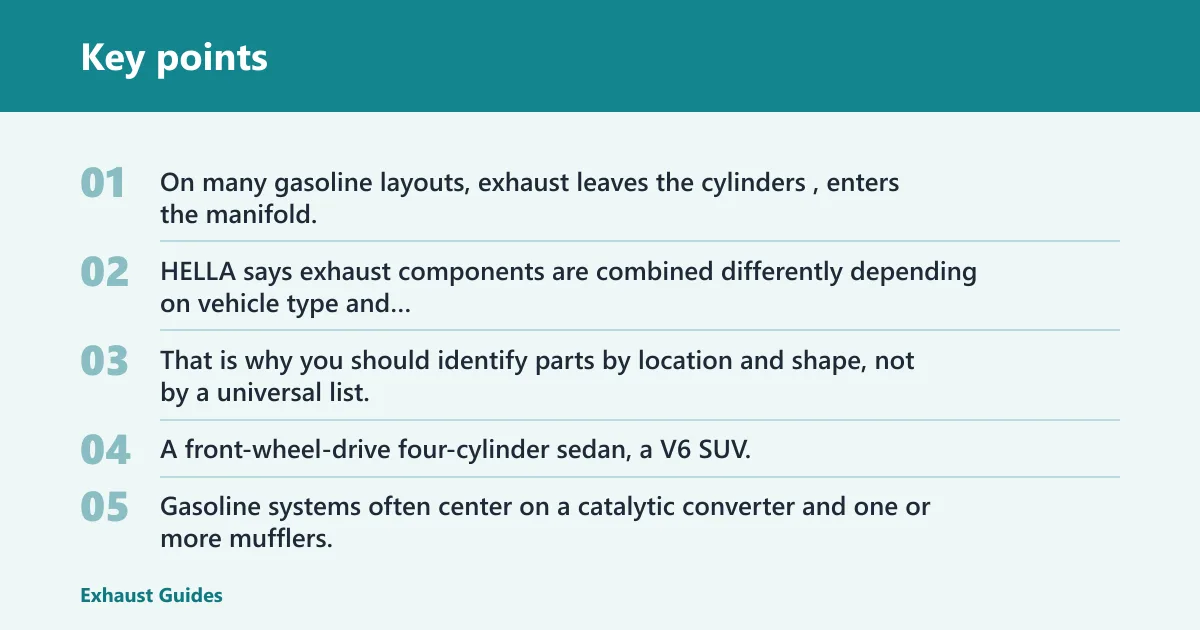
On many gasoline layouts, exhaust leaves the cylinders, enters the manifold, then moves through a catalytic converter, connecting pipes, one or more mufflers, and the tailpipe. HELLA says exhaust components are combined differently depending on vehicle type and engine concept, so the exact order can change.
That is why you should identify parts by location and shape, not by a universal list. A front-wheel-drive four-cylinder sedan, a V6 SUV, and a diesel pickup may all use different routing, different canister sizes, and different support points.
Why layout varies by engine and fuel type
Gasoline systems often center on a catalytic converter and one or more mufflers. Diesel systems may add a particulate filter, and in some layouts that filter changes or replaces front-end pieces you would expect to see on a gasoline car. The same source notes that design is adapted to the relevant vehicle.
That means the same part name can appear in a different place, or a different part can handle the same job. Do not assume every car has the same number of mufflers, pipes, or emission units.
What are the parts of an exhaust system?
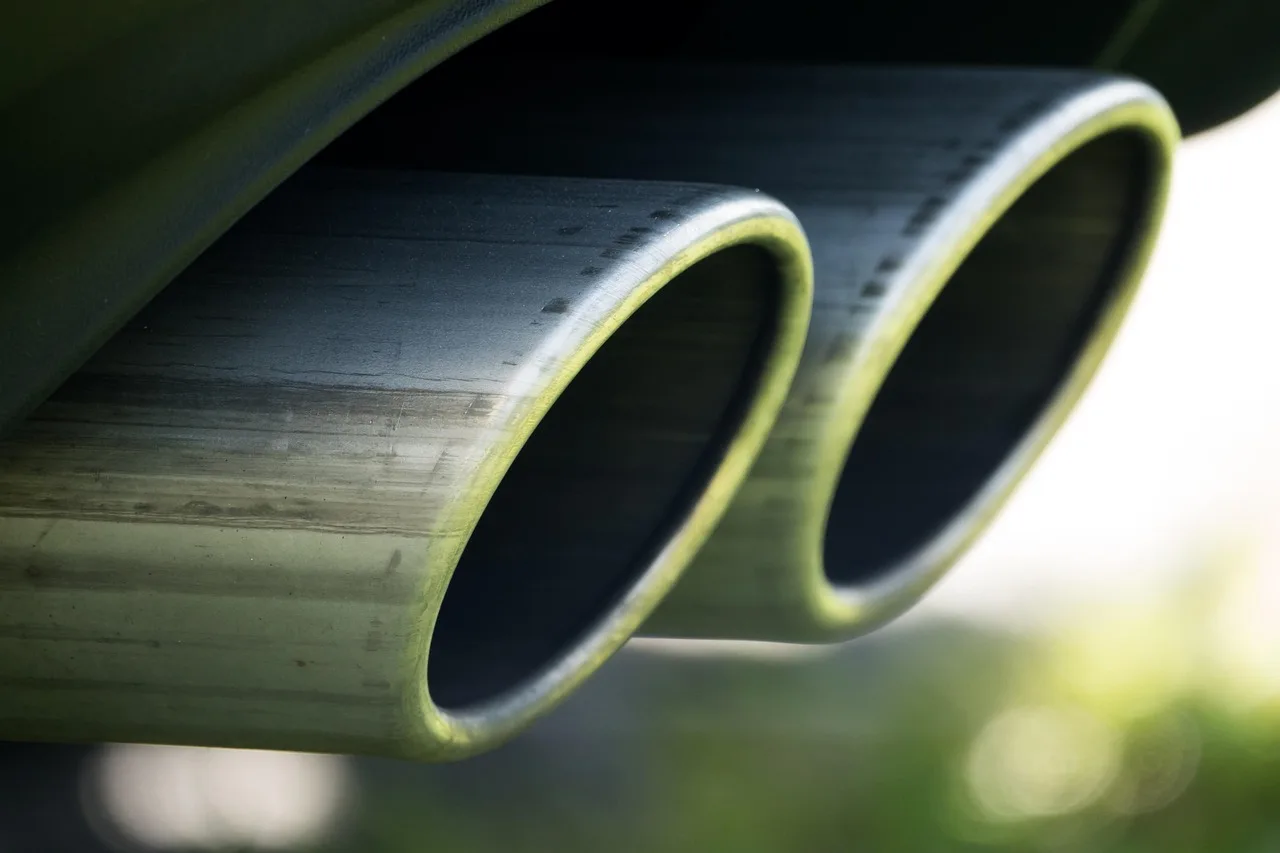
The main exhaust parts are commonly described as the manifold, catalytic converter or diesel particulate filter, pipes, mufflers, tailpipe, and the hardware that joins and supports them. Some vehicles also use a Y pipe, pre-muffler, middle muffler, or extra flex section, depending on engine layout and noise targets.
Exhaust manifold
The exhaust manifold is typically bolted to the engine and collects exhaust from the cylinders. It is often the first visible exhaust component. On many vehicles it is cast iron; on performance setups it may be tubular.
Catalytic converter and particulate filter
The catalytic converter is often located downstream of the manifold on many vehicles and helps with emissions control. HELLA names it as a modern exhaust component, and AP Emissions says its exhaust products cover everything from the catalytic converter to the exhaust tail pipe. On modern diesel systems, a particulate filter captures soot and particulates.
That diesel filter can change the front section of the system. In some layouts, it reduces the need for a pre-muffler or shifts where the first major canister sits under the car.
Pipes, mufflers, and tip
Connecting pipes link the system together. They may be straight, pre-bent, or flexible, and they must match vehicle fitment and routing. Mufflers cut exhaust sound, and HELLA lists pre-muffler, middle muffler, and rear muffler in the exhaust layout. The exhaust tip is the visible tail-end piece.
Hardware and supports
Exhaust clamps, flanges, gaskets, hangers, and rubber mounts are easy to mix up with flow parts, but they do different jobs. AP Emissions lists clamps, brackets, flanges, and gaskets among its accessories. The same source says exhaust systems use elastic suspensions or additional vibration dampers to reduce vibration transfer.
| Part name | Where it sits on the car | How it looks | What a beginner should not confuse it with |
|---|---|---|---|
| Exhaust manifold | Bolted to the engine at the front end of the exhaust path | Cast-iron lump or tubular header tubes close to the engine | Do not confuse it with the catalytic converter or a muffler |
| Y pipe | Near the front or midsection on multi-bank layouts | One inlet splitting into two, or two merging into one | Do not confuse it with a simple straight pipe |
| Catalytic converter | Downstream of the manifold on many gasoline vehicles | Metal canister, often oval or round, with heat shielding | Do not confuse it with a muffler or resonator |
| Particulate filter | In the front or underfloor section of modern diesel exhaust | Canister similar in size to an emissions box, often with sensors nearby | Do not confuse it with a catalytic converter on a gasoline car |
| Pre-muffler | Front or intermediate section, if the vehicle uses one | Small to medium canister before the main rear muffler | Do not confuse it with the rear muffler |
| Middle muffler | Mid-car, between the front emissions parts and the rear muffler | Canister in the center section of the exhaust path | Do not confuse it with a resonator or the rear muffler |
| Rear muffler | Near the back of the vehicle, before the tailpipe | Largest sound-control canister near the rear | Do not confuse it with the exhaust tip |
| Connecting pipe | Between exhaust components at any section of the route | Straight, bent, or flexible tube sections | Do not confuse it with a support hanger or clamp |
| Exhaust clamp | At a joint where two sections are joined without welding | Metal band or U-bolt style fastener around the pipe | Do not confuse it with a flange or gasket |
| Flange and gasket | At a serviceable joint between two exhaust sections | Flat mating faces with a thin sealing layer between them | Do not confuse them with a clamp or hanger |
| Hanger and rubber mount | At support points along the underbody and rear section | Rod, hook, bracket, or rubber isolator that carries weight | Do not confuse them with flow parts or sealing hardware |
| Exhaust tip | At the tail end of the exhaust | Visible outlet piece, often chrome or stainless | Do not confuse it with the muffler or tailpipe itself |
| Front-to-rear order | Common layout, not universal | Manifold or header → emissions unit → pipes → muffler → tip | Do not assume every vehicle has the same count of each part |
How to tell similar exhaust parts apart
The easiest way to identify exhaust parts is to compare location, shape, and connection style. Front hot parts bolt to the engine. Large canisters near the rear are usually mufflers. Small sealed canisters near the front are often emissions parts. Brackets, clamps, and rubber hangers do not carry exhaust flow.
Manifold vs. header
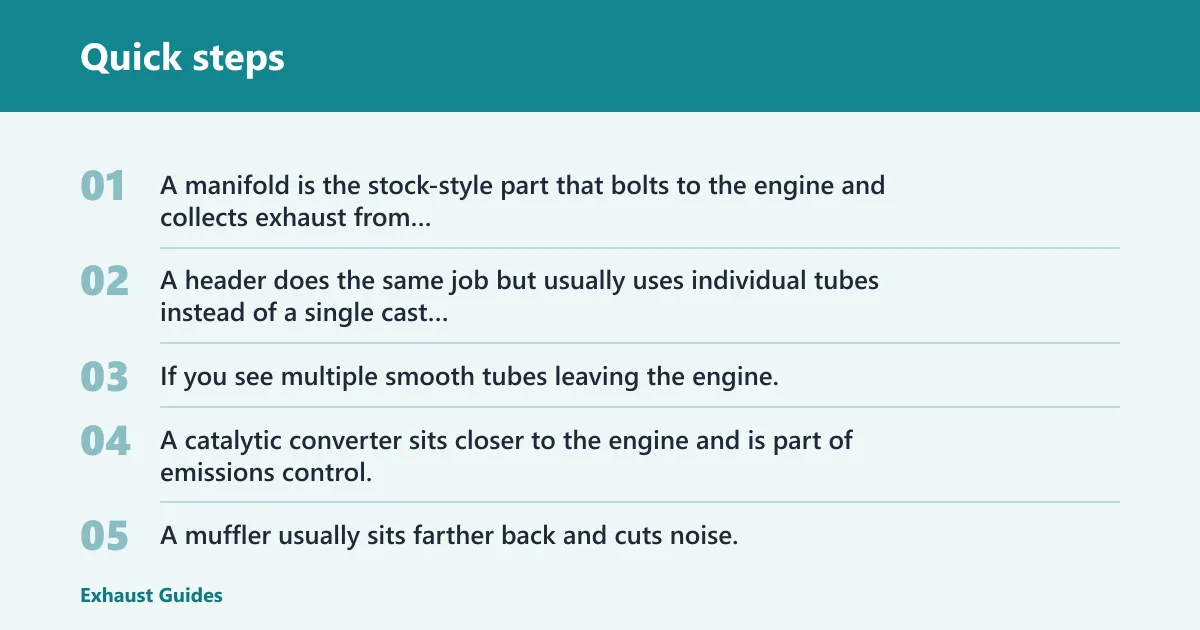
A manifold is the stock-style part that bolts to the engine and collects exhaust from the cylinders. A header does the same job but usually uses individual tubes instead of a single cast body. If you see multiple smooth tubes leaving the engine, you are likely looking at a tubular header rather than a cast manifold.
Catalytic converter vs. muffler
A catalytic converter sits closer to the engine and is part of emissions control. A muffler usually sits farther back and cuts noise. The converter is often smaller and hotter-looking, while the muffler is commonly a larger canister near the rear of the vehicle.
Say your car has two similar metal boxes under the floor. The front one is near the engine and has sensors before and after it. That is the converter. The larger box near the rear axle is the muffler.
Pre-muffler vs. middle muffler
A pre-muffler is usually the first sound-control piece after the emissions section. A middle muffler sits farther back in the center of the car. They can look similar, which is why position matters more than shape. Some systems use one, both, or neither.
Clamp vs. flange vs. gasket
A clamp squeezes two pipes together from the outside. A flange is a bolted joint with flat mating faces. A gasket is the sealing layer between those faces. If you can remove bolts, you are likely looking at a flange joint. If a band wraps around the pipe, that is a clamp.
A common beginner mistake is assuming every rattling section of the exhaust is the muffler when it could be the resonator or a loose hanger. In reality, the leak may come from a worn gasket at a flange joint, while the clamp only holds the section in position.
Where do diesel exhaust parts fit?
Diesel exhaust layouts often add a particulate filter and may place it where a gasoline car would use a simpler front section. Some diesel systems also skip a pre-muffler or place noise-control parts farther back. That changes both the flow path and the names you should expect to see.
Particulate filters
In many modern diesel exhaust systems, a particulate filter captures soot and particulates. It is a major emissions-control part, so it can sit where a beginner might expect only a pipe or small resonator. If sensors and heat shielding cluster around a canister, that is a strong clue you are looking at a filter.
When a pre-muffler may be missing
Some diesel applications use fewer front noise-control parts because the particulate filter changes the layout. The same source lists pre-muffler in the layout, but not every vehicle uses every listed piece. That is why a missing pre-muffler does not mean a part has fallen off.
Common diesel routing differences
Diesel underbody systems often place emissions hardware closer to the engine or in the underfloor section, then run through pipes to rear sound-control parts. The same vehicle may also have more sensors, more heat shielding, and different joint types from a gasoline model.
Which exhaust parts usually fail first?
The first trouble spots are often gaskets, flanges, clamps, pipes near the front, and rubber hangers near the rear. Heat, rust, and vibration attack those areas before the larger canisters fail. Leak points and support points are the places beginners should inspect first.
Leaks at gaskets and flanges
Flange joints and their gaskets are common leak points because they depend on a tight seal. If a joint has soot marks, ticking noise on cold start, or visible rust trails, inspect the gasket and the flange faces first. A clamp will not fix a bad flange seal by itself.
Rust at pipes and hangers
Connecting pipes can rust where water collects, especially near low spots and joints. Hangers and rubber mounts can also fail, which lets the system sag and rub against the body. Once that happens, a pipe can crack or a joint can open up.
Damage to clamps and mounts
Clamps can loosen, corrode, or distort after repeated heat cycles. Rubber mounts can split and drop the rear section out of position. When support fails, the exhaust moves more than it should, and that extra movement can damage parts that were otherwise sound.
Designing an exhaust system starts with the vehicle’s engine, fuel type, packaging space, and emissions requirements. The goal is to route gases from the manifold to the tailpipe with the right mix of emissions control, noise control, serviceability, and support. Layout should match the vehicle, not a generic parts list.
Start with the flow path
- Identify the engine outlet and the first hot part bolted to it.
- Locate any emissions unit, such as a catalytic converter or diesel particulate filter.
- Trace the pipes rearward and note each canister and joint.
- Mark every clamp, flange, gasket, hanger, and rubber mount.
- Check that the tailpipe exits clear of the body and bumper area.
Keep naming consistent
OEM catalogs, aftermarket listings, and performance parts often use different labels for the same section. A “resonator” may be called a pre-muffler by one seller and an intermediate muffler by another. Read the location and fitment notes, not only the part name.
Use the vehicle as the final check
Suppose you are looking at a two-wheel-drive sedan with a single rear muffler and one catalytic converter. If a catalog lists a second muffler and a mid-pipe resonator, the layout may be for another trim or engine. Always match the part to the vehicle’s route, joints, and support points.
Frequently asked questions
What makes up an exhaust system
An exhaust system usually includes the exhaust manifold, catalytic converter or diesel particulate filter, connecting pipes, one or more mufflers, the tailpipe, and support hardware. Some vehicles also use a Y pipe, pre-muffler, middle muffler, or flex section. The exact layout depends on the engine and vehicle type.
What is an exhaust system?
An exhaust system is the set of parts that moves combustion gases away from the engine and out of the vehicle while also handling emissions and noise control. On the car, it starts at the engine outlet and ends at the tailpipe. The path and number of parts vary by layout.
What does each exhaust part do?
The manifold gathers exhaust from the cylinders. The catalytic converter and diesel particulate filter handle emissions. Pipes connect the system. Mufflers cut noise. Hangers and rubber mounts support the weight and limit vibration. Clamps, flanges, and gaskets create service joints. The tip mainly shapes the outlet appearance.
What is the difference between an exhaust manifold and a muffler?
The manifold is at the engine and collects hot exhaust as it leaves the cylinders. The muffler is farther back and cuts noise before the gases exit. One is a front hot-flow part, the other is a rear sound-control part. Their jobs, locations, and shapes are very different.
How can I identify exhaust parts under my car?
Start at the engine and work rearward. The first bolted metal piece is usually the manifold. Look for emissions canisters next, then pipes, then larger canisters near the rear that are usually mufflers. Separate flow parts from support parts by checking whether the piece carries gas or only holds the system up.
Which exhaust parts usually fail first: beginners should inspect gaskets, flanges?
Beginners should inspect gaskets, flanges, clamps, pipes near joints, and rubber hangers first. Those parts see the most heat, movement, and rust. When they fail, the symptoms are often noise, soot, sagging, or vibration. Larger canisters usually last longer than the joints around them.