DIY Exhaust Gasket Replacement vs Shop Repair Cost
A DIY exhaust gasket replacement usually costs about $20-$100 in parts, while a shop repair often runs about $150-$600, though rusted studs, broken flanges, or manifold damage can raise the bill significantly. Missed fasteners or an undetected leak can make the exhaust louder, trigger a failed inspection, raise carbon-monoxide risk, and turn a gasket swap into manifold or pipe replacement. This guide compares DIY and shop costs, what changes the price, and how rust and access affect the safest choice.
| Decision factor | DIY Exhaust Gasket Replacement | Shop Repair Cost | Winner |
|---|---|---|---|
| All-in cost | $20-$100 in parts and fluids, plus tool or access costs if you need them | $150-$600 typical at independent shops, often higher at dealers | DIY Exhaust Gasket Replacement |
| Rust and seized-fastener risk | Can jump from a gasket swap to broken studs, drilling, or follow-up parts | Higher labor bill up front, but the shop can absorb stuck-fastener time and added diagnosis | Shop Repair Cost |
| Access and equipment needs | Works best with jack stands, a torque wrench, and room to reach the flange | Lift access and exhaust-specific tools are included in the labor rate | Shop Repair Cost |
| Best fit for layout | Inline-four engines, clean hardware, and simple flange or donut joints | Front-bank V6/V8, rust-belt vehicles, motorcycles, and tight catalytic-converter flanges | Depends on vehicle, often Shop Repair Cost |
Exhaust gasket cost worksheet
Parts line items
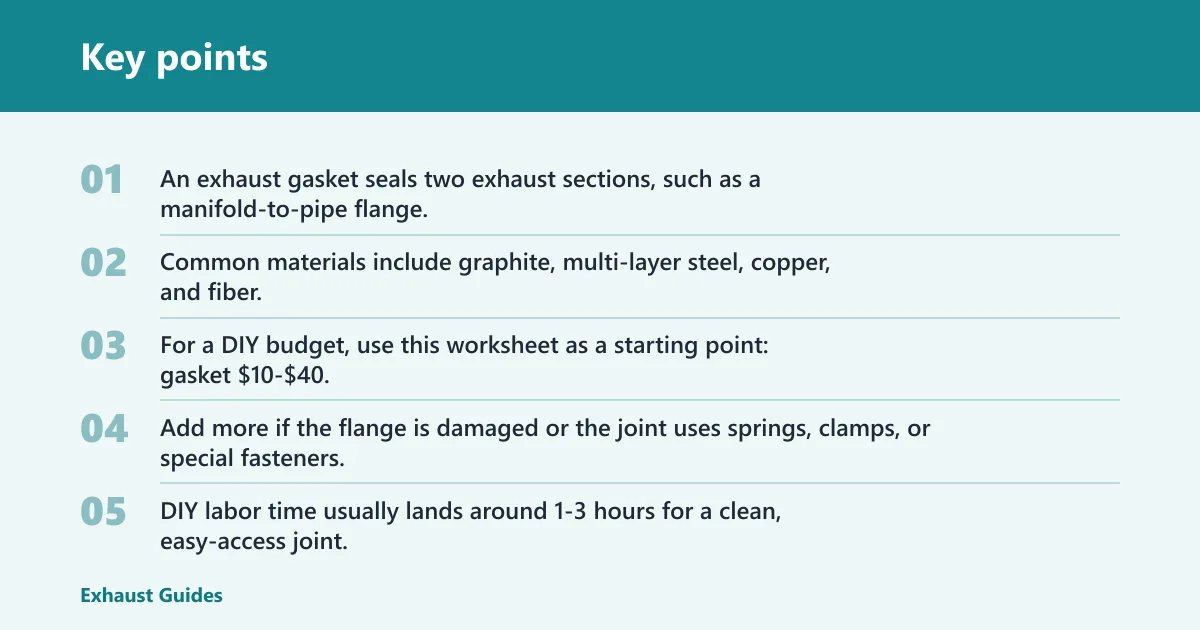
An exhaust gasket seals two exhaust sections, such as a manifold-to-pipe flange, a header flange, a donut joint, or a catalytic-converter flange. Common materials include graphite, multi-layer steel, copper, and fiber; some are single-use, while metal styles may be reusable only if the flange surfaces stay flat and the manufacturer allows it.
For a DIY budget, use this worksheet as a starting point: gasket $10-$40, hardware kit $10-$25, penetrating oil $5-$15, anti-seize $5-$10, and replacement bolts or studs $5-$30 if needed. Add more if the flange is damaged or the joint uses springs, clamps, or special fasteners.
| Line item | Typical DIY cost | Notes |
|---|---|---|
| Gasket | $10-$40 | Flange, donut, header, manifold, or catalytic-converter gasket |
| Hardware kit | $10-$25 | May include bolts, nuts, springs, or clamps |
| Penetrating oil | $5-$15 | Often needed before removal on rusty joints |
| Anti-seize | $5-$10 | Use where allowed by the service procedure |
| Replacement bolts or studs | $5-$30 | Rises fast if studs snap or threads strip |
| Jack stand or lift access | $0-$80 | Already owned, rented, or shop-only access |
Labor hours and rust contingency
DIY labor time usually lands around 1-3 hours for a clean, easy-access joint, and 4-6 hours or more when fasteners are rusted or the joint sits near the firewall. Shop book time is often about 1-2 hours for a simple gasket swap, though the final invoice can rise if broken studs, warped flanges, or extra diagnosis show up.
Rust changes the math. If a stud snaps or a nut rounds off, the job may need drilling, extraction, or a manifold removal that wipes out the savings from doing it at home.
Tools and access costs
At minimum, plan on a socket set, torque wrench, jack stands or lift access, penetrating oil, and a gasket scraper or wire brush. A straight edge helps confirm flange warpage, and a thread chaser can save a usable stud hole.
Access matters as much as the parts price. A simple inline-four with an exposed flange is one thing; a front-bank V6 or V8 with heat shields, tight packaging, and rusted hardware is another.
What drives the total bill?
Gasket type and material
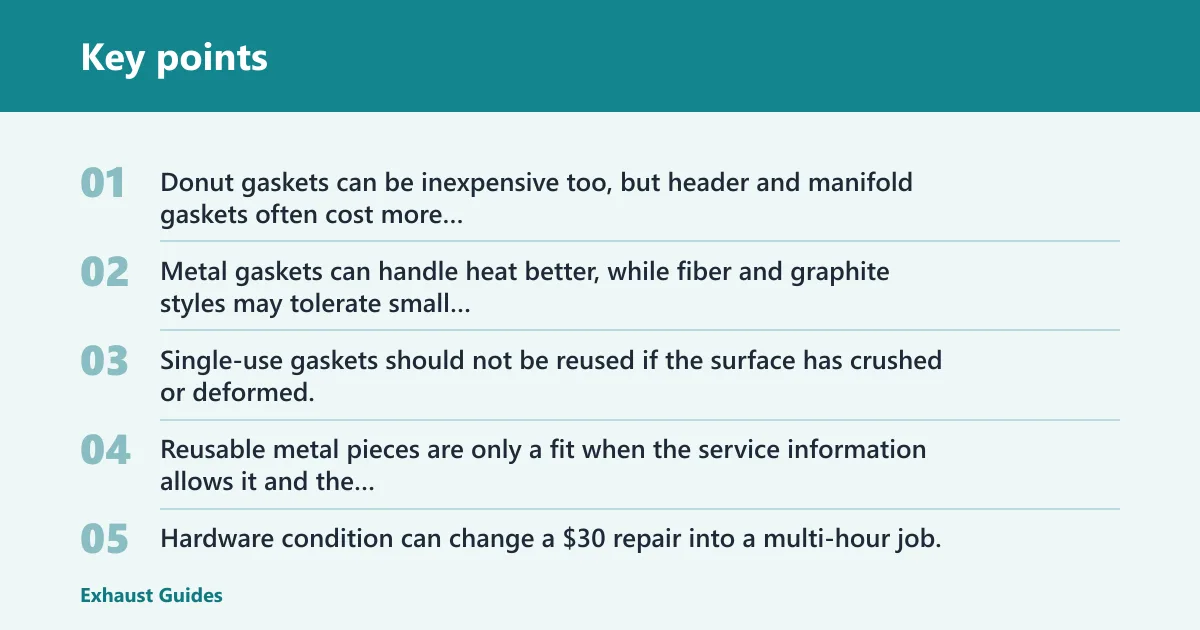
Flange gaskets are usually the cheapest. Donut gaskets can be inexpensive too, but header and manifold gaskets often cost more because they seal hotter, larger, and more complex joints. Metal gaskets can handle heat better, while fiber and graphite styles may tolerate small irregularities more easily, but none of them fixes a warped flange.
Single-use gaskets should not be reused if the surface has crushed or deformed. Reusable metal pieces are only a fit when the service information allows it and the sealing faces stay flat.
Fastener condition and corrosion
Hardware condition can change a $30 repair into a multi-hour job. When studs corrode into the manifold or flange, the repair may need new studs, nuts, springs, or clamps, plus extraction work that drives labor higher than the gasket itself.
The real cost is the seal, the hardware, and the time lost to seized threads.
Vehicle layout and access
Inline-four engines usually offer better access, so the job is more likely to stay in the low-cost range. Front-bank V6 and V8 layouts can hide the leaking joint under intake parts, heat shields, or tight firewall clearance, which adds labor even before rust enters the picture.
Motorcycles and catalytic-converter flange joints are special cases. They may be smaller and cheaper in parts, but the hardware can be odd, heat-cycled, or limited to model-specific fittings.
How much does DIY cost?
DIY usually wins on parts cost alone, but only when you already have the basic tools and the joint comes apart cleanly. A realistic home budget is about $20-$100 for the seal, hardware, penetrant, and consumables, with extra money if a new stud, clamp, or bolt kit is needed.
When to replace hardware
Replace studs, bolts, nuts, springs, or clamps when threads are pitted, nuts lose their grip, springs are stretched or corroded, or a clamp has lost clamping force. If the service procedure calls for new self-locking hardware, treat that as required, not optional.
Torque specs matter. Tightening evenly helps the gasket seat without distorting the flange, and some joints need a re-check after heat cycling if the manufacturer calls for it.
DIY time by engine layout
An easy inline-four can stay close to the low end of the time range because the flange is visible and the bolts are reachable. A V6 or V8, especially a front-bank leak, can demand extra disassembly and more time with penetrant, heat shielding, and awkward tool angles.
Say your 2.4-liter four-cylinder has a flange leak at the downpipe and the hardware backs out cleanly. That can stay a gasket-and-bolt job. Suppose the same symptom appears on a rust-belt V8 with snapped manifold studs; the job no longer fits a simple DIY plan.
How much does a shop charge?
An independent exhaust shop commonly charges about $150-$600, depending on labor time, parts markup, and whether the job stays at the gasket or turns into hardware repair. Dealer pricing often runs higher because of labor rate, model-specific parts, and diagnostic time, especially on newer vehicles or tight-access joints.
Why shop quotes vary
Vehicle age and corrosion are major pricing drivers. A shop quote will usually climb when the technician expects broken studs, seized bolts, warped flanges, or additional heat shield removal, because those issues add book time and risk.
Diagnosis also matters. A ticking sound under load may be a gasket leak, but a cracked pipe or flange warp can change the repair from a seal swap to welding or replacement sections.
Independent shop versus dealer
Independent exhaust shops often have lower labor rates and more experience with rusty hardware. Dealers may be the better choice when the vehicle needs model-specific parts or warranty documentation, but their invoices can rise quickly if the work turns into a larger exhaust repair.
Shop repair is often the safer financial choice when access is poor. Paying for the lift, the tools, and the extra labor can be cheaper than buying hardware twice after a broken stud at home.
When is DIY a false economy?
DIY becomes a false economy when the leak is not limited to the gasket. If the flange is warped, the pipe is cracked, or the stud holes are damaged, the repair can need machining, welding, or section replacement that costs more than the original gasket job.
Signs the leak is bigger than the seal
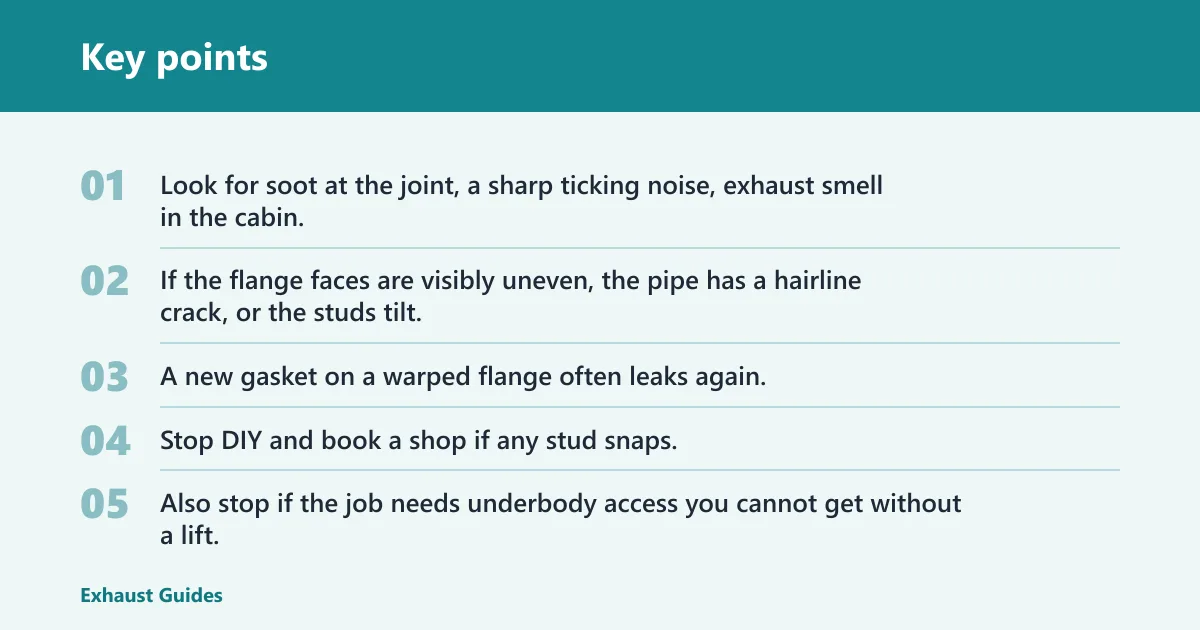
Look for soot at the joint, a sharp ticking noise, exhaust smell in the cabin, or louder noise under load. If the flange faces are visibly uneven, the pipe has a hairline crack, or the studs tilt, the gasket may be only part of the problem.
Do not force a seal onto a bad surface. A new gasket on a warped flange often leaks again, and the second repair usually costs more than doing the correct fix once.
Simple stop point
Stop DIY and book a shop if any stud snaps, if you cannot remove the joint without heat or cutting, if the flange is clearly warped, or if safe jack stand access is not available. Also stop if the job needs underbody access you cannot get without a lift.
Picture a rust-belt sedan with a manifold leak, one broken stud, and a second nut that will not budge. The first hour may look manageable, but the repair can turn into extraction and manifold work fast. That is the point to hand it off.
Choose DIY Exhaust Gasket Replacement if… / Choose Shop Repair Cost if…
Choose DIY Exhaust Gasket Replacement if the leak is at a reachable flange, the hardware is clean enough to remove, you already have jack stands or lift access, and the joint is on an easy inline-four or similarly open layout. It also fits when the parts bill is the main concern and the vehicle is out of the rust zone.
Choose Shop Repair Cost if the vehicle is rust-belt exposed, the job involves a front-bank V6 or V8, any stud is seized, the flange looks warped, or the leak sits near a manifold or catalytic-converter joint that may need more than a gasket. A shop is also the better call when safe access is poor or the repair could turn into drilling, welding, or section replacement.


Frequently asked questions
How much does it cost to replace an exhaust gasket myself?
Most DIY repairs land around $20-$100 in parts and consumables, assuming you already own the main tools. Add more if you need replacement studs, bolts, nuts, springs, or clamps, or if access equipment must be rented. Rust can turn a cheap seal job into a much larger bill.
How much does a shop charge for exhaust gasket replacement?
An independent exhaust shop often charges $150-$600, with dealers usually higher. The quote depends on labor time, rust, access, and whether the mechanic finds broken studs, warped flanges, or a cracked pipe that needs more than a gasket swap.
Is it cheaper to do an exhaust gasket replacement at home?
Yes, if the joint comes apart cleanly and the vehicle is easy to reach. DIY loses its cost advantage when rust, seized fasteners, or a damaged flange force extra parts and labor, because the repair can grow beyond the original gasket job.
Can I drive with a leaking exhaust gasket?
Short trips may be possible, but a leak should not be ignored. Exhaust smell, louder noise under load, and soot at the joint can point to a leak that may affect cabin air quality, inspection results, and nearby components if hot gases escape near wiring or hoses.
What tools do I need to replace an exhaust gasket?
Plan on a socket set, torque wrench, jack stands or lift access, penetrating oil, and a gasket scraper or wire brush. A straight edge helps check flange warp, and a thread chaser or wire brush can clean usable threads before reassembly.
Do I need to replace bolts and springs with the gasket?
Replace hardware when it is corroded, stretched, rounded, or specified as one-time-use by the service procedure. Springs, clamps, bolts, and nuts all affect clamp load, and weak hardware can let the new gasket leak again even if the seal itself is correct.
How long does exhaust gasket replacement take?
A clean DIY job can take 1-3 hours, while rusted hardware or tight access can push it to 4-6 hours or more. A shop often books 1-2 hours for a simple job, but that time can rise quickly if fasteners seize or additional damage appears.
How do I know if the leak is the gasket or the flange?
Look for soot, a ticking sound, and exhaust smell at the joint, then inspect the sealing faces. If the flange is uneven, cracked, or pitted, the leak may be the surface or pipe itself rather than the gasket alone. A straight edge can help confirm warp.
What else should I replace while the exhaust is apart?
Replace any hardware that shows rust, stretching, damaged threads, or loss of clamp force. Also inspect studs, nuts, springs, clamps, adjacent pipe sections, and heat shields, because those parts are easiest to service while the exhaust is already open.