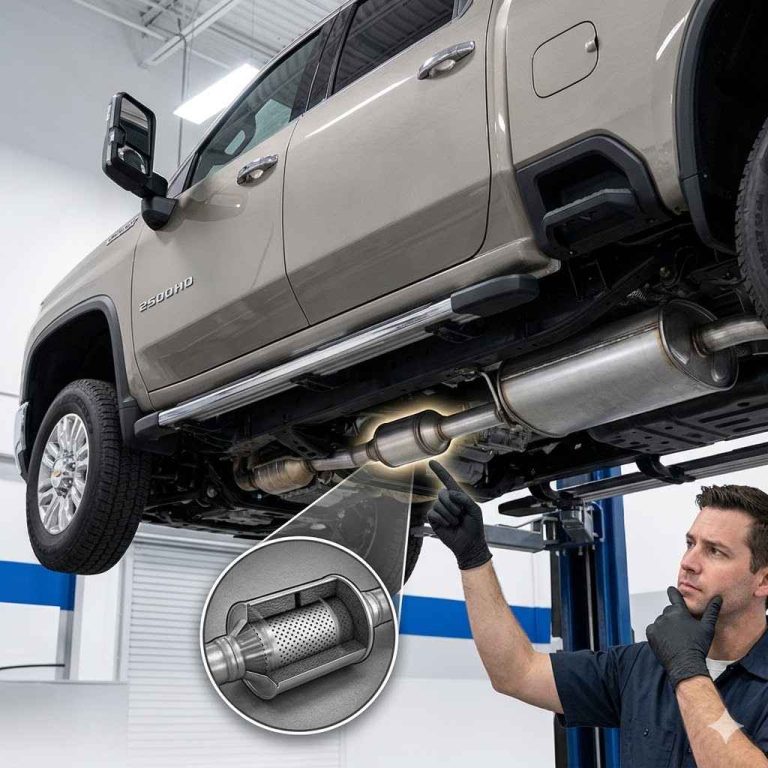
Signs Your Exhaust Leak Is Coming From the Manifold
If the ticking, tapping, or hissing is loudest at the exhaust manifold or heat shield, and changes most on cold start, the leak is likely at the manifold or its gasket. Ignoring it can waste money on the wrong repair and let hot exhaust gases damage nearby parts. This guide shows how to narrow the leak by sound, heat, and engine-bay clues before you replace anything.
What the exhaust manifold leak sounds like
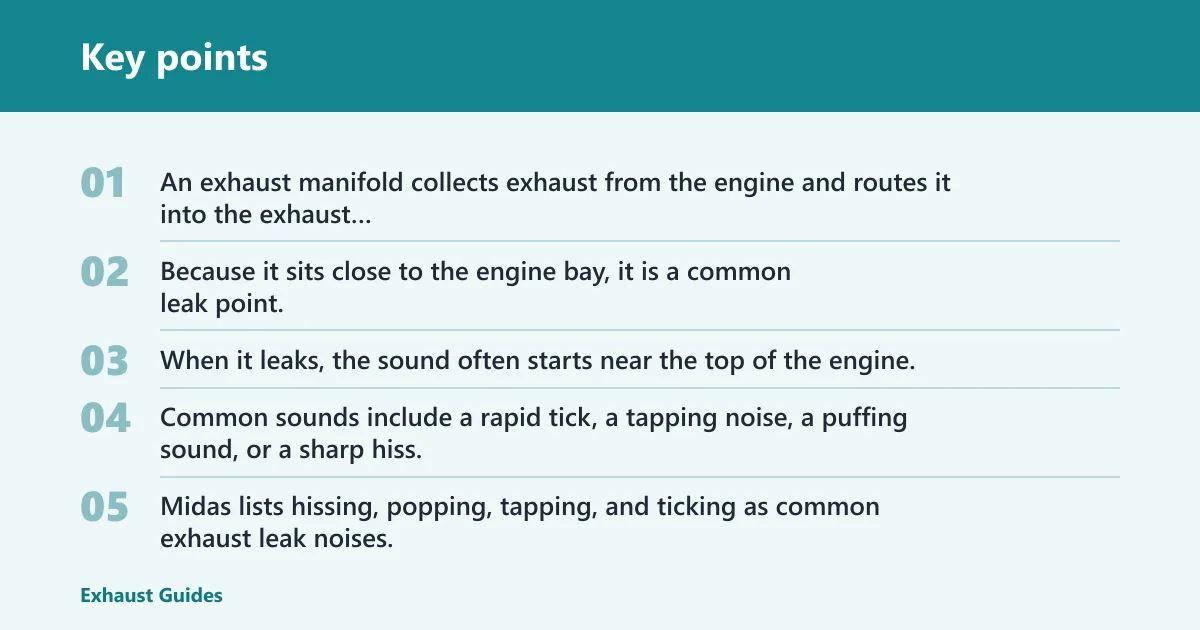


An exhaust manifold collects exhaust from the engine and routes it into the exhaust system. Because it sits close to the engine bay, it is a common leak point. When it leaks, the sound often starts near the top of the engine, not under the rear floor or at the tailpipe.
Common sounds include a rapid tick, a tapping noise, a puffing sound, or a sharp hiss. Midas lists hissing, popping, tapping, and ticking as common exhaust leak noises, and notes that a rapid ticking effect is classic during acceleration or starting cold. Miller Brothers also says manifold leaks can cause hissing, tapping, or popping noises.
The pattern matters. A small crack or a leak at one runner often sounds like a fast tick. A larger opening can sound more like a hiss or puff. If the leak is at the manifold gasket, the sound may be sharper near a single cylinder side and may change with throttle.
For a broader overview of how leaks are diagnosed by location and sound, see general exhaust leak diagnosis.
How acceleration changes the noise
Acceleration raises exhaust pressure. That makes manifold leaks easier to hear, especially around the first minutes after startup. The same source says donut gasket and manifold leaks are prime suspects during acceleration or cold start. A leak that seems faint at idle can become obvious when you blip the throttle.
Suppose the engine idles with a light tick only when cold, then the noise becomes a faster puffing sound as you pull away from a stop. That pattern points more toward the manifold area than a rear exhaust leak. A downstream pipe leak usually does not get that much louder right beside the engine bay.
Why some leaks fade as the engine warms
Heat changes metal shape. Cast manifolds, gaskets, and fasteners expand as the engine warms, so a small gap can shrink and the noise can fade. This is basic thermal expansion: as metal temperature rises, dimensions increase slightly, which can partially close a tiny leak path. That is why a cold-start leak can sound louder and then quiet down as the engine bay heats up.
Do not assume silence after warmup means the problem is gone. A crack can open more under load, and a gasket leak can still send fumes and hot gas into the engine bay even when the noise drops.
Symptoms that point to a manifold leak
Noise is only one clue. Soot, exhaust odor, uneven running, and scan-tool codes can all support a manifold leak diagnosis. The same source notes that exhaust leaks may cause sluggish acceleration and may trigger the check engine light in modern vehicles. Miller Brothers adds that exhaust smell inside the vehicle can cause headaches or dizziness.
Look for black soot, carbon buildup, or heat discoloration around the manifold flange, gasket line, studs, bolts, and nearby shield. A cracked cast manifold may leave dark streaks near the crack or runner. A failed gasket may leave a narrow soot line at the joint between the manifold and the cylinder head.
Exhaust odor near the hood is a clue. Odor in the cabin is more urgent. Midas warns that gasoline, burning, or rotten egg odor in the cabin should be diagnosed immediately. An exhaust leak can let toxic fumes enter the cabin instead of exiting through the tailpipe, and carbon monoxide is poisonous and dangerous in enclosed spaces. The EPA’s carbon monoxide guidance is clear that CO is especially dangerous because it cannot be seen or smelled.
Picture a sedan that ticks loudly for about 30 seconds after startup, then runs mostly normally but smells like exhaust near the windshield vents at idle. That combination fits the manifold area better than a muffler leak. The smell raises urgency even if the noise is not constant.
Common manifold failure patterns
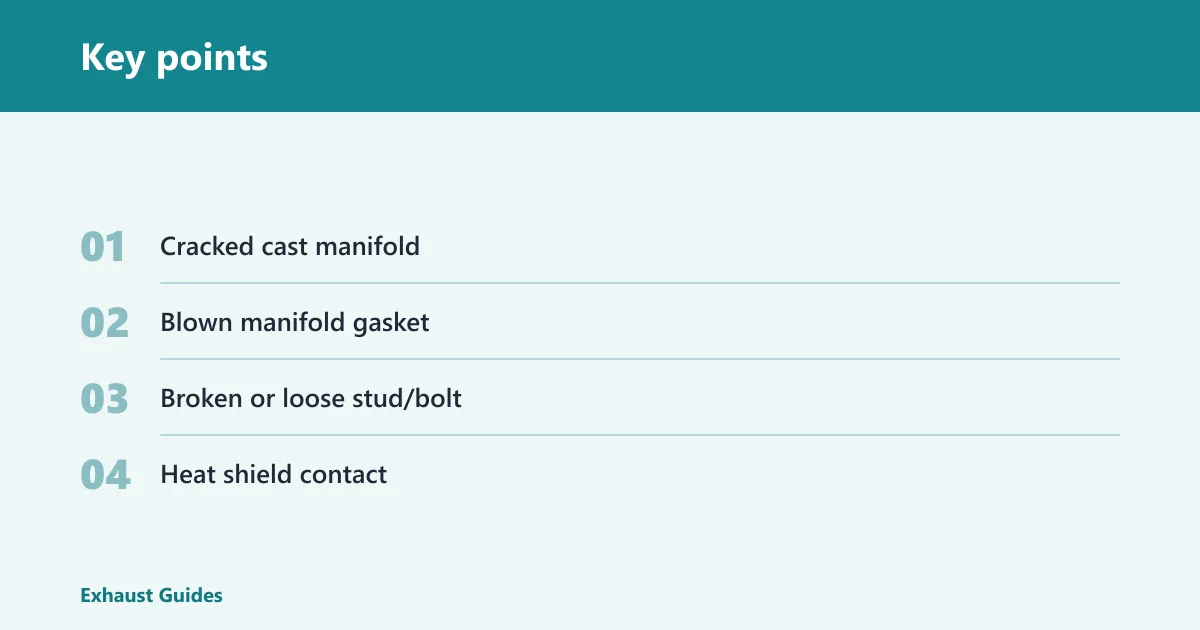
- Cracked cast manifold: Often loudest cold, may hiss or tick, and can leave soot near the crack or runner.
- Blown manifold gasket: Often makes a ticking, tapping, or popping sound at the cylinder head joint.
- Broken or loose stud/bolt: Can let the manifold lift slightly and create a leak that changes with load and heat.
- Heat shield contact: Can add rattling, but a rattle alone does not prove a leak.
Manifold vs pipe vs flex pipe differences
A leak’s source is often easier to narrow by where the sound is loudest than by the sound alone. A manifold leak is usually highest and nearest the engine bay, while a flex-pipe or mid-pipe leak is lower and farther back. This distinction matters because the repair path changes completely depending on the source.
Use cold start, idle, and throttle blips as clues. A manifold leak often shows up first at cold start, then changes with light throttle. A flex pipe leak usually sounds lower in the car and may be easier to hear from underneath. A downstream pipe leak is usually farther from the engine and less likely to be loud in the bay.
Compare it with flex pipe and pipe leaks
A flex pipe leak tends to be under the vehicle, often between the engine and the rear exhaust sections. The sound may be a hiss or puff, but it is usually not centered at the manifold or heat shield. Downstream pipe leaks often change less with engine temperature and are less likely to sound like a rapid tick near the hood.
A common first-timer mistake is hearing any ticking noise and calling it a manifold leak. If the tick is loudest under the passenger floor or near the center tunnel, keep looking. If it is loudest at the top of the engine, the manifold or its gasket moves to the top of the list.
What the oxygen sensor and fuel trims can tell you
Upstream oxygen sensors are the most relevant sensors when diagnosing a leak before the catalytic converter. If exhaust escapes ahead of the upstream sensor, outside air can be pulled into the stream and the sensor may report a lean condition even when the engine is not actually running lean. That is why a manifold leak can mimic fuel-system problems without proving a bad sensor.
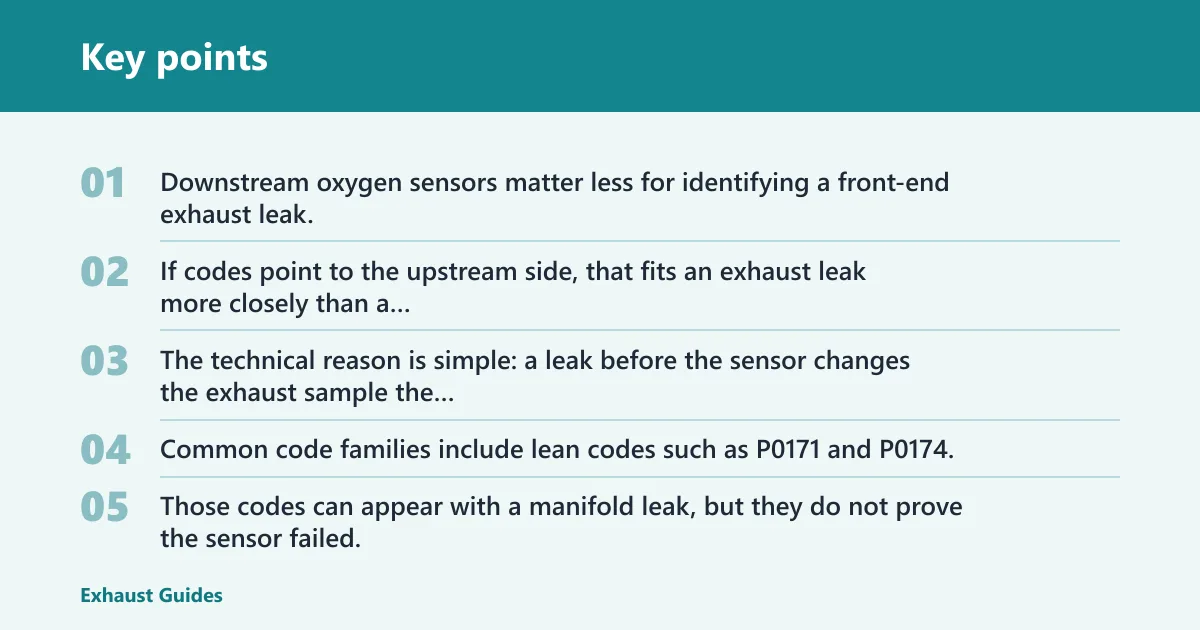
Downstream oxygen sensors matter less for identifying a front-end exhaust leak, because they are mainly used to monitor catalyst efficiency after exhaust has passed through the converter. If codes point to the upstream side, that fits an exhaust leak more closely than a downstream-only issue. The technical reason is simple: a leak before the sensor changes the exhaust sample the sensor sees.
Common code families include lean codes such as P0171 and P0174, oxygen-sensor-related codes such as P013x and P015x families, and catalyst-efficiency codes such as P0420 or P0430. Those codes can appear with a manifold leak, but they do not prove the sensor failed. For a sensor to be blamed, the leak first has to be ruled out.
For a deeper look at why exhaust leaks can distort sensor readings and fuel-trim data, see NGK/NTK’s oxygen sensor guidance and the way unmetered air can skew the mixture calculation. The key diagnostic point is that a manifold leak can create a false lean signal upstream even when the sensor itself is healthy.
How do you tell it is the manifold?
Listen near the engine bay, not the tailpipe. If the sound is strongest at the front of the engine, near the cylinder head, exhaust manifold, or heat shield, that is a strong clue. The same source says the sound depends on where the leak is and where you sit in the vehicle, so location matters as much as volume.
Use cold start, idle, and throttle blips as clues. A manifold leak often shows up first at cold start, then changes with light throttle. A flex pipe leak usually sounds lower in the car and may be easier to hear from underneath. A downstream pipe leak is usually farther from the engine and less likely to be loud in the bay.
Scan-tool clues and code patterns
A check engine light can support the diagnosis, but it does not prove a manifold leak by itself. The same source says exhaust leaks may trigger the Check engine light in modern vehicles, and Miller Brothers says the engine control unit can turn on the check engine warning light. Use an OBD-II scanner to read the codes before replacing parts.
Oxygen sensors monitor exhaust composition. If an exhaust leak changes the readings, the sensors may report faults or the engine computer may flag a mixture problem. That can happen with manifold leaks because the leak sits upstream of the catalytic converter and oxygen sensors on many vehicles.
What the codes do not prove: a code does not tell you exactly which crack, gasket edge, or bolt failed. It may point to an emissions problem that needs visual inspection. A lean code near the front bank can fit a manifold leak, but it still needs confirmation.
What an OBD-II scanner can tell you
- Read stored and pending trouble codes.
- Check whether oxygen sensor or fuel-trim codes are present.
- Clear codes only after the fault is repaired and verified.
- Watch whether codes return after a cold start and short drive.
What inspection steps confirm the leak?
Start with the engine cold. Look for cracks, loose bolts, missing studs, soot trails, and damaged gasket traces around the manifold. A cracked manifold can be visible as a hairline split or dark streak. A gasket leak often leaves a soot line right at the head-to-manifold joint.
A smoke test is a common way to trace small or hidden manifold leaks. Smoke is useful when the crack is narrow or the leak only opens under heat and pressure. The smoke can show where exhaust escapes without guessing at the wrong joint.
Use a soapy water test only at accessible points and only when heat allows. It works best on areas you can reach safely, such as a cool, accessible joint or flange. Watch for bubbles. Do not spray near hot parts, belts, or electrical connectors.
Heat shields can make diagnosis harder because they may rattle without a leak. A loose shield can mimic a ticking or buzzing noise, so noise alone is not enough. If the shield moves but there is no soot, no odor, and no pressure-related change, the rattle may be a false positive rather than the source of exhaust escape.
Inspection order that makes sense
- Inspect the manifold area with the engine off and cool.
- Check for soot, broken fasteners, and heat shield movement.
- Start the engine cold and listen near the cylinder head.
- Blip the throttle lightly and note whether the sound sharpens.
- Read codes with an OBD-II scanner if the check engine light is on.
- Use smoke testing if the leak is small or hard to hear.
- Use soapy water only where safe and physically accessible.
Manifold leak decision table
Use the table below to narrow the source before you replace parts. The goal is not perfect certainty. It is to separate manifold-area clues from flex pipe and downstream pipe clues so you do not pay for the wrong repair.
| Noise type | When it happens | Smell | Soot location | Likely source | Do not drive risk |
|---|---|---|---|---|---|
| Rapid ticking | Cold start, light throttle, acceleration | May be faint near hood | Manifold flange, runner, heat shield edge | Manifold or manifold gasket | High if cabin smell is present |
| Tapping or popping | Cold start, idle, throttle blip | Exhaust odor near engine bay | One side of manifold or broken fastener area | Gasket failure or loose/broken stud | Moderate to high, depending on fumes |
| Sharp hiss | Acceleration, deceleration, cold engine | May enter cabin at stops | Front of engine, manifold crack, or joint | Cracked manifold or gasket leak | High if smell reaches cabin |
| Hiss or puff from under car | Idle and road speed, less tied to cold start | Usually outside the cabin | Mid-pipe, flex pipe, or underbody seam | Flex pipe or downstream pipe | Usually lower, but inspect soon |
| Gurgle or lower thump | Under load, cruise, or decel | Sometimes none | Rear pipe, muffler area, or tail section | Downstream pipe or muffler leak | Lower unless fumes enter cabin |
The soot clue is one of the best separators. Soot at the manifold, gasket line, or nearby studs points toward the front of the exhaust system. Soot farther back, under the floor or near the muffler, points away from the manifold.
Can you keep driving with an exhaust manifold leak?
A very small leak may sometimes allow a short, careful trip to a repair shop, provided there is no cabin odor, no obvious heat damage, and no major noise. Because an exhaust leak can let toxic fumes enter the cabin, you should treat any smell inside the vehicle as a stop-driving warning.
If the engine bay smell is strong, the check engine light is flashing, the noise is getting louder, or you see soot spreading quickly, do not keep driving. Midas warns that an exhaust leak can damage the catalytic converter, and a hot leak can also harm nearby wiring, sensors, and plastic parts.
Suppose the car starts ticking loudly on a winter morning, then the smell appears at the base of the windshield and the noise fades only after several minutes. That is not a reason to ignore it. It is a sign to inspect the manifold area before the leak grows or fumes reach the cabin.
When in doubt, park it and inspect it cold. If you can smell exhaust in the cabin, feel dizzy, or suspect carbon monoxide exposure, stop driving and move to fresh air immediately. The safest threshold is simple: cabin odor, dizziness, or a flashing check engine light means the vehicle should not keep being driven until the cause is known.
Frequently asked questions
How do I know if my exhaust leak is coming from the manifold?
If the noise is loudest at the front of the engine, changes most on cold start, and gets sharper with throttle, the manifold or manifold gasket is a strong suspect. Soot around the cylinder head joint, broken studs, or a visible crack makes that diagnosis more likely than a rear pipe leak.
What does a manifold exhaust leak sound like when accelerating?
During acceleration, a manifold leak often changes from a light tick into a faster tapping, hissing, or puffing sound. The added exhaust pressure can make the leak easier to hear. If the sound is strongest near the hood rather than under the car, the manifold area moves higher on the list.
Does a cold start make an exhaust manifold leak louder?
Yes. Cold starts often make manifold leaks louder because the metal has not expanded yet, so the gap is larger. Miller Brothers says the manifold makes the most noise when the engine is cold. If the sound fades as the engine warms, that pattern still fits a manifold or gasket leak.
Can an exhaust manifold leak cause a check engine light?
Yes. The same source says exhaust leaks may trigger the Check engine light in modern vehicles, and Miller Brothers says the engine control unit can turn on the warning light. The light is a clue, not proof. Use an OBD-II scanner to read the codes and then confirm the leak by inspection.
What other symptoms point to a manifold leak besides noise?
Look for soot or carbon around the manifold, exhaust odor near the hood, sluggish acceleration, rough idle, or oxygen sensor and fuel-trim codes. The same source says vehicle performance problems can include sluggish acceleration. Odor in the cabin is especially serious because exhaust fumes can enter the interior.
How can I tell a manifold leak from a muffler or pipe leak?
A manifold leak is usually loudest near the engine bay, strongest on cold start, and more likely to change with throttle. A muffler or downstream pipe leak is usually heard lower and farther back under the vehicle. If the soot is at the front of the exhaust system, the manifold becomes the better fit.