Does a Larger Exhaust Always Add Horsepower?
A larger exhaust adds horsepower only when the stock system is the restriction. Size it to engine airflow and target power, not to the biggest pipe that fits. Go too big on a mild street setup and you can lose exhaust velocity, throttle response, and sometimes low-rpm torque. This guide shows how to choose diameter for naturally aspirated, turbo, truck, and track setups.
Does a larger exhaust add horsepower?
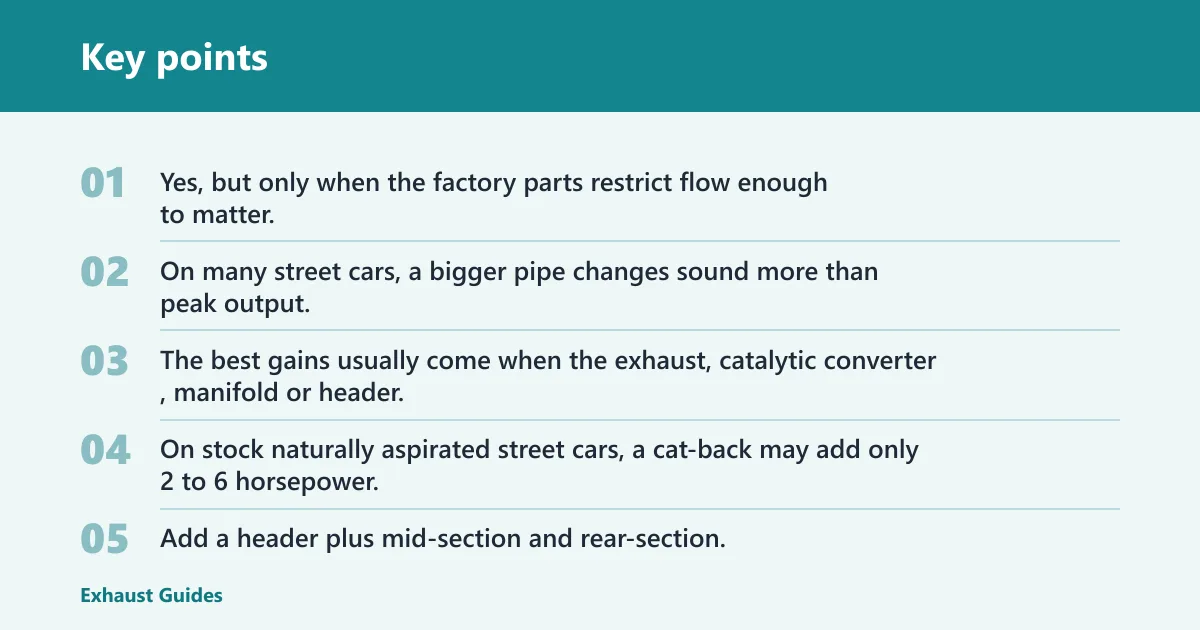


Yes, but only when the factory parts restrict flow enough to matter. On many street cars, a bigger pipe changes sound more than peak output. The best gains usually come when the exhaust, catalytic converter, manifold or header, and tuning match the engine’s airflow demand.
The short answer by engine type
On stock naturally aspirated street cars, a cat-back may add only 2 to 6 horsepower, and a mid-section plus rear-section change may add 2 to 5 horsepower. Add a header plus mid-section and rear-section, and total gains may reach 5 to 10 horsepower. Some models reach 8 to 15 horsepower with intake and ECU optimization.
Turbo cars usually react more strongly because the exhaust before the turbine directly affects spool and boost rise. Stock turbocharged cars often gain 3 to 8 horsepower from a simple exhaust upgrade, while turbo platforms with header, pre-pipe, high-flow catalytic converter, and ECU tuning can gain 10 to 25 horsepower.
Why backpressure alone is the wrong yardstick
Backpressure matters, but it is not the whole story. Exhaust gas needs enough velocity to clear cylinders and help scavenging, especially on naturally aspirated engines. A pipe that is too large can reduce gas speed, which can hurt low-end torque and throttle response even if peak flow improves.
The useful question is not “How low can backpressure go?” It is “Where is the restriction, at what rpm, and how much flow does the engine actually need?” A freer rear muffler cannot fix a choking downpipe. A larger tail section cannot replace a restrictive catalytic converter.
Wheel horsepower vs crank horsepower
Horsepower claims can refer to crank horsepower or wheel horsepower, and the two are not the same. Wheel horsepower is measured at the tires and is lower because of drivetrain loss. A claim that sounds large at the crank can shrink once measured at the wheels.
That is why an exhaust ad that says “10 horsepower” may feel different depending on what was measured. When you compare setups, keep the test type consistent. Otherwise, you are comparing numbers that do not describe the same output.
Exhaust diameter and horsepower
Pipe diameter controls how much exhaust can move, but diameter alone does not guarantee power. Inner diameter, catalyst flow, muffler design, and engine demand all matter. The right size keeps velocity high enough for response while leaving enough cross-sectional area for top-end flow.
Inner diameter and gas velocity
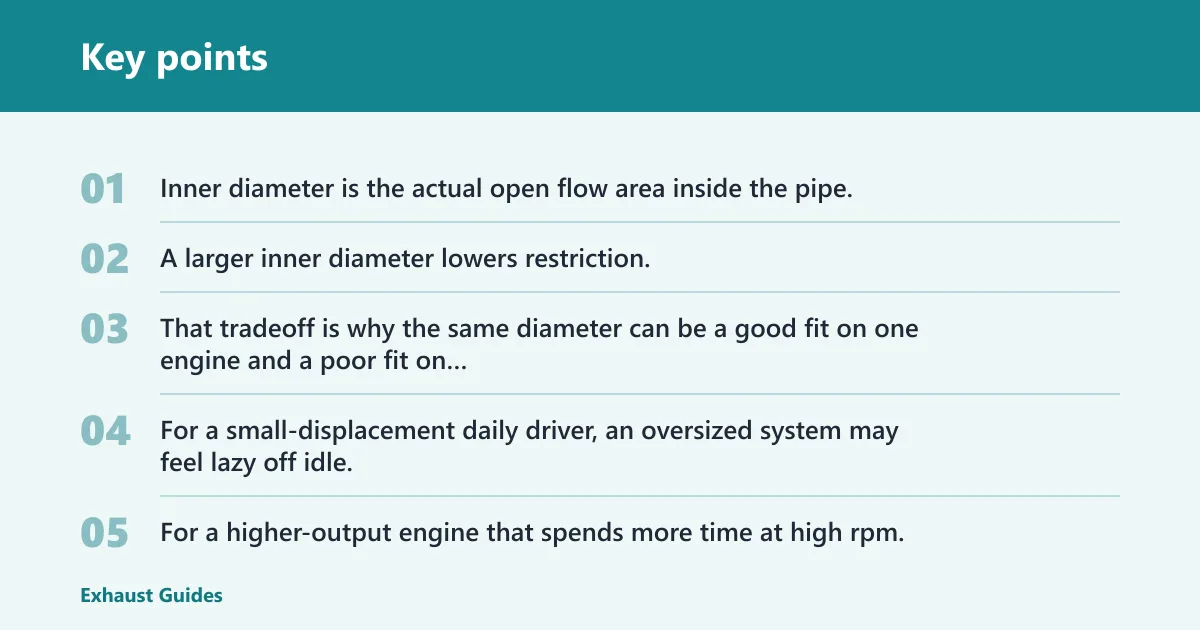
Inner diameter is the actual open flow area inside the pipe. A larger inner diameter lowers restriction, but it also lowers exhaust gas velocity at lower engine speeds. That tradeoff is why the same diameter can be a good fit on one engine and a poor fit on another.
For a small-displacement daily driver, an oversized system may feel lazy off idle. For a higher-output engine that spends more time at high rpm, the same size can help the engine breathe better near redline. The pipe size should match airflow demand, not ego.
When too much pipe hurts low-end torque
Too much diameter can soften low-speed torque because the exhaust loses velocity. On a mild naturally aspirated street engine, that shows up as slower response when leaving a stop or rolling back into the throttle at low rpm. The power loss can be small, but the drivability penalty is easy to feel.
A common first-timer mistake is moving from a properly sized single exhaust to a much larger dual setup because “more pipe has to be better.” If the engine is not moving enough exhaust mass to use the extra area, the system can become slower to respond and less pleasant in daily use.
Why displacement and RPM matter
Bigger engines move more air, so they usually tolerate larger exhaust diameters better than smaller engines. High-rpm engines also need more flow area because exhaust volume rises with engine speed. That is why an exhaust size that works on a 2.0-liter four-cylinder can be wrong on a 5.7-liter V8, and vice versa.
Picture a 2.4-liter naturally aspirated sedan with a mild tune and a 3-inch cat-back. If it spends most of its life below midrange rpm, the pipe can be larger than the engine wants. A smaller, better-matched size often preserves torque better while giving up little or no top-end power.
When a larger exhaust helps, does nothing, or hurts
A larger exhaust helps when the stock system is the restriction, does nothing when the engine is not flow-limited, and hurts when the size jump is bigger than the engine and use case can support. The deciding factors are aspiration, displacement, target power, and how much street drivability you are willing to trade for top-end flow.
| Engine type | Displacement band | Power goal | Recommended pipe-size range | Expected benefit | Risk |
|---|---|---|---|---|---|
| NA | 1.5L to 2.2L | Stock to mild bolt-on | Keep close to factory sizing; a modest cat-back step only if the stock system is restrictive | Small peak gain, mostly sound and slight response change | Torque loss, drone, weaker low-rpm feel |
| NA | 2.3L to 3.5L | Mild street power | Moderate increase only if header, cat, and tune support it | 2 to 6 horsepower from cat-back changes on some engines; more when headers and tuning are added | Too much diameter can reduce velocity |
| NA | 3.6L and up | Higher-output street or track use | Larger diameter can fit, but keep the rest of the system matched | Better high-rpm flow, especially with headers | Drone, low-speed softness if oversized |
| Turbo | 1.5L to 2.5L | Stock to mild tune | Downpipe and catalyst flow matter more than rear section size | 3 to 8 horsepower from a simple exhaust upgrade on some stock turbo cars | Slow spool, heat, tuning sensitivity |
| Turbo | 2.0L to 3.5L | Moderate performance build | Size for turbine flow and boost target; do not oversize the post-turbine system blindly | 10 to 25 horsepower with header, pre-pipe, high-flow catalytic converter, and ECU tuning | Boost response loss if diameter is excessive |
| Turbo | Any | Track-focused high flow | Use the smallest diameter that supports the target flow without choking the turbine outlet | Improved top-end and sustained power | Noise, spool tradeoff, emissions issues if catalyst is altered improperly |
Some smaller or incorrect modifications can cause a drop of 1 to 40 horsepower. That range is broad because the engine, the missing part, and the tune all matter. The point is simple: the wrong exhaust change can absolutely make a car slower.
Catalytic converters, headers, and cat-backs
These parts do different jobs, so they do not have the same effect on horsepower. A header or manifold change often matters more than a rear muffler swap, a catalytic converter can be a real restriction at high load, and a cat-back usually changes sound more than peak power on a stock naturally aspirated car.
Header or manifold changes versus rear-section changes
Headers are the first exhaust pipe coming out of the engine. They can improve scavenging, which helps the engine evacuate exhaust gases more efficiently. Long tube headers are said to provide greater performance gains than short tube designs, while short tube headers are a direct replacement for factory exhaust manifolds.
Many engines see five to twenty horsepower from headers. That is often more than a rear muffler or axle-back change because the restriction is closer to the engine. On restrictive factory systems, the first section of exhaust often matters more than the last.
Stock cats versus high-flow cats
The catalytic converter sits in the flow path and can be a major restriction at high load. Stock units use denser honeycomb structures for emissions control, which can raise restriction. High-flow catalytic converters are used to improve exhaust flow without giving up street usability, but they still must meet local emissions rules.
Placement matters too. A restrictive cat near the turbine or header can hold back the rest of the system. If the converter is the choke point, a larger pipe after it will not fix the bottleneck upstream.
What a cat-back usually changes
A cat-back replaces the mid-section and rear section of the exhaust. On street cars, it often changes sound first and power second. On stock naturally aspirated setups, gains are usually small unless the factory system is unusually restrictive.
That does not mean a cat-back is useless. It can improve tone, reduce weight, and support later mods. It just should not be sold as a guaranteed horsepower fix for every car.
Do turbo cars respond differently?
Yes. Turbo systems react differently because exhaust flow before the turbine helps determine spool, boost rise, and how quickly the engine reaches its target airflow. A larger exhaust can help a turbo engine, but the wrong size or layout can slow response and hurt drivability.
Downpipe restriction and spool
For turbocharged cars, stock downpipes can be a significant restriction. A freer downpipe often delivers the largest single exhaust-side change because it sits right after the turbine. That is why many turbo cars show more gain from the front half of the system than from the rear muffler.
Suppose a turbo compact car keeps the stock downpipe but gets a bigger rear cat-back only. The sound gets louder, but the improvement in boost response may be small. If the downpipe and catalytic converter are restrictive, the rear section is not the main problem.
Boost, airflow, and tuning
Turbo exhaust changes often need ECU tuning to show their full gain. Tuning can adjust fueling, ignition timing, and boost control so the engine uses the added flow safely. Without that calibration, the hardware may not reach its real potential.
That is also where knock protection matters. If airflow changes enough to alter exhaust temperature or boost behavior, the ECU may need to compensate. A good tune makes the engine use the new flow instead of fighting it.
Why oversizing can slow response
Too much post-turbine diameter can reduce exhaust gas velocity and increase the time it takes to build useful energy at the turbine. The result is slower spool or a duller midrange. The car may still make good peak power, but it can feel less eager in normal driving.
For a turbo street car, the best exhaust is often the one that removes the major restriction without becoming so large that response suffers. Bigger is not automatically better when the turbine already does the hard work of moving exhaust energy.
What exhaust size is best for my engine?
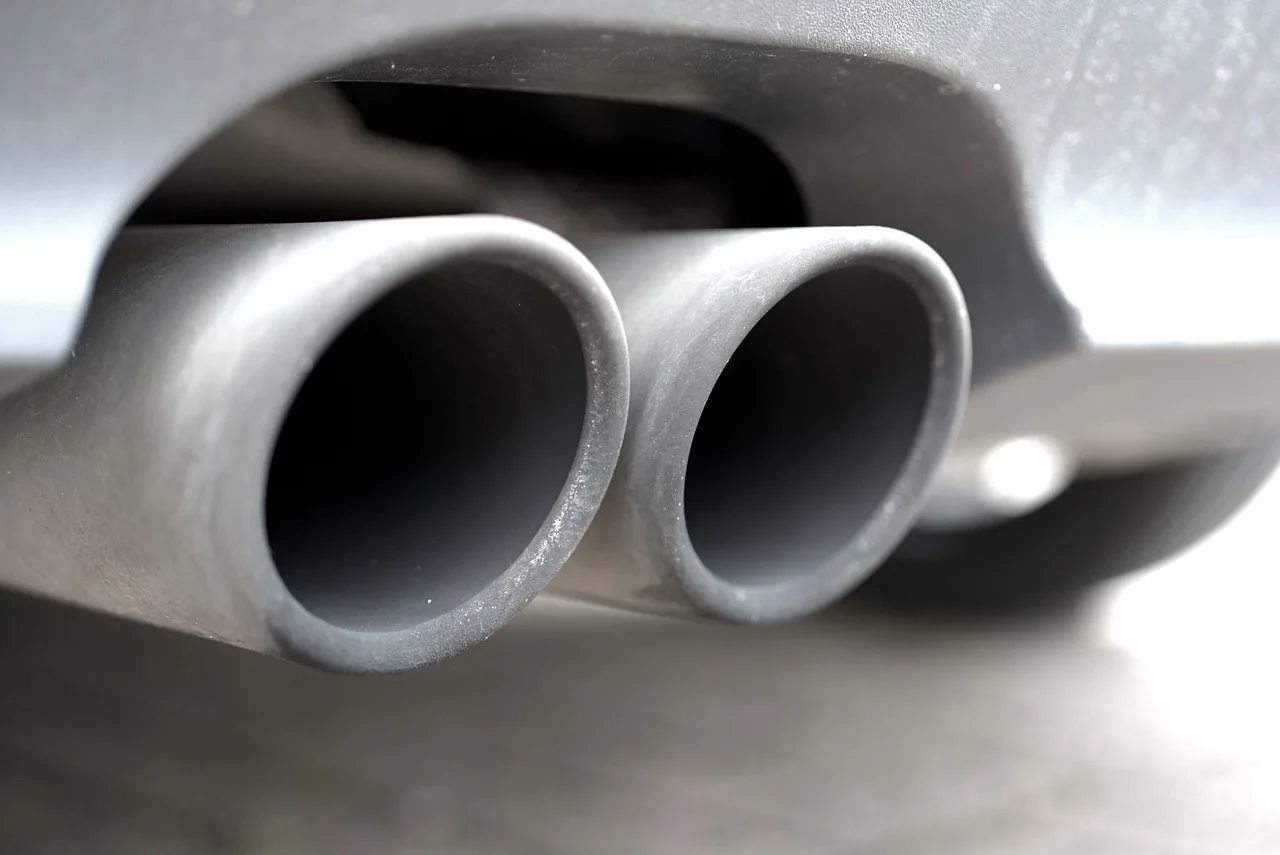
The best size is the smallest diameter that supports your airflow goal without creating excess restriction. Naturally aspirated engines usually want more attention to velocity and scavenging, while turbo engines want freer flow ahead of and through the turbine. Street use favors response; track use can justify more top-end flow.
Natural aspiration sizing rules of thumb
For a naturally aspirated street car, start by keeping the exhaust close to factory diameter unless the stock system is clearly restrictive. If you plan headers and tuning, a modest increase can make sense. If the car is daily-driven and low-rpm response matters, avoid jumping to a much larger pipe without a reason.
On stock naturally aspirated street cars, cat-back changes may only produce 2 to 6 horsepower. If your goal is sound and a slight response change, that can be enough. If your goal is a real power step, headers and ECU optimization matter more than a bigger rear section alone.
Turbo sizing rules of thumb
Turbo cars should be sized around the downpipe, catalytic converter, and power target. A simple exhaust upgrade on a stock turbo car may add 3 to 8 horsepower, while a setup with header, pre-pipe, high-flow catalytic converter, and ECU tuning can gain 10 to 25 horsepower. The right size depends on how much airflow the turbo system is moving.
For turbo use, the question is often not “How large can the pipe be?” It is “How much flow can you gain before spool and response suffer?” That is why a well-chosen downpipe and high-flow cat often matter more than an oversized tail section.
Street use versus track use
Street cars usually benefit from a balance of flow, noise control, and low-speed drivability. Track cars can tolerate more noise and some response tradeoff if the engine spends more time near redline. The same diameter can be right for one use and wrong for the other.
- Identify the bottleneck first: manifold or header, catalytic converter, downpipe, or rear section.
- Set the power target in crank or wheel horsepower, then keep the measurement type consistent.
- Choose diameter for the engine’s displacement and rpm range, not for the loudest sound.
- Plan for tuning if airflow, boost, or catalyst changes are significant.
- Leave room for daily driving comfort if the car sees city use.
Mufflers, resonators, and ECU tuning
Mufflers and resonators mainly control sound, but they can also add restriction if poorly designed. ECU tuning does not change pipe size, yet it often determines how much of the exhaust upgrade becomes usable power. The best result usually comes from matching all three parts to the same goal.
Sound control versus power change
Mufflers are built to reduce noise, and resonators help remove drone and harsh frequencies. Their power effect is usually small compared with headers, downpipes, or catalytic converters. Still, an overly restrictive muffler can trim flow at higher rpm.
For a daily driver, a resonator can be the difference between a pleasant exhaust note and a cabin drone that gets old fast. That tradeoff matters because a setup that sounds good on paper can be tiring on the highway.
How tuning affects fueling and timing
ECU tuning can adjust fueling, ignition timing, and boost control to match the new exhaust flow. On turbo cars, that is often required to reach the full gain. On naturally aspirated cars, tuning helps when the rest of the bolt-ons actually support more airflow.
Tuning also protects the engine from knock when airflow and exhaust temperature change. Without the right calibration, an exhaust upgrade may add sound, but leave power on the table.
Why tuning matters more on some setups
The more the exhaust change alters airflow through the engine, the more tuning matters. A simple rear muffler swap may need little or no calibration. A header, high-flow cat, downpipe, or turbo system usually benefits more from ECU changes because the airflow change is larger and more sensitive.
Frequently asked questions
Does a bigger exhaust give more power?
Only if the current exhaust is restricting flow. A bigger pipe can add power when the stock system is the bottleneck, but oversizing can reduce exhaust velocity and hurt low-rpm response. The right size depends on engine displacement, aspiration, rpm range, and whether the car is street- or track-focused.
Does a performance exhaust increase horsepower?
Sometimes, but not always by much. On stock naturally aspirated cars, a cat-back may add only 2 to 6 horsepower, and the change may be mostly sound. Bigger gains usually come when headers, catalytic converter flow, and tuning are part of the package.
How much horsepower does an exhaust add?
It depends on the setup. Some naturally aspirated cars see only 2 to 6 horsepower from cat-back changes, while stock turbo cars often gain 3 to 8 horsepower from a simple exhaust upgrade. With stronger supporting mods and tuning, turbo setups can gain 10 to 25 horsepower.
Will dual exhaust add horsepower?
Not by itself. Dual exhaust only helps if the total flow area and layout match the engine’s needs. On some engines it can reduce restriction and support more power, but on small or mild setups it can add weight, cost, and noise without a meaningful gain.
Does a larger exhaust always add horsepower?
No. A larger exhaust helps only when the factory system is the restriction. If the pipe is too large for the engine, it can reduce gas velocity, soften low-end torque, increase drone, or slow turbo response. The best size is the one that matches airflow demand.
What exhaust size is best for my engine: the best size depends
The best size depends on displacement, aspiration, and power goal. Naturally aspirated street cars usually do best with modest sizing changes, while turbo cars often respond more to downpipe and catalyst flow than to a large rear section. Start with the smallest size that will support your target power cleanly.