
Diesel Exhaust Manifold vs Header: What’s the Difference
On many diesels, the real comparison is factory exhaust manifold versus a turbo-manifold upgrade. A classic gas-style header swap is usually the wrong frame. Mixing up the parts can waste money, misfit the turbo, and leave you chasing leaks or cracked castings. This guide separates the terms, shows where diesel terminology stops matching the hardware, and points to the upgrade path that fits your engine.
| Decision factor | Diesel Exhaust Manifold | Header | Winner |
|---|---|---|---|
| Factory fitment | Built around OEM packaging, turbo placement, and emissions hardware. | Usually a tubular aftermarket part; fitment depends on the platform and chassis space. | Diesel Exhaust Manifold |
| Durability | Commonly cast iron or stainless steel, with long service life when heat cycles are managed. | Often steel tubing; good parts can last, but tube design and support matter a lot. | Diesel Exhaust Manifold |
| Flow and backpressure | Usually focused on packaging, sealing, and emissions control rather than peak flow. | Designed for lower backpressure and better scavenging. | Header |
| Towing and heat management | Better aligned with heat retention, turbo response, and OEM tow calibration. | Can help on some performance builds, but may change heat behavior and packaging. | Diesel Exhaust Manifold |
| Street legality on emissions-equipped trucks | Usually the safer path when kept stock or OE-equivalent. | Can trigger catalyst, DPF, or check-engine issues if the system is altered. | Diesel Exhaust Manifold |
Manifold comparison by application and engine type
The split is simple on paper and messy in real truck use. A diesel exhaust manifold is the OEM-style part that bolts to the cylinder head, gathers exhaust from each cylinder, and routes it toward the turbo or exhaust system, while a header is an aftermarket tubular part meant to reduce restriction and tune pulse timing. On many diesel platforms, the practical comparison is usually manifold versus turbo-manifold upgrade, rather than a classic gas header swap.

That difference matters because diesel packaging centers on turbo position, EGT control, and emissions hardware. If the truck has a DPF, catalyst, or tightly packaged turbo, the part choice is about fit and legality as much as flow. A part that sounds like a header in catalog language may still need to behave like a turbo manifold in the truck.
Manifold comparison table
| Use case | Typical material | Expected flow effect | Heat retention | Likely legality issues | Common failure mode | Used on this engine family? |
|---|---|---|---|---|---|---|
| Naturally aspirated gasoline | Cast iron or tubular steel | Header can reduce backpressure and improve scavenging | Header runs hotter on the outside; cast iron holds heat better | Possible catalyst and inspection issues with long-tube swaps | Crack, leak, warped flange | Yes, both |
| Turbo diesel | Cast iron or stainless steel | OEM manifold usually prioritizes turbo feed, not peak flow | High heat retention helps turbo response and packaging | Turbo, DPF, catalyst, and EGR packaging can make swaps noncompliant | Crack, leak, warped mounting surface | Mostly manifold; classic header is uncommon |
| Towing diesel | Cast iron or stainless steel | Modest gains matter less than stable exhaust flow under load | Often preferred for keeping heat in the stream | Inspection and emissions risk if the system is altered | Heat-cycle cracking, gasket leaks | Usually manifold |
| Emissions-equipped diesel | Factory cast iron manifold | Designed around stock turbo and aftertreatment placement | Supports EGT management and catalyst or DPF location | High risk if components are relocated or removed | Leak at flange, cracked runner | Manifold, not classic header |
| Performance diesel | Stainless steel or tubular steel | Can improve flow if the turbo manifold is designed for it | Varies by design and coating | Street legality depends on emissions equipment retention | Crack from poor support, warped flange | Sometimes, but platform-specific |
What is a diesel exhaust manifold?
A diesel exhaust manifold is the OEM-style part that bolts to the cylinder head, connects to each exhaust port, and funnels hot exhaust into one simple exhaust pipe or into the turbo inlet. It is usually built for fitment, longevity, and emissions control first. On V-shaped engines, there are typically two exhaust manifolds; on most inline engines, there is just one.

What it does on a diesel engine
On a diesel truck, the manifold has to feed the turbo cleanly and seal tightly under repeated heat cycles. That job is more about stable exhaust routing than about maximum horsepower. Good sealing also matters for EGT control, because leaks can upset turbo spool and sensor readings.
Common materials and fitment goals
Many factory pieces are cast iron exhaust manifolds. Cast iron exhaust manifolds are cheap to make and last a long time, so manufacturers use them often. They are also heavy and can become brittle over time, but they fit around turbos, steering shafts, frame rails, and aftertreatment hardware with less drama than thin tubing.
Exhaust manifolds are also made mostly from cast iron or stainless steel. Stainless steel is generally more corrosion-resistant than mild steel, so it is used in some higher-durability or performance-oriented applications. Good material does not prevent every crack if the runner layout, expansion space, or support is poor.
Cracks, leaks, and warping
Many people search for a manifold because of a repair problem, not an upgrade question. Common signs of a cracked diesel exhaust manifold include ticking under load, soot around the flange, a burnt smell in the engine bay, and a boost or EGT change that does not match the command from the turbo system. Warping and gasket leaks can show up the same way.
Say your tow rig starts ticking on cold start, then quiets down as the metal expands. That often points to a small leak that opens when the manifold is cold and closes as it heats up. The fix path is repair or replacement, not a performance header decision.
Do diesel engines actually use headers?
Sometimes, but not in the same way gasoline engines do. On many diesel trucks, the term “header” does not map cleanly onto the hardware because the engine uses a turbo manifold and downpipe arrangement instead of a classic bolt-on header set. That is why the usual manifold-versus-header comparison often breaks down on diesel platforms.
Why the term changes on turbo diesels
Classic headers are designed to gather pulses from individual cylinders, use tuned primary tubes, and feed a collector. Diesel turbo systems already change the exhaust path at the turbine housing, so the real decision is often whether the manifold and turbine inlet are shaped for flow, heat, and packaging. A tube-shaped part can still be called a header in catalog language, but that does not make it a gas-car style swap.
Turbo manifold versus classic header
For a turbo diesel, the manifold is part of the turbo system. The outlet, the turbine flange, the downpipe, and the aftertreatment package all interact. A part that improves pulse timing on a naturally aspirated engine may offer less obvious benefit when the turbo already dominates exhaust flow.
Picture a pickup with a stock DPF, factory turbo, and a tight engine bay. A long-tube-style header concept would collide with packaging, heat shields, and emissions hardware long before it delivered an easy gain. That is why diesel owners usually compare OEM manifold upgrades, turbo manifolds, and downpipe changes instead.
How flow, backpressure, and scavenging differ
Backpressure is exhaust flow resistance. Headers are associated with lower backpressure because tubular primaries and a tuned collector can move exhaust more freely than a heavy cast piece. Scavenging is the pressure-wave help that clears exhaust gases from the cylinder, and it depends on primary length, collector design, and pulse timing.
Backpressure on a diesel truck
Lower backpressure can help horsepower, torque, and throttle response, but the value depends on the engine and the use case. On a diesel tow rig, a small gain in peak flow may matter less than maintaining heat in the exhaust stream for turbo response and aftertreatment function. That is why a freer-flowing design is not automatically the better pick.
Scavenging and collector design
The collector merges the primary tubes. A 4-1 collector combines four primaries into one outlet and tends to favor higher-rpm flow. A Tri-Y design pairs cylinders in stages and can support a broader torque curve. That difference matters much more on a gas performance build than on a typical diesel truck, but the principle still explains why headers are built the way they are.
Why equal-length tubes matter
An equal-length header keeps the primary tubes matched so exhaust pulses arrive at the collector with more consistent timing. That can improve scavenging and make tuning more predictable. Shorty, mid-length, and long-tube versions mostly describe gasoline-engine fitment choices; they are not the normal frame for diesel truck selection.
Materials, heat, and durability
Material choice shapes more than corrosion resistance. It affects warmup, heat retention, crack resistance, packaging, and how well the part survives repeated load cycles. On diesels, those factors can matter more than a small flow gain.
Cast iron versus tubular steel
Cast iron exhaust manifolds are common factory parts because they are cheap to make and last a long time. They also hold heat well, which helps maintain exhaust energy for the turbo. Tubular steel headers are lighter and freer-flowing, but they place more weight on welds, bends, and mounting support.
Stainless steel and coating choices
Stainless steel or coated tubular designs can resist corrosion better than mild steel. That does not make them crack-proof. Poor weld quality, weak flanges, and bad bracing still cause failures, especially where vibration and heat cycling are severe.
Heat retention and crack resistance
Heat retention is a real diesel concern because the turbo, sensors, and aftertreatment all live close to the exhaust path. A part that throws off too much heat into the bay can stress nearby components. A part that runs too cool can affect energy in the exhaust stream and change how the turbo responds.
A common first-timer mistake is choosing a shiny tubular part for a diesel build because it looks like a performance gain on paper. If the truck is a work rig with a factory turbo and emissions equipment, durability and packaging usually matter more than chasing a header-style flow claim.
Choose Diesel Exhaust Manifold if… / Choose Header if…
Choose Diesel Exhaust Manifold if you need factory fitment, towing reliability, emissions control, or a repair that matches the original turbo and exhaust layout. It is also the safer choice when the truck has a DPF, catalyst, EGR hardware, or inspection rules that make modified exhaust parts a liability.
Choose Header if your platform actually supports one, you are working on a performance-focused build, and you can keep the rest of the exhaust path consistent with the new flow. That decision makes more sense on naturally aspirated gasoline engines or on a diesel platform with a specific turbo manifold upgrade engineered for the truck.
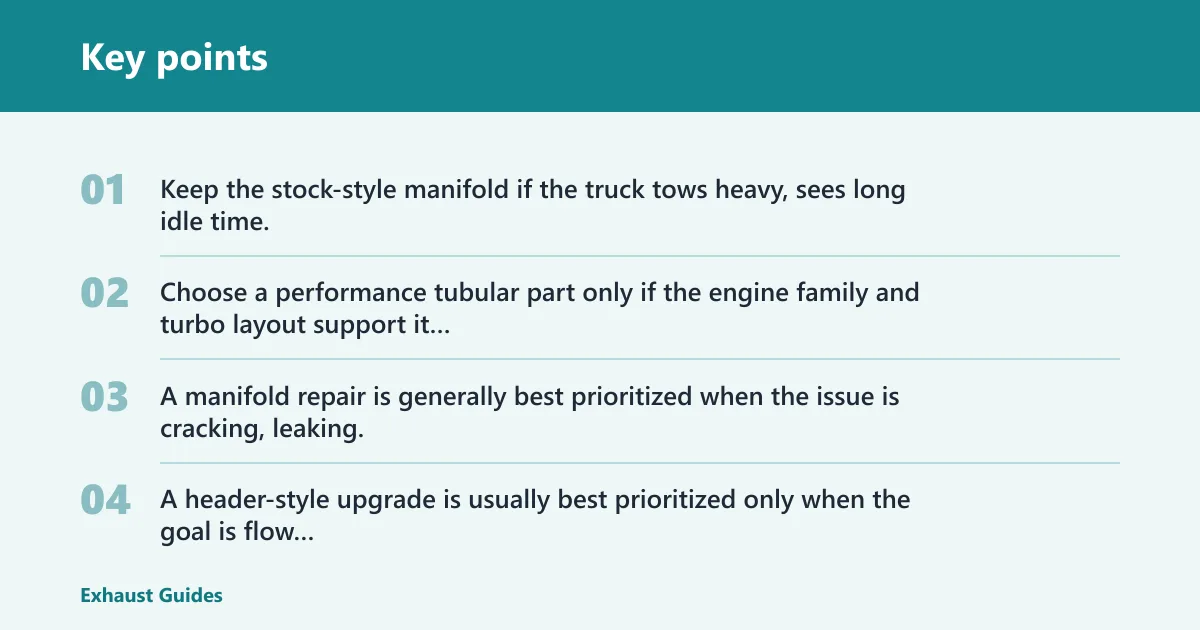
- Keep the stock-style manifold if the truck tows heavy, sees long idle time, or must pass emissions inspection.
- Choose a performance tubular part only if the engine family and turbo layout support it without fighting the turbo flange or aftertreatment package.
- A manifold repair is generally best prioritized when the issue is cracking, leaking, or warping rather than a desire for more power.
- A header-style upgrade is usually best prioritized only when the goal is flow improvement and the installation does not force illegal emissions changes.


Are diesel headers legal for street use?
Sometimes, but the answer is far less forgiving than many shopping pages suggest. On emissions-equipped diesels, legality depends on whether the catalytic converter, DPF, sensors, and other required parts stay in place and function as intended. A header or turbo manifold swap can also trigger a check-engine light if sensor placement or flow changes upset the calibration.
Catalytic converter and DPF placement
If a modified exhaust part changes the location of the catalyst or DPF, the truck may no longer be street legal in many areas. On diesels, those parts are not side notes. They are part of the system the vehicle was certified around, and moving them can create inspection problems even if the truck still runs well.
Check-engine light and inspection risk
Inspection failures are often reported to come from readiness monitors, missing sensors, or visible hardware changes. Even a well-made stainless piece can create legal trouble if it requires deleting or relocating emissions equipment. For a road-driven diesel, legality can matter more than a small gain in flow.
Frequently asked questions
What is the difference between a diesel exhaust manifold and a header?
A diesel exhaust manifold is the OEM-style part that collects exhaust from each cylinder and routes it toward the turbo or exhaust system. A header is usually a tubular aftermarket part built for lower backpressure and better scavenging. On diesels, the comparison often shifts to turbo manifold versus factory manifold.
Are headers better than manifolds on a diesel truck?
Not by default. Headers can improve flow, but diesel trucks often need heat retention, turbo response, towing stability, and emissions compliance more than peak flow. If the truck uses a turbo manifold and aftertreatment package, the factory-style manifold may be the better practical choice.
Will a header improve diesel performance or just sound?
It can improve performance when the design fits the engine family and the turbo system, but sound is not the main reason to buy one. On a diesel, any gain should come from better flow, less backpressure, and more effective pulse timing. If those gains are small, the change may not be worth the trade-offs.
Can I replace my diesel exhaust manifold with a header?
Sometimes, but only if the platform supports that swap and the turbo, sensors, and emissions parts still fit correctly. On many diesel trucks, a true header swap is not the right frame because the engine depends on a turbo manifold layout. A cracked manifold repair is a different job from a performance upgrade.
Why are stock exhaust manifolds made from cast iron?
Cast iron exhaust manifolds are cheap to make and last a long time. They also handle heat well and are easy for manufacturers to package around turbos, steering, and emissions equipment. The trade-off is weight and the chance of brittleness after many heat cycles.