How Much Does It Cost to Replace an Oxygen Sensor?
Replacing an oxygen sensor at a shop usually costs about $150 to $450, and diagnosis can add about $100 to $150 if the fault code is not already confirmed. Ignore a bad sensor long enough, and you can waste fuel, fail an emissions test, or hide misfires and exhaust leaks. Here is how part type, access, and the failure mode change the bill, plus when DIY makes sense.
Oxygen sensor replacement cost
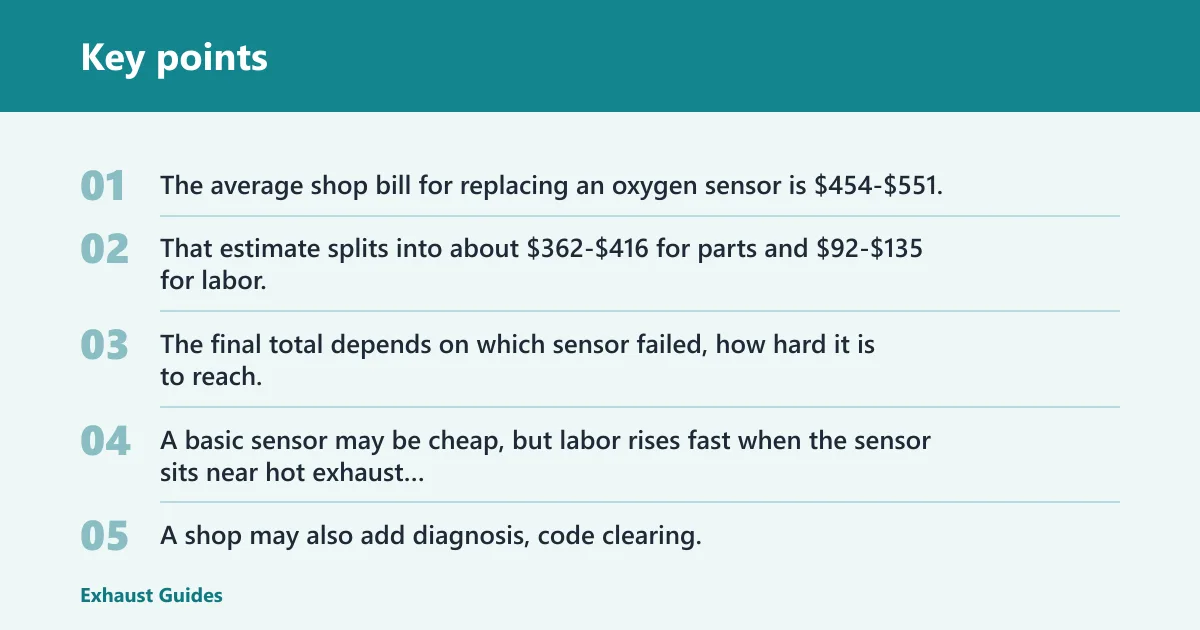


The average shop bill for replacing an oxygen sensor is $454-$551. That estimate splits into about $362-$416 for parts and $92-$135 for labor. The final total depends on which sensor failed, how hard it is to reach, and whether the threaded bung is clean enough to remove the old sensor without extra work.
Parts versus labor
Parts are only part of the story. A basic sensor may be cheap, but labor rises fast when the sensor sits near hot exhaust hardware, behind shields, or deep under the car where access is tight. A shop may also add diagnosis, code clearing, or rust cleanup if the job is not straightforward.
DIY parts-only range
DIY replacement can cost $20-$300 per sensor for parts alone. That range is wide because some sensors are simple replacement pieces while others are vehicle-specific and more expensive. A DIY job stops being much cheaper if you still need a scan tool, an oxygen sensor socket, penetrant, or a shop visit for seized threads.
What changes the bill
Vehicle type affects the quote, and exhaust layout does too. A sensor in an easy-to-reach spot takes less shop time, while one buried near the catalytic converter can push labor higher. Heat shields, rusted fasteners, and exhaust disassembly can add time even when the sensor itself is not expensive.
Vehicle class and engine layout
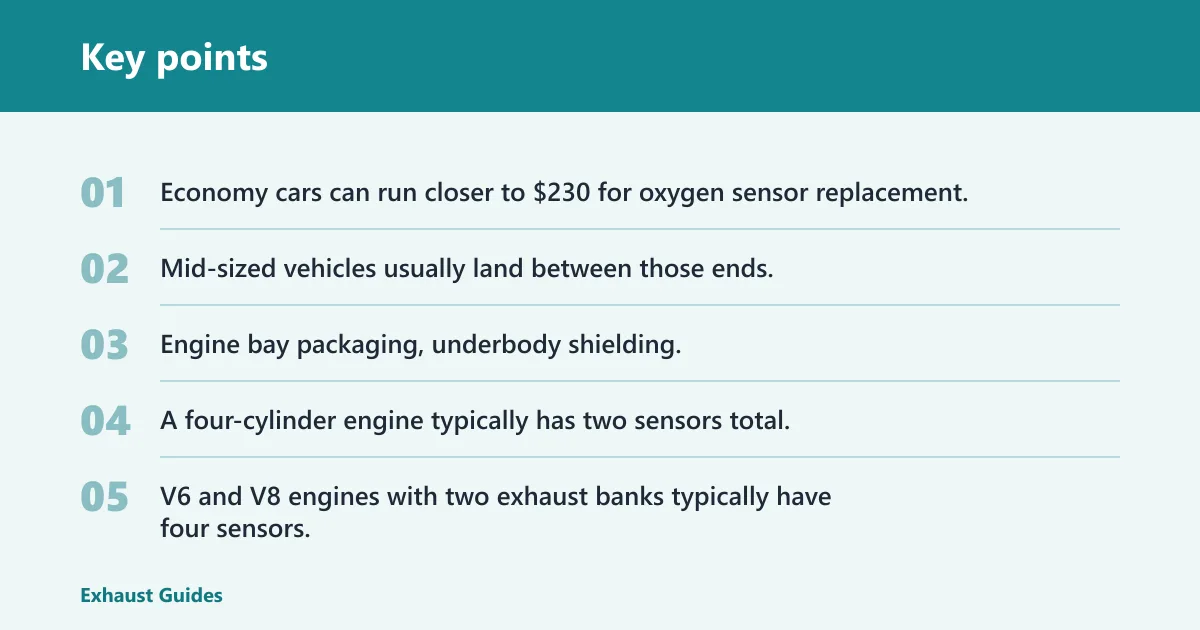
Economy cars can run closer to $230 for oxygen sensor replacement, while luxury models can push past $500 for the same repair. Mid-sized vehicles usually land between those ends. The reason is not just parts pricing. Engine bay packaging, underbody shielding, and access to the sensor bung can change the labor quote.
Most vehicles have 2-4 sensors. A four-cylinder engine typically has two sensors total. V6 and V8 engines with two exhaust banks typically have four sensors. That count matters because a shop may quote the failed sensor only, not the whole set.
Upstream versus downstream access
Upstream sensors sit before the catalytic converter, close to the engine. They are often more important for diagnosis because they help the engine computer trim fuel mixture. They are also often harder to reach than downstream sensors, which sit after the catalytic converter and mainly monitor catalyst performance.
Downstream sensors can be easier to reach on some cars, but not always. On a tight exhaust layout, the downstream sensor may still be buried in shielding or close to the floor pan. Upstream and downstream sensors are not interchangeable, so the quote must match the exact position and part number.
Rust, heat shields, and thread damage
Labor climbs when the sensor is seized in the bung, the connector is heat-damaged, or the exhaust needs to cool and come apart before removal. If the threads strip, a shop may need thread repair before the new sensor goes in. That hidden step can turn a simple replacement into a longer exhaust repair.
Suppose a midsize sedan has a P0135 code and the upstream sensor is behind a heat shield near the manifold. A cheap sensor may still end up with a larger bill because the shield has to come off and the fastener is rusted. The part price did not change. The labor did.
Upstream versus downstream sensor costs
Upstream sensors often cost more to replace in practice because they are harder to access and more likely to be blamed for drivability symptoms. Downstream sensors may be simpler on some vehicles, but the quote still depends on the exhaust route, connector placement, and whether the technician has to work around the catalytic converter or shielded pipe sections.
Why upstream sensors often cost more
Upstream sensors are usually closer to the engine and hotter in service. That location can mean tighter access, more rust, and more heat damage to the connector. They also play a bigger role in fuel control, so diagnosis may take longer if the check engine light points to a fuel-trim issue rather than a clearly failed heater circuit.
When downstream sensors are easier to reach
Some downstream sensors are installed in a straight pipe section where a socket fits cleanly and the harness is easy to unplug. In those cases, labor stays lower. Other vehicles route the downstream sensor above a crossmember or behind a shield, and the price difference narrows fast.
How much does it cost to replace an oxygen sensor in a car?
For a typical car, the replacement can land anywhere from about $230 on an economy model to well past $500 on a luxury model. The average shop estimate is $454-$551, but the final quote depends on engine layout, sensor location, and whether the failed sensor is the upstream or downstream unit.
Economy-car estimate
Economy cars can run closer to $230 for oxygen sensor replacement. These vehicles often have easier access and lower parts prices. Even so, a rusted exhaust fastener or damaged connector can move the total above that starting point.
Midsize-car estimate
A midsize vehicle usually falls near the middle of the average range, especially if the sensor is reachable from below without exhaust disassembly. Expect the quote to reflect both the part and the time needed to remove and install it cleanly, then clear the code and verify the repair.
Luxury-vehicle estimate
Luxury models can push past $500 for the same repair. Tighter packaging, higher parts pricing, and more involved access are common reasons. If the oxygen sensor is mounted near the catalytic converter or behind substantial shielding, the labor line may matter as much as the sensor itself.
How much does it cost to replace an oxygen sensor bank 1?
Bank 1 means the side of the engine that contains cylinder number one. On a V-type engine, that detail matters because bank 1 and bank 2 are different exhaust sides, and the wrong choice can send you to the wrong sensor. The cost depends more on location and access than on the bank label alone.
Bank 1 versus bank 2 on V engines
On V6 and V8 engines, two exhaust banks usually mean four oxygen sensors total. Bank 1 may have an upstream sensor and a downstream sensor, just like bank 2. The code tells the technician which side to inspect, which avoids replacing the wrong part and paying for a second diagnosis later.
Why the code matters for the quote
OBD-II trouble codes often point to a specific bank and sensor position, such as an upstream heater fault or a slow downstream response. That code helps the shop price the exact job. If the code is unclear, diagnosis may add a separate fee before any parts are installed.
Oxygen sensor cost matrix
This matrix shows how the quote changes with layout, part type, and access. It also separates the hidden items that often surprise drivers at the counter.
| Vehicle layout | Sensor position | Part price range | Labor-time range | Common add-on costs |
|---|---|---|---|---|
| Economy four-cylinder | Upstream, easy access | $20-$120 | 20-40 minutes | Diagnosis $100-$150; code clearing; minor rust cleanup |
| Economy four-cylinder | Downstream, moderate access | $20-$120 | 30-45 minutes | Diagnosis; rusted fastener cleanup; code clearing |
| Midsize V6 | Upstream, tight access | $60-$180 | 40-60 minutes | Diagnosis; heat shield removal; code clearing |
| Midsize V6 | Downstream, underbody mount | $60-$180 | 30-50 minutes | Rust cleanup; possible thread repair; code clearing |
| Luxury V8 | Upstream, shielded and hot-side | $120-$300 | 45-60 minutes | Diagnosis; heat shield work; thread repair; code clearing |
| Luxury V8 | Downstream, complex exhaust route | $120-$300 | 40-60 minutes | Diagnosis; rusted fastener cleanup; thread repair; code clearing |
How much cost replace decision checklist
| Check item | DIY usually fits | Shop is usually smarter |
|---|---|---|
| Sensor access | Straightforward reach with a basic socket | Tight access, heat shields, or underbody disassembly |
| Fastener condition | Threads look clean and move easily | Sensor is seized, rusted, or rounded |
| Tools on hand | Oxygen sensor socket, hand tools, scan tool | Specialty tools still need to be bought or borrowed |
| Fault confirmation | Code already points to one sensor | Diagnosis still needed to confirm the failure mode |
| Thread condition | Bung looks intact | Thread repair may be needed |
| Cost comparison | Parts-only total stays well below shop labor | Tool cost and rework erase the savings |
A common first-timer mistake is ordering a universal oxygen sensor when your vehicle needs a direct-fit part, which can change the total replacement cost. Say your check engine light points to Bank 1 Sensor 1 on a V6. If you order the downstream sensor for Bank 2 instead, the connector may fit poorly or the part may be wrong altogether. Match the code before you spend on parts.
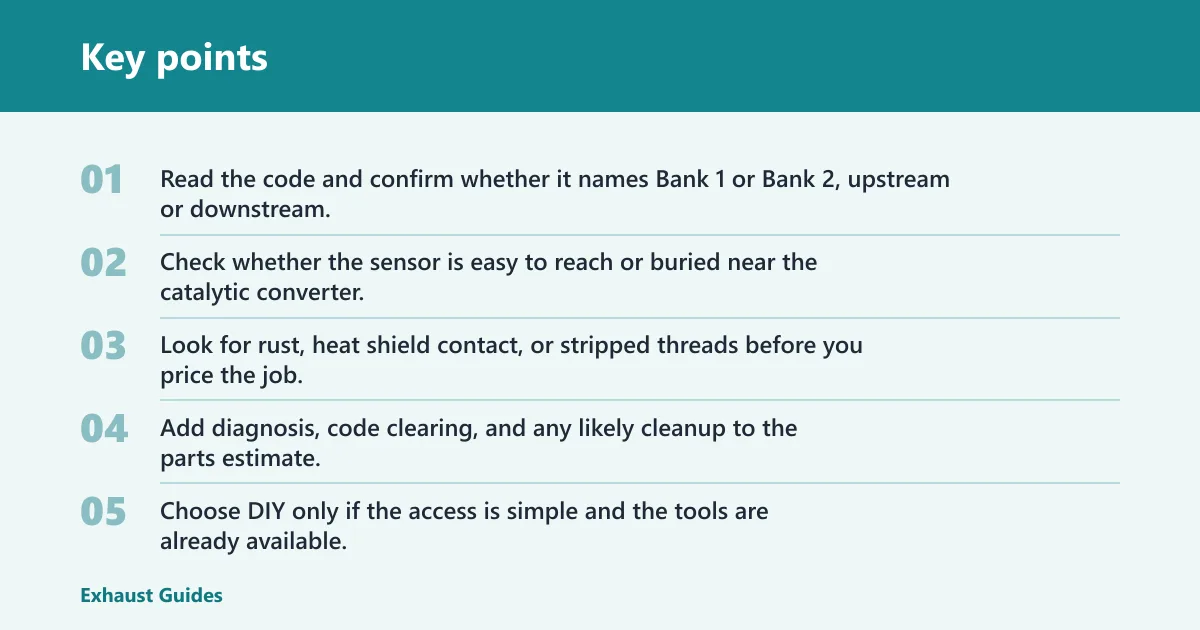
- Read the code and confirm whether it names Bank 1 or Bank 2, upstream or downstream.
- Check whether the sensor is easy to reach or buried near the catalytic converter.
- Look for rust, heat shield contact, or stripped threads before you price the job.
- Add diagnosis, code clearing, and any likely cleanup to the parts estimate.
- Choose DIY only if the access is simple and the tools are already available.
Should you replace one sensor or all of them?
In most cases, replace only the failed sensor. A bad oxygen sensor does not mean the others are worn out, and the article notes that only the failed sensor usually needs replacement. Replacing every sensor at once often adds cost without solving anything that is not already broken.
When only the failed sensor needs replacement
If the code names one sensor and the others are performing normally, a single replacement is the normal repair. That is especially true when the car has moderate mileage and there is no evidence of widespread wiring or exhaust damage. Upstream and downstream sensors should still be matched to the correct bank.
When high mileage may justify more than one
On a high-mileage vehicle, one aged sensor can mean the others are not far behind. If the car has several original sensors, rough idle history, or multiple sensor-related codes, a shop may recommend replacing more than one during the same visit to avoid repeated labor charges.
What a second repair soon after can mean
If another sensor fails soon after the first, that does not automatically mean the first repair was wrong. It may simply mean the rest of the sensors are also old. It can also point to exhaust leaks, wiring damage, or a catalytic converter issue that was already affecting sensor readings.
Consequences of ignoring a bad oxygen sensor
A faulty oxygen sensor can hurt fuel economy, trigger the check engine light, and cause failed emissions tests. If the engine runs too rich for too long, the catalytic converter can be stressed by excess fuel in the exhaust stream. That is why a small sensor fault can become a larger exhaust repair.
Picture a compact sedan with a persistent check engine light and a rich-running code. If the owner keeps driving for months, fuel economy can drop and the converter can overheat from prolonged misfueling. The sensor may still be the first failure, but the longer damage can cost far more.
Frequently asked questions
How much does it cost to fix an oxygen sensor?
Fixing an oxygen sensor usually means replacing the failed unit, not repairing the sensor element itself. The shop price often lands within the $454-$551 average, but diagnosis, rust cleanup, and code clearing can add to the bill. DIY parts-only cost can be $20-$300 per sensor.
How much does it cost to install an oxygen sensor?
Installation alone is usually folded into the labor charge, which averages $92-$135 in the cited estimate. If the sensor is easy to reach, the job may take 20 minutes to an hour at a shop. Hard access, rust, or thread repair can raise the labor line.
How much does it cost to replace an upstream oxygen sensor?
Upstream sensors often cost more to replace because they sit before the catalytic converter and are usually harder to access. The sensor itself may not be the expensive part; labor is what moves the quote. Expect the repair to depend heavily on vehicle type and exhaust packaging.
How much does it cost to change an O2 sensor?
Changing an O2 sensor usually costs the same as replacing an oxygen sensor. The average shop total is $454-$551, but a simple economy-car job can be much lower. If the old sensor is seized or the bung is damaged, the cost can climb quickly.