Best Exhaust Clamps for Repairs (2026): Research Shows
Byline: Exhaust repair guide editorial staff
Experience: This guide is built around shop-standard exhaust repair procedures: matching clamp style to joint geometry, checking OD-to-ID fit before installation, and rechecking sealed joints after heat cycling so repeat leaks are less likely on serviceable systems.
Use a band or U-bolt clamp only when the joint can compress evenly; for slip-fit and welded-overlap repairs, choose a wide band or preformed sleeve, while crushed or flared pipe usually needs replacement before clamping. Wrong clamp choice leaks again, overheats nearby hangers and sensors, and can turn a simple repair into a cut-and-rework job. This guide compares band, U-bolt, sleeve, and specialty clamps by joint shape, pipe condition, and reuse needs.
Quick comparison
| Product | Badge | Best for | Price | ||
|---|---|---|---|---|---|
 | Elifecenter Heavy Duty 2.5" 2-1/2 Inch Exhaust U Bolt ClampeLifecenter | Our pick | 2.5 inch · 2-pack · U-bolt clamp | $11.99 Price as of 28 Oct 2026 | View |
 | Exhaust Band Clamp 2.5 Inch Joint Exhaust Pipe MufflerShineyoo | Pair with it | 2.5 inch · 4-pack · band clamp | $26.99 Price as of 28 Oct 2026 | View |
The right clamp starts with the joint, not the brand. Match the overlap first, then check whether the pipe stays round under load. That is what gives a clamp a real chance to seal after heat cycling.
If the tube is ovalized, split, or short on overlap, the buying decision changes fast. In those cases, the clamp is the wrong repair, not just the wrong part.
How we chose
The comparison below starts with fit. It weighs joint geometry, pipe condition, sealing behavior after heat cycling, and whether the part can be removed and reused later.
304 stainless steel matters for under-vehicle exposure because it resists corrosion and handles exhaust heat well. Fit still matters more than material, though, a stainless clamp can still leak if the pipe size or joint style is wrong.
We also separated quick fixes from durable repairs. A clamp can be the right answer for a muffler or tailpipe connection, but a crushed edge, torn seam, or badly expanded tube often calls for replacement, sleeve repair, or welding.
Which exhaust clamp should I use?
- Fits 2.5-inch exhaust pipe
- Heavy-duty saddle design with reinforced ribs
- Reusable, no-welding installation
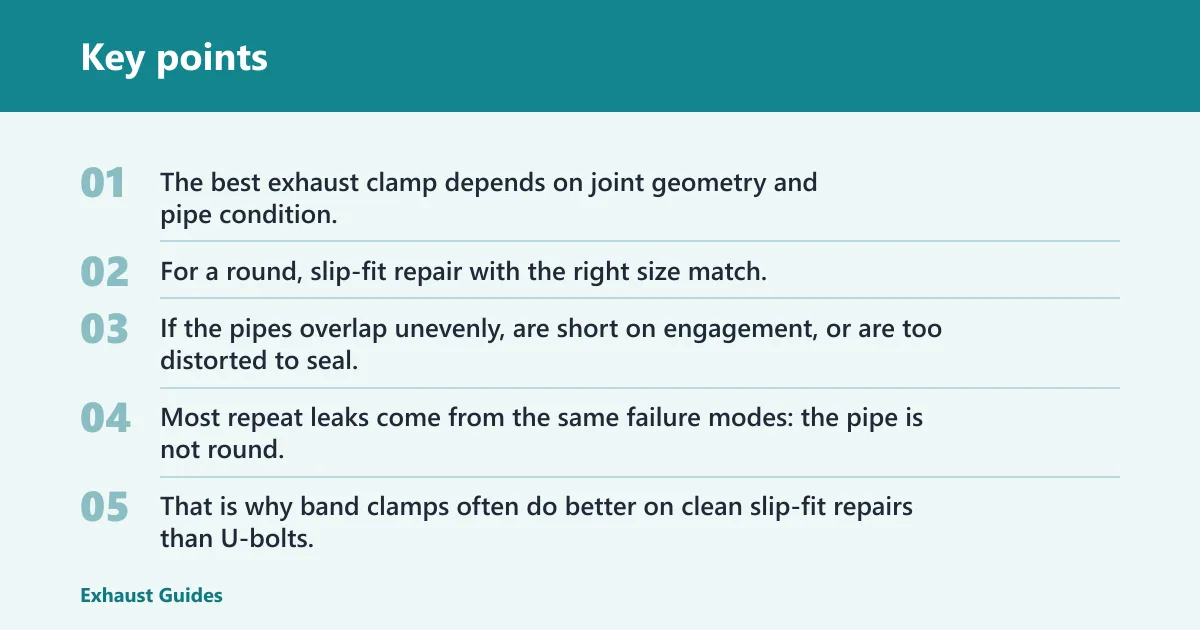
The best exhaust clamp depends on joint geometry and pipe condition. For a round, slip-fit repair with the right size match, a wide band clamp is usually the cleanest sealing choice. If the pipes overlap unevenly, are short on engagement, or are too distorted to seal, a clamp may fail and the pipe may need repair or replacement first.
Joint type and pipe condition
- 304 stainless steel resists corrosion
- Joins 2.5-inch OD to 2.5-inch ID pipe
- Simple, effective for exhaust components
| Joint type | Pipe condition | Best clamp type | When it fails | Reusable? |
|---|---|---|---|---|
| Slip-fit | Round pipe, correct diameter, clean overlap | Band clamp | Pipe is ovalized, heavily rusted, or the sizes do not match | Usually yes |
| Overlapped repair | Two pipes already nested with enough overlap | Lap-joint clamp | Overlap is too short or one pipe is badly expanded | Often yes |
| End-to-end repair | Square cuts, close alignment, tight clearance | Butt-joint clamp | Cuts are angled or the pipes cannot line up closely | Often yes |
| Older overlapped exhaust | Rust-belt pipe, quick fix needed | U-bolt clamp | Can deform the pipe and may leak after heat cycling | Sometimes |
| Turbo or performance system | Welded flanges already installed | V-band clamp | Flanges are misaligned or welded off-center | Yes |
When the clamp fails
Most repeat leaks come from the same failure modes: the pipe is not round, the overlap is wrong, or the clamp was tightened enough to distort the tube before it sealed. That is why band clamps often do better on clean slip-fit repairs than U-bolts; band clamps spread clamping pressure over a larger area than U-bolts.
A clamp also fails when the joint edge is damaged. A cracked flare, torn lip, or short overlap gives the clamp nothing stable to compress.
Reusable or one-time use
Reuse matters on stainless systems, where a clamp may come off later for muffler work, sensor access, or tailpipe replacement. In that case, a removable band or V-band setup is easier to service than a crushed repair that has already deformed the pipe.
Rust-belt repairs are less forgiving. If the pipe wall is thin from corrosion, a clamp may hold for a while but become nonserviceable once the metal starts to split under load.
Band clamp: best for clean sealing
A band clamp is the best starting point for a round, slip-fit exhaust repair because the wide stainless band spreads pressure more evenly and helps keep the pipe round. It is the cleanest sealing choice when the joint is sized correctly and the overlap is sound.
Band clamps spread clamping pressure over a larger area than U-bolts. That even distribution is why they are common on mufflers, tailpipes, and other places where vibration resistance matters.
Slip-fit joints and round pipe
Band clamps work best when one pipe slides into another with a proper fit. Lap-joint clamps are made for one pipe that slides over another, and band clamp kits often appear in that same use case when the pipe ends are round and aligned.
Some product listings call out lap-joint and butt-joint styles within the band-clamp family. The style matters more than the name on the package.
Why wide bands seal more evenly
Wide stainless bands seal more cleanly because they distribute force over a larger section of pipe. That lowers the chance of a ridge leak at the clamp edge and reduces the odds of pinching one side while leaving the other side loose.
Say your 2.5-inch tailpipe is round, but the old clamp left a dented ridge where the leak started. A wide band clamp can usually seal that joint better than a narrow U-bolt because the load is spread out instead of concentrated in two points.
U-bolt clamp: best budget repair
A U-bolt clamp is the economical repair option for an overlapped exhaust joint. U-bolt clamps use a U-shaped bolt, saddle, and nuts to compress an overlapped exhaust joint, which makes them simple and common on older vehicles and quick fixes.
That simplicity comes with a tradeoff. The same concentrated pressure that makes a U-bolt cheap can also deform pipe and leave a leak path after heat cycling.
Overlap repairs on older systems
U-bolt clamps are often used when the pipe already overlaps and the goal is to get the vehicle back on the road with minimal parts. They are common on older vehicles where corrosion has left limited options, and where appearance is less important than function.
Where it can deform pipe
A U-bolt clamp can squeeze the pipe oval or flatten a thin wall. Once that happens, the clamp may stop sealing evenly, especially if the pipe heats and cools repeatedly.
For a fast, low-cost fix on a muffler tailpipe joint, that may be acceptable. For a system that must stay clean and removable, it is a weaker choice than a band clamp.
Lap-joint clamp: best for overlapped pipes
A lap-joint clamp is built for overlapped pipe connections. Lap-joint clamps are made for one pipe that slides over another, and the clamp must match the larger outer pipe so the joint can compress without leaving a gap.
This style is common for mufflers and tailpipes because those parts often meet with one tube nested over another. The fit has to be right before the clamp goes on.
OD-to-ID fit requirements
Lap-joint clamps need a matching outside diameter to inside diameter relationship. Some product pages and fitment guides for 2.5-inch clamps show why the exact pipe fit matters instead of just the nominal size on the box.
The same point applies to 2.25-inch clamps and other common sizes: one clamp can be listed for an inside-diameter pipe, while another is listed for an outside-diameter pipe. Those are not interchangeable without checking the actual pipe ends.
Sizing the larger outer pipe
With lap-joint repairs, size the clamp to the larger outer pipe and confirm the inner pipe can slide in without forcing the joint open. If the overlap is too short, the clamp can only squeeze a bad fit tighter.
Some listings also cover broader ranges; some clamps are designed for 2.0-inch to 3.0-inch outer diameters, and fitment guides say to measure both OD and ID before installation. That is the safest way to handle odd or expanded tubing.
Butt-joint clamp: best for tight clearances
A butt-joint clamp joins pipes that meet end to end rather than overlapping. Butt-joint clamps connect two pipes that meet at their ends rather than overlap, and they are useful when welding is not preferred but the clearance is too tight for an overlapping repair.
This style depends on square cuts and close alignment. If the pipe ends are crooked, the clamp will fight the joint instead of sealing it.
End-to-end pipe repairs
Butt-joint clamps are useful when you want to preserve ground clearance or avoid the bulk of an overlap sleeve. That makes them a practical choice near heat shields, hangers, and suspension parts where extra diameter can create fit problems.
Square cuts and alignment
The pipe ends need to meet squarely and stay centered under the clamp. If one end is angled, the clamp may tighten on one edge and leave the opposite side leaking.
A small butt-joint band exhaust clamp is one example of the style used where space is limited and alignment is already close.
V-band clamp: when should you use it?
Use a V-band clamp when the exhaust already has welded flanges and you want a compact, removable joint. V-band clamps use matching flanges welded to each exhaust component, so they are best for turbo and performance systems that need frequent service access and precise alignment.
They are not a substitute for a loose slip fit. If the flanges are off-center, the clamp will not compensate for that error.
Turbo and performance exhausts
V-band clamps are common on turbo systems, downpipes, and performance exhausts because they hold firmly in a small space and come apart cleanly later. That serviceability is the main advantage.
Welded flange alignment
The flanges must sit squarely against each other before tightening. If they are misaligned, the joint can leak even with a good clamp because the seal depends on the flange faces being matched.
Clamp fitment decision table
This table turns the joint shape into a buying decision. Use it before you order anything, especially on odd tubing where nominal diameter alone does not tell the whole story.
| Joint type | Best clamp type | Failure mode | Reuse status |
|---|---|---|---|
| Round slip-fit | Band clamp | Leaks if the pipe is oval or the overlap is too short | Reusable on intact stainless systems |
| Overlapped repair | Lap-joint clamp | Leaks if OD-to-ID fit is wrong or the outer pipe is expanded | Usually reusable |
| End-to-end repair | Butt-joint clamp | Leaks if cuts are not square or the pipes sit off-center | Often reusable |
| Older rusted joint | U-bolt clamp | Pipe can deform and leak again after heat cycling | Sometimes reusable |
| Welded flange joint | V-band clamp | Leaks if flanges are misaligned | Yes |
Leak-check checklist after install
- Confirm the clamp matches the joint type and the measured OD or ID.
- Center the pipe before tightening so the joint stays round.
- Tighten the clamp evenly until the joint is snug, not crushed.
- Apply exhaust sealant only if the clamp and joint style allow it, and use it as a thin repair augmentation rather than a substitute for a poor fit.
- Start the engine and listen for ticking or puffing at the seam.
- After a full heat cycle, recheck the clamp because the metal can settle.
- Inspect hangers, sensors, and nearby shields for heat or vibration contact.
Which one should you buy?
If you want the cleanest seal on a round slip-fit repair, start with the Shineyoo 2.5-inch band clamp. Based on the product details and the clamp style, it is the better fit for corrosion resistance and even clamping on 2.5-inch OD-to-ID joints.
If you need the cheapest practical fix for an overlapped joint, the eLifecenter 2.5-inch U-bolt clamp is the budget play. It is a better match for older systems and quick repairs, but it is also more likely to deform pipe than a wide band clamp.
For muffler and catalytic converter connections, the choice is mostly about joint shape and vibration resistance. A band or lap-joint clamp is usually better when the pipe is round and the fit is correct; a U-bolt is the fallback when cost matters more than finish.
Choose 304 stainless steel whenever the clamp will live under the vehicle for a long time. It is the safer material for corrosion resistance and high-temperature exposure, especially where road spray and winter salt are part of the job.
A common DIY mistake is choosing an exhaust clamp without checking the pipe’s wall thickness and joint style. A 2.5-inch clamp still has to match the actual OD and ID relationship, and odd or expanded tubing may need a different style even when the nominal size looks right.
Frequently asked questions
What is the best exhaust clamp type for a leak-free repair?
For a round slip-fit exhaust repair, a wide band clamp is usually the cleanest sealing choice because it spreads pressure over a larger area. If the joint overlaps unevenly, a lap-joint clamp may fit better. If the pipe is crushed or flared badly, a clamp may not be enough.
Should I use a band clamp or a U-bolt clamp on my exhaust?
Use a band clamp when you want more even sealing and less pipe distortion. Use a U-bolt clamp when the repair is simple, the budget is tight, and the joint already overlaps well. U-bolt clamps are built to compress an overlapped exhaust joint.
What size exhaust clamp do I need for a 2.5 inch pipe?
A 2.5-inch clamp is only correct if the measured pipe size and joint style match that part. Some listings cite 2.5-inch exhaust clamps for 2.5-inch OD to 2.5-inch ID connections, so you should measure both OD and ID before buying. Do not rely on the nominal size alone.
Can a clamp seal an exhaust leak without welding?
Yes, if the pipe is round, the cut or overlap is sound, and the clamp matches the joint. A clamp is not a cure for torn metal, bad alignment, or a split edge. In those cases, welding, sleeve repair, or pipe replacement is the better fix.
What is the difference between lap-joint and butt-joint clamps?
Lap-joint clamps are for overlapped pipes, where one pipe slides over another. Butt-joint clamps are for pipes that meet end to end. The first depends on OD-to-ID fit; the second depends on square cuts and close alignment.
How tight should I torque an exhaust clamp?
Tighten until the joint seals evenly, then stop before the pipe distorts. Exact torque varies by clamp design, so the practical rule is even compression with no visible crush at the seam. Recheck after heat cycling, because exhaust metal settles as it warms and cools.