Do Exhaust Resonators Go Bad? Essential Signs
Yes, exhaust resonators definitely go bad over time. They typically fail due to internal corrosion from heat and moisture, leading to loud, booming noises, rattles, or complete failure. Recognizing the signs early prevents further exhaust damage and costly repairs.
Hello there! I’m Monowar Shohag, and if you’re hearing a new, strange noise coming from under your car, you’re probably wondering about that metal can called the resonator. It’s easy to confuse it with the muffler, but they have different jobs. When things go wrong down there, it can be noisy and frustrating. Many car owners worry: “Do exhaust resonators go bad?” The short answer is yes, they do, often sooner than we expect! But don’t worry, spotting a failing resonator is straightforward once you know what to look for. We are going to walk through this together, simply and clearly, so you can confidently diagnose the issue and get back to enjoying quiet drives. Let’s dive into the essential signs that tell you it’s time for a replacement.
What Exactly Is an Exhaust Resonator? (And Why It Matters)
Before we talk about failure, let’s quickly understand what this part does. Think of your exhaust system like a sound mixing board. The engine creates loud, harsh sound waves. The muffler is the main volume knob, significantly lowering the overall noise.
The resonator sits before the muffler. Its main job is more specialized: it tackles specific, irritating frequencies—like that annoying, booming drone you sometimes hear at cruising speeds. It cancels out these unwanted sound waves using carefully designed chambers.
Why does this matter to you? A healthy resonator means a comfortable ride. A failing one means noise, potential performance issues, and eventually, a very loud car.

Do Exhaust Resonators Go Bad? The Honest Truth
To answer the main question directly: Yes, exhaust resonators absolutely go bad.
They are constructed from steel (often aluminized or stainless steel) and are constantly exposed to extreme heat, road salt, water, and exhaust gases. This environment is perfect for corrosion and eventual rust-through.
Unlike the muffler, which has large baffles, the resonator relies on precise internal chambers and welding to cancel sound waves. When these chambers rust out or the welds crack, the acoustic tuning is ruined, and the component fails its primary function.
Lifespan Expectations
How long they last depends heavily on your driving conditions and the material quality:
Standard/Aluminized Steel: Often lasts 5 to 10 years, especially in areas where roads are salted heavily in winter.
Stainless Steel: Can last significantly longer, often 10 to 15+ years, as it resists rust much better.
If your vehicle is older, or if you frequently drive on wet, salty roads, it’s almost guaranteed that your resonator has sustained some internal damage.
Essential Signs Your Exhaust Resonator Is Going Bad
When the resonator starts to fail, it usually announces itself with noise. However, there are a few other subtle signs you should watch for. Here are the telltale indicators that your resonator needs attention.
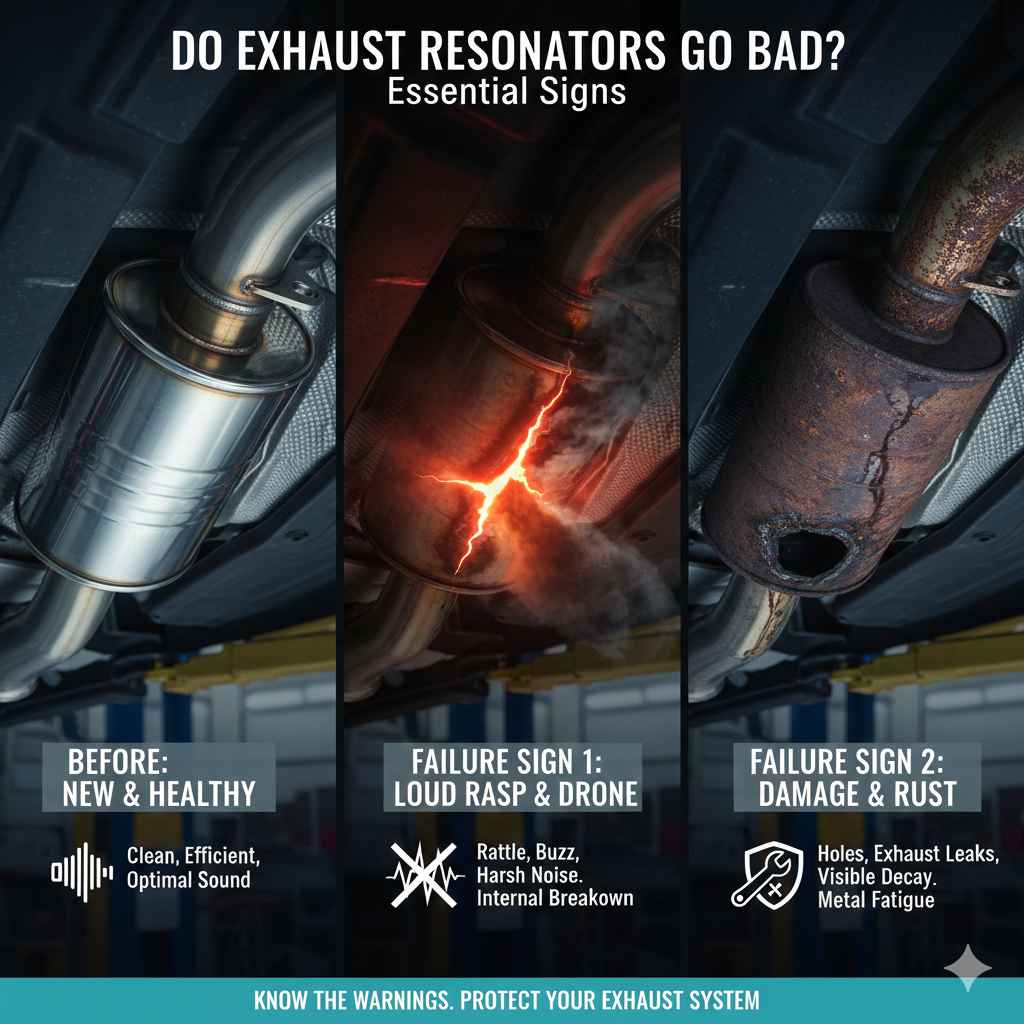
Sign 1: A Loud, Booming Drone Noise (The Most Common Sign)
This is the number one giveaway. If you notice a deep, low-frequency sound—a noticeable “boom” or “drone”—especially when driving at a steady speed (like on the highway), the resonator is likely failing.
What it sounds like: Not the loud “popping” of a full muffler failure, but a persistent, deep hum or resonance that seems to shake the cabin slightly.
Why it happens: A hole has formed inside the resonator chamber, or a weld has cracked. This allows the specific sound wave frequency it was designed to cancel to pass straight through, unchecked.
Sign 2: Rattling or Vibration Sounds Under the Car
If you hear rattling, especially when starting the car or accelerating through a specific RPM range, you might have loose or broken internal components inside the resonator shell.
What it sounds like: A metallic rattle, similar to shaking a tin can full of pebbles.
Why it happens: Over time, rust can cause the internal baffling or perforated tubes inside the resonator to break loose. These pieces then bounce around inside the outer shell when exhaust gases push them.
Sign 3: Visible Rust, Holes, or Corrosion on the Shell
While internal failure is common, sometimes the damage is visible on the outside. Grab a flashlight and take a safe look underneath your vehicle (ensure the exhaust is completely cool first!).
What to look for: Any signs of orange or dark brown rust eating away at the metal casing. If you see small pinholes or large rusted-out sections, the internal structure is certainly compromised.
Safety Note: Rust isn’t just cosmetic; it weakens the structural integrity. A heavily rusted resonator can fall off or leak dangerous exhaust fumes into the cabin if the leak is significant enough to bypass the floor pan.
Sign 4: Changes in Exhaust Gas Smell (Fumes Entering the Cabin)
This sign is serious and requires immediate attention. If you smell exhaust fumes (that rotten-egg or metallic scent) inside the car, you have a leak somewhere in the system.
Why it matters: While leaks are often in the flex pipe or manifold gasket, a large hole in the resonator can leak fumes, especially if the car is idling or moving slowly. Carbon monoxide is odorless and colorless, but the other components of exhaust gas are irritating and dangerous.
Action: If you smell fumes, drive as little as possible and get it inspected right away. For more information on exhaust safety, reputable sources like the National Highway Traffic Safety Administration (NHTSA) emphasize the dangers of exhaust leaks entering the passenger compartment.
Sign 5: Decreased Engine Performance (Less Common, But Possible)
While the resonator has minimal impact on raw horsepower compared to a blocked catalytic converter, a severely collapsed or totally rusted-out resonator can slightly impede exhaust flow.
What you might notice: Sluggish acceleration or a slight drop in fuel economy. This usually only happens if the internal structure has completely disintegrated and is blocking the path of the gases.
How to Inspect Your Resonator: A Beginner’s Guide
You don’t need to be a master mechanic to check your resonator. Here is a simple, step-by-step guide to performing a visual and physical check.
Tools You Might Need (Keep it Simple)
Safety glasses and work gloves
A bright flashlight
Jack and jack stands (if you need more clearance)
* A small screwdriver or probe (for poking suspected rust spots)
Step-by-Step Inspection Process
- Ensure Safety First: Never inspect a hot exhaust system. Let the car sit for several hours until it is completely cool to the touch. Ensure the car is parked on level ground. If lifting the car, use quality jack stands rated for your vehicle’s weight.
- Locate the Resonator: On most front-wheel-drive cars, the resonator is located toward the middle of the vehicle, often near the front axle or under the driver’s door area. It looks like a small, oblong, or oval metal canister positioned between the exhaust pipe coming from the catalytic converter and the main muffler.
- Visual Check for Exterior Rust: Shine your flashlight directly onto the entire resonator body. Look for significant surface rust. If the metal looks flaky or pitted, it’s weak.
- The Probe Test: Gently take your small screwdriver or probe and lightly press it against any heavily rusted areas. If the metal easily breaks through, you have confirmed a physical hole, and the resonator is definitely bad.
- Check Connections and Welds: Examine where the resonator connects to the exhaust pipes before and after it. Look for cracks or signs of black soot, which indicates a leaking gasket or cracked weld.
- Listen for Loose Parts: Gently tap the outside of the resonator with the handle of your screwdriver. If you hear a distinct rattling sound coming from inside, the internal baffles have broken loose.
Resonator vs. Muffler: Clearing Up the Confusion
Many beginners use these terms interchangeably, but they do different jobs. Understanding this helps you diagnose the noise correctly.
| Feature | Exhaust Resonator | Exhaust Muffler |
|---|---|---|
| Primary Function | Tunes out specific, high-frequency drone sounds. | Significantly reduces overall exhaust volume (loudness). |
| Location (Typical) | Closer to the front of the car (mid-pipe). | Closer to the rear of the car (under the trunk/bumper). |
| Failure Sound | Deep drone, boom, or internal rattle. | Loud roaring, popping, or sputtering sound. |
| Shape | Often smaller, oblong, or round canister. | Usually larger, chambered canister. |
Why Ignoring a Bad Resonator Isn’t Worth It
It can be tempting to ignore a loud drone if your car still runs fine, but letting a failing resonator linger can cause bigger problems down the road.
Potential Consequences of Neglect
- Spreading Corrosion: A small hole in the resonator invites moisture and salt deeper into the exhaust system, accelerating rust on adjacent pipes, clamps, and even the muffler.
- Emission Testing Failure: While the resonator itself isn’t tested for emissions, a large leak can sometimes cause oxygen sensors to read exhaust gas incorrectly, potentially triggering a Check Engine Light if the leak is severe enough to affect readings before the downstream sensor.
- Increased Noise Pollution: If the component completely separates, you suddenly jump from a mild drone to extremely loud, illegal noise levels.
- Fume Danger: As mentioned, any large leak increases the risk of dangerous gases entering the cabin.
Repairing vs. Replacing a Failed Resonator
When you discover your resonator is shot, you have two main options: repair or replace. For most modern vehicles, replacement is the better long-term solution.
Repairing the Resonator (Temporary Fix)
Repair usually involves welding a patch over a small hole or using heavy-duty exhaust patch kits.
Pros of Repair
- Can be cheap if the damage is minor.
- Quick solution if you need to pass inspection tomorrow.
Cons of Repair
- Rust is usually widespread internally; patching one spot rarely fixes the underlying corrosion.
- Repairs often fail quickly (within months), especially if heat cycles continue.
- Requires welding skill.
Replacing the Resonator (Recommended Solution)
Replacement involves cutting out the old unit and welding or clamping in a new resonator section.
Pros of Replacement
- Restores the original acoustic balance of your exhaust system.
- Long-term fix, often using higher-quality steel than the original OEM part (if you choose aftermarket stainless steel).
- Ensures system integrity against further rust spread.
Cons of Replacement
- Higher initial cost than a patch.
- Requires cutting and welding equipment or paying a shop.
If you decide to replace it yourself, look for “direct fit” or “bolt-on” replacement pipes if available for your model, as these often use clamps instead of welds, making the job easier for beginners. Always check compatibility using your vehicle’s VIN number when ordering parts.
Upgrading: Performance Resonators (For Enthusiasts)
If you are looking to change the sound profile of your car while fixing the bad part, you might consider a performance resonator replacement, sometimes called a “high-flow resonator.”
These parts are often made of thick stainless steel and are designed to smooth out the exhaust note further or slightly change the tone.
Performance Resonator Considerations
- Material is Key: Always opt for T-304 stainless steel for longevity, as it resists corrosion far better than standard aluminized steel.
- Sound Profile: Performance resonators usually aim to reduce raspiness associated with aftermarket mufflers, resulting in a deeper, smoother tone, rather than increasing volume significantly.
- Installation Complexity: Similar to stock replacement, these usually require cutting and welding unless you purchase an exact bolt-on match for your existing pipes.

FAQs: Simple Answers for Exhaust Resonator Issues
Here are quick answers to common questions beginners have about resonator failure.
Q1: Can I just remove the resonator entirely?
Yes, you can, but it is usually not recommended for daily drivers. Removing it often results in a very loud, booming, or droning noise (especially on V6 or V8 engines) because the specific frequencies it cancels will now pass straight through the muffler. It can also sometimes cause you to fail emissions checks due to excessive noise.
Q2: How much does it cost to replace a bad resonator at a shop?
Costs vary widely based on location and vehicle type. Generally, expect to pay between $150 and $400 for a standard replacement, including parts and labor. Performance or complex stainless steel replacements can cost more.
Q3: Does a bad resonator affect my gas mileage?
Usually, no. A resonator failure primarily affects sound, not flow dramatically. Significant fuel economy loss is more commonly linked to clogged catalytic converters or issues with oxygen sensors, not a simple hole in the resonator.
Q4: Is it legal to drive with a hole in my resonator?
It depends on your local laws. Many states and municipalities have noise ordinances. If the hole is large enough to cause excessive noise, you risk getting a ticket. More importantly, if fumes enter the cabin, it is a serious safety hazard.
Q5: How can I tell if the noise is the resonator or the muffler?
The muffler handles the bulk volume reduction. If the car is roaring like a race car when you step on the gas, it’s likely the muffler. If it has a deep, persistent hum or drone while cruising on the highway, the resonator is the more likely culprit.
Q6: Do I need specialized equipment to cut out and weld a new resonator?
For a custom fit, yes, you need an angle grinder to cut the old pipes and a welder to secure the new section. For an easier job, look for a replacement pipe section that uses heavy-duty clamps that slide over the existing pipe ends—this often just requires wrenches.
Conclusion: Keeping Your Drives Quiet and Safe
Understanding whether your exhaust resonators go bad is a key part of basic vehicle maintenance. They are vulnerable components, constantly battling heat and corrosion, making failure inevitable over time. The telltale sign—that annoying, deep drone at cruising speed—is your car telling you it’s time for a check-up.
By remembering to visually inspect for external rust and listening for specific internal rattles, you can catch the failure early. Whether you choose a quick patch or a full stainless steel replacement, addressing the problem promptly ensures your ride stays safe, efficient, and quiet. Don’t let a small exhaust leak turn into a bigger headache. A little attention under the car now saves you a lot of noise and money later!
Related pick: Check today's price on Amazon