Heat Shield vs Exhaust Leak: How to Tell the Difference
A loose heat shield is commonly reported to rattle or buzz with vibration and to change when the shield is tapped; an exhaust leak more often ticks, hisses, or thumps under load and may be accompanied by exhaust smell, so a practical first split is sound plus smell. Mixing them up can leave a hot exhaust leak unsafe or send you after a harmless rattle. This guide shows how to separate the two with location clues and a no-tools first check.
| Decision factor | Heat shield | exhaust leak | Winner |
|---|---|---|---|
| Typical sound | Metallic buzz, rattle, or light clatter that changes with vibration | Ticking, tapping, hiss, or chuffing, often sharper and more rhythmic | exhaust leak |
| Smell and soot | Usually no exhaust odor and no soot at the loose spot | May bring exhaust smell and soot at a seam, flange, or gasket | exhaust leak |
| Best clue by engine state | Often loudest on cold starts, idle, or acceleration when vibration changes | Often most obvious on cold start, idle, or under load when pressure changes | tie |
| Likely repair path | Often a clamp, bracket, or fastener issue; may be quick to secure | Requires finding the exact joint or crack before repair | Heat shield |
| Safety concern | Can expose nearby parts to excessive heat if it falls off | Can put fumes and heat where they do not belong, including the cabin | exhaust leak |
Decision factors
Typical sound
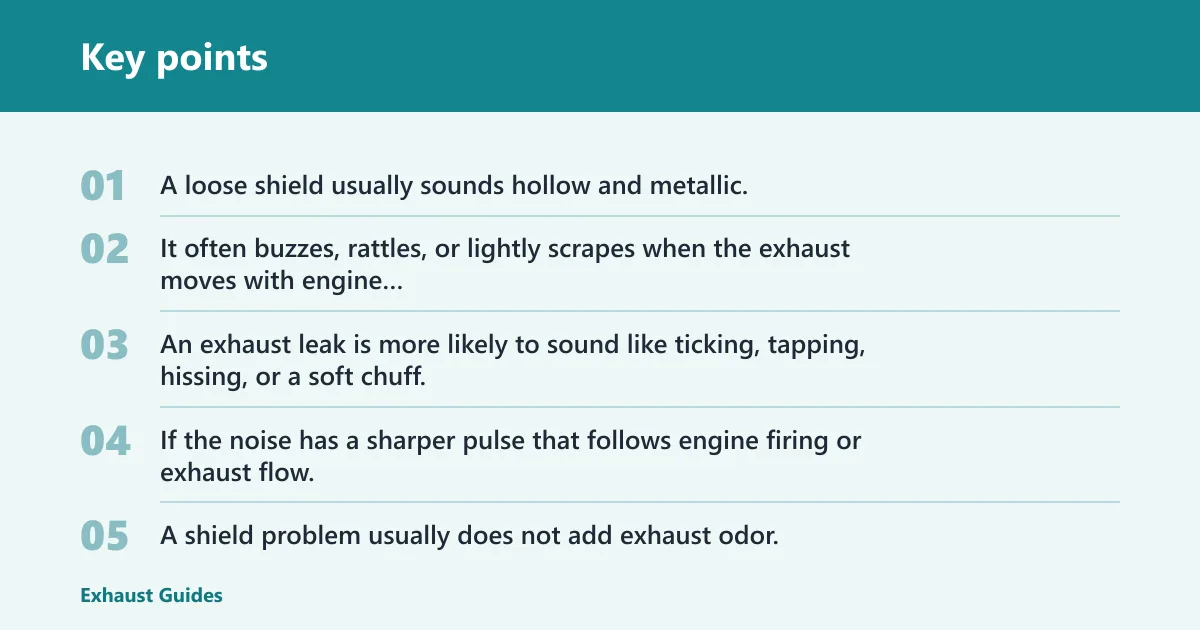
A loose shield usually sounds hollow and metallic. It often buzzes, rattles, or lightly scrapes when the exhaust moves with engine vibration or road motion.
An exhaust leak is more likely to sound like ticking, tapping, hissing, or a soft chuff. If the noise has a sharper pulse that follows engine firing or exhaust flow, start with the leak side.
Smell and soot
Smell is often one of the clearest clues. A shield problem usually does not add exhaust odor, while a leak may smell like exhaust outside the car and, in worse cases, inside the cabin.
Soot is another strong clue. Black deposits at a seam, clamp, donut gasket, or flange usually mark the leak exit, not a heat shield fault.
Engine state
Both problems can be loud on a cold start, but the pattern differs. A shield often rattles most at idle or during acceleration, while a leak may sharpen under load or during the first moments after startup when pressure pulses are easier to hear.
Diesel engines can make leak noise easier to confuse with normal clatter, while gasoline engines often make a ticking leak more obvious near the front of the car.
Repair path
A heat shield problem often comes down to loose clamps, brackets, or spot welds. Moisture, road salt, and vibration can weaken those fasteners over time, so the fix may be straightforward if the shield itself is still intact.
An exhaust leak is different. You need to locate the exact source before repair, because the joint, gasket, or pipe crack is the part that matters.
What each noise usually means
Loose heat shield noise patterns
Heat shields are thin metal barriers that protect floorboards, fuel lines, and wiring from exhaust heat. When they loosen, they often rattle from vibration rather than from gas flow.
If the noise changes when you tap the shield by hand or shifts when the engine idles up and down, that points toward the shield or its fasteners. A shield can also touch a pipe and mimic a ticking sound, which is a common overlap case.
Exhaust leak sound patterns
Exhaust leaks often occur at joints or gaskets and can create ticking or tapping sounds. Depending on where the leak sits, the noise may also be a hiss or chuff.
That sound usually stays more “air-like” than a shield buzz. If the noise grows under throttle, shows up near a flange, and comes with odor or soot, treat it as a leak until proven otherwise.
When the catalytic converter is the real source
A failing catalytic converter can rattle when internal ceramic material breaks apart. That noise can be mistaken for a shield issue because it often appears under the same section of the car.
Unlike a loose shield, the rattle comes from inside the converter shell. If the shell seems secure but the noise remains inside that area, the converter deserves inspection.
When an exhaust hanger is the real source
A broken exhaust hanger or loose pipe can make banging or thumping sounds. That is not the same as a thin, metallic shield buzz.
If the exhaust moves too freely by hand or the pipe looks misaligned, check the hanger points before assuming the shield is to blame.
Heat shield vs exhaust leak triage table
| Sound | Smell | Soot | Vibration | Engine state | Likely cause | Next safe check |
|---|---|---|---|---|---|---|
| Metallic buzz or light rattle | No exhaust odor | No soot at the spot | Changes with body or exhaust vibration | Cold start, idle, or acceleration | Likely shield | Tap the shield lightly by hand after the car is cool; look for loose clamps, brackets, or spot welds |
| Tick, tap, hiss, or chuff | Exhaust smell outside the car | Soot at a seam, flange, gasket, or clamp | May intensify with engine load | Cold start or load | exhaust leak | Inspect joints front to back and note the exact source before repair |
| Banging or thumping | Usually none | Usually none | Large movement of pipe or converter | Idle, bumps, or gear changes | Broken hanger or loose pipe | Check hanger rubber, brackets, and pipe clearance |
| Rattle near converter shell | Maybe none | Maybe soot only if a leak is also present | May stay with the converter area even when the shield is secure | Idle or light rev | Broken catalytic converter substrate | Have the converter shell inspected for internal breakage |
| Cabin fumes or exhaust odor inside the car | Strong exhaust odor | Possible soot at leak point | Not the main clue | Any state | Do not drive | Stop driving and arrange a professional inspection |
Why the table splits this way
The sound row matters because the two failures behave differently. A heat shield usually buzzes from vibration; an exhaust leak produces a gas-flow sound, which is why ticking and hiss matter more than a generic rattle description.
The smell and soot rows matter because a shield problem is mostly mechanical, while a leak moves hot exhaust gas. Soot at a flange or gasket is one of the best visual clues you can get before lifting the car.
The “do not drive” row is included because cabin fumes change the decision immediately. If exhaust gas may be entering the vehicle, safety comes before diagnosis.
How do you tell if it’s a heat shield rattle or an exhaust leak?
Use sound first, then smell and soot. A heat shield usually makes a metallic buzz or rattle that changes with vibration, while an exhaust leak is more likely to tick, hiss, or chuff and may leave odor or soot near the leak point.
Then use engine state and location. A shield is often loudest at cold start, idle, or acceleration, and it often lives near pipes, mufflers, or the floorboard. A leak is often tied to a joint, flange, gasket, or cracked pipe.
Use a no-tools first check
- Start with the car safely parked and the exhaust cool enough to touch nearby body parts without risk.
- Stand near the front, then move along the side and rear to note where the sound is loudest.
- Listen for metallic buzz versus ticking, hiss, or chuffing.
- Look for soot, broken fasteners, or contact marks on shields and exhaust joints.
- If the cabin smells like exhaust, stop driving and get the car inspected.
Where to inspect first under the car
Start with the heat shields near the exhaust pipes and muffler. Look for thin metal that has pulled away from the body, loose clamps, brackets, or spot welds, and places where the shield touches a pipe.
Then move to joints, flanges, and gaskets. Next check the converter shell and hanger points, because broken hangers and internal converter damage can mimic shield noise. Broken studs, rust, and contact marks help tell you where the failure started.
Front-to-back inspection path
For exhaust leaks, a front-to-back process is the safest way to narrow the zone and pinpoint the joint or crack. Start where the sound is strongest, then work along the system rather than guessing at the rear first.
A common first-timer mistake is to blame the loudest area under the car without checking the upstream joint. That can send you to the wrong pipe when the leak is actually at a flange or gasket a short distance away.
Can an exhaust leak cause a rattling noise?
Yes, but the rattle is often a secondary clue rather than the main sound. A leak can sound like tapping or ticking, and if a shield or loose pipe is nearby, the escaping pulse may make that part vibrate and rattle.
That overlap is why engine speed matters. A leak often changes with load and exhaust pressure, while a loose shield usually changes more with vibration from idle, bumps, or throttle blips.
Shield contact that mimics a leak
Suppose a thin shield is touching a pipe near the catalytic converter. The noise may seem like a fast tick from the engine bay, but the real problem is the metal-on-metal contact, not escaping exhaust gas.
That is why sound alone is not enough. Add smell, soot, and the exact location before you decide which part to repair.
What should you check before driving again?
Check for cabin fumes first. Exhaust odor inside the vehicle is a red flag and should be treated as urgent, because a leak can let fumes where people breathe.
Also check for hot exhaust near wiring, fuel lines, and floorboards. A loose shield can expose nearby parts to excessive heat if it falls off, and a real leak can overheat nearby materials or damage other components.
When to stop and book an inspection
Stop and arrange a professional inspection if you smell exhaust in the cabin, see heavy soot, hear loud hissing, or cannot tell whether the noise is coming from a shield, hanger, converter, or pipe. If the car sounds worse under load, do not keep guessing.
A proper exhaust inspection means a safe vehicle lift or a professional inspection, plus a visual check for broken studs, rust, and contact points. That is the point where a technician can rule out shield, converter, hanger, and leak sources without risking burns or fumes.
Safe home checks and professional inspection
At home, you can confirm the broad pattern: sound type, smell, soot, and where the noise seems to live. You can also inspect for loose shield fasteners, cracked hangers, and obvious contact marks without tools.
What you cannot safely confirm at home is every leak source. A small crack or flange leak may need the car on a lift to see clearly, and a hot exhaust can burn you before the diagnosis is finished.
What a safe vehicle lift adds
A lift lets you inspect the underside from a safer angle and see the full run of the exhaust. That matters because front-to-back inspection is often the only way to separate a rear noise from a mid-pipe leak or a converter rattle.
It also helps expose broken studs and rust that may not show from the ground. Those details often decide whether a shield can be secured or whether a joint needs repair.
Why crude fixes are a bad idea
Do not wrap a shield with wire or zip ties as a shortcut. Those fixes can fail from heat and vibration, and they can hide a real leak or create new contact points.
If the shield fasteners are damaged, the correct fix is to replace or properly secure the clamps, brackets, or fasteners that belong there.
Choose Heat shield if…
Choose Heat shield if the noise is a metallic buzz or rattle, there is no exhaust smell, no soot, and the sound changes with vibration at cold start, idle, or acceleration. That is also the better fit when the shield is visibly loose, touching a pipe, or missing a fastener.
Choose exhaust leak if the noise is ticking, tapping, hiss, or chuffing, especially if you find soot, smell exhaust, or notice the sound grow under load. If you smell exhaust inside the cabin, treat it as urgent and stop driving.
Frequently asked questions
What does an exhaust leak sound like compared with a loose heat shield?
An exhaust leak is usually sharper and more rhythmic, especially at joints or gaskets. A loose heat shield is usually a faster buzz or clatter made by thin metal moving against the body or pipe. If tapping the shield changes the noise, that supports the shield side.
What are the signs of a heat shield falling off under the car?
You may hear the rattle get louder, notice a new metallic scrape, or see the shield hanging low or missing. If the shield falls off, nearby parts can be exposed to excessive heat, so the issue becomes more than an annoyance and should be addressed promptly.
Is a loose heat shield dangerous to drive with?
Sometimes it is only noisy, but it is not harmless. A loose shield can fall or expose nearby parts to excessive heat if it detaches. If the noise is paired with cabin fumes, hot spots, or contact with wiring or fuel lines, stop driving and get it inspected.
What parts of the exhaust system are most likely to leak?
The usual leak points are joints, gaskets, flanges, cracked pipes, and the area around broken studs. A front-to-back inspection helps narrow the source, and soot at a seam, clamp, donut gasket, or flange often marks where the exhaust gas is escaping.