Best Exhaust Upgrades for Off-Road Trucks in 2026: Research Shows
For most off-road trucks, the best exhaust upgrade is a stainless cat-back with an axle-exit or high-clearance tailpipe; choose a quieter, resonated system for towing and overlanding, and a straight-through system only if you want more sound and better flow. Bad fitment can hang below the frame, rattle on the axle, or get crushed on rocks and ruts. This guide compares the best exhaust choices for mud, rocks, towing, overlanding, and desert use by clearance, durability, sound, and packaging.
Quick comparison
| Product | Badge | Best for | Price | ||
|---|---|---|---|---|---|
 | MBRP S5512AL 3" Cat Back, Single Side Exhaust SystemMBRP | Our pick | 3-inch · cat-back · single side | $299.99 Price as of 23 Oct 2026 | View |
 | MBRP 3-Inch/2.5-Inch T409 Stainless Steel Cat-Back ExhaustMBRP | Upgrade pick | 3/2.5-inch · cat-back · dual rear exit | $869.99 Price as of 23 Oct 2026 | View |
 | Borla 140801 S-Type Cat-Back Exhaust System 3.5 in. Pipe 5Borla | Also great | 3.5-inch · cat-back · side exit | $1,120.75 Price as of 23 Oct 2026 | View |
 | Upower Universal Diesel Trucks Car Exhaust Tip 4 Inch InletUpower | Pair with it | 4-inch inlet · 6-inch outlet · bolt-on | $32.99 Price as of 23 Oct 2026 | View |
Start with how the truck actually sees terrain, then work backward to layout, pipe size, and tailpipe routing. Sound matters, but clearance, departure angle, and corrosion resistance matter more on a truck that leaves pavement.
How we chose
Each option here is judged on fitment, material, routing, and likely drone at cruise speeds. The goal is to favor systems that survive mud, salt, and trail contact without turning the cab into a boom box.
We also looked at whether the layout stays useful on a lifted truck with larger tires, where the exhaust can become more visible and more exposed. Systems that leave room for spare-tire clearance and tucked routing scored better.
Finally, we favored designs that make sense for daily driving. Most systems should improve airflow, sound, and driving feel without becoming unpleasant to use every day.
Cat-back exhaust: best for most off-road trucks
A cat-back exhaust is the best all-around choice for most off-road trucks because it replaces everything from the catalytic converter back, usually gives better flow and tone, and is more likely to stay emissions-friendly than a header-back system. It gives you a meaningful upgrade without opening the door to the more complex compliance questions that come with full exhaust changes.
What it changes
Cat-back systems replace the mid-pipe, muffler, and tailpipe section after the catalytic converter. That gives you a cleaner path for exhaust gases, better sound control, and more layout choices for axle-exit or side-exit routing.
For many trucks, this is the right balance. It is simpler than a header-back setup, and it leaves the factory emissions equipment in place.
Why it fits off-road use
On a truck that sees ruts, ledges, and washouts, the key question is not only flow. It is whether the tailpipe sits high enough to stay out of trouble and whether the system clears the spare tire, rear axle, and suspension travel.
Cat-back systems are also easier to pair with a controlled tone. A daily-driven Ford Bronco or F-150 usually does best with a controlled, deeper tone rather than a sharp, hollow one.
Axle-back exhaust: best for budget and clearance
An axle-back exhaust replaces only the section behind the rear axle, so it is the lowest-cost sound-focused option and the best fit when budget and clearance matter more than performance. It changes tone with minimal packaging drama, but it usually delivers only a small performance gain.
When it makes sense
Choose axle-back when you want a better tone, an easier install, and less cost than a full cat-back. It is a sensible choice for a truck that spends more time on the street than on rocks.
If you want a real flow change, this is usually not the strongest move. It is the sound-and-clearance option.
Header-back exhaust: best for full builds
A header-back exhaust replaces everything from the headers back, so it is the most comprehensive exhaust change and the most likely to raise emissions-compliance questions. It can make sense for off-road or competition use, but it is the least casual choice for a daily-driven truck.
When the extra complexity is worth it
Use this route when the truck is built around hard use, and you are already planning other power and drivetrain changes. It makes more sense on a project than on a commuter that sees mud on weekends.
It is not the place to guess. Check emissions rules, header compatibility, and tailpipe routing before you commit.
Off-road exhaust decision table
| Use case | Preferred layout | Ideal pipe diameter range | Material recommendation | Drone risk | Clearance notes |
|---|---|---|---|---|---|
| Mud | Cat-back | 2.5 to 3.0 inches | 409 or 304 stainless | Low to moderate | Choose tucked routing and a high tailpipe exit to reduce packing and rust. |
| Rocks | Cat-back or axle-back | 2.5 inches | 304 stainless | Low | Prioritize departure angle, tucked muffler placement, and protected hanger positions. |
| Towing | Cat-back | 2.5 inches on many light-duty trucks | 409 stainless or 304 stainless | Moderate if unmuffled | Use a resonated or quieter muffler and keep the tailpipe away from trailer hardware. |
| Overlanding | Cat-back | 2.5 to 3.0 inches | 304 stainless | Low to moderate | Look for spare-tire clearance, tucked routing, and tip placement that avoids campsite or trail damage. |
| Desert | Header-back or cat-back | 3.0 to 3.5 inches on higher-output builds | 304 stainless | Moderate to high with straight-through mufflers | Protect against heat and abrasion; make sure the system stays high enough for washboard hits and debris. |
That table is the practical starting point. If the truck sees mud and salt, corrosion resistance matters as much as flow. If it sees rocks, clearance comes first.
Which exhaust upgrade fits your truck?
The best exhaust upgrade depends on where the truck gets used, how much cabin noise you can live with, and how much room the underbody gives you. A cat-back is the broad default, an axle-back is the simple budget move, and a header-back is the full build choice.
Match the system to your use case
If you wheel in mud, pick a cat-back with high routing and corrosion-resistant pipe. If rocks are the bigger issue, use the shortest practical rear section and keep everything tucked above the lowest frame reference.
For towing, a quieter cat-back with a resonator is usually the smarter call. It gives you better tone control at cruise, where highway drone becomes most annoying.
For overlanding, clearance, packability, and corrosion matter more than peak sound. A system that keeps the tip away from the spare tire and hitch zone usually ages better.
Match the system to your budget and daily driving
Axle-back makes sense when you want a smaller spend and a mild change in tone. It is also easier to justify when the truck is already close to the ground clearance limit in the rear.
Suppose your truck has a 2-inch lift and 33-inch tires, and the muffler now sits closer to the axle path than it did stock. In that case, a tucked cat-back can solve a clearance problem before it becomes a trail strike.
What is the best exhaust upgrade for an off-road truck?
For most off-road trucks, a stainless cat-back with tucked routing is the best starting point. It gives you better flow and tone than stock, keeps the install simpler than a header-back, and is usually the better fit for mud, rocks, towing, and overlanding than a louder but lower-riding setup.
The right answer still depends on packaging. If the truck has a lifted rear, a spare tire under the bed, or a hitch that sits close to the tailpipe path, the best system is the one that clears those parts without hanging below the frame.
Will a new exhaust improve performance on my truck?
A new exhaust can improve performance, but the gain depends on the truck’s engine, pipe size, and whether the rest of the intake and exhaust path can use the extra flow. The biggest changes are usually in sound and throttle feel, while real power gains are more likely when the system is matched to the engine and use case.
As a broad reference, combined intake and exhaust gains typically range from 15 to 30 horsepower, and a cold air intake can add 5 to 15 horsepower on most trucks. That does not mean every exhaust alone will show a large gain.
Pipe diameter matters here. Too small can restrict flow, while too large can soften low-end response on a towing truck. Bigger is not automatically better.
Do you need a tune after exhaust changes?
A tune is not always required after a basic exhaust swap, especially on a cat-back or axle-back system. It becomes more important when you pair exhaust with intake changes, change pipe diameter more aggressively, or want the engine control calibration to better match the new airflow.
If you add both intake and exhaust, tuning can help recover some of the combined gains and smooth drivability. That is especially useful on trucks where the owner wants better throttle response without harsh shifts or odd cruise behavior.
When tuning matters more
If the truck is getting a more open intake, a freer exhaust, and a larger pipe diameter all at once, the calibration should be checked. That is the point where airflow changes are large enough to matter more than sound alone.
If the exhaust change is mild and emissions equipment stays in place, many owners stay with stock tuning. The key is to match the tune to the hardware, not the other way around.
MBRP S5512AL 3-inch cat-back: best for budget-friendly sound
- Polished T304 stainless steel tip
- Mellow exhaust note
- Installs with common hand tools
This MBRP cat-back is for buyers who want a straightforward sound upgrade without moving into a complicated full-system build. The 3-inch cat-back layout and single side exit make it a practical fit for many light-duty trucks, and the polished T304 stainless steel tip is a clean detail.
Its main draw is value. The mellow exhaust note should suit drivers who want a deeper tone without pushing into the loudest possible setup.
The drawback is that the system is aluminized steel, so corrosion resistance is not as strong as full stainless construction. If the truck sees frequent road salt, mud, or wet winter use, that matters.
MBRP T409 stainless dual rear exit: best for towing and style
- 409 stainless steel cat-back construction
- Dual split rear exit
- Improved throttle response and torque
This MBRP cat-back fits drivers who want a more durable stainless option with a dual rear exit layout. The 409 stainless steel construction is the main selling point, and the dual split rear exit gives the truck a more aggressive visual finish.
It is a strong pick for owners who want a more premium build and better corrosion resistance than aluminized steel. Based on the published details, it is also aimed at better throttle response and torque.
The drawback is cost and complexity. A dual rear exit can be harder to package around spare-tire space, hitch hardware, and rear suspension travel than a simpler single-exit layout.
Borla S-Type 3.5-inch cat-back: best for controlled tone
- T-304 stainless steel construction
- Side-exit truck fitment
- Single round rolled angle-cut tip
This Borla system is for buyers who want a premium stainless cat-back with side-exit packaging. The T-304 stainless steel construction is the headline feature, and the S-Type tuning points toward a deeper but still controlled sound.
It is a good match for a truck where daily comfort still matters. Side-exit fitment can also help when rear clearance is tight or when a rear tip would sit too close to a trailer setup.
The drawback is price. It sits well above the budget end, so the value case depends on how much you care about material quality, sound tuning, and fitment.
Upower 4-inch stainless exhaust tip: best for a simple finish
- Bolt-on design
- Mirror-polished stainless steel
- No weld or drill needed
This bolt-on tip is for owners who want a cosmetic and finish change rather than a full exhaust system. The mirror-polished stainless steel and bolt-on design make it a simple add-on for a truck that already has the layout it needs.
It can be useful when you want a cleaner tailpipe look without welding or drilling. That makes it the easiest item here to install.
The drawback is obvious: it is only a tip. It will not solve drone, clearance, corrosion inside the system, or airflow limits from the rest of the exhaust.
What exhaust material lasts best on trucks in road salt and mud?
Stainless steel is the better choice for trucks that see salt, moisture, and mud. Stainless steel exhaust is more corrosion resistant than aluminized steel, and it is usually the safer long-term buy for off-road use where the underside gets wet and dirty often.
Among common grades, 304 and 409 stainless are the names to look for. 304 is the more corrosion-resistant option, while 409 is often used when builders want a tougher corrosion balance at a lower cost than 304.
That matters because Iowa road salt destroys aluminized steel exhausts in 5 to 7 years, while stainless steel exhausts last the life of the truck. If the truck spends winters on salted roads, material choice is not a small detail.
Should I choose a cat-back, axle-back, or header-back exhaust?
Choose a cat-back if you want the best blend of flow, sound, and day-to-day usefulness. Choose an axle-back if budget and rear clearance are your top concerns. Choose a header-back only when the truck is built for more comprehensive change and you have checked compliance, packaging, and heat management.
Cat-back is the broad recommendation because it gives the biggest practical improvement for most off-road trucks without making the system overly complex. Axle-back is the easier, quieter, lower-cost path. Header-back is the most aggressive and the most complicated.
- Measure the space behind the rear axle and around the spare tire.
- Check whether the tailpipe must exit behind the wheel, behind the tire, or out the side.
- Choose diameter based on engine output and intended use, not on maximum size.
- Prefer mandrel-bent piping if you want consistent flow through bends.
- Pick stainless if the truck sees salt, mud, or repeated wet use.
- Review muffler and resonator placement for highway drone at cruise speed.
- Confirm local emissions and noise rules before ordering a header-back system.
The practical way to upgrade exhaust is to start with the truck’s use case, then match layout, diameter, and material to the packaging limits underneath. That means checking hanger placement, weld quality, tip location, spare-tire clearance, and how high the muffler sits relative to the frame.
A common mistake is choosing a shiny exhaust kit before checking whether the pipes will clear the skid plates, tow hooks, and rear axle on a lifted truck. On a lifted truck, that can leave the tailpipe where rocks, rut edges, or trailer hardware can hit it.
What to inspect before buying
Look for mandrel-bent piping if flow consistency matters. Mandrel bends maintain full diameter through corners, while crush-bent sections can narrow the pipe and hurt flow consistency.
Also check how the hangers are placed. Good hanger placement keeps the system stable over bumps and prevents contact with the axle or frame at full suspension movement.
Finally, inspect tip placement and spare-tire clearance. A nice-looking tip is not useful if it ends up too close to the tire, hitch, or cargo box when the suspension cycles.
Will an exhaust upgrade cause highway drone on my truck?
It can. Highway drone is one of the biggest comfort trade-offs in exhaust selection, and it usually depends more on muffler and resonator choice than on pipe size alone. A straight-through system may sound strong off idle but become tiring at cruise.
The safest route for a daily-driven truck is a resonated or controlled-tone system. That is especially true if the truck runs larger tires or a lift, because both can make cabin noise seem more noticeable at the same road speed.
For towing, drone matters even more. Long highway pulls make unpleasant cabin frequencies hard to ignore, so a quieter rear section is usually worth it.
Which one should you buy?
If you want the best all-around answer, buy a stainless cat-back with a high-clearance rear exit and a controlled sound profile. That is the most balanced choice for most off-road trucks because it keeps fitment simpler than a header-back system and usually stays more comfortable than a very loud setup.
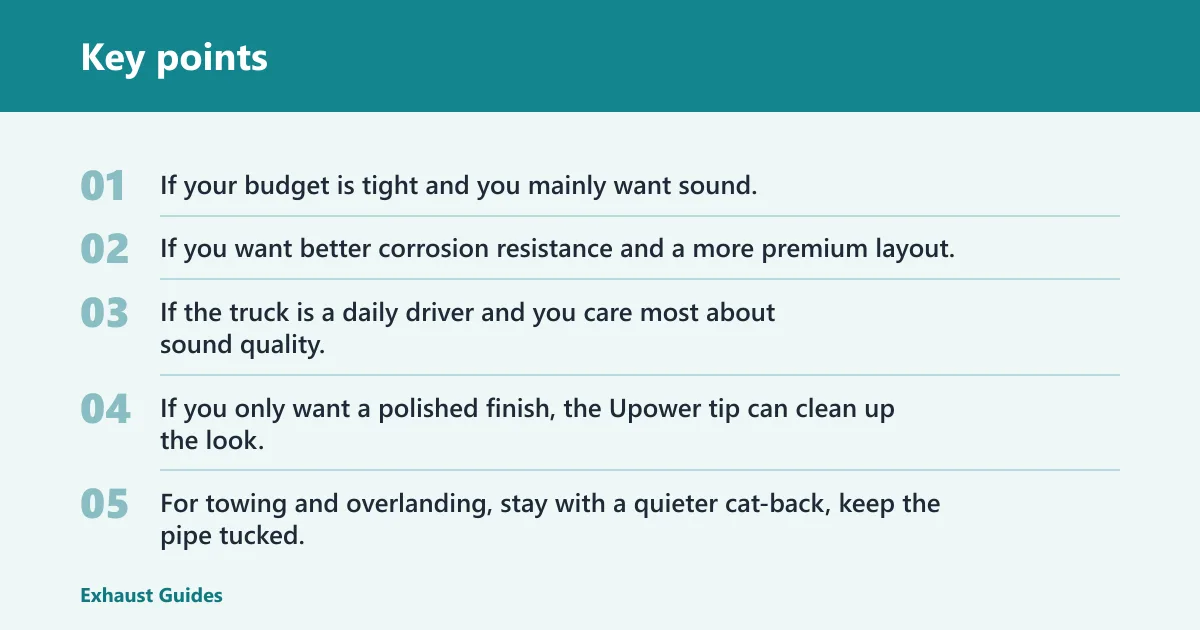
If your budget is tight and you mainly want sound, the MBRP aluminized cat-back is the easier entry point, but it is the weakest long-term choice in salt or wet mud. If you want better corrosion resistance and a more premium layout, the MBRP T409 stainless dual rear exit is the stronger buy.
If the truck is a daily driver and you care most about sound quality, the Borla S-Type is the most refined option here, though it costs the most. If you only want a polished finish, the Upower tip can clean up the look, but it does not change the system in any meaningful performance way.
For towing and overlanding, stay with a quieter cat-back, keep the pipe tucked, and avoid a setup that hangs below the frame. For hard-use desert or competition trucks, a full build can justify more aggressive hardware, but only after you check compliance and clearance.
Frequently asked questions
Does an aftermarket exhaust increase horsepower on a truck?
Sometimes. Combined intake and exhaust gains typically range from 15 to 30 horsepower, but that figure is not a promise for exhaust alone. The truck, the engine, and the rest of the airflow path all affect the final result, so match the system to the build rather than chasing the loudest option.
Which exhaust upgrade is best for towing and off-road use?
A quieter cat-back with a resonator is usually the best choice for towing and off-road use. It keeps cruise drone down, improves sound without becoming harsh, and can be routed high enough for trail work. Dual exits can work, but they add packaging complexity that many towing trucks do not need.
Do I need a tune after installing an exhaust on my truck?
Not always. A basic cat-back or axle-back usually does not require one, but a tune becomes more useful when intake and exhaust changes are combined or when the new setup changes airflow enough to affect drivability. If the system is more aggressive, calibration should be checked.