Catalytic Converter vs Downpipe: Which Upgrade Changes More?
For turbo cars, a downpipe often delivers the biggest change in power and sound. A catalytic converter upgrade changes emissions compliance and inspection odds more than outright performance. Pick the wrong part and you can lose factory-like drivability, trigger check-engine lights, or end up with hardware that fails inspection and barely helps. This guide compares power, sound, emissions legality, and drivability so you can match the part to your goal.
| Decision factor | Catalytic converter | downpipe | Winner |
|---|---|---|---|
| Flow and power change | Small to moderate gain when moving from stock to high-flow | Largest change on turbo cars, especially when replacing a restrictive factory section | downpipe |
| Sound and smell change | Usually modest; a high-flow unit keeps more factory character | Much louder when catless, with stronger exhaust odor | downpipe |
| Emissions and inspection risk | Better chance of passing OBD and street checks when approved for the vehicle | Higher failure risk, especially if catless or not calibrated correctly | Catalytic converter |
| ECU and drivability impact | Often close to stock behavior | More likely to need a tune for fueling, boost targets, and catalyst monitoring | Catalytic converter |
| Best fit use case | Daily driver and street-focused builds | Turbo street cars and track-only setups | Depends on use case |
Where each part sits and why the downpipe moves power
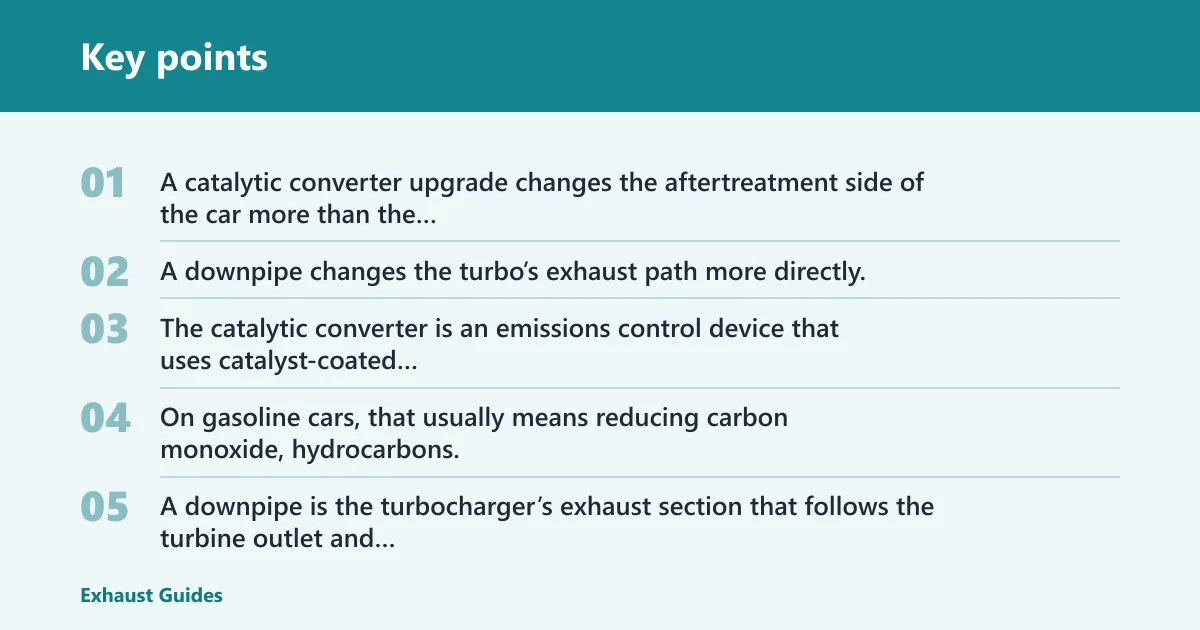


A catalytic converter upgrade changes the aftertreatment side of the car more than the driving feel. A downpipe changes the turbo’s exhaust path more directly, so it usually has the bigger effect on power, sound, and ECU behavior.
What each part changes in the exhaust path
The catalytic converter is an emissions control device that uses catalyst-coated substrate to convert harmful exhaust gases into less harmful compounds. On gasoline cars, that usually means reducing carbon monoxide, hydrocarbons, and nitrogen oxides through three-way catalyst chemistry, and its condition matters because catalyst poisons such as lead can ruin efficiency.
A downpipe is the turbocharger’s exhaust section that follows the turbine outlet and leads into the rest of the exhaust. Because it sits so close to the turbo, changing it alters restriction earlier in the flow path than a cat-back part does.
Why turbo cars see bigger differences
Turbocharged engines are sensitive to backpressure. Less restriction after the turbine can improve spool response, reduce pumping loss, and help the turbo reach the requested boost with less effort, which is why downpipes matter most there.
Naturally aspirated engines usually see smaller gains from exhaust changes alone. Without a turbine to feed, the same change in backpressure rarely transforms the car the way it can on a turbo platform.
Stock, high-flow, catted, and catless versions
A stock catalytic converter is built to balance emissions control, noise, and durability. A high-flow catalytic converter keeps the catalyst but uses a less restrictive core or housing, so it usually changes performance less than a catless setup while keeping more street compliance.
A catted downpipe includes a catalyst in the downpipe itself. A catless downpipe removes that catalyst section entirely, which is why it usually flows best, smells strongest, and carries the highest legal and diagnostic risk.
📊 Most gasoline-powered vehicles starting with the 1975 model year were equipped with catalytic converters. Source: Catalytic converter.
Catalytic converter vs downpipe matrix
Use this table to sort the real trade-offs. The best choice depends on which change matters most to you: power, sound, legality, or the chance of keeping factory-like behavior.
| Factor | Catalytic converter | downpipe | Winner |
|---|---|---|---|
| Power potential | Moderate with a high-flow unit; small with a stock-style replacement | Largest on turbo cars, especially with a freer-flowing or catless design | downpipe |
| Sound increase | Usually mild to moderate | Moderate to large, especially if catless | downpipe |
| Smell increase | Low when the catalyst is present and healthy | High when catless | downpipe |
| CEL and OBD risk | Lower if catalyst efficiency stays within ECU limits | Higher, especially with catalyst deletes or poor calibration | Catalytic converter |
| Tune need | Often no tune for a direct replacement that keeps emissions hardware intact | Often tune recommended or required on turbo cars | Catalytic converter |
| Street legality | Better odds when the part is approved for the application | Off-road use only in many setups, especially catless | Catalytic converter |
Power potential
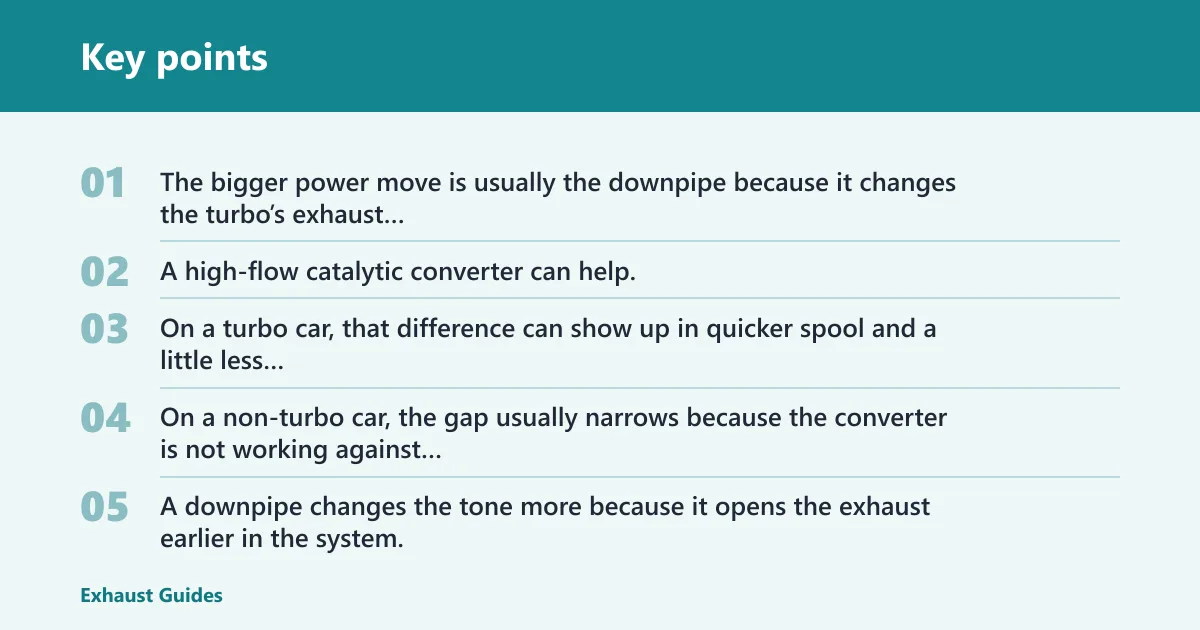
The bigger power move is usually the downpipe because it changes the turbo’s exhaust exit restriction. A high-flow catalytic converter can help, but the gain tends to be smaller unless the stock converter is unusually restrictive or aging badly.
On a turbo car, that difference can show up in quicker spool and a little less backpressure up top. On a non-turbo car, the gap usually narrows because the converter is not working against a turbine.
Sound increase
A downpipe changes the tone more because it opens the exhaust earlier in the system. A catless version is usually the loudest choice, while a catted version still tends to sound deeper and sharper than stock.
A high-flow catalytic converter usually changes volume less than a catless setup. It can still make the exhaust sound freer, but it often keeps enough attenuation to avoid the harsh, raw character many drivers dislike on the street.
Smell increase
A healthy catalytic converter reduces odor noticeably. Remove it, and unburned fuel and exhaust byproducts are more apparent, especially at idle, cold start, and low-speed driving.
That is why a catless downpipe is the common source of cabin odor complaints. A high-flow catalytic converter usually controls smell far better than a delete, though a worn or undersized catalyst can still let odor through.
CEL and OBD risk
Modern ECUs watch upstream and downstream oxygen sensor signals to judge catalyst efficiency. When those signals suggest the converter may not be storing oxygen as expected, the ECU can log P0420-style catalyst-efficiency faults or set readiness monitors that may fail inspection.
A catless downpipe raises that risk because the rear O2 sensor sees little catalyst activity. A high-flow catalytic converter can still avoid faults if it matches the platform well, but it is not guaranteed on every car.
Tune need
Many turbo downpipes may need ECU calibration because the factory tune expects a particular exhaust load, boost response, and catalyst behavior. A tune can adjust fueling and boost targets and may suppress catalyst-efficiency faults where appropriate for off-road use.
A catalytic converter replacement is more likely to stay within stock calibration if it is a proper direct-fit part. That does not make every install tune-free, but it usually changes fewer ECU assumptions than a downpipe swap.
Which changes more power?
On turbo cars, the downpipe usually changes more power because it sits in the highest-impact part of the exhaust path. A catalytic converter upgrade can help, but it generally makes a smaller difference unless the stock converter is heavily restrictive or the original unit has degraded.
Downpipe impact on turbo spool and backpressure
The turbine is trying to move exhaust gas out of the engine. If the path after it is restrictive, backpressure rises and the turbo works harder to make the same boost. A freer-flowing downpipe lowers that burden, which can help spool and midrange response.
High-flow catalytic converter gains versus stock
A high-flow catalytic converter usually gives you a middle ground. It keeps catalyst function, so you preserve more legality and daily behavior, but the power change is typically smaller than a full downpipe change because the converter is still doing emissions work.
Why results depend on the turbo platform
Some turbo platforms respond dramatically because the factory downpipe is very restrictive. Others show only modest gains because the stock turbo and tune are already near the limit of what the exhaust can expose.
That is why two cars can react very differently to the same modification. The turbine size, factory catalyst placement, and ECU calibration all matter.
Which changes sound and smell more?
The downpipe changes sound and smell more, especially in catless form. A catalytic converter upgrade usually leaves the car more civil, with a smaller jump in volume and a far smaller jump in exhaust odor than a delete.
How a catless downpipe changes exhaust note
Without a catalyst in the path, exhaust pulses reach the rest of the system with less damping. That usually means more volume, more turbo whistle, and a harsher edge under throttle.
What a high-flow catalytic converter changes instead
A high-flow catalytic converter still filters and reacts with exhaust gases, so it softens the rawness. The sound change can be noticeable, but it usually stays closer to a refined street setup than a catless one does.
Cabin noise and exhaust odor trade-offs
Suppose you commute in stop-and-go traffic and back into a garage every night. A catless downpipe can make the car smell stronger at idle and startup, and that becomes tiring long before peak power feels exciting.
For many drivers, that is the part that turns the mod into a compromise. More noise can be fun once in a while, but odor and drone are the usual daily-use costs.
Emissions and check-engine risks
Will either modification pass emissions and OBD checks? A catalytic converter is the safer bet for inspection and OBD readiness, while a downpipe is much more likely to create catalyst-monitor issues, especially if it is catless or not matched to the ECU. Local rules still decide the outcome.
O2 sensor roles and catalyst monitoring
The upstream O2 sensor helps the ECU manage fueling. The downstream sensor helps the ECU watch catalyst efficiency by comparing how much oxygen activity remains after the converter.
When exhaust mods change that relationship, the ECU may decide the catalyst is not working correctly even if the car still drives well. That is how a P0420-style code can appear after an exhaust change.
Readiness monitors and inspection rules
Many inspections also check OBD readiness and stored fault codes, not just a visual inspection. They also look for OBD readiness and stored fault codes, which means a car can fail even if it sounds healthy and has no obvious drivability issue.
A part that keeps the catalyst in place has a better path through those checks. A catless downpipe often struggles here because it changes the data the ECU expects to see.
Street legal versus off-road use
Emission compliance is not one rule everywhere. State and regional standards vary, and the same part can be acceptable in one place and illegal in another.
For that reason, catless hardware is often treated as off-road only unless that exact application is legal where you live. A high-flow catalytic converter is usually the safer street choice, but it still needs to match local inspection rules.
Do I need a tune after installing a downpipe?
Often yes, especially on a turbo car. A downpipe can change exhaust flow enough that the factory ECU calibration no longer tracks boost, fueling, and catalyst monitoring the way it was designed to, so a tune is commonly recommended and sometimes required for clean behavior.
Fueling and boost target changes
The ECU may need revised fuel and boost targets after a downpipe because the engine reaches airflow targets differently. Without that recalibration, you can get inconsistent boost control or fault behavior the factory map was not built to handle.
Cold start and fault-code behavior
A tune can also shape cold-start behavior and reduce nuisance faults in off-road-only applications. That matters because the first few minutes after startup are often when catalyst-monitor logic is most sensitive.
Daily driving and drivability
A common first-timer mistake is thinking a louder exhaust automatically means better drivability. In practice, an untuned downpipe can drive worse than stock if the ECU reacts with limp behavior, boost inconsistency, or repeated warning lights.
What happens if I remove the catalytic converter?
Removing the catalytic converter usually gives the largest flow increase, but it also brings the largest penalty in smell, emissions compliance, and diagnostic risk. On turbo cars, that means more sound and potential spool change, plus a much higher chance of a check-engine light or inspection failure.
What the driver notices first
The first changes are usually louder exhaust note and a stronger odor. Power can improve, but the practical difference often depends on the platform and tune rather than the delete alone.
Why catalyst condition matters
A catalytic converter that is damaged, poisoned, or undersized can act more like a bottleneck than a healthy one. That is why replacing a bad converter with the correct high-flow part can make more sense than deleting it outright.
Choose Catalytic converter if… / Choose downpipe if…
Choose Catalytic converter if your priority is daily use, lower inspection risk, and a car that stays close to factory behavior. Choose downpipe if you want the biggest change in turbo response, sound, and top-end flow, and you are prepared for tune work and possible off-road-only constraints.
Choose Catalytic converter if…
- You need the best shot at passing OBD and emissions checks.
- You want modest performance change without much added smell.
- You drive the car every day and want fewer calibration headaches.
- You are replacing a failing factory converter with a compliant part.
Choose downpipe if…
- Your car is turbocharged and you want the largest hardware-driven change.
- You are planning a tune and expect to calibrate boost and fueling.
- You can accept more noise, odor, and inspection risk.
- You are building a weekend or track-focused car where street legality is not the main goal.
- Decide whether street legality or performance comes first.
- Check whether your car is turbocharged, since that changes the value of a downpipe.
- Confirm local inspection rules before buying catless hardware.
- Plan for a tune if the downpipe changes catalyst monitoring or boost control.
- Pick the least aggressive part that still meets your goal.
Frequently asked questions
Which upgrade changes more, a catalytic converter or a downpipe?
A downpipe usually changes more, especially on turbo cars. It affects the exhaust path before the rest of the system, so it tends to move power, sound, and ECU behavior more than a catalytic converter swap does. The converter mainly matters when emissions compliance is the priority.
Does a downpipe add more power than a catalytic converter?
Usually yes. On turbo platforms, a downpipe can reduce restriction where it matters most, which often produces a larger gain than a high-flow catalytic converter. If the engine is naturally aspirated, the difference shrinks and neither mod is likely to transform the car on its own.
Will a high-flow catalytic converter improve performance enough to notice?
Sometimes, but the gain is usually modest. You are more likely to notice a smoother exhaust note and a small improvement in response than a dramatic jump in horsepower. If the stock converter is badly restrictive or failing, the change can feel more obvious.
Is a catless downpipe louder than a catalytic converter upgrade?
Yes. A catless downpipe usually makes the car noticeably louder and adds more turbo and exhaust harshness than a catalytic converter upgrade. A high-flow catalytic converter can still sound freer than stock, but it normally keeps the car far more civil than a delete does.
Will either modification pass emissions and OBD checks?
A proper catalytic converter replacement has the better chance of passing. A downpipe, especially a catless one, often creates readiness or catalyst-efficiency problems that can fail OBD inspection. Local law still decides the final answer, and some areas are stricter than others.