Exhaust gasket vs crush washer: which should you use?
Use a crush washer for a flat, single-bolt plug-style exhaust joint; use a gasket for a flanged, two-surface joint, and replace either when the joint no longer clamps cleanly. Get this wrong and you risk leaks, broken studs, warped flanges, soot stains, and repeat disassembly. This guide shows how joint shape, clamp load, and temperature decide the right seal.
This guide is part of our Exhaust gaskets and seals guide series.
Exhaust gasket vs crush washer: the real difference


The key difference is shape, not wording. A gasket seals between two mating faces. A crush washer is meant to deform into a tight seat at a plug-style interface. In exhaust work, the joint type decides whether you need broad face sealing or local compression.
| Decision factor | Exhaust gasket | Crush washer | Winner |
|---|---|---|---|
| Best joint geometry | Flat flange faces, manifold-to-pipe, many catalytic converter joints | Single-bolt, plug-style joints with a designed crush seat | Depends on joint |
| How it seals | Seals across a broad face area | Seals by controlled compression and deformation | Depends on joint |
| Reuse potential | Sometimes reusable if material and face condition allow it | Typically one-time use only | Exhaust gasket |
| Heat-load tolerance | Often better for hot flange and header locations when specified correctly | Can lose sealing ability after heat cycling if reused | Exhaust gasket |
| Wrong-part failure risk | Leak, blowout, or flange distortion if the face type is wrong | Leak almost immediately if used on a flat flange joint | Exhaust gasket |
How each part seals
An exhaust gasket works when two surfaces are built to clamp together across a face. A crush washer works when a joint is designed to compress a sacrificial metal ring or similar insert into a tight seat. If the hardware was not built to load the seal that way, the washer is not a gasket substitute.
Why exhaust joints are not all built the same
Exhaust systems can include a cylinder head and exhaust manifold, a catalytic converter, and a muffler or silencer. On motorcycles, a two-into-one exhaust layout can change how the joint loads; four-cylinder sport bikes often have a twin exhaust system. That variety is why you have to identify the joint before buying a seal. (en.wikipedia.org)
Which exhaust joint are you actually fixing?
You need to identify the joint type before choosing a seal. Flat flange joints generally use a gasket; donut-style or semi-floating joints often use a donut gasket; some service points use a crush washer only if the part is designed for it. A mismatch usually shows up as soot, ticking, or a joint that loosens after heat cycling.
Flat flange joints
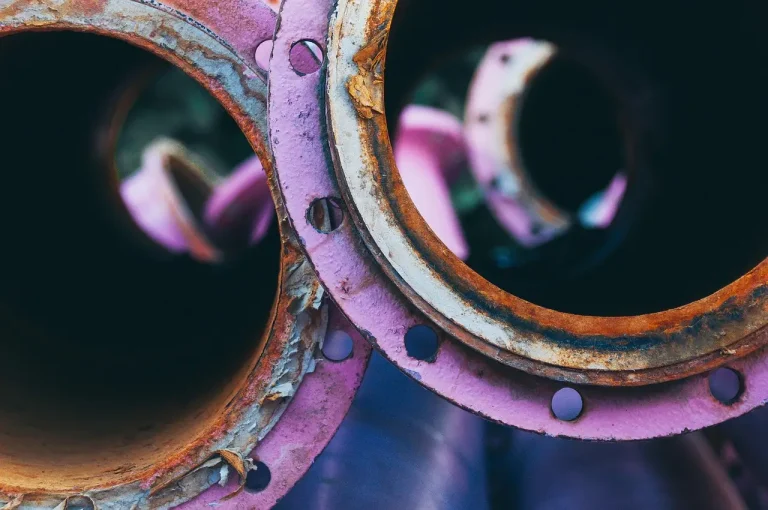
These joints usually use a bolt pattern that draws two flat or nearly flat faces together. Check pipe alignment, surface flatness, and clamp load from the bolts or studs. If the flange is warped or the pipe sits crooked, even the correct gasket can leak.
Donut and semi-floating joints
A donut gasket belongs in a conical or semi-floating connection, especially where the pipe needs some movement as the system heats and cools. A flat gasket or crush washer is the wrong shape for that seat. Force the wrong part in, and the joint often leaks as soon as the exhaust expands.
Header flange joints
Header flanges sit close to the engine and can see very high heat. That makes gasket thickness and material more important than in cooler rear sections. Thin, heat-rated gaskets are commonly used here because a thick or mismatched seal can distort, burn out, or blow out under repeated thermal cycling.
Catalytic converter joints
Catalytic converter connections are often vehicle-specific and should be matched to the cataloged joint location, flange shape, and hardware. Some use a gasket between flanges; others use a ring or donut-style seal. Do not assume a universal part fits just because the pipe diameter looks close.
Joint type decision table: pick the right seal
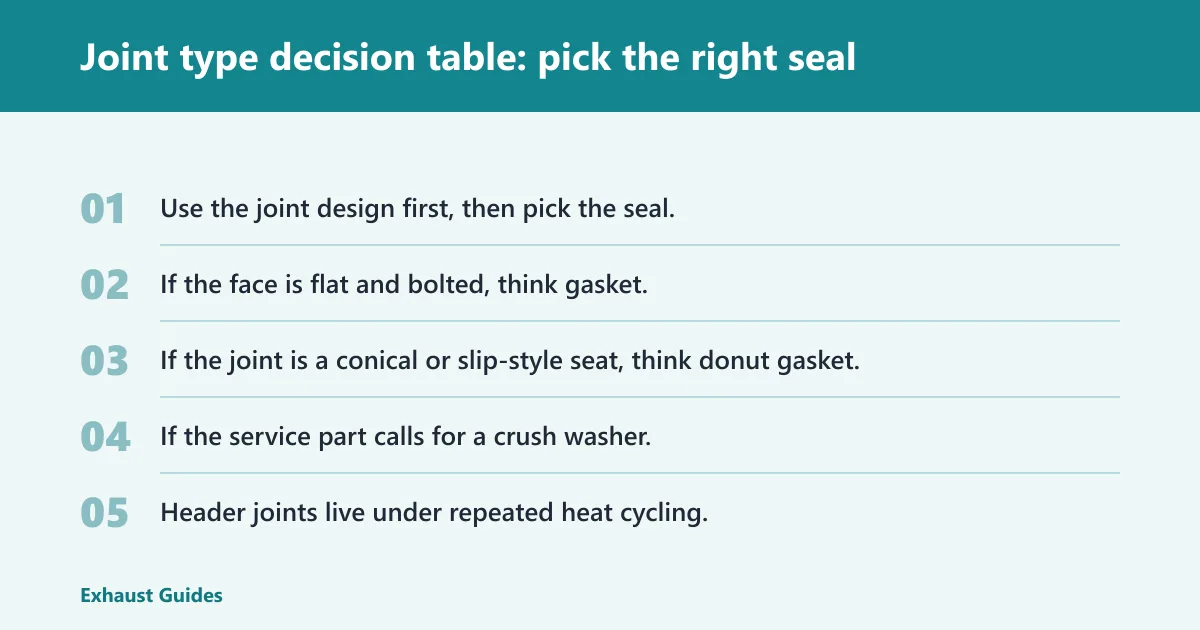
Use the joint design first, then pick the seal. If the face is flat and bolted, think gasket. If the joint is a conical or slip-style seat, think donut gasket. If the service part calls for a crush washer, it will usually be obvious from the seat shape and hardware.
| Connection type | Correct seal | What not to use | Likely failure symptoms if wrong |
|---|---|---|---|
| Header flange to pipe | Heat-rated exhaust gasket | Crush washer on the flange face | Ticking at idle, soot at the seam, gasket blowout after heat cycling |
| Slip joint with donut seat | Donut gasket | Flat gasket or crush washer | Exhaust puffing on acceleration, loose joint after expansion, black streaks |
| Catalytic converter connection | Vehicle-specific gasket or seal ring | Generic washer that does not match catalog fitment | Persistent leak, flange warp, check-engine symptoms from a bad upstream seal location |
| Flange face with bolt pattern and flatness check | Flat exhaust gasket | Crush washer | Fastener loosening, uneven clamp marks, repeat leakage after retorque |
Header flange to pipe
Header joints live under repeated heat cycling, so seal choice matters more than at the tail section. A correct gasket can tolerate expansion better than a washer forced into the wrong geometry. If the flange face is not flat or the bolts pull unevenly, fix that before blaming the seal.
Slip joint with donut gasket
The donut is there to allow controlled movement while still sealing hot gas. That is why it belongs in a conical or semi-floating joint, not a rigid flat flange. A crush washer cannot fill that shape properly, and a flat gasket cannot follow the seat.
Catalytic converter connection
Catalytic converter gaskets are a fitment problem as much as a sealing problem. The part has to match the joint location and the flange design, or you may clamp the wrong surfaces together. Replacement criteria should include the vehicle catalog callout, not only the pipe diameter.
Flange face and bolt pattern checks
Before buying parts, check the bolt pattern, flange flatness, and pipe alignment. Torque specification matters because under-tightening leaves a gap and over-tightening can distort the flange or crush the gasket too far. A straightedge and a clean mating surface solve more exhaust leaks than a second seal purchase.
When a crush washer belongs in an exhaust system
A crush washer belongs only when the exhaust joint was built around a compressed ring or washer seat. It is typically one-time use only because the metal has already deformed to fit the joint. If the seat is flat, broad, or flange-based, a crush washer is usually the wrong part.
Single-use compression behavior
Crush washers are designed to be compressed to create a tight seal. They are commonly made from aluminum, copper, or brass, and they conform to the shape of the mating surfaces as they deform. Once crushed, they do not spring back to their original shape in a reliable way.
Signs it is the wrong part for the joint
If the joint needs a broad face seal, a crush washer will leave part of the interface unsupported. That usually shows up as a quick leak, soot around the edge, or a fastener that bottoms out before the joint is sealed. On a flat flange, the washer is a shape mismatch, not a seal upgrade.
Are exhaust gaskets reusable, and do they need sealant?
Some exhaust gaskets can be reusable, but only if the material has not been heat-damaged, crushed beyond its working range, or torn during removal. Sealant is not automatic. Whether you use it depends on the joint design and the service manual, because some exhaust faces are meant to clamp dry.
Common gasket materials and reuse limits
Exhaust gaskets are often made from layered metal, graphite, or composite materials. Reuse depends on whether the gasket still has its original shape and whether the flange faces are still flat. If the gasket is etched, split, or heat-brittled, replace it.
Heat cycling and blowout risk
Heat cycling repeatedly expands and contracts the exhaust joint. That movement can relax clamp load, especially at header flanges, and can blow out a weakened gasket. A gasket that survives one removal may still be done if the engine-side heat has cooked it hard enough.
When sealant is unnecessary or not advised
Sealant is unnecessary on many properly designed exhaust flanges and can create debris or uneven clamping if overused. Use it only when the manufacturer calls for it or when the service procedure specifically allows it. The joint geometry should do the sealing work, not paste trying to fix the wrong fit.
Choose exhaust gasket if… / choose crush washer if…
Choose by face shape, clamp pattern, and heat load. An exhaust gasket wins when the joint has two mating faces, a bolt pattern, and enough area for a flat seal. A crush washer wins only when the exhaust component was built for a compressed ring-style seat and the service part listing says so.
Choose exhaust gasket if…
Choose a gasket if the joint is a header flange, manifold-to-pipe connection, catalytic converter flange, or any other broad face seal. Choose it when the flange needs even loading across the face and when heat cycling is part of normal operation. Choose it again if the old gasket was flattened, burned, or torn.
Choose crush washer if…
Choose a crush washer if the exhaust connection is explicitly built around a crush seat and the hardware specification calls for a single-use compressed seal. Choose it when the part catalog identifies that style for that joint. Choose a new one after removal, because reused washers often no longer deform evenly.
What to replace if the joint still leaks
If the joint still leaks after the correct seal is installed, inspect the flange face, bolt condition, and pipe alignment. Look for warped metal, stretched studs, uneven tightening, or a damaged donut seat. The wrong torque sequence can also leave one side of the flange underclamped.
How do I know if my exhaust seal is leaking?
You can usually spot an exhaust seal leak by ticking noises, soot at the joint, a smell of exhaust near the engine or underbody, or visible hot gas traces around the flange. On motorcycles, leaks at the header or collector are often more obvious under throttle because heat cycling and pulse pressure open a weak seal faster.
- Start the engine cold and listen for a sharp ticking near the joint.
- Inspect the flange or donut seat for black soot lines.
- Check fastener tightness against the service torque specification, in the correct sequence.
- Look for warped faces, damaged threads, or a pipe that sits off-center.
- After repair, recheck the joint after a full heat cycle if the service manual allows it.
Frequently asked questions
What is the difference between an exhaust gasket and a crush washer?
An exhaust gasket seals between two mating exhaust faces, usually across a flange or similar broad contact area. A crush washer seals by being compressed in a joint designed for that deformation. The right choice depends on the joint geometry, not on which part sounds more universal.
Can you reuse a crush washer on an exhaust joint?
Usually no. A crush washer is typically one-time use only because it seals by deforming into the seat. Once it has been compressed, it often cannot return to a shape that seals evenly again, especially after exhaust heat cycling has hardened or distorted it.
When should you use a gasket instead of a crush washer?
Use a gasket when the exhaust joint has flat flange faces, a bolt pattern, and needs sealing across a surface rather than at a single compressed seat. Header flanges and many catalytic converter connections fall into that category. A crush washer is the wrong shape for those joints.
Are exhaust gaskets reusable?
Sometimes. Exhaust gaskets can be reusable if they are still flat, intact, and not heat-damaged, but reuse depends on material and condition. If the gasket is crushed, torn, or heat-blown, replace it. Reusing a damaged gasket is a common way to end up with the same leak twice.
Do exhaust gaskets need sealant?
Not always. Many exhaust joints are meant to seal dry, and sealant can interfere with even clamping if the service procedure does not call for it. Follow the vehicle manual for that joint, because sealant use depends on the flange design, the gasket material, and the maker’s instructions.
What happens if you install the wrong seal on an exhaust flange?
The joint usually leaks. You may also see soot, hear ticking, or damage the flange by over-tightening while trying to force the wrong part to work. On hot joints, the wrong seal can blow out after expansion and contraction loosen the hardware.
Which exhaust joints use a crush washer?
Only exhaust joints built for a crush-style seat should use one. That is usually a specific service connection, not a flat flange, not a header face, and not a random pipe joint. If the catalog or service manual does not call for a crush washer, assume it is the wrong part until proven otherwise.
How do I know if my exhaust seal is leaking?
Look for ticking, soot, exhaust smell, or visible discoloration at the joint. A leak may show up after a cold start or after heat cycling has expanded the metal. If the symptoms stay at the same flange after retorque, inspect for warp or misalignment.