Stainless Steel vs Chrome Exhaust Tips: Which Lasts Longer?
Stainless steel exhaust tips usually last longer than chrome, often by years, because stainless resists rust and heat staining far better. Chrome can fail early in winter salt, short trips, or damaged plating. Ignore the finish choice and you may buy again sooner, deal with peeling or pitting, and keep a tip that looks rough fast. This guide compares lifespan by climate and driving pattern, and shows when chrome is fine and when stainless is the smarter buy.
| Decision factor | Stainless steel | Chrome exhaust tips | Winner |
|---|---|---|---|
| Corrosion resistance | Base material contains chromium and resists rust better; 304 stainless is generally more corrosion-resistant than 409 stainless. | Thin chrome plating over a steel base can fail where moisture reaches the substrate. | Stainless steel |
| Winter and road salt durability | Better choice for salted roads, wet climates, and year-round daily driving. | Road salt accelerates plating damage, rust, and pitting once the finish is chipped or worn. | Stainless steel |
| Appearance retention | Can stain or discolor from heat, but usually keeps a usable finish longer with regular cleaning. | Starts mirror-bright, then can dull, bubble, flake, or pit if the plating is damaged. | Stainless steel |
| Maintenance burden | Usually lower upkeep; cleaning still matters. | Needs more careful washing, drying, and inspection to catch early plating failure. | Stainless steel |
| Best use case | Daily drivers, winter vehicles, high-mileage cars, garage-kept cars that still see rain. | Dry-climate weekend cars, garage-kept show cars, low-mileage fair-weather use. | Depends on use case |
What the comparison is really about: finish durability, not just shine


The core trade-off is simple. Stainless steel usually lasts longer because the corrosion resistance is built into the alloy, while chrome exhaust tips are usually a plated steel part with a thin outer layer that can fail if it gets chipped or exposed to salt and moisture.
That matters more than mirror brightness. A chrome tip may look better on day one, but a stainless tip is more likely to stay presentable after winter driving, repeated washing, and the heat cycles that come with normal exhaust use.
📊 Stainless steel corrosion resistance comes from 10.5% chromium or more. Source: Stainless steel.
What chrome exhaust tips are made of
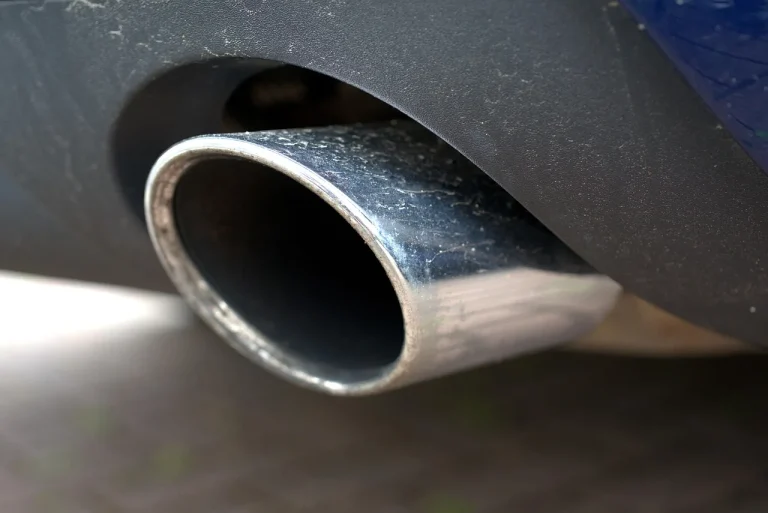
Most chrome exhaust tips are not solid chrome. A chrome exhaust tip is usually a plated steel base, with chrome plating described as a thin outer layer on the tip.
How plating failure starts: chips, flakes, bubbles, pits
Chrome plating can chip, flake, bubble, or pit. Once the coating is damaged, moisture and road salt can reach the steel beneath and rust starts at the weak spot, not evenly across the whole part.
That is why a small scratch matters. A chipped edge near the outlet can spread into a larger rough area, and the failure is often visible long before the part is structurally unusable.
What stainless steel exhaust tips are made of
Stainless steel tips use stainless alloy throughout the visible material, and stainless steel contains chromium, which gives it corrosion resistance. For exhaust tips, 304 stainless is generally more corrosion-resistant than 409 stainless, so it is usually the safer long-term choice.
304 stainless steel vs 409 stainless steel
304 stainless is the common premium grade for long-term corrosion resistance. It also has a tensile yield strength around 210 MPa when annealed, and it can be strengthened up to 1,050 MPa by cold working.
409 stainless is still a stainless exhaust material, and it is generally better than chrome-plated mild steel in harsh conditions. But it does not hold up as well as 304 when the tip sees constant moisture, winter grime, and repeated washing.
Why stainless usually lasts longer than chrome
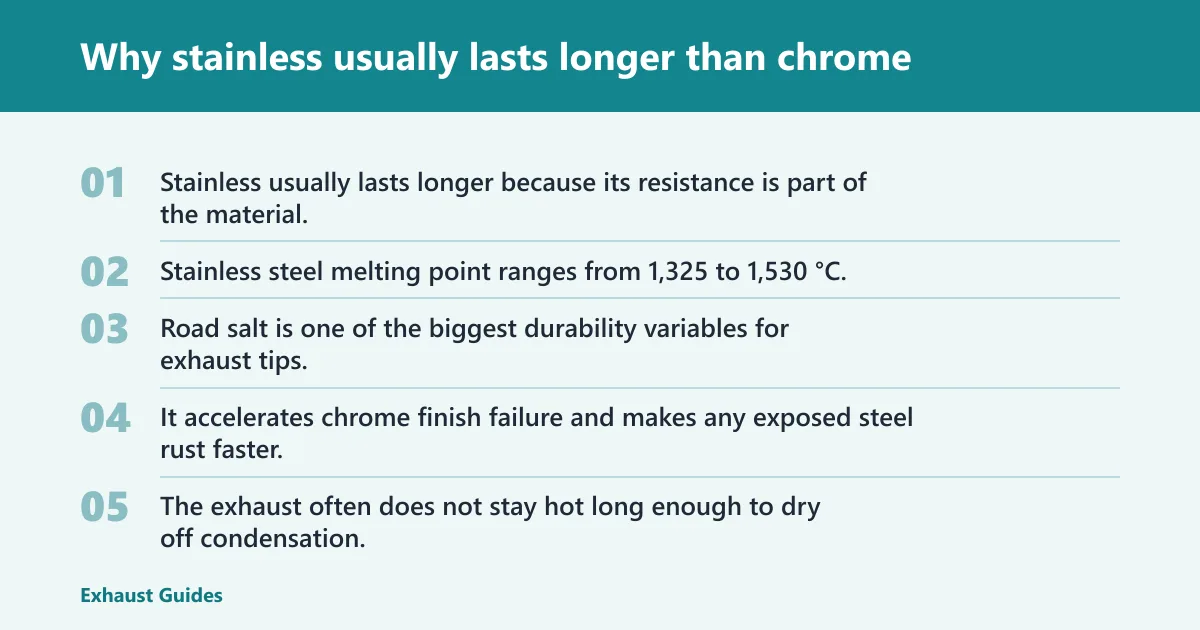
Stainless usually lasts longer because its resistance is part of the material, not a surface skin. Stainless steel melting point ranges from 1,325 to 1,530 °C, so normal exhaust heat is not the limiting factor; corrosion exposure and maintenance are.
Road salt and moisture
Road salt is one of the biggest durability variables for exhaust tips. It accelerates chrome finish failure and makes any exposed steel rust faster, which is why stainless is the better long-term buy for winter driving, coastal air, and wet parking conditions.
Frequent short trips are hard on chrome too. The exhaust often does not stay hot long enough to dry off condensation, so moisture lingers on the tip and attacks the plating edge after repeated cycles.
Heat cycles, soot, and surface wear
Heat cycles can discolor both finishes and contribute to surface breakdown over time. Stainless can show yellowing or staining near the outlet, while chrome can lose reflectivity, haze, or show tiny surface defects that become more obvious as the plating ages.
Soot matters as well. If you do not clean the tip, the buildup can hold moisture and make it harder to spot early damage.
Maintenance and cleaning frequency
Stainless still needs cleaning, but usually less often than chrome. Mild soap, water, and a non-abrasive cleaner are usually enough for routine care, with periodic inspection for staining or corrosion around welds and seams.
Chrome needs closer attention. If you wash a chrome tip, drying it afterward helps, because standing water and salt residue are what turn a bright surface into a pitted one.
When is chrome still the better choice?
Chrome can still be the better choice for dry, garage-kept, fair-weather use where the goal is bright appearance and the tip will not face winter salt or constant rain. In that setting, a chrome finish can last a long time if it stays clean and undamaged.
Weekend cars and show-first buying decisions
For a low-mileage weekend car, chrome may be worth the trade-off if the owner prioritizes a mirror look and accepts more upkeep. A garage-kept car that only comes out on dry days does not expose the plating to the same corrosion load as a commuter in salted traffic.
Say your car sees 2,000 miles a year, stays indoors, and comes home before bad weather. Chrome is a reasonable finish there, as long as the owner checks for chips and wipes off water spots after washing.
Buyer decision matrix: which finish lasts longest for your use case?
The finish most likely to last longest depends on climate, parking, washing habits, and annual mileage. Use this matrix as a practical rule, not a style guide.
| Use case | Climate and parking | Wash habits | Annual mileage | Finish most likely to last longest |
|---|---|---|---|---|
| Winter daily driver | Snow, salt, outdoor parking or street parking | Frequent winter washes, underbody spray if available | 12,000+ | 304 stainless |
| Wet-climate commuter | Rainy weather, humid air, mixed parking | Regular washes, some drying after rain | 8,000 to 15,000 | 304 stainless |
| Dry-climate weekend car | Low rain, garage kept, limited road spray | Occasional cleaning, careful drying | Under 5,000 | Chrome exhaust tips |
| High-mileage daily driver | Any climate, frequent highway use, repeated heat cycles | Regular cleaning but limited detailing time | 15,000+ | 304 stainless |
| Fair-weather show car | Garage kept, dry storage, rarely driven in rain | Careful hand washing and drying | Very low | Chrome exhaust tips |
How to read the matrix
If salt, water, and daily use are part of the plan, stainless wins almost every time. Chrome only becomes the smart durability choice when environmental exposure is low enough that the plating is unlikely to be stressed.
How to inspect exhaust tips before you buy
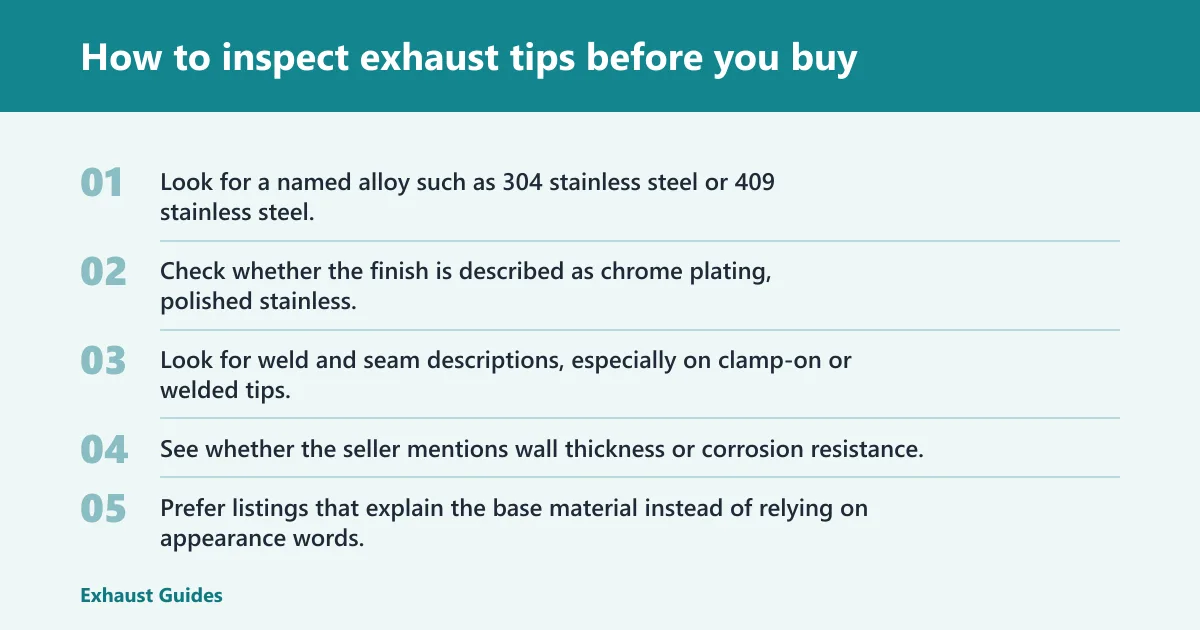
Before you buy, check the listing for the base material, the finish description, and whether the seller names 304 stainless or 409 stainless. If the listing only says “chrome” without explaining the base metal, assume it is chrome-plated steel unless the product description proves otherwise.
What to check in product listings
- Look for a named alloy such as 304 stainless steel or 409 stainless steel.
- Check whether the finish is described as chrome plating, polished stainless, or mirror finish.
- Look for weld and seam descriptions, especially on clamp-on or welded tips.
- See whether the seller mentions wall thickness or corrosion resistance.
- Prefer listings that explain the base material instead of relying on appearance words.
What to check in photos and product details
Look closely at cut edges, welds, and the inside lip of the tip. If the photos show rough seams, thin-looking metal, or inconsistent plating at edges, that is a warning sign because those are the places where moisture reaches the base first.
Suppose a 3-inch tip shows visible waviness at the rolled edge and no mention of alloy grade. That is not proof of failure, but it is enough reason to keep looking for a better-built part.
Early warning signs of cheap chrome plating
Cheap chrome plating often gives itself away with very bright marketing and very little material detail. Warning signs include vague wording, no stainless grade listed, no mention of base metal thickness, and product photos that hide welds or inside surfaces.
A common first-timer mistake is choosing chrome tips for a winter daily driver just because they look brighter on the showroom floor. A bright surface is not the same thing as a durable one, and the plating can still peel or flake if the substrate and coating quality are weak.
Choose stainless steel if… / choose chrome exhaust tips if…
Choose stainless steel if you drive in winter, live where roads stay wet, park outside often, wash the car regularly, or want the lower-maintenance option that usually lasts longer. Choose chrome exhaust tips if the car is a fair-weather, garage-kept weekend or show vehicle and you are willing to inspect and clean them more often.
- Choose stainless steel if road salt is part of your climate.
- Choose stainless steel if the car is a year-round daily driver.
- Choose stainless steel if you want less upkeep and longer finish life.
- Choose chrome exhaust tips if the car lives indoors and avoids bad weather.
- Choose chrome exhaust tips if mirror brightness matters more than long-term durability.
- Choose chrome exhaust tips if you are willing to monitor plating wear closely.
Frequently asked questions
Do stainless steel exhaust tips last longer than chrome?
Yes, stainless steel exhaust tips usually last longer than chrome in real use because corrosion resistance is built into the alloy, while chrome tips rely on a thin plated layer over steel. That difference matters most in wet climates, winter driving, and any situation where road salt can attack exposed edges.
What rusts first on chrome exhaust tips?
The first rust usually appears where chrome plating is chipped, flaking, or thin at edges, seams, and welds. Once the plating breaks, moisture and salt can reach the steel base and rust starts there. Small scratches and stone chips matter more than the bright center area.
Is 304 stainless better than chrome-plated steel for exhaust tips?
For long-term corrosion resistance, yes. 304 stainless is generally a better choice than chrome-plated steel because the corrosion resistance is part of the material, not a surface coating. It is especially worth it for salted roads, daily driving, and cars that see repeated rain or washing.
Will stainless exhaust tips discolor from heat?
Yes, stainless exhaust tips can discolor from heat. Heat cycles can cause staining or color change near the outlet, especially on polished finishes. That is usually a cosmetic issue, not a sign that the material is failing, but cleaning becomes more important if soot and grime are allowed to bake on.
Are chrome exhaust tips worth it in winter or salted roads?
Usually not. Road salt is a major factor in chrome finish failure because it speeds up rust once the plating is damaged and can also dull the surface faster. If the car sees winter roads, stainless is the safer long-term choice and often ends up cheaper over time.
Can chrome exhaust tips peel or flake over time?
Yes, chrome exhaust tips can peel or flake over time because the finish is a thin outer layer on a steel base. Once that layer lifts, moisture reaches the metal underneath and the damage tends to spread. Chips, bubbles, and edge corrosion are early signs to watch for.
How often do stainless steel exhaust tips need cleaning?
Stainless steel tips still need cleaning, but often less frequently than chrome. A regular wash schedule is usually enough for daily use, with extra attention after winter driving or heavy rain. The goal is to remove soot, salt, and water spots before they sit long enough to stain.