Genius BMW Labor Hours: Essential Fixes
Bolded Quick Summary (Top of Article)
Understanding BMW labor hours for essential fixes, like knowing how many hours labor to change Exhaust Manifolds bmw 525i, demystifies repair costs. These standard times help you budget accurately for common jobs, ensuring fair pricing from any mechanic, especially for exhaust system work.
Genius BMW Labor Hours: Essential Fixes Explained for Everyday Owners
Do you ever get a repair quote for your BMW and feel like the labor charge is a mystery? You are not alone. Many BMW owners worry about paying too much for simple fixes. Understanding how shops estimate repair time is the key to feeling confident at the garage. This is especially true for exhaust work, which can sometimes seem more complicated than it is.
We are here to shed light on these “labor hours.” Think of labor hours as the official time guide a shop uses to charge you fairly. This guide helps level the playing field between you and the mechanic. Don’t worry about complex manuals; we will break down common, essential fixes in simple terms. Let’s turn those confusing repair bills into clear plans so you can maintain your BMW safely and affordably.
What Are BMW Labor Hours, Anyway? (The Beginner’s Guide)
When a mechanic tells you a job will take “3 hours,” that’s the labor estimate. But what does that number mean for a BMW? It’s not just how long the mechanic actually spent under the car. Labor time is set by the manufacturer (BMW) or by industry standard guides, like ALLDATA or Mitchell. These guides provide a fixed, estimated time for a trained technician to complete a specific job under ideal conditions.
Why use a fixed time? It keeps things fair. If your mechanic takes 5 hours because they are new, you shouldn’t pay for their extra learning time. Conversely, if a master technician finishes in 1.5 hours, they might still bill you for the standard 2.5 hours because that is the agreed-upon benchmark for that repair.
Why Labor Time Varies (And When It’s Okay to Question It)
While standardized times exist, real life happens under the hood of a German machine like a BMW. Here are common reasons the actual time might differ from the book time:
- Accessibility Issues: Sometimes, one bolt on a BMW exhaust system is rusted solid. A simple job can turn into a nightmare requiring extra time for cutting, drilling, or heating.
- Model Year Differences: A 2005 E46 model might be easier to work on than a 2015 F30 model due to changes in engine bay layout.
- Vehicle Condition: If your undercarriage is full of old grime, it takes longer to safely lift the car and access components.
- Required Tools: Some complex repairs need special, manufacturer-specific tools. If the shop doesn’t have them ready, time is lost.
Essential BMW Fixes and Their Estimated Labor Benchmarks
As someone who spends a lot of time working with BMW exhaust components, I know these standard repairs inside and out. Below, we look at some essential maintenance and repair items and the general labor time associated with them. Remember, these are benchmarks for highly skilled work. Always check with your local shop for their specific hourly rate.
Fix 1: Spark Plug Replacement (The Basics of Engine Health)
Spark plugs are vital for smooth running and fuel efficiency. If your BMW is sputtering, this is a common starting point. On most modern inline-six BMW engines (like the popular N52 or N54), accessibility is decent, but the sheer number of cylinders means the time adds up.
Labor Estimate Breakdown:
For a typical 6-cylinder engine, replacing all six plugs usually falls between 0.75 and 1.5 hours. V8 or V12 engines will take significantly longer due to complexity and access around the intake manifold.
Fix 2: Oil Filter Housing Gasket (OFHG) Replacement
This is a notorious BMW leak point. The gasket around the oil filter housing fails, leading to oil seeping onto belts or dripping underneath. This fix usually requires removing some air intake components for access.
Labor Estimate Breakdown:
On a standard 4 or 6-cylinder engine, this typically takes a shop between 2 to 3.5 hours. It requires careful cleaning and sealing to prevent immediate re-leaking.
Fix 3: Brake Pad and Rotor Service
Brakes are a safety essential. BMWs often require electronic parking brake service (EPB) procedures to retract the rear calipers before beginning work. This specialized step adds a small, but necessary, chunk of time.
Labor Estimate Breakdown:
For all four corners (pads and rotors), expect 2 to 3 hours. If the EPB service is required, ensure the shop accounts for that 0.2 to 0.4 hours of diagnostic/reset time.
Fix 4: Oxygen (O2) Sensor Replacement
Faulty O2 sensors can cause your check engine light to illuminate and ruin your fuel economy. These are often threaded directly into the exhaust system.
Labor Estimate Breakdown:
If the sensor is easy to reach from underneath (front pipes), it might take only 0.5 hours total. If the sensor is stuck or located in a hard-to-reach area requiring exhaust component removal, it can jump to 1.5 to 2 hours per sensor.
Deep Dive: How Many Hours Labor to Change Exhaust Manifolds BMW 525i?
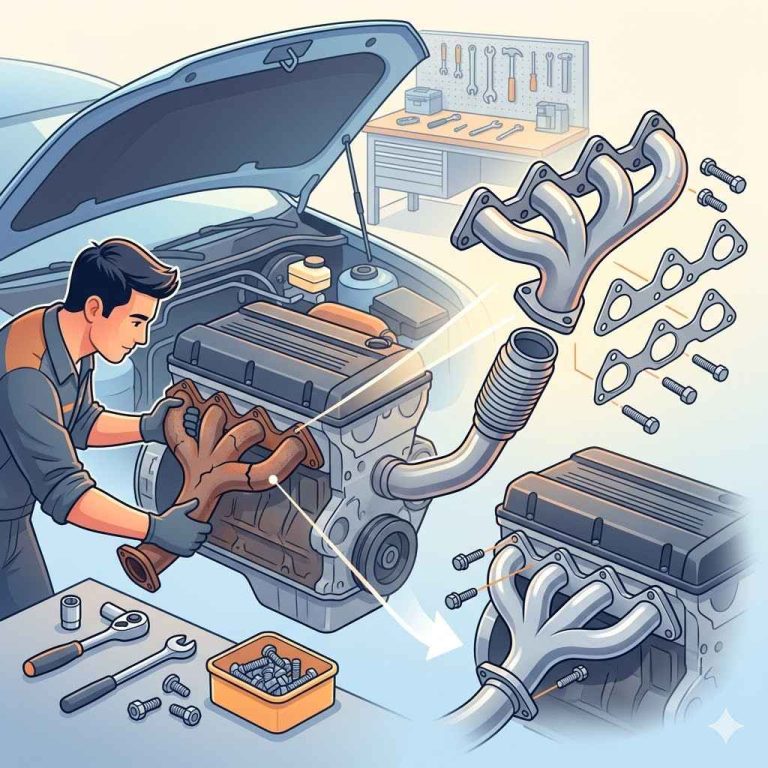
This is a highly specific question that many E39 or E60 owners face, especially when dealing with cracking manifolds on older 525i models. Exhaust manifold replacement is one of the heavier jobs because you are working directly adjacent to the engine block, often facing tight clearances and high heat stress on bolts.
For the typical BMW 525i (often featuring an M54 engine), accessing the exhaust manifolds means dealing with tight spaces and many heat shields. The labor time is significantly higher than simple bolt-on exhaust parts.
The Benchmark for BMW 525i Exhaust Manifold Replacement
Based on industry standards for the M54 engine in the 525i platform, here is the estimated labor window:
| Component | Estimated Labor Hours (BMW M54 Engine) | Why the Time Varies |
|---|---|---|
| Single Exhaust Manifold (Pre-Cat Side) | 3.5 – 5.0 Hours | Access to the upper bolts and heat shields is tight. |
| Both Exhaust Manifolds (Full Job) | 6.0 – 9.0 Hours | Dealing with rusted or broken studs, exhaust gasket replacement, and checking for leaks post-install. |
Expert Insight: The biggest time killer here is stubborn manifold bolts. If the shop has to drill out several broken studs, you are adding 1 to 3 hours easily. Always ask if the quote includes bolt extraction time or if it’s based on the assumption that all bolts come out cleanly.
For more generalized maintenance schedules and safety standards relating to vehicle repair times, you can reference resources like the National Highway Traffic Safety Administration (NHTSA) regarding vehicle standards, although specific labor times are proprietary to repair guides.
Understanding BMW Exhaust System Upgrades vs. Repairs
It’s crucial to distinguish between fixing what’s broken and upgrading for performance. Repair labor times are usually standardized. Upgrade labor times can sometimes be slightly inflated or negotiated, as they often involve custom fitting.
Repair vs. Upgrade Labor Time Comparison
When replacing a cracked stock muffler (Repair), the labor is generally quick because the replacement part is an exact fit. When installing an aftermarket axle-back system (Upgrade), there might be extra time needed for alignment or trimming clamps.
- Repair (Stock Muffler Replacement): Lower labor variance. Parts fit perfectly. Time is predictable (e.g., 1.0 – 1.5 hours).
- Upgrade (Performance Cat-Back System): Higher labor variance. May require temporary suspension adjustments or mild pipe bending for perfect alignment. Time could range from 2.0 – 4.0 hours depending on the system complexity.
Tools of the Trade: What Mechanics Need for BMW Exhaust Work
As a guide who values transparency, knowing what tools are necessary helps you appreciate the labor charge. BMWs often require specific tools, especially for exhaust hangers or sensor removal.
Essential Tool List for Basic Exhaust Maintenance:
- High-Quality Jack Stands: Safety first! Never work under a car supported only by a jack. (Refer to general safety guidelines from organizations like the Occupational Safety and Health Administration (OSHA) regarding proper vehicle support.)
- Penetrating Oil (like PB Blaster): Essential for soaking old, rusted exhaust bolts before attempting removal. This saves labor time dramatically.
- Torque Wrench: BMW specifications are precise. Reinstalling manifolds or hangers without proper torque risks leaks or failure.
- Oxygen Sensor Socket: A specialized socket with a slot to allow the sensor wire to pass through while turning the sensor.
- Exhaust Hanger Removal Tool: A simple pry bar shaped perfectly to slide off stubborn rubber exhaust hangers without tearing them.
Decoding the Repair Invoice: Putting Labor Hours into Perspective
Once you have the labor hours, the final cost depends on the hourly rate the shop charges. A high-end dealership might charge $180 per hour, while an independent BMW specialist might charge $130 per hour. The labor time stays the same, but the cost changes dramatically.
Formula Check:
Total Labor Cost = Estimated Labor Hours x Shop Hourly Rate
Let’s use the 525i manifold example (estimated 7 hours standard time):
| Shop Type | Estimated Hourly Rate | Total Estimated Labor Cost (7 Hours) |
|---|---|---|
| BMW Dealership | $180.00 | $1,260.00 |
| Independent Specialist | $130.00 | $910.00 |
| General Repair Shop | $100.00 | $700.00 |
See how understanding the labor hours allows you to shop around effectively? You are comparing apples to apples in terms of effort required, making the hourly rate the only real variable.
When Does Labor Time Get “Booked Out” Longer?
Sometimes a shop needs to book more time than the industry standard. This isn’t always a red flag, but it requires a good explanation:
- Diagnostic Time: If the issue isn’t obvious (e.g., intermittent exhaust drone), the first hour or two is diagnostic labor. This must be billed, even if the final fix is quick.
- Corrosion Factor: If the vehicle has spent its life in a salty, northern climate, the mechanic might add a small “corrosion buffer” (e.g., +0.5 hours) to complex tasks like manifold removal, understanding the risk of seized bolts.
- Parts Cleaning/Prep: For critical seals (like manifold gaskets), experienced mechanics often spend extra time meticulously cleaning mating surfaces to ensure a leak-free seal, time that might not be fully accounted for in the base labor guide.
Safety First: Never Compromise on Exhaust Repairs
I always emphasize this: Exhaust system work is not just about performance; it’s about safety. Leaks in the exhaust manifold or near the catalytic converter can allow dangerous carbon monoxide gas to enter the cabin.
Key Safety Checks During Exhaust Labor:
- Inspect the catalytic converter body for physical damage or melting after a manifold job.
- Ensure all oxygen sensor wires are routed away from hot exhaust components or moving driveline parts.
- Verify that all heat shields are properly reinstalled and secured; loose shields rattle loudly and can pose a fire risk near hot mufflers.
Achieving Confidence in Your BMW Maintenance Budget
The goal of demystifying labor hours is to empower you. When you call for a quote on a common BMW essential fix—whether it’s brakes, gaskets, or those notorious exhaust manifolds on your 525i—you now have a baseline expectation.
Ask these three powerful questions when getting quotes:
- “What is the standard book time you use for this job?” (This gauges their reliance on industry standards.)
- “Does this estimate include the time required to address rusted fasteners, or is that extra?” (This clarifies potential hidden costs.)
- “What is your total shop hourly rate?” (This translates the time into the final dollar figure.)
Knowing that an exhaust manifold job is generally an 8-hour affair on certain models prepares you for the resulting bill and helps you judge whether the shop is being thorough or overcharging.
Frequently Asked Questions (FAQ) About BMW Labor Times
Q1: How much does BMW charge per hour for labor at a dealership?
A: BMW dealership hourly rates are usually the highest, often ranging from $160 to over $200 per hour, depending on your geographic location and the specific dealership.
Q2: Is it cheaper to have an independent shop do the work?
A: Yes, typically. Independent shops specializing in BMWs often charge significantly less per hour (sometimes $30–$50 less) but use the same industry standard labor times.
Q3: What is a “flat-rate” system, and how does it differ from book time?
A: Many modern shops use a flat-rate system. This means they charge you a fixed price for the job, which is based on the book time multiplied by their rate. This is usually what you see on the final invoice.
Q4: If a repair takes longer than the estimate, do I have to pay for the extra time?
A: Generally, no, if you agreed to a flat-rate price upfront. However, if the mechanic discovers unexpected complications (like stripped bolts), they should stop, call you, and explain the necessary extra time before proceeding.
Q5: What is the easiest essential BMW repair in terms of labor time?
A: Simple tasks like replacing an air filter or cabin air filter usually take less than 0.2 hours and are often done very quickly by any competent technician.
Q6: Should I buy my own OEM parts and bring them to the mechanic?
A: Some shops refuse to install customer-supplied parts due to liability concerns (warranties). If they agree, ensure the part is genuine OEM; cheap aftermarket parts often require more labor time to fit correctly.
Conclusion: Taking Control of Your BMW Repair Experience
Understanding BMW labor hours transforms you from a passive recipient of repair bills into an active, informed consumer. Whether you are tracking down a minor oil leak or facing a significant exhaust manifold replacement on your reliable 525i, knowing the expected time investment allows you to budget confidently and vet repair quotes accurately.
Remember, these times are guidelines designed for efficiency. By combining this knowledge with a trusted, independent specialist who is transparent about their process—especially concerning those tricky, rusted exhaust components—you ensure your BMW receives the best care without unnecessary surprise costs. Keep learning these essential benchmarks, and you’ll maintain that legendary BMW performance safely for years to come.