Are 331 354 392 Hemi Headers Same? Proven Fit!
Yes, 331 Hemi, 354 Hemi, and 392 Hemi engine headers are generally not the same, though they share some fundamental similarities due to being Chrysler’s early Hemis. Significant differences exist in port spacing, port shape, and overall engine block dimensions that necessitate specific header designs for each displacement to ensure a proper fit and optimal performance. Always verify fitment for your specific engine and vehicle.

Speedway Motors
Early for Hemi Universal Side Engine Mounts
- Heavy-duty steel construction
- Sold as a pair
- Will fit '52-'61 DeSoto FireDome Compatible with V8 and '51-'58 Compatible with Chrysler Compatible with Hemi Compatible with V8
As an Amazon Associate I earn from qualifying purchases.
Ever stared at a pair of engine headers and wondered if they’d fit your classic Mopar? It’s a common question when working with legendary engines like the Chrysler 331, 354, and 392 Hemis. These “early Hemi” powerhouses are iconic, but their exhaust systems can be a bit of a puzzle. You want to upgrade for that sweet sound and extra horsepower, but the thought of buying the wrong parts can be frustrating. Don’t worry! We’re here to clear the air and give you the confidence to choose the right headers. We’ll break down what makes them similar, what makes them different, and how to make sure you get a perfect fit for your beloved Hemi.
Understanding Early Hemi Header Basics
Before we dive into the specifics of the 331, 354, and 392 Hemis, let’s grasp what makes headers important in the first place. Your engine’s exhaust manifolds are like its lungs. They take the hot, used gases from the cylinders and send them out. Stock manifolds are often bulky and designed for quiet operation and cost-effectiveness, not performance. Headers, on the other hand, are designed to make this process smoother and more efficient.
Headers typically consist of individual tubes, one for each exhaust port on the cylinder head. These tubes merge into a collector, which then connects to your exhaust system. The design of these tubes – their length, diameter, and how they flow into the collector – significantly impacts how quickly exhaust gases can escape. Better exhaust flow means your engine can “breathe” easier, leading to:
- Increased Horsepower and Torque: A less restricted exhaust allows the engine to expel gases more efficiently, meaning it can take in more fresh air and fuel on the next cycle.
- Improved Throttle Response: When the engine can expel exhaust quickly, it reacts faster to your inputs on the gas pedal.
- Better Fuel Efficiency (sometimes): While often associated with performance, a more efficient exhaust process can, in some cases, lead to better fuel economy when not driving aggressively. This is because the engine doesn’t have to work as hard.
- Distinct Exhaust Note: Headers are usually a key component in achieving that classic, aggressive V8 rumble that enthusiasts love.
When people ask if headers are the same across the 331, 354, and 392 Hemis, they’re often hoping for a universal solution. While these engines share a family resemblance and many core design elements, the devil is in the details. Even small changes in engine block dimensions or cylinder head port configurations can mean the difference between a perfect fit and a frustrating installation.
The Chrysler Early Hemi Family: A Quick Look
Chrysler introduced its legendary Hemi engine in 1951. Known for its hemispherical combustion chambers, this design was revolutionary and offered significant advantages in power and efficiency for its time. Our focus today, the 331, 354, and 392 cubic inch versions, represent the first generation of these powerful V8s.
These engines were primarily used in Chrysler, Dodge, and Plymouth vehicles from the mid-1950s through the late 1950s. They are highly sought after by hot rodders and classic car enthusiasts for their robust construction and immense power potential.
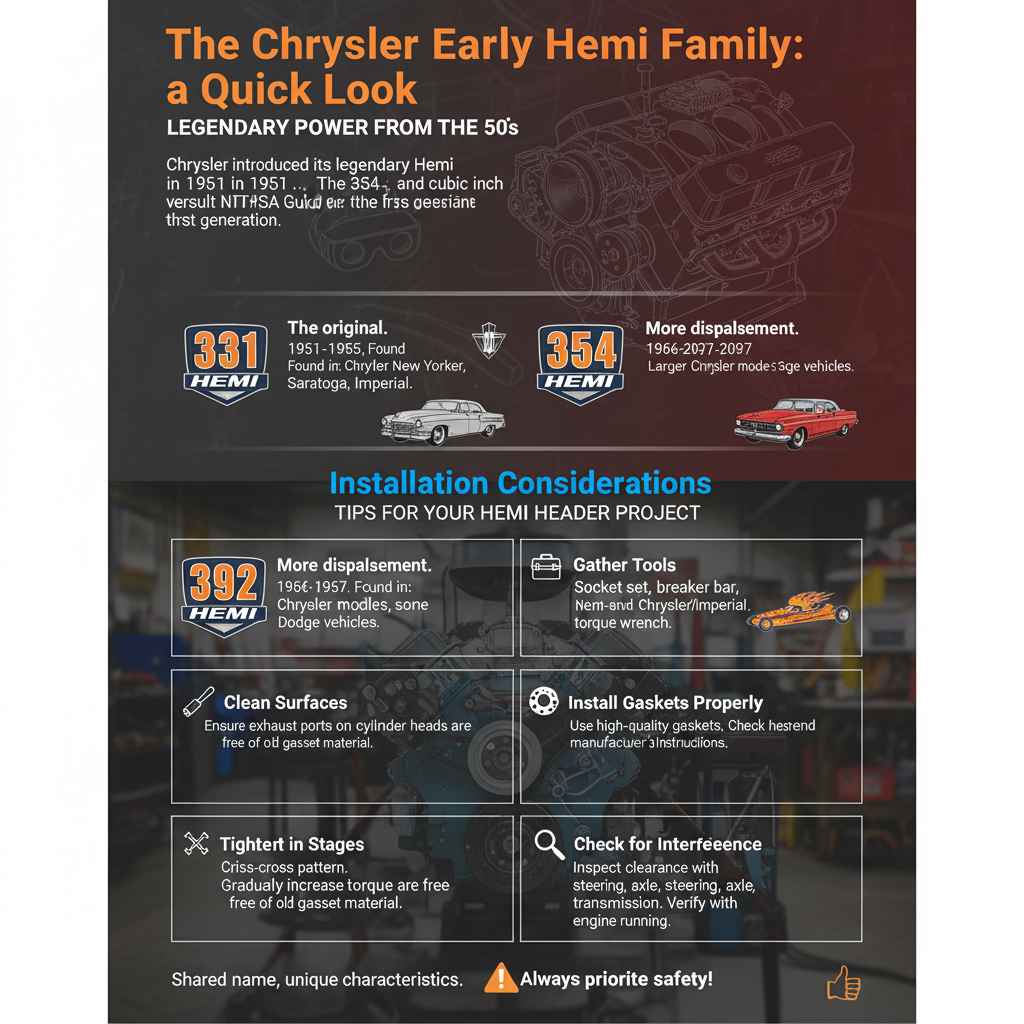
- 331 Hemi: The original. Introduced in 1951, found in models like the Chrysler New Yorker, Saratoga, and Imperial.
- 354 Hemi: An evolution, offering more displacement and power. Often seen in larger Chrysler models and some Dodge vehicles.
- 392 Hemi: The king of the early Hemis in terms of displacement. This was the most powerful iteration, found in high-end Chrysler and Imperial models, and also a popular choice for drag racing.
While they share the “Hemi” name and the iconic hemispherical head design, each engine has its own specific dimensions and characteristics that affect component compatibility, including exhaust headers.
Key Differences Affecting Header Fitment: 331 vs. 354 vs. 392
The main reason you can’t just grab any header set for an early Hemi and expect it to fit all three displacements comes down to a few critical engine geometry differences:
1. Cylinder Head Port Design and Spacing
This is perhaps the most significant factor. While all early Hemis have V-shaped cylinder heads with exhaust ports arranged in a specific pattern, the exact size, shape, and spacing of these ports can vary slightly from the 331 to the 354 and 392. Manufacturers of aftermarket headers must carefully measure these dimensions to ensure their header tubes align correctly with each exhaust port on the cylinder head.
A header tube that is slightly misaligned can:
- Be difficult or impossible to bolt up.
- Require excessive force, risking damage to the header or the cylinder head.
- Create exhaust leaks at the port if not sealed perfectly.
- Potentially obstruct flow if the fit is very poor.
2. Engine Block Dimensions and Accessory Mounts
As displacement increased from the 331 to the 354 and then to the 392, there were subtle changes in the overall engine block dimensions. These can affect the available space around the exhaust ports. Furthermore, the location and design of accessory mounts (like for the generator, power steering pump, or A/C compressor) can differ between these engines and the vehicles they were installed in. Headers need to clear not only the cylinder heads but also these engine-mounted accessories and often the vehicle’s frame and steering components.
A header designed for, say, a 331 might be too wide or hang too low in a chassis that originally housed a 392 due to these dimensional differences or accessory layouts. This is why header manufacturers often specify which engine displacement their headers are designed for.
3. Exhaust Port Shape and Angle
Beyond just spacing, the precise shape and angle of the exhaust port opening on the cylinder head can vary. This affects not only how the header tube seals to the head but also the most efficient way to direct exhaust gases into the tube. Headers are designed with specific port shapes and often a slight angle to match the cylinder head’s port without creating turbulence.
4. Collector Placement and Diameter
While the individual tube lengths might be designed for optimal scavenging, the way these tubes merge into a collector can also differ. The collector’s position and diameter are crucial for maintaining exhaust velocity and directing the flow into the rest of the exhaust system or mid-pipe. Headers for different Hemi displacements might have collectors positioned slightly differently to accommodate the chassis and exhaust routing.
Are Custom Headers the Answer?
For enthusiasts seeking the absolute best fit, performance, and aesthetics, custom exhaust headers are an option. A reputable exhaust shop can fabricate headers specifically for your engine and vehicle combination. This process involves:
- Taking Measurements: The fabricator will meticulously measure your engine, cylinder heads, and the available space in the engine bay.
- Bending and Welding Tubing: Using specific mandrel-bent tubing (which maintains a consistent diameter), they will create the individual primaries and collector.
- Ensuring Clearance: Careful attention is paid to clearing the steering, suspension, frame, firewall, and any accessories.
- Material Choice: Options often include mild steel, stainless steel, or ceramic-coated steel for durability and corrosion resistance.
While custom headers offer a perfect solution, they are typically more expensive and time-consuming than off-the-shelf parts. However, for rare applications or highly modified engines, they can be the only way to achieve the desired outcome.
Table: Early Hemi Engine Specifications Overview
Here’s a quick look at the key specifications for these early Hemi engines that illustrate why header fitment is not universal:
| Feature | 331 Hemi | 354 Hemi | 392 Hemi |
|---|---|---|---|
| Displacement (cu. in.) | 331 | 354 | 392 |
| Bore x Stroke (in.) | 3.625 x 3.25 | 3.75 x 3.28 | 4.00 x 3.75 |
| Engine Block | Cast Iron | Cast Iron | Cast Iron |
| Year Range (approx.) | 1951-1958 | 1956-1958 | 1957-1958 |
| Common Horsepower (Stock) | 180-270 hp | 250-350 hp | 355-375 hp |
As you can see, while they are all “early Hemis,” the increased displacement in the 354 and 392 often comes with physically larger bore and stroke dimensions, which can influence the engine’s ‘footprint’ and the clearance required for exhaust systems.
Proven Fit: How to Choose the Right Headers
So, if they aren’t all the same, how do you make sure you’re buying the right headers? It boils down to diligent research and confirming fitment with the manufacturer.
1. Identify Your Specific Engine Displacement
First and foremost, confirm which Hemi you have. Is it a 331, 354, or 392? This information is usually stamped on the engine block or can be found by checking the vehicle’s original specifications. Don’t guess!
2. Consult the Header Manufacturer’s Application Guide
This is non-negotiable. Reputable header manufacturers (like Hooker, Doug Thorley, Sanderson, and others) provide detailed application guides, either in print or on their websites. These guides list:
- Vehicle Make and Model: Headers are often designed to fit specific car models and years due to chassis variations.
- Engine Size: They will clearly state which engine displacements (e.g., 331, 354, 392 Hemi) the headers are designed for.
- Transmission Type: Sometimes, clearance can be affected by whether you have a manual or automatic transmission.
- Key Clearance Points: Many guides will also mention potential clearance issues with common components like steering boxes or crossmembers.
An excellent resource for understanding common engine swaps and part compatibility for classic Mopars is the Allpar Hemi Engine Evolution page. While not directly about headers, it provides valuable context on these engines.
3. Look for “Direct Fit” or “Application Specific” Headers
When buying off-the-shelf, seek out headers that are explicitly advertised as fitting your specific year, make, model, AND engine. Phrases like “direct fit,” “bolt-on,” or “designed for [your specific car and engine]” are good indicators.
4. Check Material and Coating Options
Headers come in various materials and finishes:
- Mild Steel: The most basic and often most affordable. They will rust without protection.
- Ceramic Coated: A popular choice. The ceramic coating helps reduce underhood temperatures and offers corrosion resistance.
- Stainless Steel: The most durable and corrosion-resistant, offering the best long-term value, though they are usually the most expensive.
Ensure the coating or material is suitable for your climate and driving conditions. For long-term use and to combat rust, consider ceramic coating or stainless steel, especially if your vehicle is driven in wet conditions. For more information on exhaust material properties, resources like Corrosion Technologies can be helpful.
5. Consider Collector Size and Exhaust Hook-up
Headers end in a collector which bolts to your downpipe or exhaust system. Make sure the collector size (e.g., 2.5-inch, 3-inch) matches your planned exhaust system diameter for optimal flow. Manufacturers will usually specify this.
6. Read Reviews and Ask the Community
Don’t underestimate the power of fellow gearheads! Look for online reviews of specific header models. Forums dedicated to classic Mopars or specific Hemi engines are invaluable places to ask questions and get real-world feedback on fitment and ease of installation from other owners.
Installation Considerations
Even with the correct headers, installation can be a bit of a job. Here are a few tips:
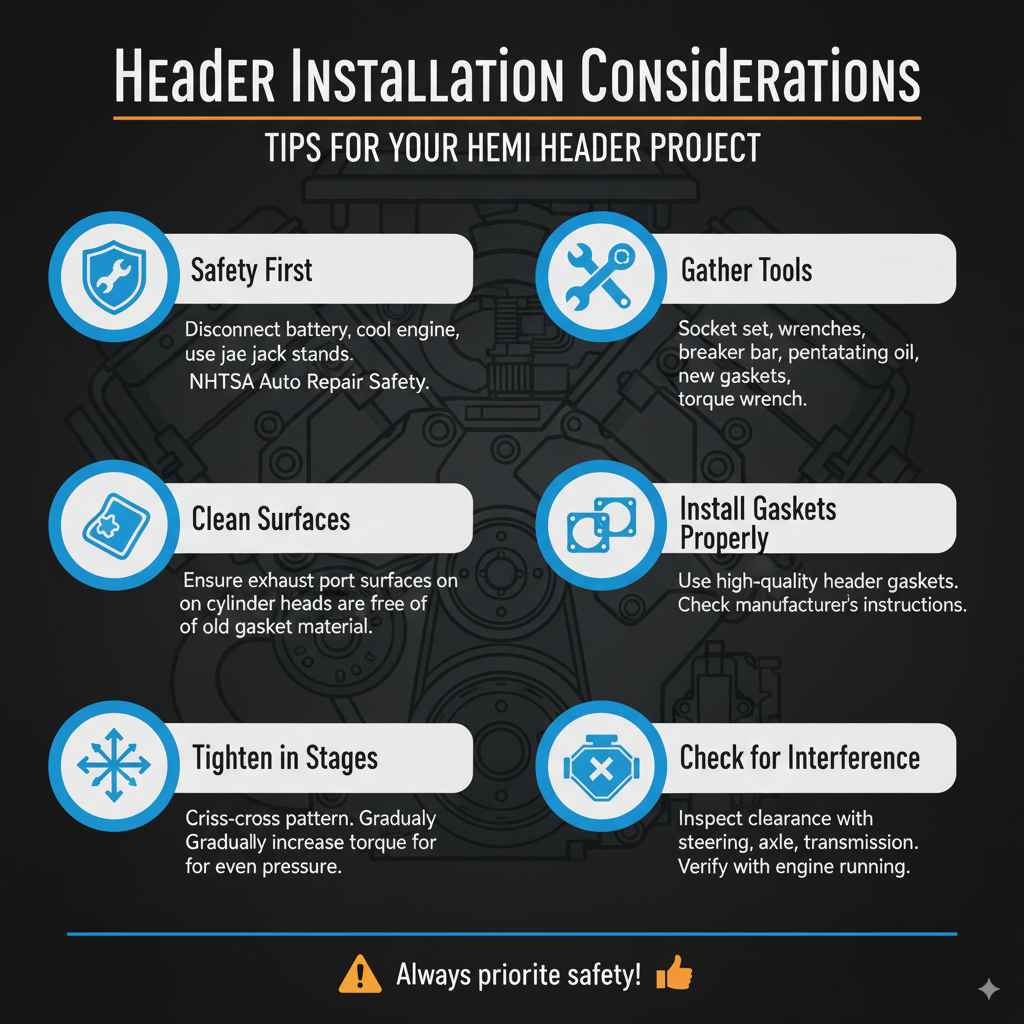
- Safety First: Always disconnect the battery, let the engine cool completely, and use jack stands to securely support the vehicle. Never rely on a jack alone. Familiarize yourself with proper automotive safety procedures. For comprehensive safety guidelines, the NHTSA Consumer Guide to Auto Repair Safety is an excellent resource.
- Gather Tools: You’ll likely need a good socket set, wrenches, possibly a breaker bar, penetrating oil (for stubborn bolts), new gaskets, and possibly a torque wrench.
- Clean Surfaces: Ensure the exhaust port surfaces on the cylinder heads are clean and free of old gasket material.
- Install Gaskets Properly: Use high-quality header gaskets. Sometimes, header manufacturers include them, other times you’ll need to purchase them separately.
- Tighten in Stages: Don’t just tighten one bolt all the way. Tighten bolts in a criss-cross pattern, gradually increasing torque to ensure even pressure and prevent warping or leaks.
- Check for Interference: Once installed, double-check for any interference with the steering, front axle, transmission, or any other components, especially when the engine is running and potentially moving slightly on its mounts.
FAQ: Your Early Hemi Header Questions Answered
Q1: Are the exhaust ports on a 331 Hemi the same as a 392 Hemi?
A: No, while they are both early Hemis, there are differences in the exact spacing, shape, and angle of the exhaust ports between the 331, 354, and 392. Headers are designed to match these specific port configurations.
Q2: Can I use headers designed for a 354 Hemi on my 331 Hemi?
A: It is highly unlikely to be a direct fit. While they are from the same engine family, the precise port dimensions and possibly engine bay clearances differ enough that headers for a 354 will probably not bolt up correctly to a 331 without modification, if at all.
Q3: What are the biggest physical differences that affect header fitment between these engines?
A: The primary differences are the cylinder head port spacing and shape, overall engine block dimensions affecting clearance, and the mounting locations for accessories which can block header tubes.
Q4: How can I be sure the headers I buy will fit my specific car and engine?
A: Always consult the header manufacturer’s application guide. Look for headers that explicitly list your vehicle’s year, make, model, and the specific engine displacement (331, 354, or 392 Hemi).
Q5: What does “proven fit” mean for headers?
A: “Proven fit” means that a specific header model has been designed, tested, and confirmed by the manufacturer to install correctly on the specified vehicle and engine without modification. This often relies on extensive R&D and customer feedback.
Q6: Are shorty headers different from long-tube headers for early Hemis?
A: Yes, they are fundamentally different in design and purpose. Shorty headers are usually designed for tighter engine bays, easier installation, and sometimes to retain emissions equipment (though less relevant for these classic engines). Long-tube headers are longer, extend further down the car, and are generally designed for maximum performance by improving exhaust scavenging at higher RPMs. Both types must still specific application fitment for the 331, 354, or 392.
Related pick: Check today's price on Amazon