Why Your Exhaust Sounds Louder Than Normal
A louder exhaust is often normal for about the first 30 to 90 seconds after a cold start, but if the noise stays loud, gets sharper, or changes with speed, treat it as a possible leak or failing muffler, pipe, or gasket. Ignoring it can waste fuel, let fumes enter the cabin, and turn a small repair into a bigger one. This guide shows how to tell normal cold-start noise from a fault by sound, location, and timing.
Matching exhaust noises to their likely components

Cold starts are the most common harmless reason. The engine idles faster for a short time, fueling is richer, and cold metal carries more sound, especially in freezing weather. That should fade as coolant temperature rises. If the volume stays high after warm-up, or the tone turns sharp, metallic, or raspy, something in the exhaust path may be damaged.
Loudness under load can also be normal for a few seconds during hard acceleration. The clue is whether the sound returns to normal at steady cruise and idle. Persistent loudness at all speeds points away from throttle response and toward a leak, restriction, or failed noise-control part.
Noise diagnosis table
| Sound type / urgency | When it happens | Likely component | First safe check |
|---|---|---|---|
| Ticking – inspect soon | Sharp on cold start, often fades as the engine warms | Exhaust manifold, manifold gasket, or an upstream leak | Listen near the front of the engine bay with the hood open; look for soot around the manifold or gasket area. |
| Hissing – inspect soon | Louder on startup or under acceleration | Exhaust leak at a gasket, weld, flange, or flex pipe | Check the underbody for black soot, loose joints, or a split braided flex section. |
| Rumbling – inspect soon | Constant at idle or cruise, often deeper than usual | Muffler rust-through, failed chambers, or resonator damage | Look at the rear section for rust holes, hanging parts, or heat discoloration near the muffler. |
| Rasping – inspect soon | Most obvious during throttle changes or hill climbs | Flex pipe split, cracked pipe, or leaking joint | Check the front exhaust sections for a braided section that looks frayed, open, or displaced. |
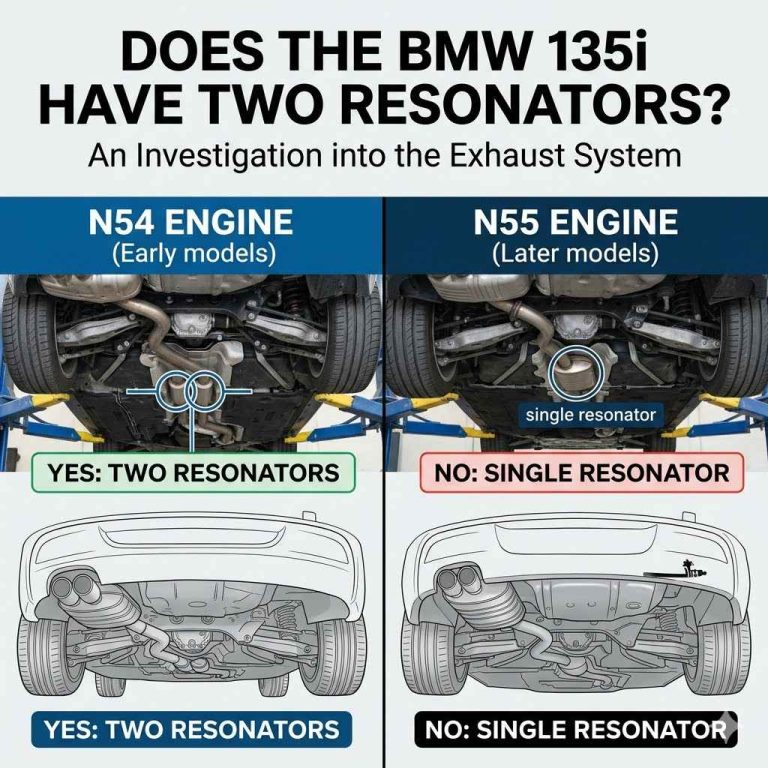
| Booming – normal to inspect soon | More noticeable after resonator removal or failure | Resonator missing, damaged, or replaced with a straight pipe | Compare the underside to the original layout if the car recently changed sound after repair or modification. |
| Buzzing – inspect soon | Shows up with engine speed or under load | Small exhaust leak, loose shield, or cracked pipe seam | Lightly tap nearby shields only when cool, then check for movement or contact marks. |
| Rattling – inspect soon | Changes with RPM or bumps | Loose heat shield | Look for thin metal shields near the catalytic converter or muffler that can move by hand when the exhaust is cool. |
| Metallic clatter – stop driving | Inside the exhaust, sometimes with loss of power | Catalytic converter substrate breaking apart | Stop if pieces are shaking inside the converter or if exhaust flow feels restricted. |
| Sudden loud roar – stop driving | Appears after a scrape, impact, theft, or a loud pop | Broken pipe, missing muffler section, or stolen catalytic converter | Check whether a section is missing, hanging, or visibly cut. |
| Sharp leak sound with check-engine light – inspect soon | Cold start, idle, or load; may come with fault codes | Leak upstream of an oxygen sensor | Read the code if available and inspect for soot or damaged joints near the sensor. |
| Deep drone – inspect soon | At highway speed or steady throttle | Resonator issue, muffler failure, or exhaust leak in the rear section | Note whether the drone changes when you lift off the throttle; rear-section problems often do. |
What a louder exhaust sound usually means
A louder exhaust often points to one of a few things: a leak, a failing muffler, a damaged resonator, a catalytic converter problem, or a loose shield that only sounds like an exhaust fault. The sound shape matters. Ticking and hissing usually mean escaping gas. Rattling usually means metal moving, not more exhaust volume.
Leak points that matter most
Common exhaust leak points are the manifold, flex pipe, gasket, weld, and flange. Those leaks are often louder on cold start or under load because the metal contracts when cold and the exhaust pressure tends to rise when you accelerate. If the leak sits upstream of an oxygen sensor, the engine may set a check-engine light because the sensor reads extra oxygen from the leak instead of the true exhaust mix.
Exhaust manifold cracks and gasket failures usually sound like sharp ticking from the engine bay. Flex pipe splits often sound like a raspy leak or a buzz from the front of the underbody. Weld and flange leaks more often make a hiss that follows engine speed.
Muffler, resonator, and catalyst changes
The muffler is the main noise-reduction part at the rear of most cars. If it rusts through or its internal baffles or chambers fail, the exhaust can become abruptly louder. That change often sounds deeper, rougher, and more hollow than a leak.
The resonator fine-tunes exhaust tone and drone. Removing it makes the car sound noticeably louder and deeper, and some vehicles never had one in the first place. A catalytic converter can also change sound if its substrate breaks apart or if theft leaves part of the system missing. It reduces noise slightly while cleaning emissions, so damage can change both volume and tone.
Where the noise comes
Location narrows the fault fast. Front-of-car ticking usually points to the manifold, gasket, or flex pipe. Underbody raspy leaks and buzzing usually point to a cracked pipe, flange, or weld. Rear booming or a sudden jump in volume usually points to the muffler, resonator, or a missing converter section.
A loose heat shield is different. It usually rattles, especially over bumps or when engine speed changes, and it does not usually make the exhaust itself louder. That distinction matters, because a shield problem may be annoying but still repairable with clips, bolts, or replacement rather than a full exhaust repair.
Can a louder exhaust be a leak?
Yes. A leak is one of the most common reasons an exhaust gets louder than usual. If the sound is sharp, pops up at startup, or gets stronger when you press the throttle, suspect a leak at the manifold, flex pipe, gasket, weld, or flange. A leak can also leave black soot near the failure point.
Oxygen sensors help narrow the diagnosis. If a leak sits before an upstream sensor, the sensor may report false oxygen readings, and fault codes can appear even though the engine itself is not the original problem. That overlap is why a louder exhaust sometimes looks like an engine issue at first.
- Start with the cold engine. Listen for ticking or hissing at idle during the first minute. If the volume fades as the engine warms, that leans toward cold-start behavior or a small leak that expands with heat.
- Check the front first. Open the hood and look around the manifold area for soot, cracked heat shielding, or a burnt smell. Front-end ticking is more likely to come from the manifold or gasket than from the muffler.
- Inspect the underbody. Look for a split flex pipe, loose flange, or shiny scrape marks on the exhaust line. A raspy leak under the car usually points to a front exhaust section rather than the rear muffler.
- Read warning lights. If the check-engine light is on, note whether the car also smells of exhaust inside or outside. Codes tied to oxygen sensors or mixture faults often appear with leaks upstream of the sensor.
Say your sedan suddenly starts ticking on a winter morning, then quiets down after two minutes at idle. That pattern fits a cold-start leak or normal metal contraction more than a muffler failure. If the same car also leaves a black soot line near the manifold, the leak becomes the leading suspect.
Can a bad muffler make your car louder?
Yes. A bad muffler can make a car much louder, and the change is often abrupt when rust opens a hole or internal baffles fail. The sound usually comes from the rear of the car and often feels deeper and more intrusive than a small leak. If the muffler shell is rusted through, replacement is often the fix.
Resonator damage can have a similar effect, especially if the car becomes droney at highway speed. The resonator is not on every vehicle, so a missing or failed one can be mistaken for muffler trouble. If sound changed after an exhaust repair, compare the current layout to the original system, especially under the rear floor.
Picture a hatchback that starts booming at 45 mph after a rear exhaust section rusts through. The noise may be worst on smooth roads and quieter on rough pavement. That pattern points away from engine misfire and toward rear exhaust hardware.
What to check before you drive
Use a simple order: listen, look, note smell or warning lights, then decide whether to drive. If the car only sounds louder for the first 30 to 90 seconds after a cold start and then settles down, that is usually normal. If the sound persists, gets sharper, or comes with fumes, treat it as a possible fault.
- Listen at idle. Stand clear of the tailpipe and listen for ticking, hissing, rumbling, or buzzing. Match the sound to the front, middle, or rear of the car.
- Look for damage. With the engine off and cool, check for rust holes, dangling shields, missing sections, or soot marks. Those are the fastest visual clues to the source.
- Notice smell and lights. Exhaust odor inside the cabin, fuel smell, or a check-engine light raises the urgency. A leak near sensors can also create drivability codes.
- Decide on the trip. If the car is only a little loud on cold start, you can usually drive it and plan an inspection. If there is a strong leak sound, a missing converter, or metal rattling inside the exhaust, stop driving and get help.
When loudness changes with acceleration, compare idle to a steady rev. A louder exhaust under load can be normal for a moment, but if the tone turns harsh, the car loses power, or the sound only appears under throttle, a leak or restriction is more likely than a normal throttle response.
Frequently asked questions
Why does my exhaust sound louder than normal?
Most often, the car is cold, the idle is higher, and the engine is running richer for a short time. If the sound stays loud after warm-up, or if it turns into ticking, hissing, rumbling, or rattling, the cause is more likely a leak or a failed exhaust part than normal startup behavior.
Is a louder exhaust always a leak?
No. A bad muffler, failed resonator, broken catalytic converter substrate, or even a loose heat shield can change the sound. Cold start can also make a healthy exhaust seem louder for 30 to 90 seconds. The key is whether the noise fades, stays the same, or changes with speed and bumps.
Can a bad muffler make my car louder?
Yes. A muffler with rust-through or failed internal baffles can cause an abrupt jump in volume, usually from the rear of the car. The tone often becomes deeper and rougher. If the sound is coming from the back section and the shell is corroded, the muffler is a strong suspect.
Why does my exhaust get louder when accelerating?
Some increase under acceleration is normal because exhaust flow rises with engine load. If the sound becomes harsh, raspy, or much louder than it is at idle, that points to a leak, a split flex pipe, or a restriction. A healthy system usually quiets back down at steady cruise.
Could a catalytic converter problem make the exhaust louder?
Yes. A broken substrate can rattle, a theft-related hole or missing section can make the car much louder, and a restriction can change the tone and volume. The converter is monitored by upstream and downstream oxygen sensors, so fault codes may appear along with the sound change.
When is a louder exhaust unsafe to drive?
Stop driving if you smell exhaust in the cabin, hear metal rattling inside the converter, see a missing or hanging pipe, or notice a loud leak that gets worse with throttle. Those signs can mean fumes, heat damage, or a part that may fail completely. If the noise is only brief at cold start, it is usually less urgent.