Catalytic Converter Replacement Cost Nissan
A Nissan catalytic converter replacement is often reported at about $900 to $3,500, with many mainstream models landing near $1,200 to $2,200; if a quote is well outside that range, compare the converter type, labor time, and emissions compliance before agreeing. Ignoring those details can leave you overcharged or stuck with a part that fails inspection. Use this guide to split parts from labor, compare fitment by Nissan model family, and judge whether the estimate is fair.
Nissan converter costs by model


Nissan quotes differ because one model may use a simple bolt-on part while another uses a manifold-mounted assembly. Engine size, front-wheel-drive versus all-wheel-drive packaging, rust, and whether the shop is replacing one converter or a front two-piece system all change the bill. The part number matters, and so does the access path.
On mainstream Nissan sedans and crossovers, parts often fall in the mid-range sedan or crossover band of about $800 to $1,500 for parts, with labor often reported at about $150 to $400. Higher-priced quotes usually come from tighter packaging, more sensors, or emissions-compliance requirements, not from the word “converter” itself.
Say your Altima quote lists a rear catalytic converter plus two oxygen sensors. That can be a very different job from a Pathfinder quote that uses a front two-piece kit with more hardware and more labor time. The label on the estimate matters more than the headline total.
How engine size and exhaust layout change the bill
The converter on a 4-cylinder sedan can be easier to reach than a converter built into a manifold or tucked close to the engine bay. A welded assembly adds labor because the shop may need to cut, drill, or free corroded fasteners before the old unit can come out.
Rear converters and front converters also price differently. Retail listings for a Nissan Altima often point to rear catalytic converter fitment, while Nissan Versa listings commonly show direct-fit EPA-compliant replacement parts in 1.6L fitment. A Pathfinder front two-piece setup is a different comparison entirely.
What drives the gap between parts cost and labor cost
Parts cost is often the biggest driver, especially when the estimate calls for an OEM-style or emissions-compliant assembly. Labor can still be a major share, though, when the exhaust is rusted, the converter is welded in, or the shop must remove sensors and heat shields to reach the part.
A quote that looks high on labor alone may still be reasonable if it includes broken studs, new gaskets, sensor removal, or exhaust repair. A low parts number can hide a higher labor total if the assembly is harder to access than the line item suggests.
How much does labor cost to replace catalytic converter?
Labor cost is often reported at about $150 to $400 on many mainstream Nissan sedans and crossovers, though access can push it higher. On harder jobs, labor may move toward the $200 to $500+ range seen on luxury, OEM, or high-performance models. The same part can cost very different amounts to install.
The labor line should reflect access time, not just wrench time. If the converter is bolted to a rusty flange, welded to the exhaust, or surrounded by shields and sensors, the shop is billing for removal difficulty as much as replacement time. That is where the quote grows.
What a shop is charging for access time
A good labor estimate usually includes removal of the old converter, transfer or replacement of sensors if needed, installation of gaskets or clamps, and a leak check. If the estimate skips those details, ask what is included before comparing it with another shop’s price.
Labor can be a smaller part of the total on easy-access jobs. It can become a large share when the converter sits in a tight bay or when corrosion turns a routine replacement into a slow removal job.
Why welded parts, rust, and sensor seizure raise labor
Welded exhaust sections, seized O2 sensors, and rusted studs create extra steps. Those problems add time and sometimes add replacement hardware. If a converter was stolen, the shop may also need to repair cut piping or damaged flanges before the new part can go on.
Picture a 2013 Altima with a rear converter and a corroded flange. The part may be inexpensive, but the labor line rises because the shop has to separate old fasteners, fit the replacement cleanly, and confirm there is no leak before releasing the car.
When labor can rival the converter price
Labor can rival the converter price when the assembly is complex or the car is in a rust belt market. That is more common on older vehicles, on exhaust systems that have never been apart, and on models where the converter is integrated into a manifold or front pipe.
If labor is close to parts cost, the estimate is not automatically inflated. It may simply reflect a difficult installation path. The key is whether the shop explains that difficulty line by line.
Parts, labor, and add-ons
Parts and labor are only part of the story. A Nissan catalytic converter replacement can also include gaskets, O2 sensors, bolts, clamps, heat shields, or exhaust pipe repair if the old part was stolen or the flange rusted away. Those add-ons can change the final total fast.
OEM-style versus aftermarket part pricing
Aftermarket parts usually cost less than OEM parts, and fitment style changes the number again. The sourced ranges show economy or compact car aftermarket parts at $400 to $1,200, mid-range sedan or crossover parts at $800 to $1,500, and luxury, OEM, or high-performance parts at $1,500 to $3,000+.
Retail examples show how wide the spread can be: an A-Premium rear catalytic converter for Nissan Altima is priced at $134.99, an A-Premium catalytic converter kit for Nissan Versa is priced at $156.99, an A-Premium front 2-piece catalytic converter kit for Nissan Pathfinder is priced at $194.59, and a Walker Exhaust CalCat Carb 83197 is priced at $571.78.
Gaskets, O2 sensors, and exhaust hardware
Gaskets are common because exhaust sealing surfaces are disturbed during removal. O2 sensors matter because some are reused, while others are replaced if they are seized, damaged, or contaminated. Hardware is easy to overlook, yet it can decide whether the system seals and passes inspection.
Ask the shop whether sensors are included or billed separately. If the quote says “converter replacement” but the total omits sensors, gaskets, or pipe repair, the final invoice may be higher than the estimate.
When a quote includes damage from theft or rust
Theft can turn a simple part swap into a larger repair because thieves often cut exhaust pipe sections, leave jagged edges, or damage sensor wiring. Rust can do the same by breaking studs or warping flanges. Those are repair items, not padding.
A fair estimate names the damaged pieces. It should not hide them inside a single vague labor number.
Nissan catalytic converter quote-decoder
Use this table to split a Nissan quote into the pieces that matter. The part type, fitment family, compliance label, and labor line should all be visible. If a quote leaves out one of these items, ask for a revised line-by-line estimate before authorizing the work.
| Model family | Converter location | Part type | Compliance standard | Expected part-price band | Labor-time band | Common add-ons |
|---|---|---|---|---|---|---|
| Altima, 2007-2018 fitment family | Rear converter or front section, depending on engine | Direct-fit aftermarket or OEM-style | EPA-compliant or CARB-compliant, state-dependent | $400 to $1,200 for aftermarket economy-style parts; higher for OEM-style | 2 to 4 hours | Gaskets, O2 sensors, flange hardware |
| Versa, 2012-2018 fitment family | Front exhaust section on 1.6L listings | Direct-fit EPA-compliant replacement | EPA-compliant | $400 to $1,200; retail listing example at $156.99 | 1.5 to 3 hours | Gaskets, sensor swap, rusted bolts |
| Rogue | Underbody converter or manifold-adjacent unit | Direct-fit or OEM-style | EPA-compliant; CARB if required by state | $800 to $1,500 | 2 to 4 hours | Heat shields, sensors, pipe repair |
| Pathfinder | Front 2-piece system | Two-piece kit | EPA-compliant or CARB-compliant, depending on jurisdiction | $800 to $1,500; retail example at $194.59 for a front 2-piece kit | 3 to 5 hours | Gaskets, hardware, sensor replacement |
How to read the table
Use the model family first, then confirm the converter location. If the quote says “Altima” but the parts catalog number matches a rear converter or a different engine family, the shop may be pricing the wrong assembly. Fitment mistakes are common when years and engines are grouped too loosely.
Use the compliance column next. EPA-compliant replacement parts are common retail labels, but they are not always legal everywhere. CARB-compliant parts cost more in stricter states, and the wrong label can create an inspection failure even if the car runs well.
Is this quote normal? checklist
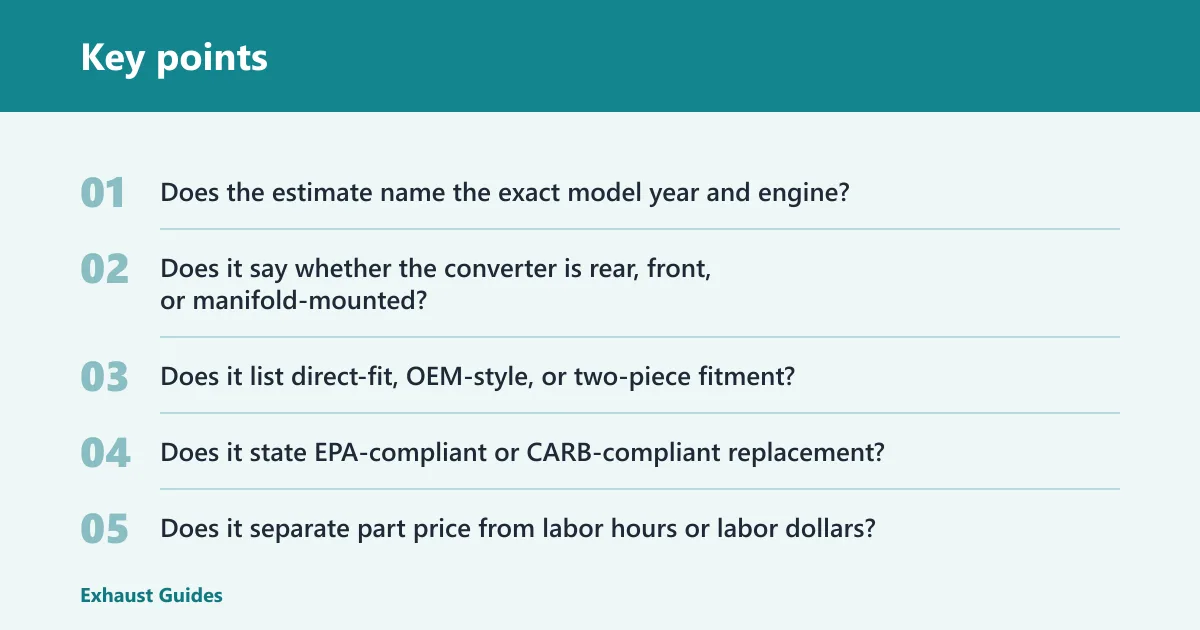
- Does the estimate name the exact model year and engine?
- Does it say whether the converter is rear, front, or manifold-mounted?
- Does it list direct-fit, OEM-style, or two-piece fitment?
- Does it state EPA-compliant or CARB-compliant replacement?
- Does it separate part price from labor hours or labor dollars?
- Does it include gaskets, clamps, sensors, or pipe repair?
- Does it mention theft damage, rust, or broken hardware if present?
- Does the total fit the model-specific band, not just a Nissan-wide average?
Is a direct-fit converter cheaper?
Usually yes. A direct-fit converter is typically cheaper than a manifold-mounted replacement when you compare like for like, because it is easier to install and more common in aftermarket listings. The difference can disappear if the direct-fit part must still meet stricter emissions rules or comes with extra sensors.
Direct-fit versus manifold-mounted replacement
Direct-fit parts are built for the vehicle’s exhaust shape and bolt pattern. Manifold-mounted units combine more of the exhaust assembly into one piece, so the part itself and the labor both tend to cost more. That is why two quotes that say “converter replacement” can be nowhere near each other.
Why universal fitment can create extra labor
Universal fitment sounds cheaper, but it can create fabrication work. If the shop has to cut and weld to make the part fit, labor rises and inspection risk rises too. For most Nissan owners, direct-fit is the cleaner comparison point when reading an estimate.
When direct-fit is the cleaner comparison point
Direct-fit is the better reference when the quote is for an Altima rear converter, a Versa 1.6L EPA-compliant replacement, or a common Rogue application. It lets you compare apples to apples across shops, and it makes labor easier to judge.
EPA-compliant versus CARB-compliant
Compliance matters because the wrong part can be legal in one state and a problem in another. EPA-compliant converters are common retail options, but some states require CARB-compliant parts on specific vehicles. The compliance label affects both price and inspection outcome.
Which label matters for your state?
If your state follows stricter emissions rules, a cheaper EPA-compliant part may not pass inspection. That is why a quote should state the compliance standard, not just the part brand. The wrong label can cost more in the end if the car fails inspection and needs a second replacement.
How compliance changes price and fitment
CARB-compliant parts often cost more because the part design and approval requirements are tighter. Fitment can also narrow. A part that fits physically may still be the wrong legal choice for your registration area.
Why the wrong part can fail inspection
An exhaust system can run fine and still fail an emissions check if the converter is not approved for the vehicle and location. That is why the estimate should show the compliance line clearly before you approve the job.
Can a bad converter be another problem?
Yes. A failing catalytic converter can be mistaken for an oxygen sensor fault, an exhaust leak, or even misfire damage. That is why a diagnosis should start with codes, leak checks, and sensor data before the converter is replaced. Replacing the wrong part wastes money fast.
O2 sensor faults that mimic converter failure
A bad upstream or downstream O2 sensor can trigger symptoms that look like converter trouble. If the estimate jumps straight to the converter without naming the sensor readings or fault codes, ask for the diagnostic basis first.
Exhaust leaks and misfire damage
Exhaust leaks can skew sensor readings, and engine misfires can overheat the converter. Both can produce a code that points to the converter even when the root problem sits elsewhere. A proper repair should address the cause, not only the symptom.
A common first-timer mistake is approving a converter after a quick scan, then discovering a leaking flange or a bad sensor was the real cause. A short diagnostic step can prevent a second bill.
How much of the total repair is parts versus labor on a Nissan?
On many Nissan repairs, parts carry the larger share, especially on mid-range sedans and crossovers where the converter assembly and compliance label drive the bill. Labor can still be a large slice when access is tight, but the part line often sets the ceiling on total cost.
Parts versus labor by quote type
If the estimate is for a direct-fit aftermarket part on a common sedan, parts may stay closer to the lower bands while labor remains moderate. If the estimate involves a manifold unit, a front two-piece system, or CARB compliance, the part line usually grows faster than the labor line.
Use the split to judge fairness. A quote with a low part price and a huge labor charge, or the reverse, deserves a second look.
How expensive to replace catalytic converter
The repair is expensive because the part itself contains costly materials and the labor can be involved. The broad replacement range is $900 to $2,500, while a full replacement can run from $2,123 to $2,459 in one estimate set and from $933 to $4,414 in another. That spread is why model-specific comparison matters.
How much is it to get your catalytic converter replaced?
The answer depends on the Nissan model, the converter location, and the emissions label required in your state. For many mainstream Nissans, the total often lands near $1,200 to $2,200, but a quote can move lower or higher when parts, labor, sensors, or exhaust repair are added.
Frequently asked questions
How much does labor cost to replace catalytic converter: for many mainstream Nissan sedans?
For many mainstream Nissan sedans and crossovers, labor is often listed at $150 to $400. Hard-to-reach converters, rusted hardware, and welded sections can push that higher. If labor is close to the part price, the job likely has access or corrosion challenges.
How much is the labor to replace a catalytic converter?
Labor usually depends on access, not just time on the wrench. A direct-fit replacement on an easy-to-reach exhaust path may stay near the lower end, while a manifold-mounted or rusted assembly can move into the higher range. Ask for labor hours, not only a dollar figure.
What does catalytic converter replacement cost on a Nissan Altima?
An Altima quote depends on engine and fitment family, but retail examples show rear catalytic converter listings and aftermarket prices as low as $134.99 for a specific part. Installed totals can still rise into the mainstream Nissan range once labor, sensors, and compliance are added.
Why is Nissan catalytic converter replacement so expensive on some models?
Some Nissan models use tighter packaging, manifold-mounted parts, or front two-piece systems that take more labor and more expensive parts. Compliance rules can also raise the price. If a quote looks high, check whether it is for a direct-fit converter or a more complex assembly.
Can a bad catalytic converter be mistaken for an oxygen sensor or exhaust problem?
Yes. A bad O2 sensor, exhaust leak, or misfire can mimic converter failure and trigger similar symptoms or codes. That is why a diagnostic check should come before replacement. If the shop cannot explain why the converter is the source, ask for more testing first.