Oxygen Sensor Repair Cost
A fair oxygen sensor repair quote usually lists the sensor, plus 0.5 to 1.5 labor hours. On many cars, that lands around $150 to $450. Rusted exhaust hardware or hard-to-reach sensors can push it higher. Bad quotes can hide a wrong diagnosis, extra parts, or inflated labor. This guide shows how to read each estimate line by line, match it to the fault code, and spot padding.
How much does oxygen sensor repair cost?
On many cars, a routine sensor replacement falls between $150 and $450. Independent-shop pricing is commonly about $150 to $300 per sensor, while broader published ranges run from $110 to $550 and $200 to $500 depending on vehicle, sensor type, and access.
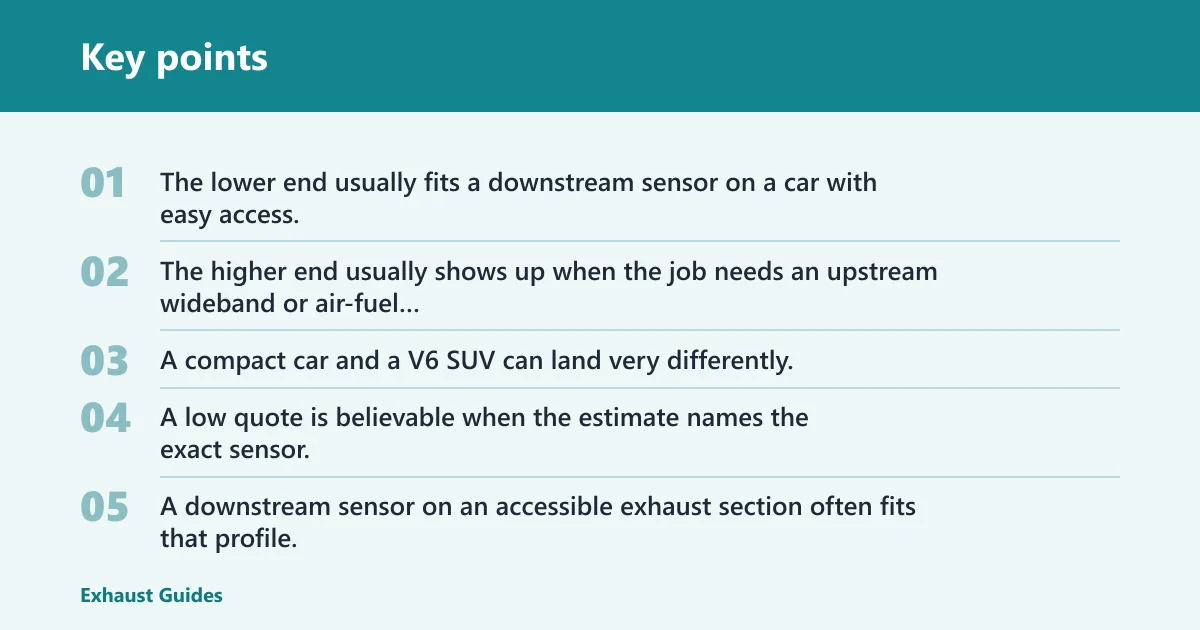
The lower end usually fits a downstream sensor on a car with easy access. The higher end usually shows up when the job needs an upstream wideband or air-fuel sensor, a dealer labor rate, or extra time for seized exhaust hardware. A compact car and a V6 SUV can land very differently.
Typical cost ranges
| Quote item | Typical cost range | Why it appears | What proof to ask for before approving it |
|---|---|---|---|
| Diagnosis | $0 to $150 | Scans codes, checks live data, looks for leaks or wiring faults | Ask for the code numbers, test results, and a reason the sensor is being blamed |
| Replacement labor | 0.5 to 1.5 hours, often $75 to $250+ | Remove and install the sensor, route the harness, clear codes, verify repair | Ask for labor hours, labor rate, and whether access is top-side or underneath |
| Seized-sensor extraction | Extra charge, often case by case | Corrosion or heat cycles lock the sensor into the pipe or manifold | Ask for photos or a tech note showing the fastener or sensor is stuck |
| Thread repair | $50 to $200 | Damaged threads need an insert, chase, or repair after removal | Ask whether the threads are stripped, cross-threaded, or already repaired |
| Companion sensor | Varies by vehicle; often only when both sensors fail or the wiring is shared | Some shops suggest replacing a pair | Ask for proof the second sensor failed, not just that it is nearby |
| Verification | Usually included, sometimes a small charge | Road test, monitor scan data, confirm the code does not return | Ask what was checked after repair and whether readiness monitors were cleared |
When a low quote is believable
A low quote is believable when the estimate names the exact sensor, shows a direct-fit part, and includes only standard labor. A downstream sensor on an accessible exhaust section often fits that profile. If the estimate skips diagnosis or ignores the code details, the low number may be incomplete rather than truly cheaper.
Oxygen sensor quote decoder
Read an estimate in pieces, not as one total. A normal bill separates diagnosis, the sensor itself, labor, and any extra work for rust or thread damage. If those pieces are bundled without explanation, ask for each line item before you approve the job.
What each line item means
- Diagnosis fee: Pays for code reading, live-data checks, and inspection for leaks, wiring faults, or mixture problems.
- Replacement labor: Covers sensor removal, installation, code clearing, and verification.
- Seized-sensor extraction: Applies when the old sensor will not come out normally because corrosion or heat has locked it in place.
- Thread repair: Applies if the bung threads are damaged and need repair before the new sensor can seal.
- Companion sensor and verification: Makes sense only when the second sensor also failed or the shop found a separate problem during testing.
Suppose the estimate says “oxygen sensor replacement” with one flat price but does not name the bank, sensor position, or part type. That quote is too vague to approve. You want a line that says whether the job is bank 1 sensor 1, bank 2 sensor 2, or another exact position.
Upstream vs downstream sensor cost
Upstream sensors sit before the catalytic converter. They have a larger effect on fuel mixture and drivability, and they often cost more because many newer vehicles use wideband or air-fuel sensors there. Downstream sensors sit after the converter and mainly monitor converter efficiency, so they are often cheaper and easier to replace.
What each sensor does
An upstream sensor helps the engine control system adjust fuel delivery. If it is wrong, the engine may run too rich or too lean. A downstream sensor mainly watches converter performance, so its failure often affects emissions monitoring more than day-to-day drivability.
Why upstream parts cost more
RepairMath lists upstream air-fuel sensors at $100 to $250 in parts, while a simple downstream sensor runs $50 to $120. That difference matters on the estimate. The upstream unit can be the main part cost, even when labor stays modest.
Why downstream jobs are often cheaper
Real Repair Cost lists downstream shop totals at $200 to $450, while upstream shop totals are $260 to $560. That gap makes sense: downstream sensors are usually easier to reach, and many vehicles use a simpler sensor design there.
How do you read bank and sensor position?
Bank and sensor position tell you exactly which part the estimate means. Bank 1 is the side of the engine with cylinder 1. Sensor 1 is before the catalytic converter. Sensor 2 is after the catalytic converter. Those labels matter because the wrong side changes both price and fitment.
Bank 1 and bank 2
On V-type and boxer engines, bank 1 and bank 2 identify the two cylinder groups. If the estimate only says “oxygen sensor,” ask which bank. The cylinder-1 side is bank 1, and that is the one you should match to the code and the catalog listing.
Sensor 1 and sensor 2
Sensor 1 is upstream of the converter. Sensor 2 is downstream. The estimate should say whether the sensor is before or after the converter, because that location changes part price, access, and labor time.
Before and after the converter
DENSO distinguishes sensors before and after the catalytic converter, and that is the right way to read the bill. If a quote says “upstream sensor” but the code points to a downstream issue, ask the shop to explain the match.
Short checklist for the estimate
- Find bank 1 or bank 2.
- Find sensor 1 or sensor 2.
- Check whether the sensor is before or after the converter.
- Match the part number to the exact engine and emissions setup.
- Confirm connector style: original plug, OE-style direct fit, or splice-in universal.
What can make labor bill higher?
Labor rises when access is poor, the exhaust is rusty, or the sensor has been heat-cycled in place for years. Dealer rates also tend to be higher than independent-shop rates. RepairMath estimates 0.5 to 1 hours of labor for a typical sensor job, but difficult access can push that higher.
Access and corrosion
Rear-bank sensors, underfloor sensors, and units near heat shields can take longer to reach. Corrosion can turn a simple swap into extraction work. If a shop quotes extra labor for seized fasteners, ask whether that charge is contingency pricing or a confirmed need.
Dealer rates vs independent rates
Dealer labor generally costs more than independent labor because the hourly rate is higher. The part itself may also be different, especially if the dealer quotes an OE sensor. A quote that looks expensive may still be normal if the labor rate and part type are listed clearly.
Which sensor type should you buy?
Choose the sensor type that matches the vehicle exactly. OEM and OE-equivalent sensors are built for the application and usually use the correct connector and calibration. Aftermarket parts can be fine when the fit is exact. Universal sensors can work, but splice labor and comeback risk make them a separate choice.
OEM and OE-equivalent sensors
These are the easiest to approve when you want the least fitment risk. They should match the connector, wire count, and sensor type listed for the vehicle. If the estimate names a direct-fit OE-equivalent part, the labor is usually straightforward.
Aftermarket sensors
Aftermarket parts are often cheaper than OEM. That is the main appeal. Check the part number, connector shape, and application list carefully, because a low price does not help if the connector is wrong or the sensor response does not match the engine computer.
Universal sensors and splice labor
Universal sensors are usually cheaper up front, but they need wire splicing or connector transfer. That adds labor and raises the chance of a poor connection later. If a quote includes a universal sensor, ask exactly how much splice labor is included and who pays if the wiring repair fails later.
Picture a four-cylinder sedan that has a downstream sensor code and easy undercarriage access. A direct-fit sensor may be the best value there. Now compare that with a newer V6 using an upstream air-fuel sensor near a hot manifold; the part cost and labor can both rise quickly.
Can a sensor code mean the part is fine?
Yes. Oxygen-related codes point to a fault area, not automatic proof that the sensor itself failed. Codes in the P0130 to P0167 range and P003x heater-circuit codes can also come from leaks, wiring faults, heater problems, or mixture issues. Diagnose first, replace second.
P0130-P0167 codes
Those codes cover oxygen sensor circuit and performance problems. They are a starting point. A sensor code can mean the sensor is tired, but it can also mean the engine is reading bad exhaust conditions from a leak or fuel-trim problem.
Heater-circuit codes
P003x codes point to heater-circuit faults. That may be a bad heater element, a blown fuse, or damaged wiring. Replacing the sensor without checking power and ground can waste money.
Leaks and wiring faults
An exhaust leak upstream of the sensor can trick the computer into seeing extra oxygen. Damaged harnesses can do the same. A quote that skips leak checks or wiring inspection is incomplete when the code points to sensor performance rather than a confirmed dead sensor.
What happens if you delay repair?
Delay can raise the total bill. A bad upstream sensor can skew fuel trim, and rich running can damage the catalytic converter over time. If the problem affects emissions, the vehicle may fail a test and the repair can become more expensive later.
Fuel-trim effects
When the upstream sensor sends the wrong signal, the engine computer may add too much fuel or pull too much fuel. That can show up as poor fuel economy, rough running, or a check engine light. Those symptoms support diagnosis, but they do not prove the sensor failed.
Catalytic converter risk
Rich running can overheat or contaminate the catalytic converter. That is why a small sensor job should not be ignored for long. Replacing the right sensor early is usually cheaper than adding converter damage to the repair.
Emissions-test consequences
If the monitor will not run or the code returns, the vehicle may not pass an emissions inspection. A delayed repair can also turn a straightforward sensor quote into a larger emissions repair if the converter or wiring suffers while the fault stays active.
Frequently asked questions
How much does it cost to replace a faulty oxygen sensor?
For most drivers, replacement falls in the low hundreds. Independent-shop pricing is often about $150 to $300 per sensor, and published ranges run higher on some vehicles. Upstream sensors, dealer rates, and seized hardware can push the bill toward the upper end.
How much does it cost to fix a 02 sensor?
A 02 sensor repair usually means diagnosis plus replacement, so the total depends on whether the sensor is upstream or downstream and whether labor is simple. A fair quote can start near the lower hundreds, but extraction, thread repair, or a wideband sensor can move it much higher.
Why is one oxygen sensor quote much higher than another?
Usually because one quote includes more than a basic swap. The higher quote may include a dealer labor rate, an upstream air-fuel sensor, a seized sensor, thread repair, or a more complete diagnosis. Ask which line items are confirmed and which are only contingency items.
Do I need to replace the upstream or downstream sensor?
Only the failed sensor should be replaced unless testing shows a second problem. Upstream sensors affect fuel mixture and drivability more, while downstream sensors mainly monitor catalyst efficiency. Match the estimate to the code, bank, sensor number, and before-or-after-converter position before approving the work.
Can an oxygen sensor code mean the sensor itself is still good?
Yes. That is why diagnosis matters. The code tells you where to look, not always what to replace.
Should I choose OEM, aftermarket, or universal oxygen sensors?
Choose the part that matches the application, connector, and wire count. OEM and OE-equivalent parts usually fit with the least risk. Aftermarket parts can be fine if the fit is exact. Universal sensors may lower part cost, but splice labor and connection risk can erase the savings.