V-Band Clamp vs Band Clamp: Sound, Seal, and Durability
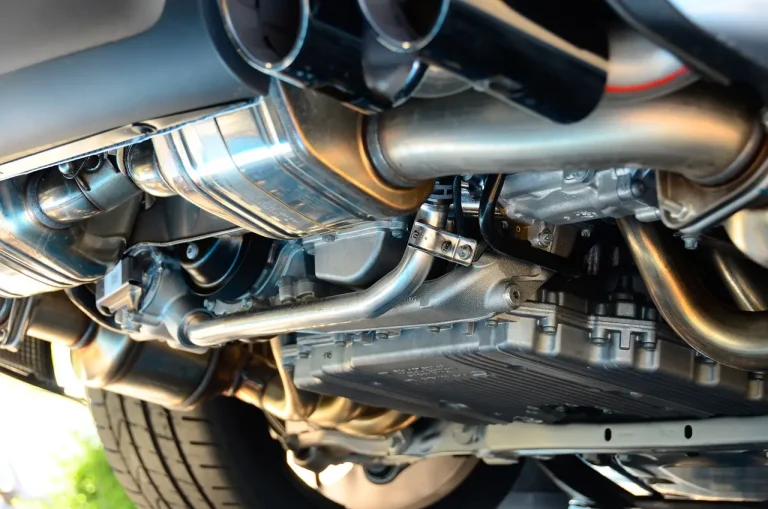
V-band clamps usually give a more repeatable seal, quicker service, and a steadier exhaust note over time; band clamps suit lower-cost slip joints when the fit is already correct. Pick the wrong clamp and you can get leaks, rattles, moving pipe joints, and a harsher or uneven sound. This guide compares seal quality, sound behavior over time, serviceability, and durability so you can choose the right clamp for your build.
V-band outlasts band clamps in seal and noise
| Factor | V-band clamp | Band clamp | Winner |
|---|---|---|---|
| Seal reliability | Uses matched flanges and a clamp ring for a 360° radial seal. | Depends on strap pressure around the pipe OD and good pipe roundness. | V-band clamp |
| Sound risk over time | Lower leak risk when flanges are aligned and threads are kept in good shape. | More likely to hiss, tick, or drone if the pipe end is oval, stepped, or poorly prepped. | V-band clamp |
| Service frequency | Better for repeated removal and reassembly on turbo and race-style joints. | Fine for occasional repair, but can deform or relax if overtightened. | V-band clamp |
| Install complexity | Needs welded flanges, careful alignment, and careful fastener care. | Usually simpler to fit because no special flanges are required. | Band clamp |
| Cost and labor | Higher parts cost because of machined flanges and welding labor. | Lower-cost general-purpose option. | Band clamp |
Seal reliability
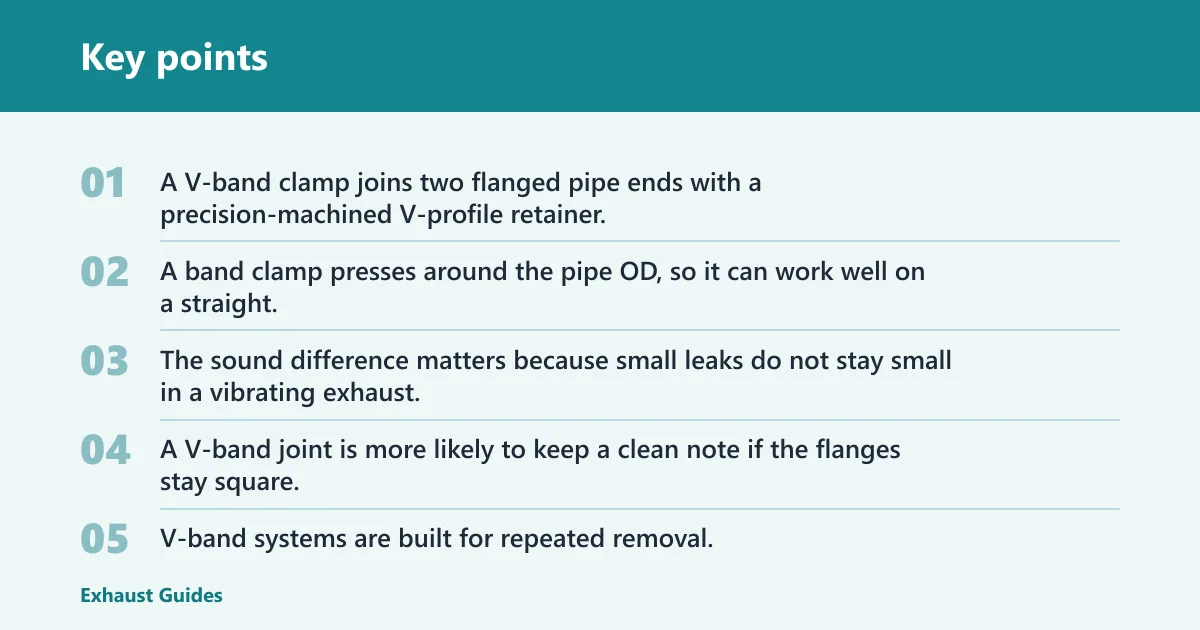
A V-band clamp joins two flanged pipe ends with a precision-machined V-profile retainer, so the seal depends more on flange fit and alignment than on brute clamping force. A band clamp presses around the pipe OD, so it can work well on a straight, round slip joint, but it is less forgiving of ovality, poor cut quality, or uneven pipe ends.
Sound risk over time
The sound difference matters because small leaks do not stay small in a vibrating exhaust. A V-band joint is more likely to keep a clean note if the flanges stay square; a band clamp is more likely to become audible first at a marginal joint, where a slight leak can turn into ticking at idle or a light hiss under load.
Service frequency
V-band systems are built for repeated removal, especially on turbocharger downpipes and exhaust headers. Band clamp joints are easier to assemble once, but if the strap is overcompressed or the pipe ends move during heat cycling, the joint can need more attention later.
Install complexity
Band clamp is simpler when you want a practical repair on an existing slip fit. V-band clamp needs welded flanges, and those flanges must match the clamp profile; poor alignment at the flange face can create a leak even when the clamp is tight.
Cost and labor
Band clamp usually wins on price because it avoids machined flanges and welding labor. V-band systems cost more up front, but that cost buys serviceability and a more repeatable joint when the exhaust sees frequent heat cycling.
Pro Tip: On a 3.0L turbo setup, a slightly tilted flange face can make a V-band joint leak even when the fastener feels tight. That failure mode is common enough that alignment matters as much as clamp force. For most V-band fasteners, a typical service torque falls around 30-35 Nm, but always verify the clamp maker’s spec first; over-torque can distort the ring and under-torque can let the joint walk under heat cycling.
Why V-band clamps seal and stay quiet
Matched flanges and 360° radial seal
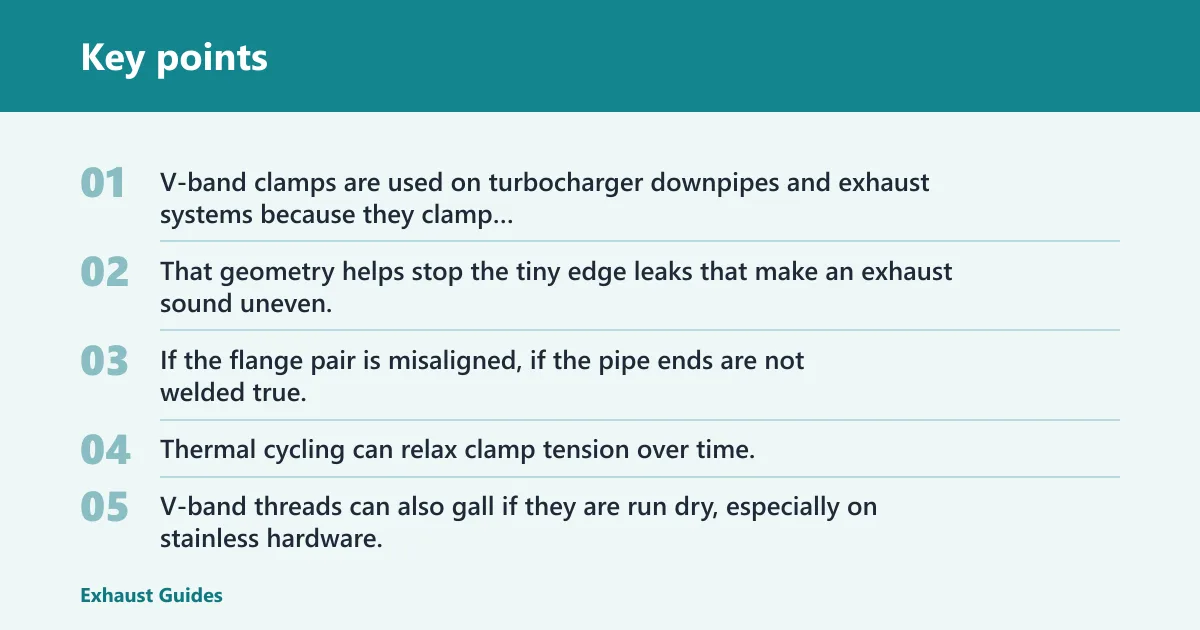
V-band clamps are used on turbocharger downpipes and exhaust systems because they clamp two matched flanges into a gas-tight 360° seal. That geometry helps stop the tiny edge leaks that make an exhaust sound uneven, especially where pressure pulses are high.
That does not make them leak-proof. If the flange pair is misaligned, if the pipe ends are not welded true, or if the retainer is damaged, the joint can still tick or weep under load.
Heat cycling, vibration, and thread care
Thermal cycling can relax clamp tension over time. V-band threads can also gall if they are run dry, especially on stainless hardware, so anti-seize on the threads helps future removal and lowers the risk of a seized fastener.
A torque wrench matters here. Overtightening can distort the ring, crush the flange faces, or make later service harder, while under-tightening leaves the joint vulnerable to movement and leak noise. For many common exhaust clamps, 30-35 Nm is a useful starting range, but the clamp’s brand and size should always control the final number.
Material choice matters
Common V-band materials include 304 stainless steel, 316 stainless steel, and 321 stainless steel. These are common choices rather than absolute rules: 304 is a common default, 316 is often chosen for better corrosion resistance, and 321 is sometimes used when the joint sees frequent heat swings near the engine. Actual longevity depends on heat, salt exposure, joint alignment, and fastener care; material data and composition guidance are commonly referenced in ASTM A240 and by clamp manufacturers.
For extreme-temperature use, some systems use Inconel 625 or 718. That matters most where heat and service loads are both severe, not on a mild street splice.
Why band clamps are simpler to fit
Wrap-around strap and pipe OD clamping
Band clamps use a wrap-around metal strap tightened by a screw or bolt mechanism. Because they clamp the outside diameter directly, they do not require special flanges, which makes them easier to use for a quick repair or a simple slip-fit exhaust section.
The trade-off is fit tolerance. If the pipe ends are not round, if the overlap is too short, or if the clamp size does not match the joint well, the seal can relax after a few heat cycles and start making noise.
When no welded flange is needed
A band clamp is attractive when you want to avoid cutting and welding. That is why it often fits a street exhaust repair better than a full flange conversion, especially when the goal is to stop a leak without reworking the whole system.
Do not confuse exhaust band clamps with hose clamps. Hose-style clamps are for flexible hose, not hot exhaust tubing, and they do not belong in this comparison.
Fit tolerance decides the result
Band clamps depend on pipe end prep, roundness, and a clean overlap. A common first-timer mistake is assuming tighter is always better; too much torque can deform the pipe, while too little torque lets the joint shift and start rattling.
Say your 2.5-inch mid-pipe has a slight oval at the cut end. A band clamp may hold it at first, but the joint can start ticking after a few heat cycles because the strap is trying to crush a shape it cannot fully correct.
Which clamp is better for turbo exhausts?
For turbo exhausts, V-band Clamp is usually the better choice because turbocharger downpipes see high heat, boost-related stress, and frequent service needs. The matched flange design is better suited to that environment than a wrap-around strap, especially when you want repeatable sealing after removal and reinstall.
Turbo outlet and downpipe serviceability
Turbocharger downpipe joints often need to come apart for turbo access, catalyst work, or engine removal. A V-band joint supports that service pattern better because the single-bolt or nut fastener releases the ring without dismantling the whole joint.
That convenience matters when the joint is close to the turbine housing and sees fast heat swings. A band clamp can work in some turbo-adjacent sections, but it is not the usual pick for the hottest and most service-heavy point.
Heat load and boost-related stress
High-pressure exhaust pulses and heat cycling can move marginal joints around. A V-band clamp is built for that type of load; the seal is radial, the connection is compact, and the flange pair gives the joint a better chance of staying quiet after repeated service.
Picture a turbo downpipe that comes apart twice in one season. If the V-band faces are kept clean and the threads are protected with anti-seize, the joint is more likely to go back together without extra leak chase work.
Decision matrix for four exhaust scenarios
| Scenario | Sound risk | Seal reliability | Service frequency | Install complexity | Durability | Pick |
|---|---|---|---|---|---|---|
| Turbo outlet | Low with proper flange alignment | High | High service need | Higher | High under heat cycling | V-band clamp |
| Mid-pipe splice | Moderate if pipe ends are imperfect | Moderate to high on a round, well-cut joint | Low to moderate | Low | Moderate | Band clamp |
| Muffler section | Moderate if the joint moves or leaks | Moderate | Low | Low | Moderate | Band clamp |
| Daily-driver repair | Moderate if fit is off by a little | Moderate | Low | Low | Moderate | Band clamp |
For a turbo outlet, a V-band clamp is often the preferred pick because the joint sees high heat and frequent service pressure. For a mid-pipe splice, band clamp is often the smarter repair when the pipe ends already mate cleanly and the goal is to stop a leak without welding new flanges.
For a muffler section or a daily-driver repair, the sound outcome depends heavily on fit. If the pipe section is straight and the clamp is sized correctly, band clamp keeps cost and install time down while still giving a stable enough seal for street use.
Choose V-band Clamp if… / Choose Band Clamp if…
Choose V-band clamp if the joint will be opened often, if the section sees high heat or boost, or if you want the most repeatable seal at a turbo outlet or header connection. Choose Band clamp if you are repairing a straightforward street exhaust splice, avoiding welding, or working on a section where low cost and simple installation matter more than repeated disassembly.
Choose V-band clamp if…
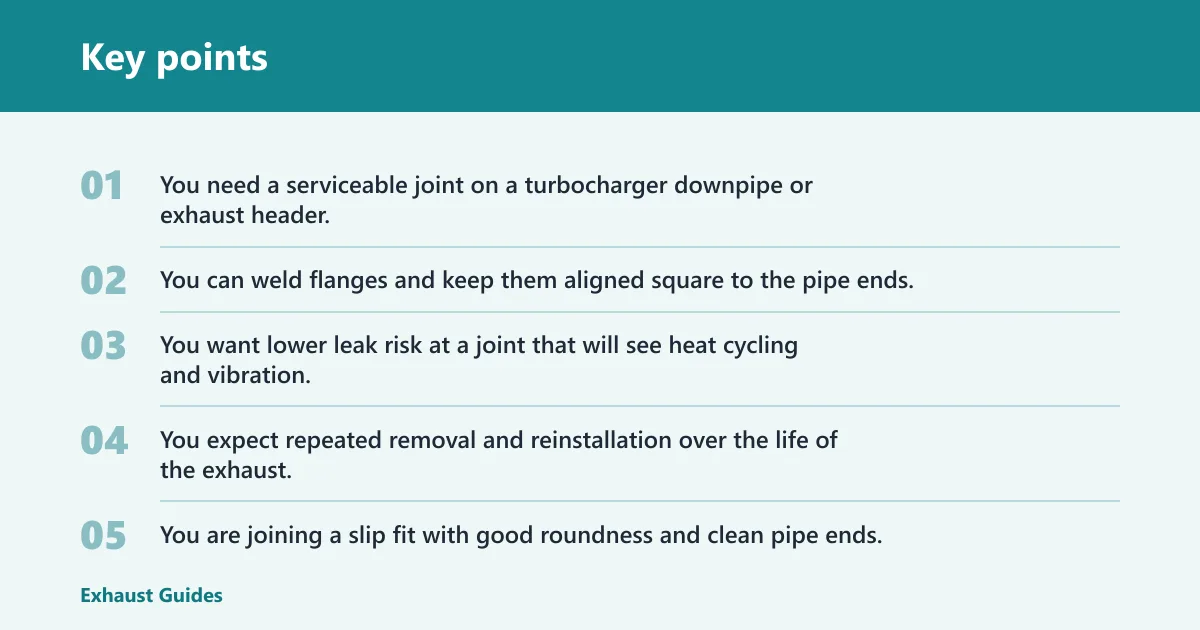
- You need a serviceable joint on a turbocharger downpipe or exhaust header.
- You can weld flanges and keep them aligned square to the pipe ends.
- You want lower leak risk at a joint that will see heat cycling and vibration.
- You expect repeated removal and reinstallation over the life of the exhaust.
Choose Band clamp if…
- You are joining a slip fit with good roundness and clean pipe ends.
- You want a lower-cost fix for a street exhaust repair or muffler section.
- You do not want to add welded flanges.
- You only need moderate serviceability, not frequent teardown.


Frequently asked questions
What is the difference between a V-band clamp and a band clamp?
V-band clamp uses matched flanges and a clamp ring to create a 360° radial seal. Band clamp wraps a strap around the pipe OD and tightens with a screw or bolt. The first is better for repeat service and high heat; the second is simpler and cheaper for straightforward repairs.
Which clamp seals better on an exhaust system?
V-band clamp usually seals better on an exhaust system because the flanged joint is designed to center itself and hold pressure evenly around the circumference. Band clamp can seal well too, but only when the pipe ends are round, the size is right, and the joint is prepared carefully.
Does a V-band clamp need welding?
Yes, in normal exhaust use it does. V-band systems require welded flanges on the pipe ends, and flange alignment affects the seal. If the flanges are off-center or tilted, the clamp can still leak even when the fastener is fully tightened.
Can you reuse a band clamp or V-band clamp?
Both can often be reused, but condition matters. A V-band clamp is more reusable when the threads are not seized and the ring is not distorted. A band clamp can be reused if the strap has not been overcompressed, but any deformation from overtightening reduces its reliability.
Is a band clamp good for a street exhaust?
Yes, when the joint is a clean slip fit and you want an affordable repair. Band clamp is a practical street-exhaust choice for mid-pipe and muffler sections, but it is less tolerant of ovality, poor cuts, or movement than a V-band joint.
Do V-band clamps need gaskets or sealant?
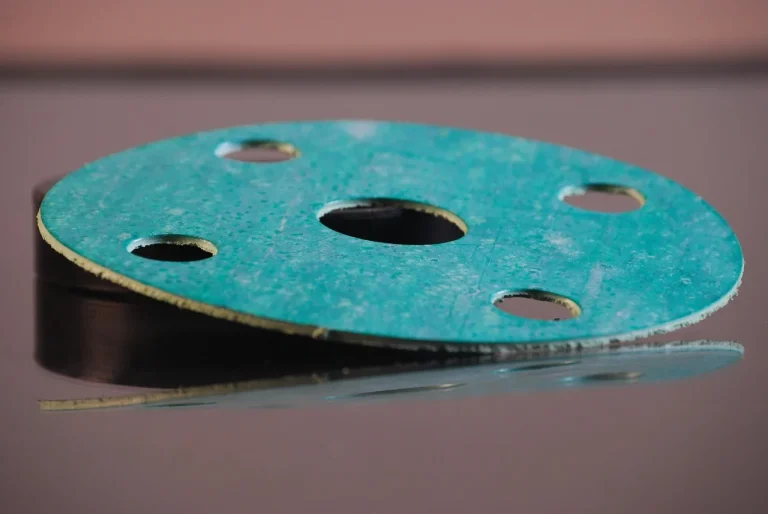
Normally no. V-band clamp is designed to seal metal-to-metal through the flange faces and clamp ring, so gaskets and sealant are usually unnecessary. The better fix is proper alignment, clean faces, and correct torque rather than adding sealant to a joint that should not need it.
Which clamp is cheaper and easier to install?
Band clamp is cheaper and easier to install because it does not need welded flanges and usually takes less labor. V-band clamp costs more and takes more setup, but it pays back when the joint needs repeat service, high heat resistance, and a more stable exhaust note over time.