Bank 1 vs Bank 2 Oxygen Sensor Explained for Diagnostics
Bank 1 is the side with cylinder 1, and Bank 2 is the opposite side on V-type engines; Sensor 1 is the upstream O2 sensor before the catalytic converter, while Sensor 2 is downstream after it. Guessing wrong can send you to the wrong part, waste money, and leave the fault code unchanged. This guide shows how to identify bank 1 vs bank 2 from the engine layout, exhaust routing, and scan-tool data without relying on driver-side or passenger-side assumptions.
| Factor | Bank 1 | bank 2 oxygen sensor explained | Winner |
|---|---|---|---|
| How it is identified | Defined by the side that contains cylinder 1; it is the anchor point for OBD-II fault codes and sensor labels. | Defined only after Bank 1 is known; it is the opposite side on V-type engines. | Bank 1 |
| Use on inline engines | Exists on inline engines; inline engines use Bank 1 only. | Does not exist on inline engines. | Bank 1 |
| Risk of confusion | Commonly confused with driver side or passenger side, so guessing can send you to the wrong part. | Depends on Bank 1, so it is easier to mislabel if Bank 1 was guessed wrong. | Bank 1 |
| Replacement priority | Usually the first bank you map before buying parts. | Secondary reference after Bank 1 is verified. | Bank 1 |
| Scan-tool confirmation value | Often matches the DTC label you need to trace first. | Useful only after the engine layout confirms a true second bank. | Bank 1 |
| Cost impact if guessed wrong | Guessing wrong can waste money and leave the fault code unchanged. | Replacing the wrong bank or sensor can also waste money without fixing the complaint. | Tie |
| Maintenance / verification approach | Best verified by the firing order chart or service manual, then by exhaust routing and scan-tool data. | Best confirmed only after Bank 1 is established, using exhaust routing and connector location. | Bank 1 |
| Performance role of the related oxygen sensor | Sensor 1 on Bank 1 is upstream before the catalytic converter and influences air-fuel control. | Sensor 2 on Bank 2 is downstream after the catalytic converter and helps judge catalyst efficiency. | Tie |
| Best-fit use | Best starting point when identifying the correct side before buying a sensor. | Best used as a secondary reference after Bank 1 is verified. | Bank 1 |
What Bank 1 means
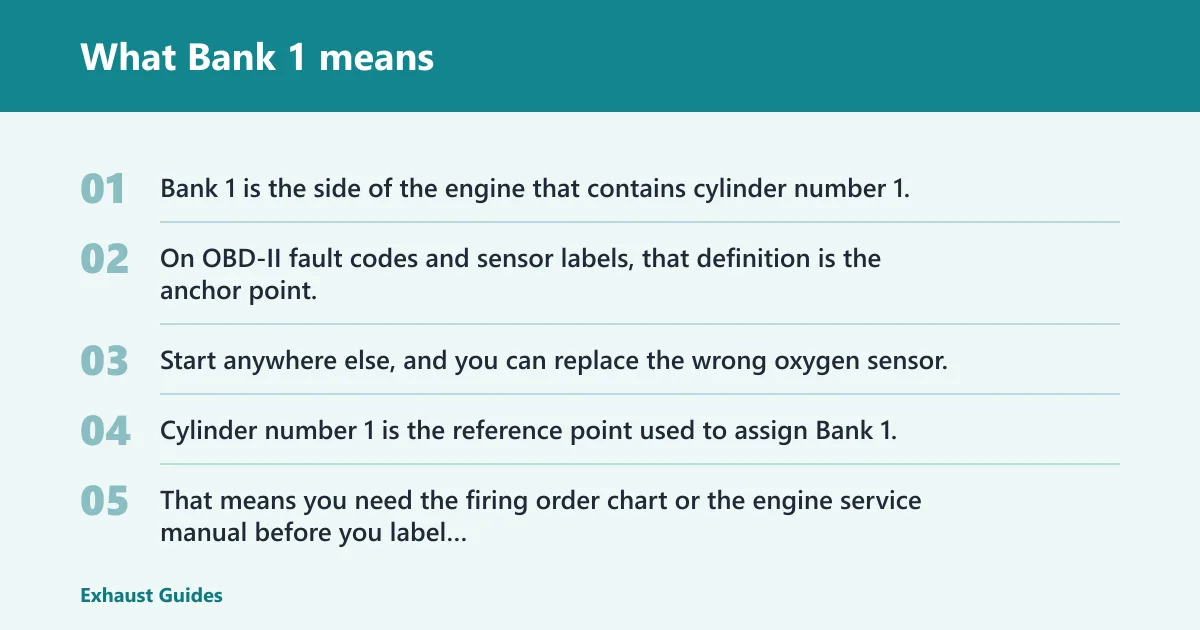


Bank 1 is the side of the engine that contains cylinder number 1. On OBD-II fault codes and sensor labels, that definition is the anchor point, not the driver side and not the passenger side. Start anywhere else, and you can replace the wrong oxygen sensor.
Why cylinder 1 sets Bank 1
Cylinder number 1 is the reference point used to assign Bank 1. That means you need the firing order chart or the engine service manual before you label the banks, especially on engines where the layout is not obvious from above.
A common first-timer mistake is to read a code such as an O2 sensor fault and jump straight to the side that looks easiest to reach. Suppose a V6 has the rear cylinder head closest to the firewall and the front bank easier to see. Easy access does not tell you which side is Bank 1.
Why Bank 1 is not always driver side
Bank labels are not universal side labels. On some vehicles, Bank 1 is on the driver side; on others, it is not. Transverse engine layouts make this even less predictable, because left-right placement changes with the chassis and with how the engine is installed.
What Bank 2 means
Bank 2 is the opposite side of Bank 1 on V-type engines. It is not a separate naming system and it is not interchangeable with sensor numbering. If the engine is inline, Bank 2 does not exist at all.
Why Bank 2 is the opposite side on V engines
V6, V8, and V10 layouts split cylinders into two banks. Once cylinder 1 identifies Bank 1, the other side becomes Bank 2 by definition. Each bank typically has two oxygen sensors, one upstream and one downstream.
Why Bank 2 does not exist on inline engines
Inline engines have only Bank 1; no Bank 2 exists. That is why an inline-6 such as the BMW N54 uses only Bank 1 references. If a scan tool or parts listing shows Bank 2 on an inline engine, something about the description is being read incorrectly.

Is Bank 1 the driver side or passenger side?
Bank 1 is not automatically the driver side or the passenger side. On some vehicles it lines up that way, but the correct side still comes from cylinder 1 and the engine’s physical layout. The only safe method is to verify the engine family, then confirm the cylinder arrangement before buying parts.
How transversely mounted V engines create confusion
Transverse mounting can flip the mental map owners use for longitudinal engines. A side that looks like “front” may not correspond to the side that contains cylinder 1. That is why a V engine in a compact car can confuse bank labels even when the engine bay seems simple.
Why you should verify instead of guessing
Guessing by side is fast and often wrong. A Mercedes M278 is a practical example where Bank 1 is on the left side, which shows why a blanket driver-side rule fails. The right move is to verify cylinder 1, then trace the bank from there.
What is the difference between sensor 1 and sensor 2?
Sensor 1 is the upstream oxygen sensor before the catalytic converter, and Sensor 2 is the downstream sensor after the catalytic converter. Upstream sensors influence air-fuel control, while downstream sensors monitor catalytic converter performance. The numbers describe location and job, not the cylinder bank itself.
Upstream sensor 1 and fuel control
Sensor 1 sits before the catalyst, where it can report exhaust oxygen content quickly enough for fuel trim corrections. That makes it part of the engine’s feedback loop. If this sensor is misidentified, the repair can leave the mixture fault unresolved.
Downstream sensor 2 and catalyst monitoring
Sensor 2 sits after the catalytic converter and helps the control system judge catalyst efficiency. It does not do the same job as the upstream sensor. Replacing a downstream sensor for an upstream code is a common way to spend money without fixing the complaint.
How to identify the correct bank before you buy a sensor
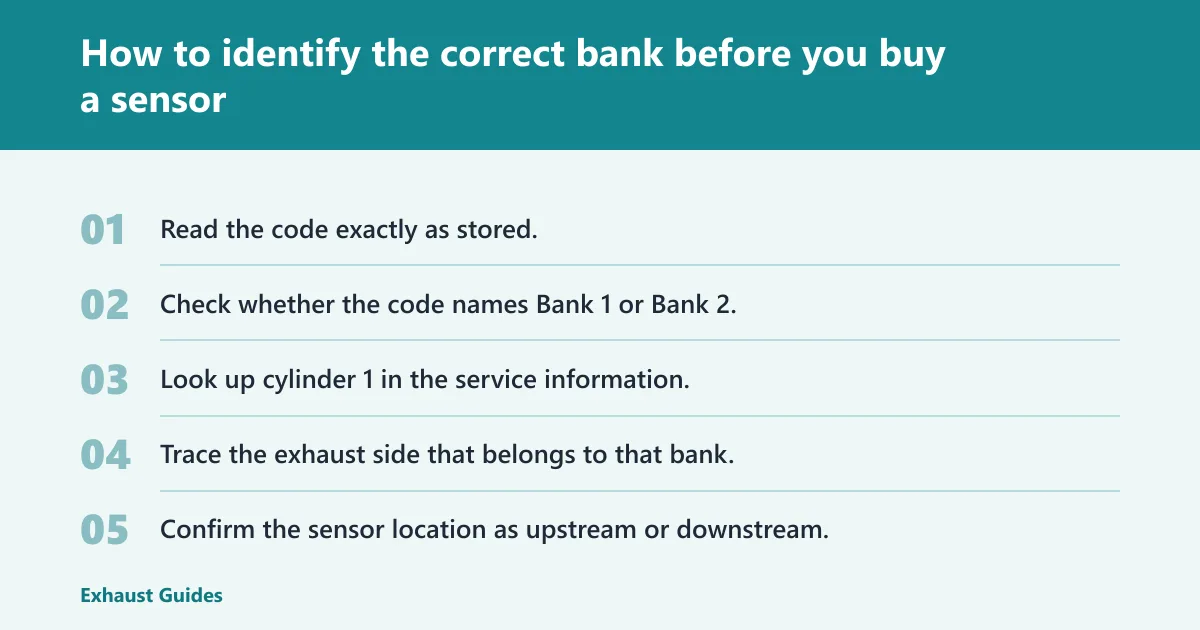
Start with cylinder 1, not with the sensor name. Then use the exhaust routing and the OBD2 scan tool to verify the bank before replacement. This is the repeatable method that avoids side guesses and reduces the chance of ordering the wrong part.
1. Find cylinder 1 in the service information
Use the firing order chart or the engine service manual. That step tells you which side contains cylinder 1 and therefore which side is Bank 1. Without that reference, you are labeling by assumption.
2. Trace the exhaust manifold routing
Follow each exhaust manifold or header back toward the catalytic converter. On a V engine, the bank with cylinder 1 corresponds to the side of the engine feeding Bank 1’s exhaust path. This step helps you connect the bank label to the physical hardware in front of you.
3. Use the OBD2 scan tool to confirm the fault code
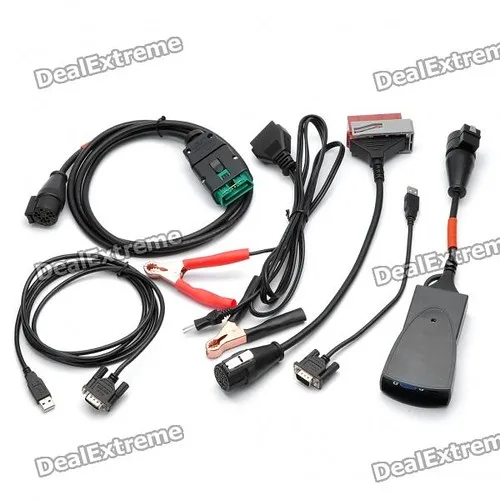
An OBD2 scan tool can help confirm which sensor set is triggering the DTC. A practical method is to unplug an upstream sensor and see which DTC is triggered, then compare that result with the code already stored. That kind of confirmation is useful before you replace anything.
- Read the code exactly as stored.
- Check whether the code names Bank 1 or Bank 2.
- Look up cylinder 1 in the service information.
- Trace the exhaust side that belongs to that bank.
- Confirm the sensor location as upstream or downstream.
Say your scan tool shows a Bank 2 Sensor 1 code on a transverse V6. Do not order a passenger-side sensor just because it sounds plausible. Verify cylinder 1 first, then use the exhaust layout and connector location to confirm that the fault really points to the Bank 2 upstream sensor.
Can a scan tool confirm the bad bank?
Yes. A scan tool can confirm the bad bank by showing the exact DTC and by helping you observe how the engine reacts when a sensor is unplugged. It does not replace the service manual, but it narrows the diagnosis and keeps you from chasing the wrong side.
How DTC bank labels narrow the diagnosis
Codes that name Bank 1 or Bank 2 already narrow the search to one side of the engine. That matters because a fault on the wrong bank can lead you to a sensor that has nothing to do with the code. The code label is the first filter, not the final proof.
How live data helps separate bank faults from sensor faults
Live data can often show whether a sensor is switching normally or appears stuck lean, stuck rich, or flatlined. That helps separate a wiring or sensor issue from an exhaust leak or fuel-control problem. The point is to confirm the correct bank before replacement, not to swap parts until the light goes out.
Bank 1 vs Bank 2 oxygen sensor checklist
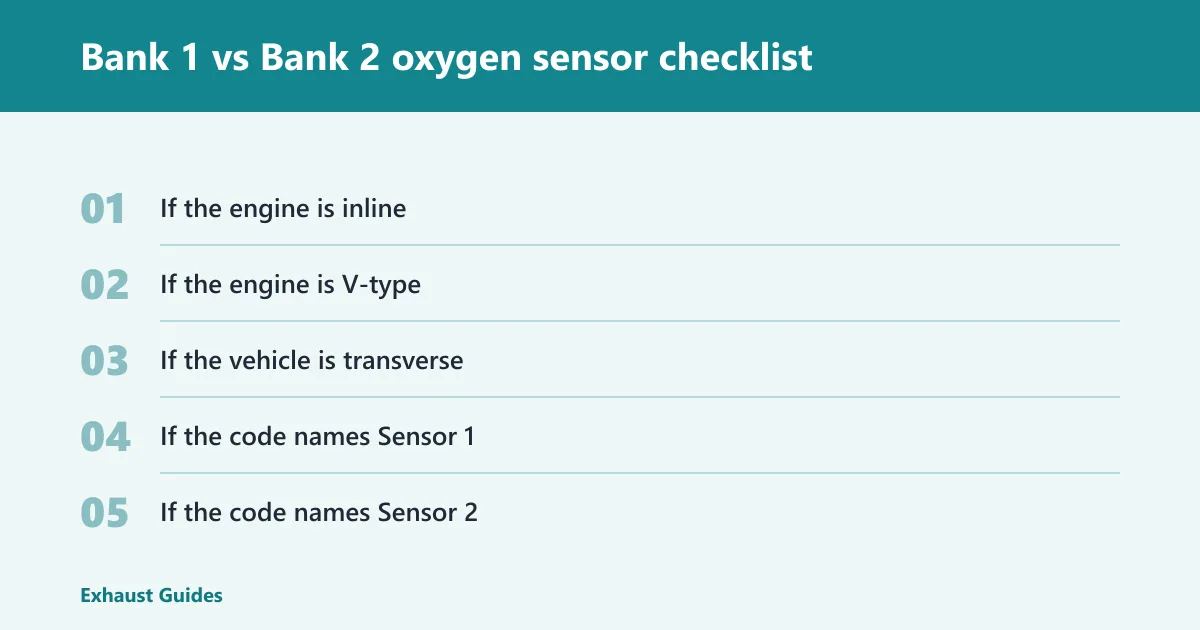
This one-page checklist gives you a decision path you can repeat on inline and V-type engines. Use it in order. The goal is to identify the bank, then map the upstream and downstream sensors before you buy anything.
Decision tree by engine type
- If the engine is inline: use Bank 1 only; Bank 2 does not exist.
- If the engine is V-type: find cylinder 1 first, then name that side Bank 1.
- If the vehicle is transverse: do not assume the bank by driver side or passenger side.
- If the code names Sensor 1: look for the upstream sensor before the catalytic converter.
- If the code names Sensor 2: look for the downstream sensor after the catalytic converter.
- If the label looks uncertain: verify with the service manual and scan tool before replacement.
Final bank and sensor mapping table
| Engine layout | Bank 1 location | Bank 2 location | Sensor 1 location | Sensor 2 location |
|---|---|---|---|---|
| Inline engine | Only bank present; contains cylinder 1 | Does not exist | Upstream, before the catalytic converter | Downstream, after the catalytic converter |
| V6 | Side containing cylinder 1 | Opposite side of Bank 1 | Upstream on each bank | Downstream on each bank |
| V8 | Side containing cylinder 1 | Opposite side of Bank 1 | Upstream on each bank | Downstream on each bank |
Picture a V8 with a code for Bank 2 Sensor 2. That does not mean “the second oxygen sensor on the right side” unless the service information has already identified which side is Bank 2. The code points to the downstream sensor on the bank opposite cylinder 1.
Why do bank labels matter when replacing an oxygen sensor?
Bank labels matter because the wrong bank sends you to the wrong sensor, which leads to misdiagnosis. Bank 1 and Bank 2 can look similar from above, and Sensor 1 can be confused with Sensor 2 if you skip the cylinder 1 check. The result is wasted time and a code that stays put.
Common replacement mistakes
One mistake is buying the sensor by side instead of by bank. Another is treating Sensor 1 and Sensor 2 as if they were the same as Bank 1 and Bank 2. A third is assuming every V engine has the same orientation, when vehicle layout can change the left-right view.
Choose Bank 1 if…
Choose Bank 1 as your starting point if you are mapping the engine, decoding a DTC, or trying to identify the side that contains cylinder 1. It is the reference side, and on inline engines it is the only bank. If you need a single anchor for diagnosis, Bank 1 is where you begin.
Choose bank 2 oxygen sensor explained if…
Choose Bank 2 only after Bank 1 has been verified on a V-type engine, and use it when the code or service data clearly points to the opposite side. If the engine is inline, do not search for Bank 2 at all. For replacement work, the right choice is the side confirmed by cylinder 1 and the scan tool, not the side that looks easiest to reach.
Frequently asked questions
What does bank 1 mean on an oxygen sensor?
Bank 1 means the side of the engine that contains cylinder number 1. It is the reference point used in OBD-II fault codes and sensor naming. On inline engines, that is the only bank; on V engines, it identifies one side before you label the opposite side as Bank 2.
Is bank 2 the driver side or passenger side?
Bank 2 is not automatically the driver side or passenger side. It is simply the opposite side of Bank 1 on V-type engines. Because engine orientation and vehicle layout vary, you should verify cylinder 1 and the service information instead of guessing by seating position.
How do I know which side of the engine is bank 1?
Find cylinder 1 in the firing order chart or engine service manual, then follow that side of the engine. That side is Bank 1. If the engine is transverse or tightly packaged, check the exhaust routing and sensor locations to confirm the label before ordering parts.
Does bank 2 exist on an inline engine?
No. Inline engines have only Bank 1; no Bank 2 exists. That is why inline-six and inline-four layouts use Bank 1 sensor labels only. If a scan tool or parts listing suggests Bank 2 on an inline engine, the label should be rechecked.
What is the difference between sensor 1 and sensor 2?
Sensor 1 is the upstream oxygen sensor before the catalytic converter, and Sensor 2 is the downstream sensor after the catalytic converter. Sensor 1 is used for air-fuel feedback, while Sensor 2 helps monitor catalyst performance. The numbers describe position, not bank.
Can I use a scan tool to identify the bad bank?
Yes. A scan tool can show the DTC and help confirm which bank and sensor are being called out. Used with the service manual, it reduces guesswork. Some technicians also unplug an upstream sensor to see which DTC is triggered, then compare that result with the code.