Does a Bigger Exhaust Pipe Burn More Gas? An Exhaustive Look
Lots of people wonder about cars and how they work. One common question is: Does a Bigger Exhaust Pipe Burn More Gas? It seems tricky, but don’t worry! We’ll break it down in a way that’s easy to follow. You’ll get a clear answer and know how exhaust pipes affect your car’s gas use. Let’s start by exploring how it all works.

Burn Jacket
BurnJacket Motorcycle Exhaust Pipe Burn Protective Sleeve…
- Three Style Options For Maximum Protection: Choose the original BurnJacket, Pro, Max or ProMAX depending on your calf size and nee…
- Stylish and Functional Motorcycle Gear: Designed to fit seamlessly under motorcycle pants or be worn with shorts, BurnJacket combi…
- Unisex Fit with Flexible Design: Capable of expanding to calves widths of 12.5-16.5 inches wide, standing and 7 inches long, BurnJ…
As an Amazon Associate I earn from qualifying purchases.
Exhaust Systems Explained
The exhaust system is super important. It does more than just get rid of smelly fumes. It helps your engine work right. It also plays a role in how well your car uses gas. We’re going to explore what a basic exhaust system is made of and how it works.
Exhaust System Parts
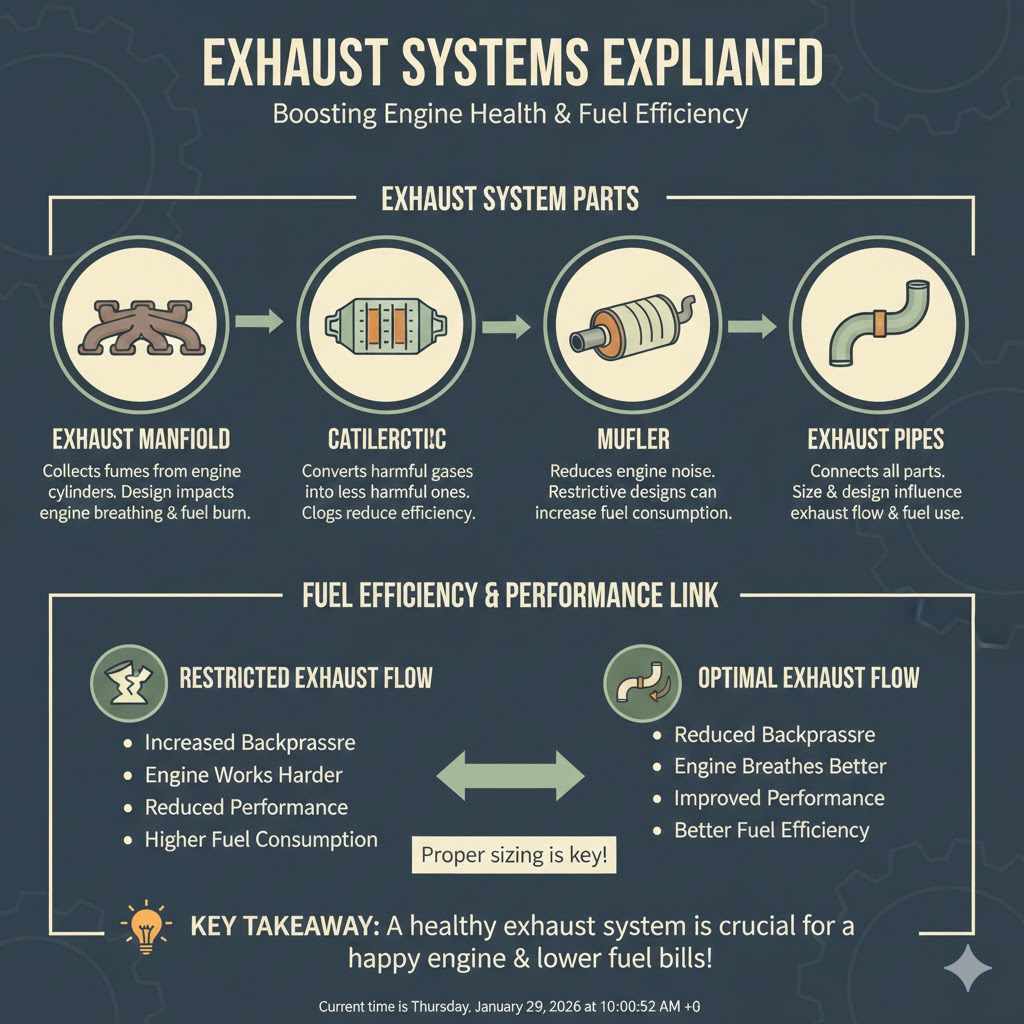
Your car’s exhaust system has several parts. They all team up to get the job done correctly. The exhaust manifold collects the fumes coming from the engine. The catalytic converter cleans up harmful gases. The muffler quiets the noise. The exhaust pipes connect everything.
Exhaust Manifold. This part bolts onto the engine. Its job is to gather the exhaust gases as they leave the engine’s cylinders. The design impacts how well the engine breathes, and this influences how it burns gas. It is often made of cast iron or stainless steel.
An exhaust manifold’s performance greatly influences overall engine efficiency. A well-designed manifold will allow exhaust gases to escape the cylinders more efficiently, reducing backpressure and improving the engine’s ability to draw in fresh air and fuel. This enhanced efficiency is key to efficient fuel usage.
Catalytic Converter. This is a vital piece. It takes the harmful stuff in exhaust fumes and turns it into less harmful stuff. A catalytic converter helps reduce pollution. It also affects how your car runs and how much gas it uses.
The catalytic converter’s condition and efficiency can indirectly affect fuel consumption. A clogged or damaged converter will create backpressure, forcing the engine to work harder to push exhaust gases out. As a result, this will make the engine use more fuel. Regular maintenance and replacement, when needed, are key to ensuring the converter functions correctly and doesn’t negatively impact fuel economy.
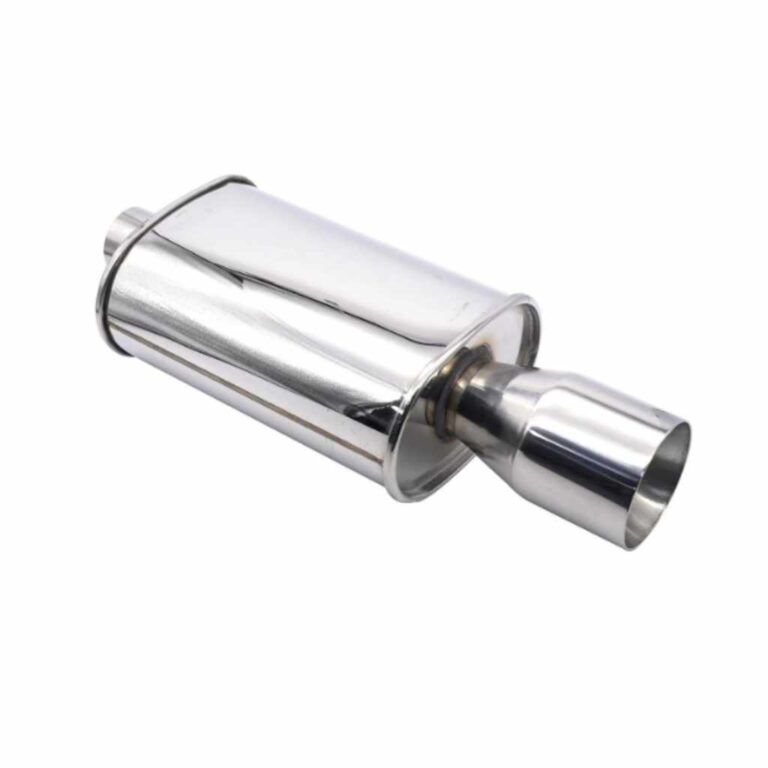
Muffler. This is the part of your car that makes it quieter. It reduces the noise from the engine and exhaust gases. Mufflers work by using chambers and baffles to absorb and dampen sound waves.
Mufflers play a key role in how your car sounds, but they also can have an effect on performance and fuel efficiency. A muffler that restricts exhaust flow will create backpressure, like a catalytic converter. It forces the engine to work harder to get rid of exhaust gases. This can lead to increased fuel consumption. Choosing a muffler with appropriate flow characteristics for your engine is important for maintaining optimal fuel efficiency and performance.
Exhaust Pipes. These pipes connect all the parts of the exhaust system. They carry exhaust gases from the engine to the end of the system. The size of these pipes can influence exhaust flow and, as a result, how much gas your car uses.
The exhaust pipes’ size and design are the main focus of our topic. Different pipe diameters can alter the exhaust flow characteristics. A larger-diameter pipe generally means lower backpressure, potentially improving performance. However, there’s a trade-off. An excessively large pipe can lower the exhaust velocity, especially at low engine speeds, which could negatively impact fuel economy. Proper sizing is a key consideration for maximizing efficiency.
The Impact of Pipe Size on Fuel Efficiency
The size of your car’s exhaust pipe matters. A bigger pipe changes how exhaust gases move. It affects the pressure inside the exhaust system. This pressure, or backpressure, can change how well your engine runs. We’ll explore how pipe size affects fuel efficiency, looking at the good and bad.
Understanding Backpressure
Backpressure is like a roadblock for your exhaust. It is the resistance that exhaust gases face as they leave the engine. A little backpressure is good, helping with low-end torque. Too much backpressure makes your engine work harder, which can use more fuel. Too little, especially on certain engines, can also negatively affect fuel efficiency.
Too Much Backpressure. Imagine trying to run with a heavy backpack. That is what your engine experiences with too much backpressure. The engine has to work harder to push exhaust gases out. This can reduce how well your engine runs and, as a result, use more gas.
High backpressure can cause several issues. It can decrease engine power. It will also reduce fuel efficiency. This is because the engine has to use more fuel to overcome the resistance. In turn, this creates more exhaust gases, thus creating more backpressure. It’s a vicious cycle that can harm your car’s performance and fuel economy over time.
Too Little Backpressure. While it sounds good, too little backpressure isn’t always best. In some cases, especially on engines with specific designs, it can negatively influence how the engine operates at low speeds. This can hurt fuel economy.
Engines are designed to work with a certain level of backpressure. Too little backpressure can lead to reduced exhaust velocity, meaning the exhaust gases don’t move out of the cylinders as quickly. This can affect how the engine fills with fresh air and fuel, especially at lower engine speeds. This can impact fuel efficiency, in some cases.
The Balance. The best exhaust system has the right balance of backpressure. This balance helps the engine run efficiently. This usually means a good flow without being too restrictive.
Finding the perfect balance of backpressure involves careful design and tuning. It considers factors like engine size, type, and intended use. The goal is to maximize performance and fuel efficiency without causing other problems. This is often accomplished by using the right diameter exhaust pipe and other components.
Big Pipes and Gas Use
Does a bigger exhaust pipe always save gas? Not necessarily. A bigger pipe can help in some situations, but not always. Let’s see how exhaust pipe size affects fuel use.
Larger Pipes. In theory, bigger pipes help exhaust gases flow faster. This can reduce backpressure. This can improve engine performance and, potentially, save gas, especially at high speeds.
Larger exhaust pipes can be helpful for vehicles with modified engines or high-performance requirements. They reduce resistance to exhaust flow, allowing the engine to breathe better. This can result in increased power. It can also improve fuel efficiency in certain driving conditions. However, the gains are typically more noticeable in performance. Fuel efficiency improvements are not always guaranteed.
The Downside. A pipe that’s too big can cause problems. If the pipe is oversized, it might lower exhaust velocity. It may also reduce engine performance at low speeds.
When an exhaust pipe is oversized, the exhaust gases can lose velocity. This is especially true at lower engine speeds. This can decrease the scavenging effect, where the exhaust gases help draw fresh air and fuel into the cylinders. This can lead to a decrease in engine efficiency. It can also affect fuel economy in certain driving situations.
Pipe Size and Engine Type. Different engines may need different pipe sizes. A small engine needs a smaller pipe. A large, powerful engine may benefit from a bigger one.
Engineers design exhaust systems specifically for a car’s engine. This includes considering engine size, compression ratio, and intended use. The optimal pipe size depends on many factors. A one-size-fits-all approach is not effective. It’s important to match the pipe size to the engine type for the best results in terms of both performance and fuel efficiency.
Real-World Examples
Let’s look at some real-world examples to see how exhaust pipes and fuel use go together.
Example 1: Sportscar Upgrade. A sports car owner changes their car’s exhaust. They put on a bigger pipe. They also change other things. The car now has better performance at high speeds. Their gas mileage may stay the same, or it might get a little better.
In this example, the owner is likely experiencing benefits from the improved exhaust flow. The larger exhaust pipe helps the engine breathe more freely. However, the fuel efficiency gains will depend on various factors. This includes the car’s engine, driving habits, and other modifications. The owner may see improvements in performance more than a big change in fuel economy.
Example 2: Small Car with Big Pipe. A person puts a big pipe on a small car. The car may feel less responsive at low speeds. Their gas mileage could get a little worse.
In this scenario, the oversized exhaust pipe is probably causing a loss of exhaust velocity. The lower exhaust velocity will make the engine less efficient at low speeds. The result may be a decrease in fuel economy. This illustrates that a larger exhaust pipe is not always better for fuel efficiency. It is important to match the exhaust system to the vehicle’s engine and intended use.
Example 3: Truck with a Better Exhaust. A truck driver installs a new exhaust system. They improve their truck’s performance and see a small increase in fuel economy. This often happens because the new system is designed to match the truck’s engine.
Trucks often benefit from exhaust upgrades. This is especially true when towing or hauling heavy loads. The improved exhaust flow can lead to increased power and torque, which can make the truck more efficient. The fuel economy gains will vary. It will depend on the design of the new exhaust system. It will also depend on how the truck is used.
Here’s a table comparing different exhaust pipe sizes and their potential effects on fuel consumption:
| Exhaust Pipe Size | Potential Effects on Fuel Consumption |
|---|---|
| Too Small | Increased backpressure, decreased efficiency, and potentially worse fuel economy |
| Optimal | Reduced backpressure, improved engine breathing, potential for better fuel economy |
| Too Large | Reduced exhaust velocity, decreased low-speed performance, potentially worse fuel economy |
What To Do Before Changing Your Exhaust
Before you change your car’s exhaust system, you should consider things. You should think about what you want to achieve. Also, it is key to select the right components.
Thinking About Your Goals
Before modifying your exhaust, decide what matters most. Do you want more power? Do you want to save gas? Or do you want a better-sounding car? Your goals will influence your choices.
Performance. If you need more power, think about a system designed to improve exhaust flow. This can mean a bigger pipe, but it depends on your car. You may get the most power gains by pairing your exhaust system upgrade with other improvements, like an air intake or engine tuning.
When performance is the primary goal, focus on components that reduce backpressure. This includes headers, catalytic converters with better flow, and mufflers designed for performance. These changes can increase horsepower and torque, leading to faster acceleration. Be aware that these modifications will sometimes require changes to other systems of the car, such as the engine’s computer.
Fuel Economy. If your goal is to save gas, consider what changes will reduce resistance. Think about a system matched to your car’s engine. A properly sized pipe can help, but it’s not the only factor.
Improvements in fuel economy come from several factors. One of them is exhaust system changes, such as pipe size. Making sure all the components work together, from the exhaust manifold to the muffler, is important. You should also consider your driving habits and regular vehicle maintenance for the best results.
Sound. If you want a different sound, consider different mufflers. The muffler is the component that primarily controls the sound of the exhaust. The exhaust pipe’s size has less influence on the sound.
Mufflers come in various designs. Each design has its own sound signature. Some mufflers are designed for a quiet, subtle sound. Others provide a loud, aggressive tone. When choosing a muffler, consider its impact on backpressure. Consider its impact on performance and fuel economy. Make sure it fits your car and matches your sound preferences.
Choosing the Right Parts
Choosing parts that fit your car is essential. Select the components that match your engine and goals. Get the correct exhaust pipe size for your car.
Do Your Research. Look at what other people say. Read reviews. Also, make sure the parts you choose will work with your car. Check online car forums to find helpful information.
Researching exhaust system components is key to a successful upgrade. Look for components from trusted brands. Read reviews from people who have the same car. Check for specific recommendations for your car’s make, model, and engine. This approach will help you avoid problems.
Talk to Experts. If you’re not sure, get advice from a mechanic or a car expert. They can help you select the parts that will work best for your car.
Consulting with an expert can help you when you select parts. They can offer advice. They can assist with installing the components. The expert will review your car’s specifications and your goals. They will also recommend the best approach for you.
Consider the Catalytic Converter. Make sure your catalytic converter meets the law. A faulty converter can hurt your car’s performance and fuel economy.
The catalytic converter is part of your car’s emissions system. It is key to environmental protection. You must comply with local and federal laws. When you replace your converter, make sure it is legal for your vehicle and meets the required standards. A good catalytic converter is essential for reducing pollution. It can help the engine run efficiently.
Installation Tips
Getting your exhaust installed correctly is important. If you can, take your car to a trusted mechanic. Improper installation will cause problems. Let’s explore some things to keep in mind.
Get the Right Tools. You’ll need the proper tools for the job. This usually includes wrenches, jacks, and safety gear. Also, make sure you know how to use them.
When working on your car, using the right tools makes the job easier. It also makes it safer. Make sure you have the required tools for the job. Read the instructions carefully. If you do not have the right tools, consider having a professional perform the work for you.
Follow Instructions. Read the instructions carefully. Make sure you know how everything goes together before you start.
Carefully following the instructions is important to a successful installation. It minimizes errors. It helps ensure the exhaust system works properly. If you’re not sure about any step, seek help from someone who has the experience.
Check for Leaks. After you install the exhaust, check for leaks. Leaks reduce your car’s performance. They also pose a safety risk. Start your car. Use soapy water on the connections. If bubbles form, there’s a leak.
Checking for leaks is a key step after the installation. Exhaust leaks will cause problems. They reduce performance. They can allow dangerous gases to enter the cabin. Check the connections at the manifold, the catalytic converter, and the muffler. You should also check where the pipes connect to each other. Fix any leaks you find right away.
Does a Bigger Exhaust Pipe Burn More Gas? The Summary
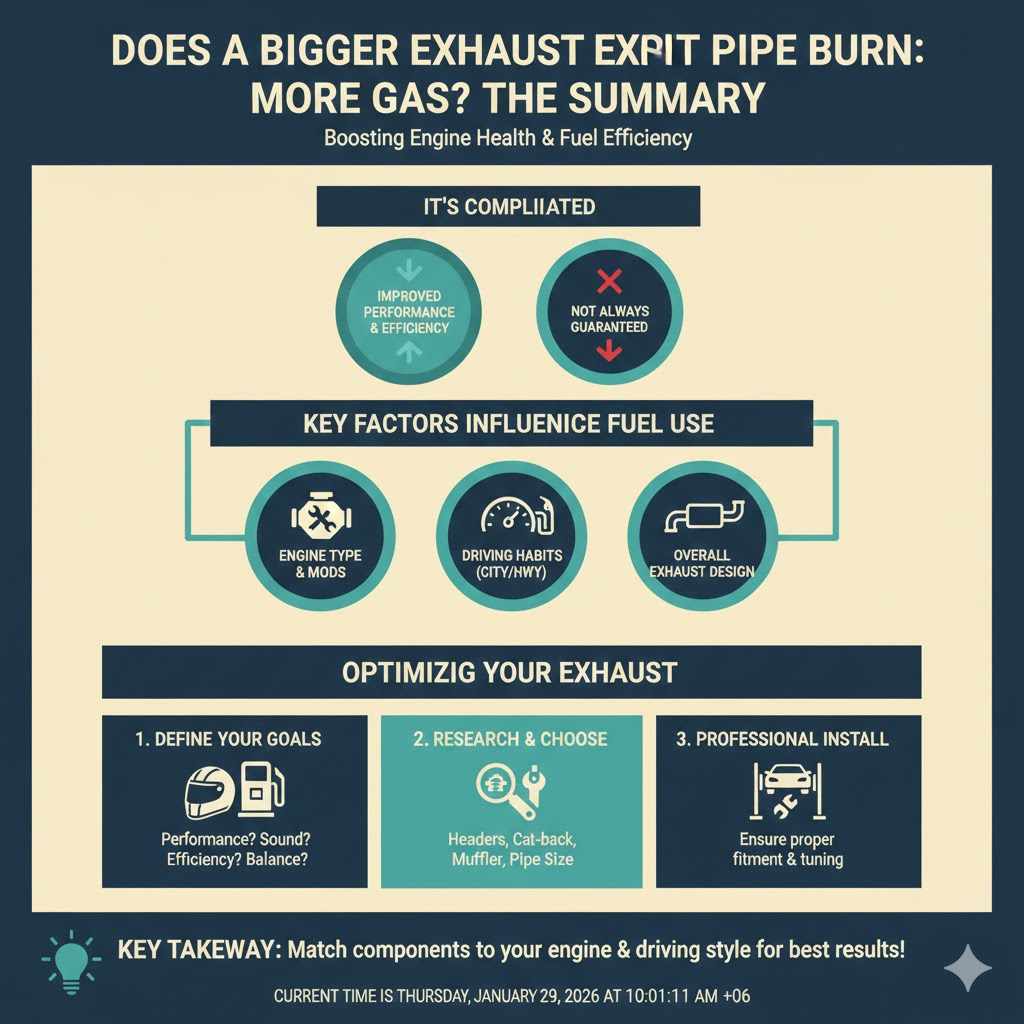
So, does Does a Bigger Exhaust Pipe Burn More Gas? It is complicated. It depends. A bigger exhaust pipe can help improve performance. It can also help with fuel efficiency. But it is not always guaranteed. Several factors influence how the exhaust system affects fuel use. This includes engine type, driving habits, and the overall design of your exhaust system. If you want a better exhaust, think about your goals and choose the right components.
Frequently Asked Questions
Question: What is backpressure?
Answer: Backpressure is the resistance to exhaust flow in the exhaust system. It affects how the engine runs.
Question: Does a larger exhaust pipe always improve fuel economy?
Answer: No, it doesn’t. Pipe size alone is not the only factor. The engine type, driving habits, and other factors have an impact.
Question: What’s the main function of the catalytic converter?
Answer: The catalytic converter reduces harmful pollutants in exhaust gases.
Question: What do I need to think about before changing my exhaust system?
Answer: Think about your goals: performance, fuel economy, or sound. Then, research parts and consider the correct size.
Question: Can an exhaust leak cause problems?
Answer: Yes. An exhaust leak will reduce performance and can be dangerous.
Final Thoughts
Choosing an exhaust system is important, so you need to explore your options. You’ve now seen how the size of an exhaust pipe can influence gas usage, among other things. Remember, a bigger pipe does not always mean better fuel economy. It’s key to choose the proper pipe size for your engine and driving style. Think about your needs and do some homework before making a change. By selecting components that complement your car, you can improve how it performs. You also may be able to slightly improve fuel economy. Enjoy your car and the driving experience!
Related pick: Check today's price on Amazon