Do Factories Have Exhaust Pipes: Essential Guide
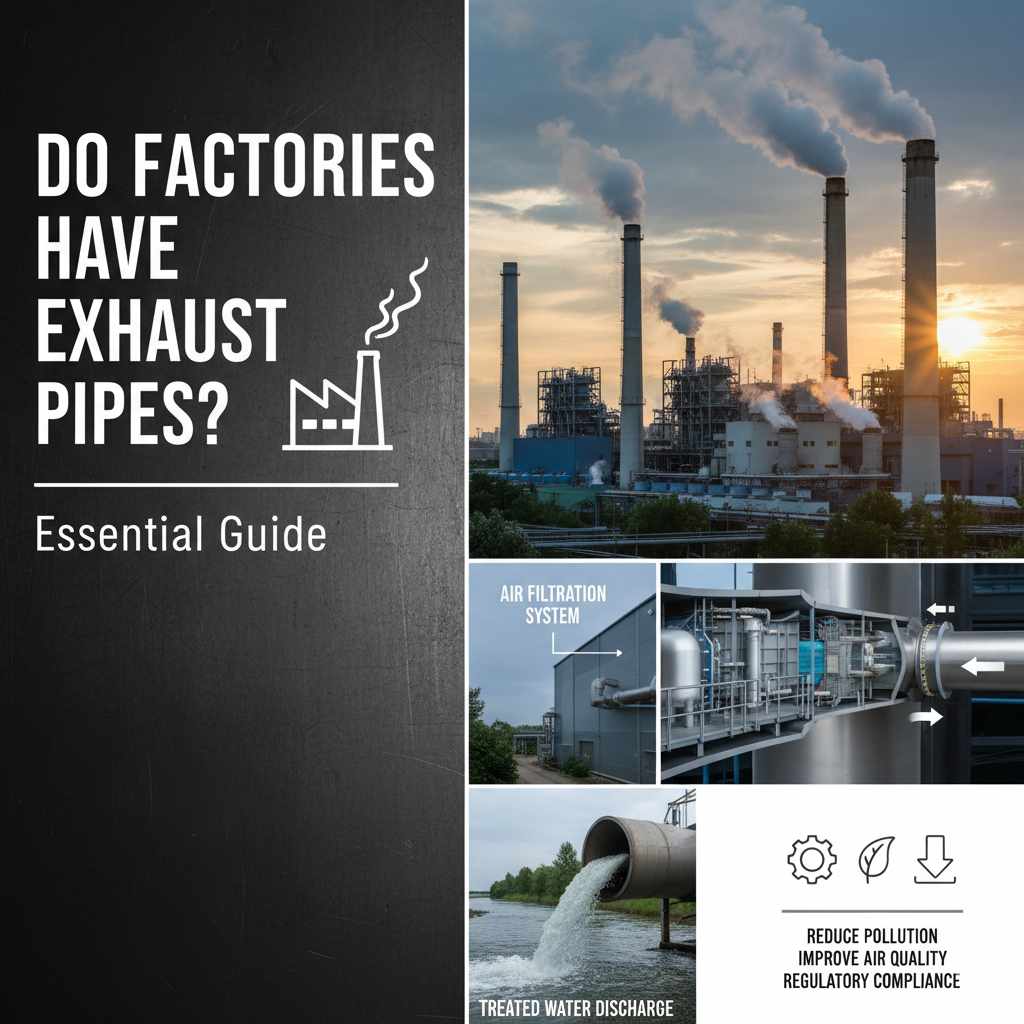
Do factories have exhaust pipes? Yes, factories absolutely have exhaust pipes, often called chimneys or stacks. These are crucial for safely releasing exhaust gases and pollutants into the atmosphere, helping to keep the environment around the factory cleaner and safer.

ZJXDZY
2.5 Inch Exhaust Pipe T304 Stainless Steel…
- 【Texture】Made of High Quality Stainless Steel with Computerized Mandrel for Strength and Durability。 Exchaust Tube Pipe 2.5 inch i…
- 【Applications】 stainless steel tubing Universal (Fit for Exhaust system,air intake, cooling systems, turbo intercooler piping setu…
- 【Announcements】2.5" stainless exhaust pipe Round Straight Steel Pipe Universal Fitment for VehicleProfessional Installer Is Highly…
As an Amazon Associate I earn from qualifying purchases.
Ever wondered what happens to all the smoke and fumes that industrial machines create? It’s a common question, and for good reason! Factories are busy places, humming with activity that often involves processes generating gases. If these aren’t managed properly, they could make the air around them harmful to breathe. Fortunately, there’s a system in place to handle this: exhaust pipes, or as they are more commonly known in industrial settings, chimneys or stacks. These towering structures are far from just decoration; they play a vital role in protecting both the people working inside and the communities living nearby. Understanding how they work is a key part of appreciating how modern industry takes steps towards safety and environmental responsibility. Let’s dive into the fascinating world of factory exhaust systems and see what makes them tick!
Why Factories Need Exhaust Pipes (Chimneys)
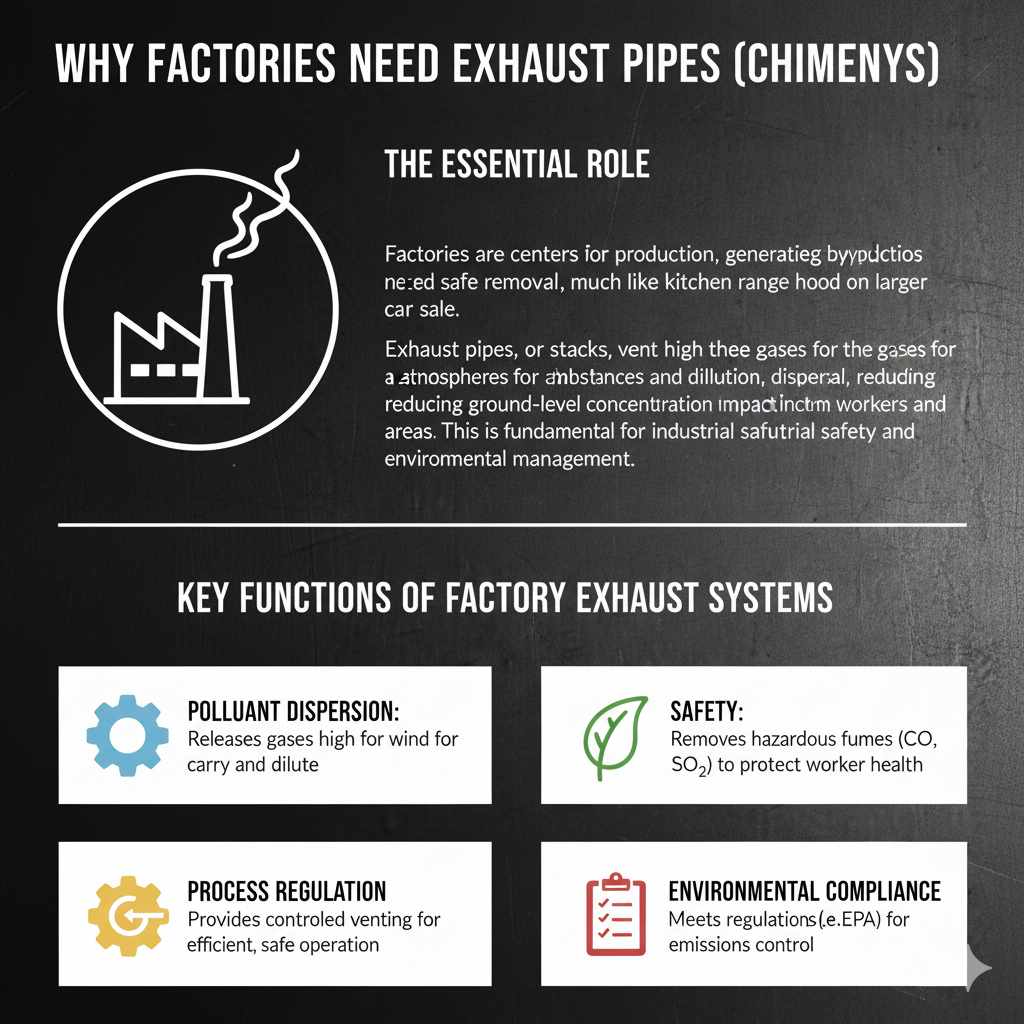
Factories are centers of production, and many of the processes involved generate byproducts that need to be safely removed. Think of it like a home kitchen; the stove or oven produces heat and sometimes smoke. You have a range hood or exhaust fan to draw that out. Factories are just on a much larger scale. The gases released can contain various substances, some of which are harmful or contribute to air pollution if not properly vented.
These exhaust pipes, or stacks, have a primary purpose: to vent these potentially harmful gases away from the immediate workspace and higher into the atmosphere. This dispersal helps to dilute the pollutants, reducing their concentration at ground level and minimizing their impact on air quality for workers and surrounding areas. It’s a fundamental aspect of industrial safety and environmental management.
Key Functions of Factory Exhaust Systems
Pollutant Dispersion: The most obvious function is releasing exhaust gases. Stacks are designed to send these gases high up, where wind can carry them away and dilute them more effectively.
Safety: By removing hazardous fumes like carbon monoxide, sulfur dioxide, or particulate matter, they protect the health of factory workers.
Process Regulation: Some industrial processes require controlled venting to operate efficiently and safely. Improper ventilation could lead to pressure build-up or other operational problems.
Environmental Compliance: Regulations set by environmental protection agencies, like the U.S. Environmental Protection Agency (EPA), mandate that factories control and monitor their emissions, making exhaust systems essential for compliance.
What Comes Out of Factory Exhaust Pipes?
The specific materials exiting factory exhaust pipes vary greatly depending on the industry and the processes involved. It’s not just simple smoke; it can be a complex mix.
Common Components of Factory Emissions
Gases: These include combustion byproducts like carbon dioxide (CO₂), carbon monoxide (CO), nitrogen oxides (NOx), and sulfur dioxide (SO₂). Other industrial processes might release volatile organic compounds (VOCs) or specific chemical vapors.
Particulate Matter: This refers to tiny solid or liquid particles that are suspended in the air. Examples include soot, dust, ash, and aerosols. These can range in size from microscopic to visible.
Water Vapor: Many industrial processes involve heating or cooling, which naturally produces water vapor. This is often seen as steam or a white plume, especially in cooler weather.
Heat: The exhaust gases are typically very hot, which contributes to their upward lift due to buoyancy.
Examples by Industry
Power Plants: Often release large amounts of CO₂, SO₂, NOx, and particulate matter from burning fossil fuels like coal or natural gas. Modern plants often have scrubbers to reduce SO₂ emissions.
Manufacturing Plants (e.g., Cement, Steel): Can emit dust, particulate matter, heavy metals, and various gases depending on the raw materials and processes used.
Chemical Plants: May release a wide range of specific chemical vapors and gases, sometimes with distinct odors, depending on the chemicals being processed.
Food Processing: Might emit steam, odors, and some particulate matter from cooking, baking, or drying processes.
How Factory Exhaust Pipes (Chimneys) Are Designed
Designing a factory chimney is a serious engineering task. They aren’t just random pipes stuck on top of a building. Their design is carefully considered to ensure they function effectively and safely.
Key Design Considerations
Height: This is perhaps the most critical factor. Stacks are built tall to ensure that pollutants are released high enough to be dispersed by wind currents, reducing ground-level concentrations. The required height depends on factors like the type and volume of emissions, local weather patterns, and the surrounding terrain. The EPA provides guidance on emission standards and dispersion modeling.
Diameter: The width of the pipe affects how quickly gases can exit and how much air can be drawn in, if the design incorporates that feature, influencing the plume’s behavior.
Material: Stacks are built from durable materials that can withstand high temperatures, corrosive gases, and harsh weather. Common materials include reinforced concrete, steel, and acid-resistant bricks or liners.
Flow Rate: The velocity at which gases exit the stack is important for plume rise and dispersion.
Plume Control: Some advanced facilities might incorporate features like water sprays to cool the exhaust or scrubbers to remove certain pollutants before they are released.
Table: Common Chimney Materials and Their Properties
| Material | Key Properties | Typical Applications |
|---|---|---|
| Reinforced Concrete | Strong, durable, good heat resistance, cost-effective | Large industrial stacks, power plants |
| Steel (Carbon/Stainless) | High strength, good corrosion resistance (stainless) | Smaller stacks, internal liners, structures supporting brick |
| Acid-Resistant Brick/Linings | Excellent resistance to corrosive gases and high temps | Inner lining of stacks exposed to harsh emissions |
| Fiberglass Reinforced Polymer (FRP) | Lightweight, corrosion-resistant, cost-effective | Chemical plants, smaller industrial applications |
The Science Behind Plume Rise
One of the fascinating aspects of factory exhaust is the plume you see rising from the chimney. This plume isn’t just carried horizontally; it actively rises above the stack. This “plume rise” is a result of several factors:
Buoyancy: The hot exhaust gases are less dense than the surrounding cooler air. Like a hot air balloon, this buoyancy causes the plume to rise.
Momentum: The speed at which the gases are expelled from the stack also contributes to an initial upward push.
The combined effect of buoyancy and momentum, along with atmospheric conditions like wind speed and temperature gradients, determines how high the plume will rise above the stack. This is crucial because the higher the plume, the more diluted the pollutants will be by the time they reach ground level. Meteorologists and environmental engineers use complex atmospheric dispersion models to predict how these plumes will behave.
Are There Different Types of Factory Exhaust Pipes?
Indeed, there are! The variety of factory exhaust systems reflects the diverse needs of modern industry. While the image of a tall brick chimney is common, many other types exist.
Types of Industrial Exhaust Structures
Tall Stacks/Chimneys: The classic image. These are designed for large-volume emissions and require significant dispersion to meet air quality standards. They are common at power plants, large manufacturing facilities, and incinerators.
Ventilation Stacks: Smaller, localized stacks designed to vent specific equipment or process areas, rather than the entire facility’s emissions. These are often found on individual machines or smaller buildings within a larger industrial site.
Fume Hoods and Local Exhaust Ventilation (LEV): While not always large, external structures, these are essentially highly localized exhaust systems used to capture pollutants right at their source within a workspace. They vent through ductwork that may eventually lead to a larger stack or an air treatment system.
Flare Stacks: Used in oil and gas industries to burn off excess flammable gases that cannot be economically recovered or stored. These are visually distinctive with a flame at the top.
Ductwork: In many cases, exhaust gases are first collected via a network of pipes and ducts that run throughout the factory. These ducts then lead to a central stack, an air pollution control device, or are vented through smaller openings.
The choice of exhaust system depends on the volume of emissions, the type of pollutants, the required dispersion, and the factory’s specific industrial process. You can learn more about industrial air pollution control technologies from resources like the EPA’s overview.
Pollution Control Technologies Used with Factory Exhaust
It’s important to remember that simply releasing pollutants into the air isn’t usually the end of the story. Many factories employ sophisticated technologies to clean the exhaust gases before they leave the stack, or to monitor what is being released. This is crucial for meeting environmental regulations and protecting air quality.
Mechanisms for Reducing Emissions
Scrubbers: These devices remove pollutants like sulfur dioxide (SO₂) and particulate matter from exhaust gases. They work by using a liquid (like water or a chemical solution) or a dry sorbent to absorb or react with the pollutants.
Wet Scrubbers: Gas passes through a spray of water or a liquid solution.
Dry Scrubbers: A dry powder or slurry is injected into the gas stream.
Filters (Baghouses): These are large fabric filters that trap particulate matter from the exhaust gas. The collected dust is periodically removed. These are very effective for removing fine particles.
Electrostatic Precipitators (ESPs): These devices use an electric charge to attract and remove particulate matter from the exhaust stream. They are highly efficient for capturing very fine dust particles.
Catalytic Converters: Similar to those found in cars, but on an industrial scale, these use catalysts to convert harmful gases like NOx and CO into less harmful substances like nitrogen and CO₂.
Selective Catalytic Reduction (SCR) / Non-Catalytic Reduction (SNCR): These technologies are commonly used to reduce NOx emissions from combustion sources. They involve injecting ammonia or urea into the exhaust stream to react with NOx and convert it to nitrogen and water.
Table: Common Air Pollution Control Devices
| Device Type | Primary Pollutants Controlled | How it Works |
|---|---|---|
| Wet Scrubber | SO₂, particulate matter, acid gases | Gas is passed through a liquid spray or packed bed. |
| Baghouse (Fabric Filter) | Particulate matter (dust, ash) | Gas is filtered through large fabric bags. |
| Electrostatic Precipitator (ESP) | Particulate matter (fine dust) | Uses electrical charges to remove particles from gas stream. |
| Catalytic Converter | CO, NOx, VOCs | Converts harmful gases into less harmful substances via catalyst. |
| SCR/SNCR | NOx | Injects ammonia/urea to convert NOx into nitrogen and water. |
Monitoring Factory Emissions
Beyond installing pollution control equipment, factories are often required to continuously monitor the emissions coming out of their stacks. This ensures that the pollution control systems are working effectively and that the factory is in compliance with environmental laws.
Continuous Emission Monitoring Systems (CEMS): These sophisticated instruments are installed directly on the smokestack to measure the concentration of specific pollutants (like SO₂, NOx, CO, particulate matter) and flow rates in real-time.
Periodic Testing: Even with CEMS, regular independent testing is often performed to verify the accuracy of the monitoring equipment and to assess pollutants not covered by CEMS.
Safety and Environmental Impact Considerations
The design and operation of factory exhaust systems are heavily regulated to protect human health and the environment.
Health Impacts
Exposure to high concentrations of pollutants released from factories without proper controls can lead to:
Respiratory problems: Asthma, bronchitis, reduced lung function.
Cardiovascular issues: Heart disease.
Allergies and irritations: Eyes, nose, and throat irritation.
Long-term effects: Some pollutants are carcinogenic or can affect neurological development.
Environmental Impacts
Uncontrolled emissions can contribute to:
Acid Rain: SO₂ and NOx react with water in the atmosphere to form sulfuric and nitric acids, which can damage forests, lakes, and buildings.
Smog: NOx and VOCs react in the presence of sunlight to form ground-level ozone, a key component of smog, which is harmful to human health and plants.
Climate Change: Greenhouse gases like CO₂ trap heat in the atmosphere, contributing to global warming.
Particulate Matter: Fine particles can travel long distances, leading to hazy skies and contributing to respiratory and cardiovascular health problems far from the source.
Regulations like the Clean Air Act in the U.S. play a vital role in limiting these impacts by setting strict emission standards for industries.
How You Can Identify a Factory’s Exhaust
Spotting a factory’s exhaust pipe is usually straightforward once you know what to look for. They are typically the tallest structures on an industrial site.
Visual Clues
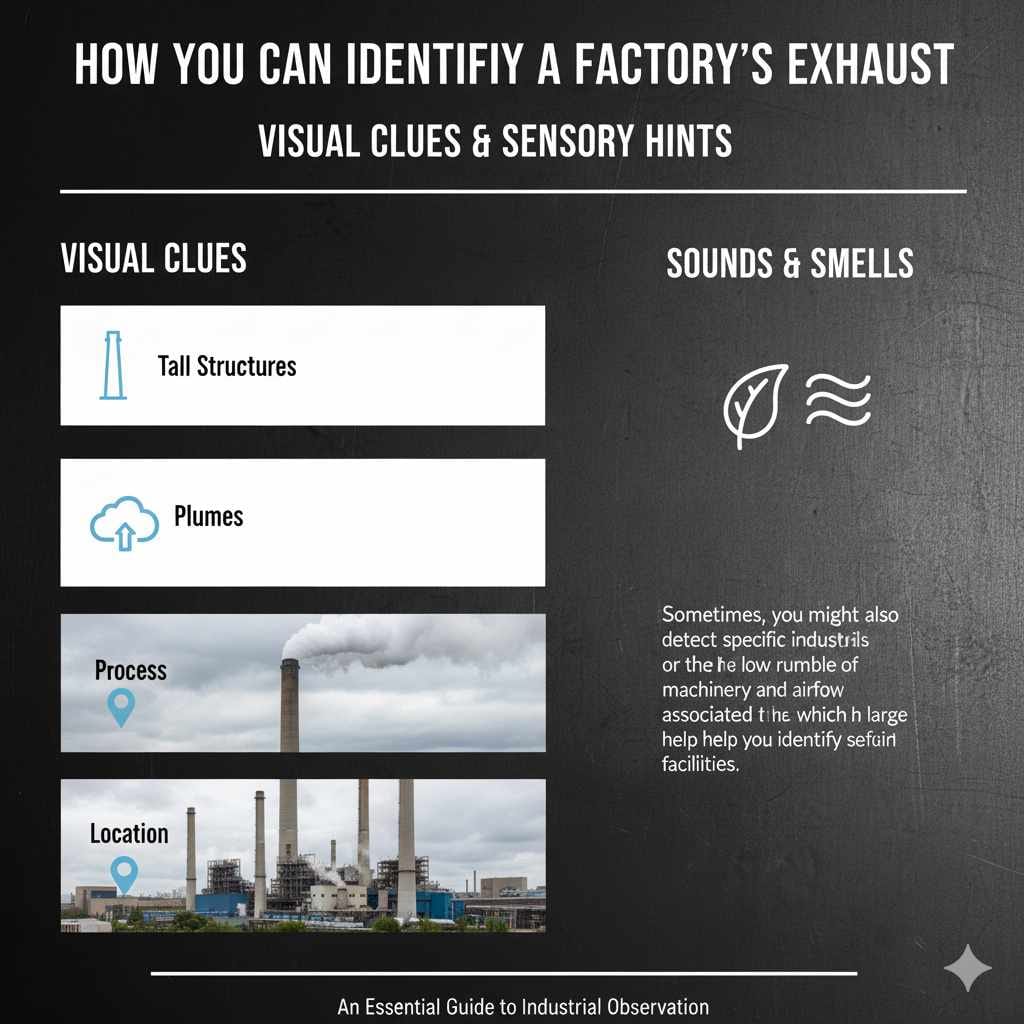
Tall Structures: Look for large, cylindrical structures, often made of brick, steel, or concrete, rising significantly above the factory buildings.
Plumes: You might see a plume of white steam or smoke rising from the top, especially on cooler or more humid days. Note that a white plume isn’t always a sign of pollution; it can often be just water vapor from processes like steam generation or cooling towers – though water vapor can sometimes carry pollutants.
Location: They are usually situated near the main production buildings or energy generation units.
* Industrial Sites: They are found on premises dedicated to manufacturing, energy production, chemical processing, mining, and heavy industry.
Sounds and Smells
Sometimes, you might also detect specific industrial smells or the low rumble of machinery and airflow associated with large industrial facilities, which can further help you identify the likely source of emissions.
Frequently Asked Questions (FAQ)
Are all factory chimneys the same?
No, factory chimneys, or stacks, come in various sizes, shapes, and materials. Their design depends on the type of industry, the volume and nature of the emissions, and the required height for safe dispersal of pollutants.
Is the smoke from factory chimneys always harmful?
Not necessarily. While many industrial emissions contain harmful pollutants, some visual plumes are primarily water vapor, similar to steam from a kettle. However, even seemingly harmless plumes can carry microscopic particulate matter or other substances. Modern factories often use pollution control technologies to significantly reduce harmful emissions.
Can I tell a factory’s emissions by its smell?
Sometimes. Certain industrial processes release distinctive odors. However, the absence of a smell doesn’t mean there are no emissions, and strong smells can be masked by atmospheric conditions or other factors. The best way to know about emissions is through official monitoring data.
Do factories have exhaust pipes inside the building too?
Yes, factories use a variety of exhaust systems. Besides the large external stacks, they have internal ductwork and local exhaust ventilation (like fume hoods) to capture emissions directly from machinery or workstations and channel them to be treated or vented outside.
What happens if a factory doesn’t have proper exhaust systems?
If a factory lacks proper exhaust systems or pollution controls, it can lead to unsafe working conditions due to poor air quality, significant environmental damage (like air pollution and acid rain), and hefty fines or legal action from environmental regulatory agencies.
How tall are typical factory chimneys?
The height varies greatly. Smaller industrial sites might have stacks only tens of feet tall, while major power plants or chemical facilities can have chimneys hundreds of feet (or even over 1,000 feet) tall to ensure adequate dispersion of emissions.
Can I see data about what factories are emitting?
Yes, in many countries, emissions data from industrial facilities is publicly available. Environmental protection agencies, like the EPA, often maintain databases and reports detailing regulated emissions from specific factories. You can often find this information on their official websites.
Conclusion
So, to answer the initial question directly: yes, factories absolutely have exhaust pipes, commonly known as chimneys or stacks. These are far more than just parts of a building; they are sophisticated engineering solutions essential for the safe and responsible operation of industrial facilities. They play a critical role in managing the byproducts of production, from heat and steam to potentially harmful gases and particulate matter.
By releasing emissions at a controlled height, these systems facilitate dispersion and dilution, minimizing immediate impacts on workers and the surrounding environment. Furthermore, the integration of advanced pollution control technologies like scrubbers and filters means that what exits these stacks is often much cleaner than it would be otherwise.
Understanding factory exhaust systems highlights the ongoing efforts in industrial practices to balance production needs with environmental stewardship and public health. It’s a complex but vital aspect of the modern world, ensuring that the engines of industry can run while minimizing their footprint on our planet. Next time you see a tall stack, you’ll know it’s performing a crucial function, backed by science and engineering to keep our air cleaner.
Related pick: Check today's price on Amazon