
Are 350 Headers and LS Headers Essential for Performance?
For your typical daily driver, installing 350 or LS headers is usually not essential for performance. While they can boost power in modified engines, an average car benefits more from basic maintenance. Focus on regular tune-ups before considering exhaust upgrades; they offer a better performance return for most owners.
Hey there, car enthusiasts! Have you ever heard that little word, “headers,” thrown around when people talk about making a car faster or sound better? It can be confusing, especially if you’re just starting to learn about what makes your engine tick. You might wonder, “Are these special headers, like the ones for a 350 engine or an LS engine, something I absolutely need for my car to perform well?” Let’s clear up that confusion together. We’ll break down what headers do, who really needs them, and what else you should think about first. Stick with me, and by the end, you’ll know exactly what’s what!
What Are Headers, Anyway?
Think of your engine like a big breathing machine. It takes in air and fuel, makes power, and then needs to get rid of the used-up gases. These gases travel through your exhaust system. Your stock exhaust manifold is like the engine’s standard “breathing out” pipe.
Headers, also called exhaust headers or headers for short, are a performance upgrade to that stock manifold. Instead of a single pipe collecting exhaust gases from all the cylinders, headers usually have separate, tuned pipes (called “tubes” or “runners”) for each cylinder. These tubes then merge into a collector, which then connects to the rest of your exhaust system.
The main idea behind headers is to make it easier for the engine to “breathe out.” By giving each cylinder its own smoother, less restrictive path for exhaust gases, headers help the engine expel those gases more efficiently. This smooth flow can lead to a few good things:
- Better Airflow: The engine can push out exhaust gases faster.
- More Power: When the engine breathes out easier, it can take in more fresh air and fuel, which means it can make more power.
- Improved Sound: Headers often change the exhaust note, making it sound more aggressive or sporty.

The “350” and “LS” Connection
When people mention “350 Headers” or “LS Headers,” they’re talking about headers specifically designed to fit engines that are very common in many vehicles, especially older American cars and trucks. Let’s break that down:
What is a “350” Engine?
The “350” usually refers to the Chevrolet 350 cubic inch (which is about 5.7 liters) small-block V8 engine. This engine has been incredibly popular for decades, found in everything from classic muscle cars like the Chevrolet Camaro and Chevelle to trucks like the Chevrolet C10 and even some Corvettes. Because it’s so common, there’s a huge aftermarket for parts, including headers, designed just for it.
What is an “LS” Engine?
The “LS” engine family is also from General Motors (Chevrolet’s parent company) and is a modern evolution of the small-block V8 design. LS engines are known for their power, efficiency, and modular design. They started appearing in production vehicles in the late 1990s and are now found in almost all modern GM performance cars (Corvettes, Camaros, Cadillacs) and trucks. Like the 350, the LS engine platform has a massive aftermarket, with countless header options available.
So, when you hear “350 headers” or “LS headers,” it’s really just a way to specify headers that are engineered to bolt correctly onto these particular, very common engine types. They are not some magical type of header different in principle from others, but rather tailored for specific engine configurations.
Are They Essential for Performance? Let’s Get Real.
This is the million-dollar question, right? For the average car owner, driving a vehicle that’s mostly stock and used for daily commuting or regular transportation, the answer is almost always: No, 350 headers and LS headers are generally NOT essential for performance.
Hear me out. Your car’s factory exhaust system is designed by engineers to meet several goals: emissions regulations, noise limits, durability, and a balance of performance and fuel efficiency for everyday driving. For most cars, the factory manifold does a perfectly adequate job. It gets the exhaust gases out without causing major issues.
Replacing your stock exhaust manifold with aftermarket headers is indeed an upgrade. These headers can improve performance. However, the gains on a completely stock engine might be surprisingly small, perhaps only a few horsepower. Sometimes, the perceived performance improvement comes more from the louder, sportier sound than from a massive actual power increase.
Who Actually Benefits Most from Headers?
Headers start to make a significant difference when you begin to modify other parts of your engine. Think of it like building a house. You can’t expect a bigger roof to do much good if the foundation is crumbling. The same applies to engines.
Here are the scenarios where headers can be truly beneficial:
- Heavily Modified Engines: If you’ve upgraded your camshaft, added a supercharger or turbocharger, installed a more aggressive intake system, or tuned the engine’s computer (ECU), your engine is capable of making much more power. In these cases, the restrictive stock manifold can become a “bottleneck,” hindering the engine’s ability to breathe and preventing you from realizing the full potential of your other upgrades. Headers help alleviate this.
- Racing or Track Use: Vehicles used for motorsports often benefit from the increased airflow and potential power gains headers offer, especially at higher engine speeds.
- Specific Performance Goals: If you’re building a project car specifically for maximum horsepower and torque, headers are often a standard part of achieving those goals, alongside other modifications.
- Towing or Hauling with Modified Trucks: For trucks that are frequently used for heavy-duty towing or hauling, and have other performance modifications, improved exhaust flow from headers can help the engine work more efficiently under load.
When NOT to Prioritize Headers
If your car is your daily driver and the engine is stock, putting headers on it might not give you the bang for your buck you’re expecting. The cost of headers, plus installation, could be better spent on other maintenance or upgrades that offer more noticeable improvements for your everyday driving experience.
What Should You Focus on Instead?
Before you even start thinking about headers for your 350 or LS engine, make sure your car is in top shape. Prioritizing these areas will make a bigger difference to your car’s performance, reliability, and your wallet than headers alone would on a stock vehicle:
1. Basic Maintenance is King
This is the absolute foundation. A well-maintained engine runs as it should. Neglecting this is like trying to put racing tires on a car with flat wheels – it won’t help much.
- Oil Changes: Regular oil changes keep your engine lubricated and running smoothly.
- Spark Plugs and Wires: Fresh spark plugs ensure efficient combustion.
- Air Filter: A clean air filter allows the engine to breathe in enough air.
- Fuel System: A clean fuel filter and injectors ensure proper fuel delivery.
- Cooling System: An engine that runs too hot or too cold won’t perform optimally.
For a great overview of why this is so important, check out the U.S. Department of Energy’s guidelines on vehicle maintenance for efficiency:
Fueleconomy.gov – Maintaining Your Vehicle
2. Tire Pressure and Alignment
This might sound simple, but it’s crucial! Properly inflated tires reduce rolling resistance, saving fuel and making your car feel more responsive. Good alignment ensures your tires are pointing in the right direction, preventing drag and uneven wear. It makes a surprising difference to how your car drives and its overall performance.
3. Ignition Timing and Carburetor/Fuel Injection Tuning
For older “350” engines with carburetors, ensuring the timing is set correctly and the carburetor is properly adjusted can unlock significant performance that might have been lost over time. For “LS” engines with fuel injection, ensuring the system is clean and functioning as intended is key.
A good mechanic can check and adjust these to make sure your engine is firing on all cylinders at the right time for optimal power and efficiency.
4. Catalytic Converter Check
The catalytic converter is vital for emissions control, but a clogged or failing one can severely restrict exhaust flow, robbing your engine of power. If your car feels sluggish, a restricted catalytic converter could be the culprit and is often more critical to address than headers on a stock vehicle.
When Headers Might Be Your Next Step (After the Basics)
If you’ve addressed all the basic maintenance, your car runs smoothly, and you’re still looking for more, then headers can be a consideration. Especially if you have a classic car with a 350 or a more modern GM vehicle with an LS engine.
| Pros | Cons |
|---|---|
| Potential for modest horsepower and torque gains (especially on modified engines). | Can be expensive, both for the part and installation. |
| Improved exhaust note for a sportier sound. | May require other modifications (like a new exhaust system) to achieve full benefits. |
| Can improve engine breathing, helping other performance mods work better. | Installation can be tricky and may require specialized tools or knowledge. |
| Can sometimes improve fuel efficiency slightly if the engine is under less strain (though often performance mods hurt MPG). | May affect emissions compliance in some areas if not smog-legal. |
| A popular upgrade for enthusiasts building performance-oriented vehicles. | On a stock, daily-driven car, gains might be minimal and not worth the cost. |
Types of Headers to Know About
Even if you decide headers are for you, there are a few types to be aware of, particularly for 350 and LS engines. This helps you understand what you might see when shopping:
- Shorty Headers: These are shorter and designed to be a more direct bolt-on replacement for stock manifolds. They offer some performance gain but are less dramatic than long-tube headers. They’re often easier to install and more likely to be emissions-legal in more places.
- Long-Tube Headers: These have much longer pipes (runners) that extend further down the exhaust system before collecting. They are generally considered the performance king, offering the most significant gains in horsepower and torque, particularly at higher RPMs. However, they are often more expensive, harder to install, may require modifications to your exhaust system, and can sometimes hang lower, potentially affecting ground clearance.
- Tri-Y Headers: These are a hybrid, with two pipes merging into one, then two more merging into a final collector. They aim for a balance of mid-range torque and high-RPM power.
When looking for headers, you’ll see terms like “1 5/8” or “1 3/4″” (tube diameter) and “3” collector” (the size of the pipe where all the runners meet). These dimensions are engineered for specific engine types and intended uses. For example, smaller tube diameters are often for naturally aspirated engines focused on low-end torque, while larger diameters can help with high-RPM power on engines with forced induction.
The Importance of Fitment and Quality
If you decide on headers, buying a quality set designed specifically for your car’s year, make, model, and engine is crucial. A poor fit can lead to headaches, leaks, and even damage.
Reputable manufacturers use good materials (like stainless steel or ceramic-coated steel) to ensure durability and prevent rust. Poorly made headers can crack or leak, creating exhaust noise issues and losing you the performance you paid for.
For information on exhaust component metallurgy and its importance, you can find detailed resources from organizations like the American Society for Metals, which explain why certain materials are chosen for high-temperature, high-stress environments like exhaust systems.
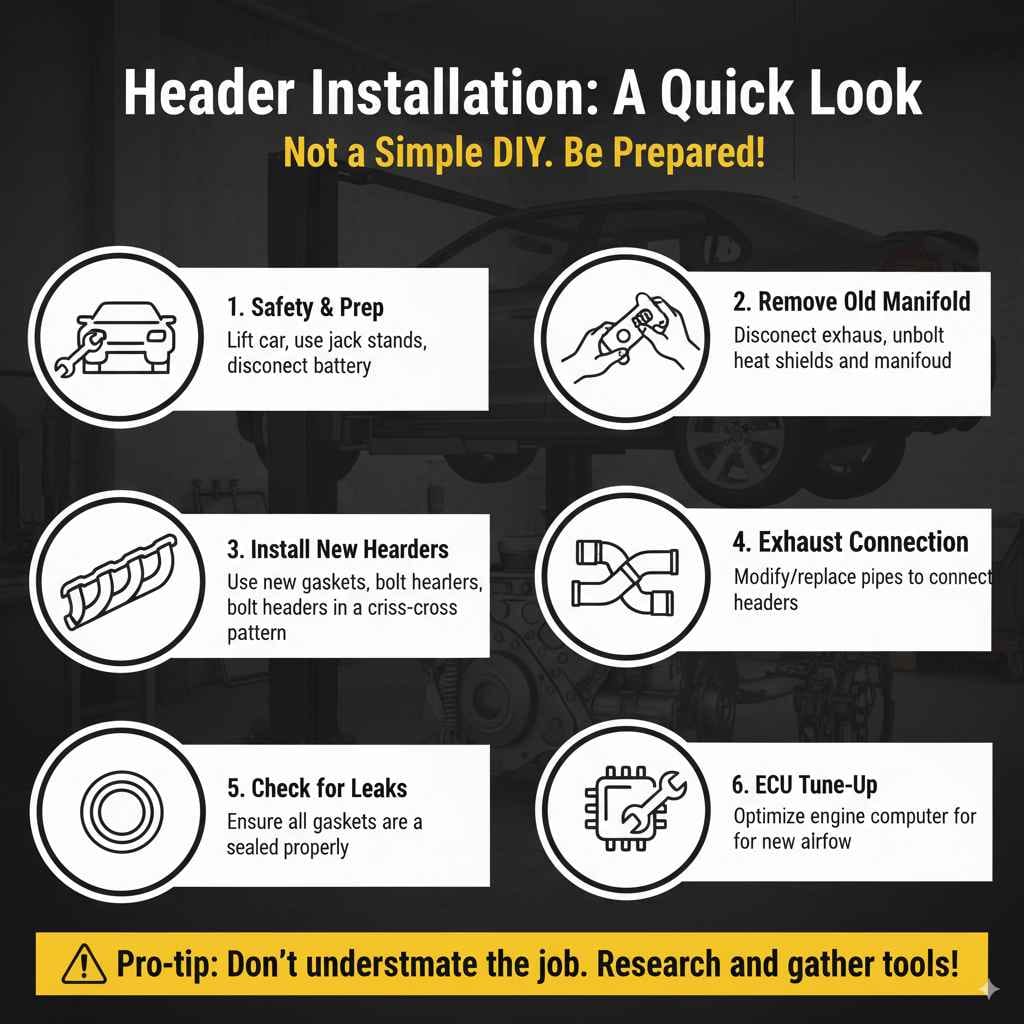
Installation: A Quick Look
Installing headers, especially long-tube headers, isn’t always a simple DIY job, even for experienced mechanics. It often requires:
- Lifting the car safely on jack stands.
- Removing exhaust manifold heat shields.
- Disconnecting the exhaust system from the manifold.
- Unbolting the old manifold.
- Bolting on the new headers.
- Potentially modifying or replacing other exhaust components to connect to the new headers.
- Ensuring all gaskets are properly sealed to prevent leaks.
It’s also very common for headers to require a tune-up of the engine’s computer (ECU) afterward, especially if you’re changing the amount of air flowing through the engine. This is to optimize fuel delivery and ignition timing for the new exhaust setup.
Frequently Asked Questions (FAQ)
Q1: Will 350 Headers make my stock V8 faster?
A: On a completely stock engine, the gains from 350 headers are usually very small, often just a few horsepower. You might notice the sound more than the speed. They become much more effective when combined with other engine modifications.
Q2: Are LS Headers expensive?
A: Yes, LS headers can be quite expensive. Prices can range from a few hundred dollars for basic shorty headers to over a thousand dollars for high-quality, long-tube stainless steel headers. Installation costs can add significantly to the total price.
Q3: Do I need a new exhaust system if I install headers?
A: Often, yes. Long-tube headers, in particular, usually require a custom exhaust system or specific mid-pipe to connect them to the rest of your exhaust. Shorty headers are more likely to bolt up to your stock exhaust, but it always depends on the specific header and vehicle.
Q4: Will headers help with fuel economy?
A: This is a mixed bag. While better exhaust flow can theoretically make the engine more efficient, the primary reason people install headers is for performance. Anyone driving aggressively to take advantage of the newfound power will likely see a decrease in fuel economy. For a conservative driver, the change might be negligible or a very slight improvement.
Q5: Can headers cause my car to fail emissions testing?
A: Yes, this is a significant concern. Many aftermarket headers, especially aggressive long-tube designs, are not “smog legal” or “catalytic converter compatible.” If your local emissions testing requires your vehicle to have a functioning stock-style catalytic converter and manifold setup, installing headers that bypass or alter this could cause you to fail. Always check local regulations and purchase headers that specifically state they are emissions-legal for your area if this is a concern.
Q6: What’s the difference between stainless steel and ceramic-coated headers?
A: Stainless steel headers are made from corrosion-resistant alloy, offering excellent durability and a clean look. Ceramic-coated headers have a protective coating applied over steel (sometimes mild steel, sometimes stainless) that helps to insulate them, keeping heat in the exhaust gases (which can slightly improve flow) and protecting the metal from corrosion. Ceramic coating can also help with aesthetics, often appearing in black or silver. Quality and price vary for both.
Q7: Is it possible to install headers myself?
A: For some vehicles and some types of headers (like bolt-on shorty headers), it’s a feasible DIY project for someone with moderate mechanical experience and the right tools. However, for many applications, especially with long-tube headers, it can be a very difficult and time-consuming job. It often requires working in tight spaces, dealing with stubborn bolts, and potentially making modifications. If you’re unsure, it’s usually best to have a professional mechanic handle the installation.
Conclusion: Headers Are an Upgrade, Not a Requirement
So, to wrap things up: are 350 headers and LS headers essential for performance? For the vast majority of everyday drivers, the answer is a clear no. Your car’s stock exhaust manifold is designed to do its job perfectly for normal driving, and focusing on regular maintenance like oil changes, air filters, and spark plugs will yield far more noticeable and cost-effective improvements in performance, reliability, and fuel efficiency.
Headers are specialized performance parts. They truly shine when your engine is built to handle more power, meaning you’ve already upgraded other components like the camshaft, intake, or forced induction.