
Why Your Car Loses Power with an Exhaust Leak
An exhaust leak can make a car lose power when it pulls outside air into the exhaust stream, skews the upstream oxygen sensor, pushes fuel trims off target, and leaves the engine running weak; a leak near the manifold or sensor matters far more than a tailpipe leak. Ignoring it can waste fuel, set false codes, and make a real catalytic-converter or fuel problem harder to catch. This guide explains the leak-to-power-loss chain and the tests that separate an exhaust leak from a restricted converter or a fuel-delivery fault.
What an exhaust leak does


An exhaust leak is a hole, crack, loose flange, damaged flex section, or failed gasket anywhere in the exhaust path. It can happen from the exhaust valve to the tailpipe, and it may create noise, fumes, fuel economy loss, and performance loss.
Leaks near the front of the exhaust system usually matter more than tailpipe leaks. A crack at the manifold, a failed manifold gasket, or a leak before the upstream oxygen sensor can change how the engine computer reads exhaust oxygen. Rear leaks are still a problem, but they usually have less effect on fueling and acceleration.
Leak points that matter most
- Exhaust manifold gasket. A common front-of-engine leak source. It often makes a ticking or tapping noise on cold start or during acceleration.
- Flex pipe. A common crack point. It can leak more as the engine rocks under load.
- Flanges and joints. Loose hardware or a damaged sealing surface can open a path for outside air.
- Pipe cracks and holes. These can be subtle at idle and louder under load.
- Rear muffler or tailpipe leaks. Usually less likely to change fuel trims or power unless the leak is large or the system is badly damaged.
A leak ahead of the upstream oxygen sensor can make the sensor see extra oxygen that may not reflect a lean engine. The engine computer may then add fuel because it thinks the mixture is lean, and that correction can leave the engine feeling sluggish, especially during acceleration or climbing.
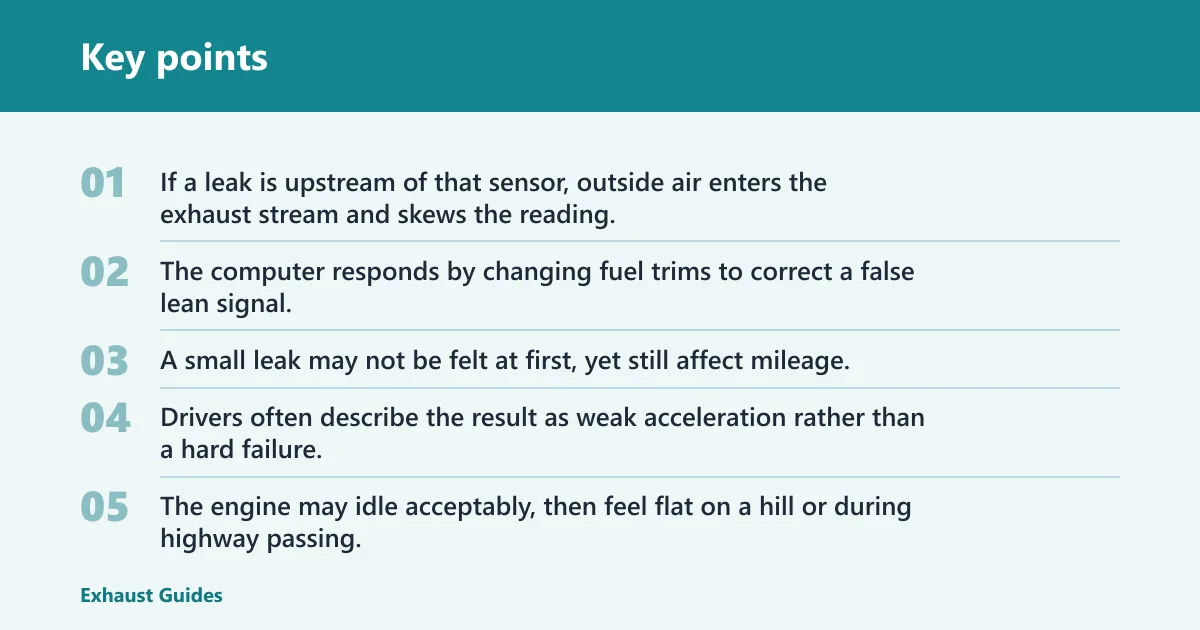
That chain matters because the problem is not only noise. The computer changes fuel trims, the mixture shifts away from target, and the car can feel weak under load even if it seems mostly normal at idle.
Leak, sensor error, and fuel trim
The upstream oxygen sensor sits before the catalytic converter and is the main sensor used to fine-tune the air-fuel mixture. If a leak is upstream of that sensor, outside air enters the exhaust stream and skews the reading. The computer responds by changing fuel trims to correct a false lean signal.
That extra fuel can feel like hesitation, soft throttle response, or a lazy pull when you ask for more torque. A small leak may not be felt at first, yet still affect mileage.
How the driver feels it
Drivers often describe the result as weak acceleration rather than a hard failure. The engine may idle acceptably, then feel flat on a hill or during highway passing. A leak near the manifold or sensor can also set a check engine light, but not every leak does.
Say your car pulls normally around town, then feels dull climbing a grade at 50 mph. That pattern fits a leak that matters under load more than at idle, especially if the noise gets louder when you press the throttle.
Why does it show up under load?
Exhaust leaks often open more when the engine moves, the pipes heat up, or back pressure rises. That is why the complaint may show up during acceleration, hills, towing, or highway passing rather than in the driveway.
Cold-start leaks can tick or tap before parts expand. Hot-running leaks can hiss or roar when flow increases. A flex pipe can crack, then leak more as the engine twists under load.
Load changes the leak
Under load, exhaust pressure often rises and engine movement increases. A weak flange or split flex section may seal at idle and open enough to change sensor readings once you accelerate. That is why diagnosis should include an under-load check, not just a quick idle listen.
A loud roar under acceleration can suggest a leak that opens under load.
Turbocharged versus naturally aspirated engines
On a turbocharged engine, leaks before the turbine can hurt response sooner because they can reduce energy that would have driven the turbo. Rear-system leaks usually have less effect on boost, fuel trims, and power. On a naturally aspirated engine, a leak ahead of the upstream sensor is still the bigger concern because it can distort mixture control.
Exhaust leak diagnosis table
| Symptom pattern | Most likely leak location or alternative fault | Next test |
|---|---|---|
| Cold-start ticking or tapping that fades as the engine warms | Exhaust manifold gasket or manifold crack near the front of the engine | Visual inspection for soot, then a smoke test around the manifold area |
| Power loss only under load, such as hills or highway passing | Leak at the manifold, flex pipe, or a joint that opens with engine movement; also consider a restricted catalytic converter | Scan tool fuel trims, then an under-load back-pressure test or exhaust pressure check at an oxygen-sensor port |
| Fuel economy drop with no obvious drivability issue | Small leak before the upstream oxygen sensor | Check short- and long-term fuel trims on a scan tool, then smoke test for a small leak |
| Power loss plus rotten-egg smell | Restricted or damaged catalytic converter, sometimes after rich running or a long exhaust problem | Back-pressure test and converter temperature check, then inspect for misfire or rich-fuel causes |
Visual inspection and scan tool fuel trims are good DIY checks. Smoke testing and back-pressure testing are usually shop-only because they need equipment, access points, and a correct under-load interpretation. A shop can also inspect the system while the engine is held at the right rpm and load.
- Inspect the front exhaust. Look for soot trails, loose fasteners, cracked pipes, and damaged gaskets near the manifold and flex section. Pay attention to burned-looking marks and warped flanges, because those often point to a leak path.
- Listen during a cold start. A rapid ticking during acceleration or cold start is a classic exhaust leak sound. If the tick fades as the metal warms, the leak may be opening only when parts are cold and contracting.
- Check fuel trims. Use a scan tool and look at short-term and long-term fuel trims at idle and under a light road test. A leak before the upstream oxygen sensor can push trims positive because the computer thinks the engine is lean.
- Test under load. Drive the car up a grade or under steady acceleration while watching symptoms. Power complaints that appear only when the engine is working are more useful than an idle-only check.
- Measure exhaust restriction. If power loss comes with a rotten-egg smell or the engine feels like it cannot breathe out, test back-pressure at an oxygen-sensor port. A restricted catalytic converter can create back-pressure and may mimic a fuel problem.
How to tell a leak from a clogged catalytic converter
A leak and a restriction can both cause weak acceleration, but they do it in different ways. A leak usually corrupts sensor readings and fuel trims, while a clogged catalytic converter blocks exhaust flow and builds back-pressure that the engine must push against.
If the car feels worse at higher rpm, struggles to rev, or loses power while driving uphill, restriction moves higher on the list. If the main clue is a front-end tick, fuel-trim correction, or mileage loss without a hard power drop, the leak side moves up.
Restriction symptoms
A restricted converter can make the engine feel strangled, especially under load. The vehicle may accelerate poorly, lose speed on grades, or feel like it hits a wall when flow demand rises. That is different from a small upstream leak, which often starts as noise or trim correction before it becomes obvious power loss.
Back-pressure and sensor-port testing
Back-pressure can be measured at an oxygen sensor port, which helps separate exhaust restriction from fuel or ignition problems. High back-pressure points toward a clogged converter or crushed pipe. Normal back-pressure with weak power pushes attention back to leaks, fuel delivery, or ignition.
A damaged converter can also follow rich running. If a leak or sensor error has forced the engine to add extra fuel for long enough, the converter can overheat and break down later.
Could fuel trims or a fuel problem be the real cause?
Yes. Fuel trims can point to an exhaust leak, but they can also point to low fuel pressure, injector trouble, or a misfire that leaves oxygen in the exhaust. That is why a scan tool reading alone is not enough; you need the symptom pattern and an under-load check.
Idle-only diagnosis can mislead you. Some faults show at cruise or load, while the engine seems fine in the driveway. A lean code does not always mean a leak, and a power complaint does not always mean the converter is bad.
When another fault fits better
- Ignition issue. A misfire can dump oxygen into the exhaust and skew sensor readings, which may look like a leak at first glance.
- Fuel delivery fault. Low fuel pressure or a weak pump can create real lean running, poor acceleration, and positive fuel trims.
- Restricted converter. If power loss is strongest under load and the engine cannot rev freely, back-pressure testing matters.
Which parts leak most often?
The most common front-of-engine leak points are the exhaust manifold gasket, the manifold itself, and nearby flanges. The flex pipe is another frequent failure point because it moves with the engine and can crack where the braid or inner tube has worn out.
Rear system leaks still matter for fumes, noise, and emissions. They are just less likely to explain a power complaint by themselves.
Exhaust manifold gasket
This is the classic source of a cold-start tick or tapping sound. It can leak enough to affect upstream sensor readings, especially if the leak is ahead of the sensor and close to the engine.
Flex pipe
A flex pipe can crack and leak more as the engine rocks under load. That makes it a strong suspect when the car feels weak on acceleration but seems quieter or more normal at idle.
Upstream flange and pipe joints
Loose hardware, a damaged donut gasket, or a warped flange can let air in before the oxygen sensor. Those leaks often make hissing, popping, tapping, or ticking noises.
Rear system leaks
Leaks at the muffler or tailpipe can still create fumes, smell, and noise. They usually affect performance less because they are farther downstream from the sensor and the engine.
Can an exhaust leak make my car lose power uphill?
Yes. Hill climbs increase engine load, exhaust flow, and sometimes the size of a leak opening. If the leak is upstream of the oxygen sensor, the computer may correct fuel delivery in the wrong direction, and the car can feel weaker when it needs torque most.
That is why a driver may notice normal city driving but poor passing power or a drop in speed on grades. The problem often shows up when exhaust pressure and engine movement both rise.
Frequently asked questions
Why does my car keep losing power?
If the power loss shows up mostly under load, the likely causes are an exhaust leak, a restricted catalytic converter, a fuel delivery problem, or an ignition fault. The best clue is when the symptom appears. A front exhaust leak often brings ticking, fuel-trim changes, and weak acceleration.
Why does my car lose power while driving?
Power loss while driving usually means the problem shows up only when airflow, exhaust flow, or fuel demand rises. A leak before the upstream oxygen sensor can make the engine add the wrong amount of fuel, while a restricted converter can choke exhaust flow and limit acceleration. Both are load-sensitive faults.
Can a small exhaust leak cause performance problems?
Yes. A small leak can still skew the upstream oxygen sensor if it is close to the manifold or sensor, and that can change fuel trims enough to affect drivability. Small leaks are especially important when they occur before the sensor, because the engine computer uses that signal to control fueling.
What can a leaky exhaust system cause?
A leaky exhaust system can cause noise, fumes, fuel economy loss, bad odors, and performance loss. Common symptoms include a Check Engine light, bad odor, and black smoke. If you smell burning in the cabin, exhaust leak service should be top priority.
What causes a car to lose power?
Power loss can come from exhaust restriction, leak-related fuel-trim errors, ignition misfire, or low fuel pressure. The failure path matters. A leak before the upstream oxygen sensor can make the engine add fuel because it thinks the engine is lean, which can feel sluggish.
Why would my car suddenly lose power?
A sudden loss of power often points to a large leak that opened, a converter that became restricted, or a fuel or ignition fault that moved from intermittent to severe. If the car still idles but struggles on hills or during passing, test under load rather than at rest.
What’s leaking from my car?
If the leak is from the exhaust system, what you notice is usually noise or fumes rather than a puddle. If you see liquid, that is more likely to be engine oil, coolant, transmission fluid, power steering fluid, or fuel. Exhaust leaks are gas leaks, while fluid leaks leave drips or wet spots.
Why is my car leaking?
A car can leak because a gasket, hose, seal, pipe, or connection has failed from heat, vibration, age, or damage. If the leak is exhaust-related, the signs are usually ticking, hissing, odor, or fumes. If the leak is a fluid, look for drips, residue, or a changing fluid level.
Can an exhaust leak make a car feel weak when accelerating?
Yes. A leak ahead of the upstream oxygen sensor can distort the sensor reading, change fuel trims, and leave the engine feeling flat on throttle. A manifold gasket or flex pipe leak is especially likely to show up during acceleration because the parts move and the leak can open wider.
Is it safe to keep driving with an exhaust leak?
It depends on the leak location and severity. If fumes enter the cabin, or if power loss is severe, driving is not a good idea. Carbon monoxide danger is the main safety concern, and a leak with strong fumes deserves prompt repair.