Are Chambered Mufflers Street Legal?
Chambered mufflers are street legal if the full exhaust system stays within your local noise limit and keeps any required exhaust hardware in place. Legality turns on the whole setup, not the chambered layout alone. If the system is too loud or missing required parts, you can still face tickets, inspection trouble, or a costly redo.
What is a chambered muffler?


- Chambered muffler design
- Dual 2.5-inch inlet
- 3-inch center outlet
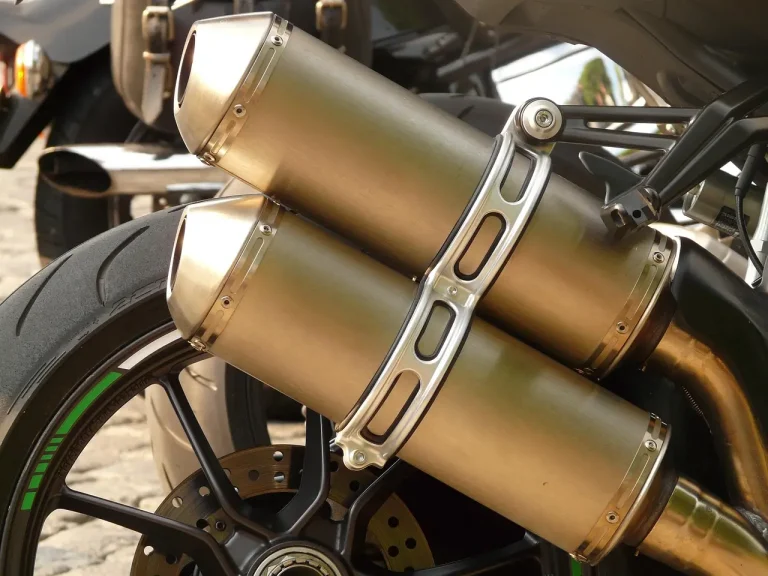
A chambered muffler uses internal chambers to split and redirect exhaust pulses, changing tone before the gases leave the tailpipe. It is common in performance exhaust systems because it can create a deeper or sharper sound without deleting the muffler. Legality usually comes down to noise level and required equipment, not the chambered design itself.
How internal chambers change exhaust tone
Inside the muffler, sound waves bounce through chambers and reflect off baffles or walls. That can cancel some frequencies while leaving others louder. The result is often a more aggressive note than stock, with less restriction than a fully packed muffler in some designs.
Where chambered mufflers fit in the exhaust system
The muffler typically sits downstream of the catalytic converter and, on many vehicles, after a resonator. That location matters because upstream parts shape the sound before it reaches the muffler. Remove too many pieces, and the system can get much louder even if the muffler is still there.
How they differ from straight-through and baffled mufflers
Chambered mufflers use chambers to alter pulse timing. Straight-through mufflers use a perforated core wrapped in packing, which usually flows more freely and is often louder than stock. Baffled mufflers use internal baffles to disrupt sound waves, and their tone can differ from both chambered and straight-through layouts.
Are chambered mufflers street legal?
Yes, often, but only when the full exhaust setup meets local noise rules and equipment rules. A chambered muffler may be legal in one city and more likely to draw a ticket in another. Loudness alone does not decide it, and a legal muffler can still fail if the vehicle is missing required parts or exceeds a decibel limit.
Why the same muffler can be legal in one place and illegal in another
State and city noise ordinances often set different limits, and some places enforce them with sound meters while others rely on officer judgment. Equipment laws can also require a muffler to be present and securely attached. That means the same chambered muffler may pass in one area and fail in a stricter one.
How noise limits and equipment rules work together
Sound legality asks, “Is it too loud?” Equipment legality asks, “Is the required hardware still there and working?” A setup can pass one check and fail the other. For example, a muffler may be present but too loud, or the exhaust may be quiet enough yet missing required equipment.
Why loud does not always mean illegal
Some legal systems allow aftermarket exhausts as long as they stay under the local limit and keep the required hardware. That is why brand name or style alone does not settle the issue. A chambered muffler, straight-through muffler, or even a Cherry Bomb style muffler may be legal if the setup stays within the rules.
Muffler legality checklist
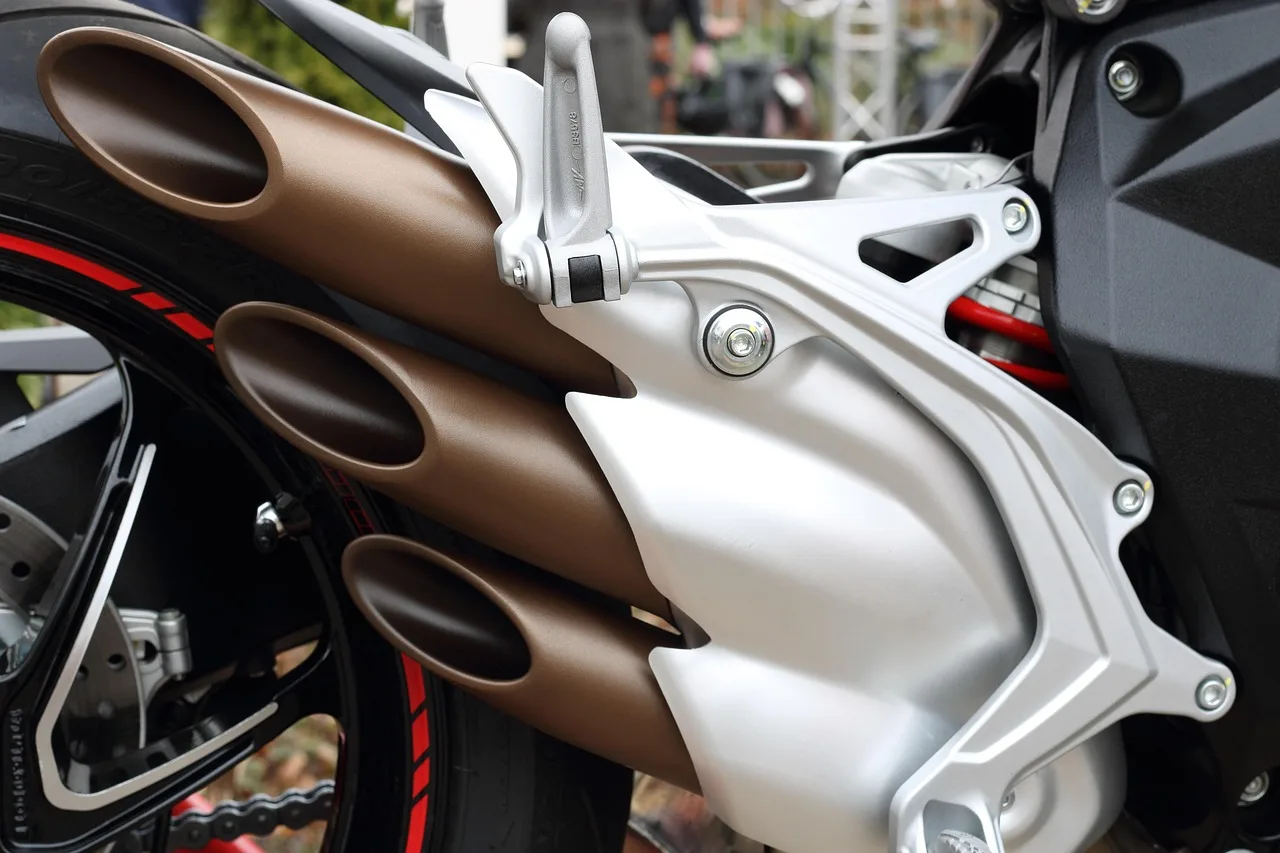
Use this decision framework to sort the setup before you buy parts. Start with the yes/no checks, then compare the likely rule type. A muffler can be present and still fail a sound test, while a delete can create both sound and equipment problems at once.
| Question | Yes path | No path | Rule type to look for | Likely legality risk | Recommended next step |
|---|---|---|---|---|---|
| Does your area use a fixed decibel cap? | Measure against the stated limit | Check for a general noise ban instead | Fixed dB cap | Moderate if the exhaust is aggressive | Confirm the final setup stays under the cap |
| Does the rule use “excessive” or “unusual” noise language? | Expect officer judgment or complaint-based enforcement | Look for a specific meter test or inspection standard | “Excessive/unusual noise” standard | Moderate to high if the exhaust is loud at idle or acceleration | Choose a calmer muffler and avoid extra deletions |
| Does the law require a muffler to be present? | Keep a functioning muffler installed | Focus on the sound limit and any inspection rules | Required muffler language | High if the muffler is removed or bypassed | Do not cut out the muffler if the rule requires one |
| Is the vehicle subject to inspection only? | Prepare for a visual check of the exhaust system | Roadside enforcement may still apply | Inspection-only states | Low to moderate if hardware is intact | Keep the system secure, complete, and leak-free |
| Could local rules override state-level tolerance? | Assume the stricter rule controls where you drive | State rules may be the main standard | Local ordinance override risk | Moderate to high in dense or noise-sensitive areas | Check city and county rules before choosing the muffler |
Check your local rule. Look for a specific decibel limit or a general ban on “excessive” or “unusual” exhaust noise. If the rule is written around sound, the muffler’s style matters less than the final output at the tailpipe.
Confirm inspection standards. Find out whether your area requires a visible muffler, secure mounting, or a functional exhaust path. A vehicle can still fail inspection even if it sounds acceptable.
Count every removed part. Note whether the resonator, catalytic converter, or factory muffler will stay in place. Removing more than one sound-control part often pushes the setup into higher-risk territory.
Match the muffler to use. Daily drivers usually benefit from a quieter chambered or turbo-style muffler. Track-focused cars can tolerate more sound, but public-road use still has to meet local rules.
Plan for enforcement. If the exhaust is likely to draw attention at idle, under acceleration, or during cold start, choose a calmer setup. Enforcement can be subjective, especially where officers can stop vehicles for obvious noise.
Which exhaust setups create the most risk?
The highest-risk setups remove both sound control and required equipment. Chambered mufflers usually carry less risk than a delete, but that does not make them automatic passes. Straight-through and Cherry Bomb style mufflers can also draw attention if the rest of the system is loud.
Chambered muffler vs straight-through muffler
A chambered muffler often gives a more aggressive tone shape, while a straight-through muffler usually flows more freely and may be louder than stock. Legality usually turns on the final sound level and the presence of required hardware, not on which of the two designs you chose.
Chambered muffler vs turbo muffler
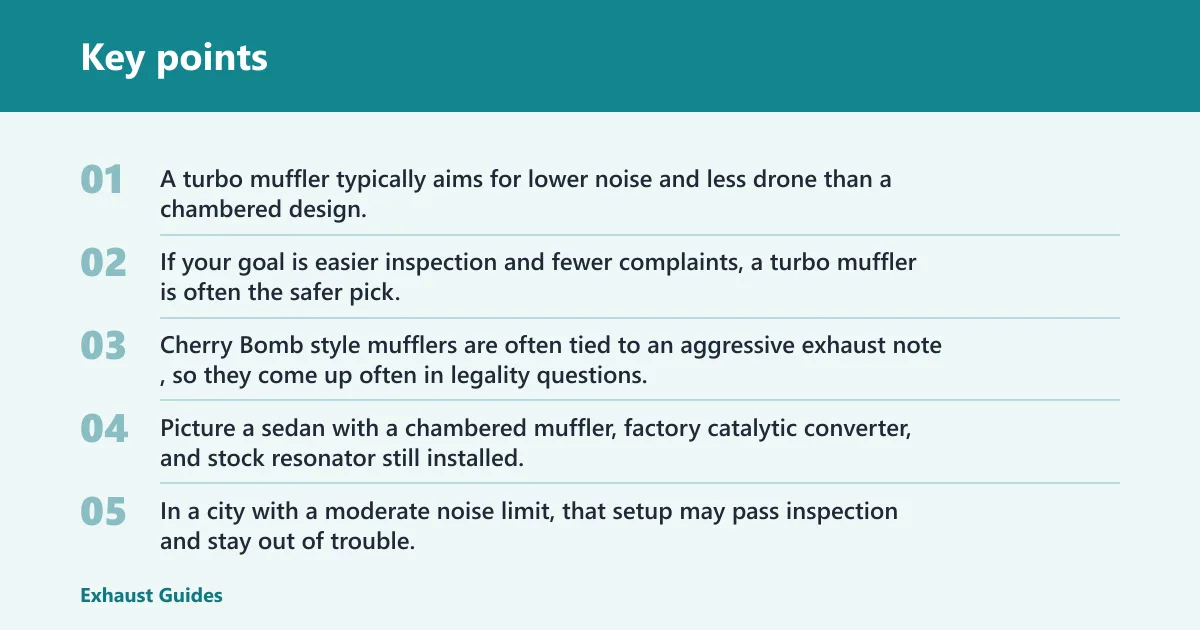
A turbo muffler typically aims for lower noise and less drone than a chambered design. If your goal is easier inspection and fewer complaints, a turbo muffler is often the safer pick. If your goal is a stronger performance tone, a chambered muffler may fit better, but you still need to stay within local limits.
Cherry Bomb style mufflers and common attention points
Cherry Bomb style mufflers are often tied to an aggressive exhaust note, so they come up often in legality questions. They are not automatically illegal. The risk rises when the rest of the system is stripped down, the tailpipe is very loud, or the vehicle is missing a resonator or other required equipment.
Picture a sedan with a chambered muffler, factory catalytic converter, and stock resonator still installed. In a city with a moderate noise limit, that setup may pass inspection and stay out of trouble. Change only one part to a muffler delete, and the same car becomes far more likely to fail on sound or equipment grounds.
Is a muffler delete legal?
A muffler delete is often the riskiest exhaust change because it removes the part many rules expect to see. It usually increases noise substantially, and that may be enough to violate local ordinances. Even where sound laws are vague, inspection rules may still require a functioning muffler.
What changes when the muffler is removed
Without the muffler, exhaust pulses exit with far less sound control. The car gets louder, drone often increases, and the setup may draw attention at idle or during acceleration. That does not always make it illegal everywhere, but it raises the odds of a citation or failed inspection.
Why a cut-off muffler often draws inspection or noise problems
Cutting off the muffler can look like a bypass or tampering issue during a visual inspection. It also leaves an obvious absence where required equipment used to be. If the state or city requires a muffler, the vehicle can fail even before anyone checks decibel levels.
How a delete compares with keeping an aftermarket muffler
Keeping an aftermarket muffler gives you a better legal position because there is still a sound-control device in place. A chambered, straight-through, or turbo muffler can still fail if it is too loud, but that is usually a narrower problem than having no muffler at all.
Suppose a hatchback passes a visual inspection with a chambered muffler installed, then fails roadside scrutiny after the owner swaps to a delete and removes the resonator too. The second setup is louder and leaves fewer parts to defend if an officer or inspector checks the exhaust.
Why loud mufflers can still pass
Loud mufflers can pass when the law allows aftermarket exhaust noise up to a certain limit and the vehicle still carries the required equipment. The key is the difference between a legal sound level and a legal hardware setup. Many failures happen when a build breaks both at once.
State and municipal noise ordinances
Noise ordinances may set a fixed decibel cap, ban excessive revving, or prohibit exhaust systems that create unnecessary sound. Some places measure at a set distance and engine speed; others do not. Because enforcement varies, the same setup can be treated differently across nearby jurisdictions.
Vehicle inspection standards and visual checks
Inspection stations may check that a muffler is installed, securely mounted, and not obviously bypassed. Some also check for leaks or unsafe routing. If the vehicle lacks a muffler or has a visibly cut system, the result can be a fail even if the exhaust sound is not extreme.
How resonator and catalytic converter changes affect the result
Removing the resonator can make a chambered or straight-through setup sound sharper and increase drone. Removing the catalytic converter changes the exhaust path further and may trigger inspection issues where emissions-related equipment is checked. Those changes can make a borderline exhaust much harder to defend.
Frequently asked questions
Baffled vs chambered muffler: what is the difference?
A chambered muffler routes exhaust through internal spaces that shape pulse timing and tone. A baffled muffler uses barriers to disrupt and redirect sound waves more directly. Both can be street legal if they meet local noise and equipment rules, but their sound character and drone levels can differ.
Chambered muffler vs straight through: which is legal?
Neither design is automatically legal or illegal. A chambered muffler and a straight-through muffler can both pass if the final sound level stays within local limits and the exhaust still meets equipment rules. The legal question is the finished system, not the internal layout alone.
Why are loud mufflers legal in some places?
Some places allow loud but still compliant exhausts because the law uses a decibel limit or a general noise standard, not a ban on performance parts. If the muffler is present and the vehicle stays under the local threshold, the setup may pass even if it sounds aggressive.
Is cutting off your muffler illegal?
Often yes, because cutting off the muffler can violate equipment rules and make the exhaust too loud for local standards. Even where the law is less specific, the missing hardware can fail inspection or attract enforcement. If the area requires a muffler, removal is usually the clearest path to trouble.
Is it illegal to have no muffler?
In many places, yes, or at least risky enough to fail inspection. A missing muffler can violate equipment rules even before noise is measured. The exact answer depends on your state or city, but a no-muffler setup is usually much harder to defend than an aftermarket muffler.