How to Choose an Exhaust for Towing and Hauling
Choose an exhaust for towing and hauling by putting exhaust-brake compatibility, heat control, and factory-like backpressure first. For many diesel tow rigs, a 4-inch exhaust system is a common practical default; gas trucks often do best staying near stock diameter unless the calibration is set up for more flow. Wrong choices can raise exhaust gas temperature, weaken engine braking, and hurt low-rpm pulling with a trailer attached.
Choose the right exhaust for towing


Towing means pulling a trailer. Hauling means carrying cargo in the truck itself. They strain the vehicle in different ways, so exhaust choice should follow the job, the engine, and the drivetrain rather than sound alone.
Start with the vehicle’s exact configuration. Tow rating changes with engine, transmission, axle gearing, and package content, and heavier trims and options can reduce payload. Check the owner’s manual and the rating labels on the door jamb before you compare exhaust setups.
Stock exhaust vs mild aftermarket
Stock exhaust is often the safest baseline for gas trucks and for light-duty towing where noise is the main reason to change parts. A mild aftermarket system can make sense when it preserves normal backpressure behavior, fits emissions equipment, and does not create drone under load.
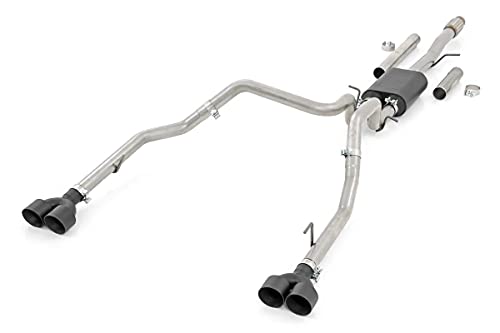
For towing, louder is not better. A loud cat-back can change cabin noise more than it changes hill-climbing or braking control. On diesel trucks, the better question is whether the system keeps or improves exhaust-braking function and leaves enough support for controlled downhill speed.
Diesel tow rigs vs gasoline trucks
Diesel tow rigs get more benefit from exhaust-brake planning because turbocharged diesels often support engine-braking features. Many modern diesels also come with factory-equipped exhaust brakes. Gasoline trucks usually do not gain the same braking benefit from exhaust changes, so the main goal is fit, tone, and keeping the factory behavior intact.
Exhaust brakes are installed at or near the turbo outlet on diesel applications. A simple unit uses a butterfly valve inside a tubular housing to increase exhaust backpressure on demand. That backpressure helps slow the vehicle on descents and can cut brake wear and overheating.
What sound level means for towing use
Sound level is a comfort choice, not a towing metric. A deeper tone does not mean more control on a grade, and an open exhaust does not replace trailer brakes or stronger service brakes. For towing, choose sound as a secondary filter after fitment and braking behavior.
Suppose a half-ton gas truck only tows a small camper a few weekends a year. A stock-style exhaust with no extra drone is usually the better choice than a louder system that adds cabin noise but no real control benefit.
Tow/Haul mode and exhaust braking
Tow/Haul mode is a factory tow setting on many trucks that changes transmission behavior during towing. It is useful, but it is not a substitute for physical braking hardware. Exhaust braking works alongside Tow/Haul by adding more deceleration when you need it.
What Tow/Haul mode changes
Tow/Haul mode commonly holds gears longer, downshifts sooner on descents, and can reduce hunting between gears. That helps the transmission stay in a better range under load, but it does not add much braking force by itself. Think of it as drivetrain control, not a brake upgrade.
Trailer brake controllers matter here too. A trailer brake controller works with truck braking rather than exhaust flow, and some tow packages can still miss it. Tow/Haul mode, trailer brakes, and the truck’s service brakes all do different jobs.
How exhaust braking works
An exhaust brake increases exhaust backpressure on demand to help slow the vehicle. On a turbo diesel, it is often placed behind the turbine outlet, so it can work with the turbo and the engine’s exhaust stream. Many systems are controlled electronically, and some use variable vane control rather than a simple butterfly valve.
The useful part is controlled resistance, not constant restriction. Higher backpressure helps only in a braking event. Outside that moment, too much restriction can hurt drivability and low-rpm response.
Why drivetrain setup matters
Engine, transmission, axle ratio, and package content all affect how an exhaust change behaves under load. A truck with the right gears and a well-matched tow package can use Tow/Haul and engine braking more effectively than a mismatched build with the same engine.
GCWR matters more than trim badges. Tow rating tells you what the truck can pull, but GCWR tells you how the truck and trailer work together as a combined system. Payload tells you how much cargo the truck can carry before it is overloaded.
Do you need an exhaust brake?
You need an exhaust brake when downhill control, brake wear, and repeated descents matter more than sound or peak power. It is most useful on diesel tow vehicles, especially when the trailer is heavy enough that service brakes would otherwise do too much work on long grades.
When downhill control matters most
Choose an exhaust brake if you tow in mountains, descend long grades, or haul enough weight that brake fade is a real concern. Exhaust brakes help control speed downhill, reduce truck and trailer brake wear, and help prevent brakes from overheating.
- Match the route first. If your towing includes steep descents, treat downhill control as the main requirement. Flat terrain and short trips rarely justify the same braking hardware.
- Check the brake system. Make sure the truck has the right service brakes and a trailer brake controller. Exhaust braking supports them; it does not replace them.
- Confirm fitment points. Look for a system that fits behind the turbo outlet on a diesel and matches the exhaust layout. A poor fit can reduce braking effect or create leaks.
A common first-timer mistake is buying a louder muffler for a mountain tow rig and expecting better grade control. The truck may sound stronger, but the downhill speed still depends on braking hardware and drivetrain setup.
Factory VGT systems on diesel trucks
Modern diesel engines often use turbocharger-based braking support. A variable geometry turbo can help provide factory engine braking, and that is one reason diesel tow rigs often respond better to exhaust-brake planning than gasoline trucks.
Still, factory support is not always the same as a dedicated exhaust brake. If the truck already has strong built-in braking behavior, a separate brake may be a good upgrade only for heavier trailers or steeper routes.
Aftermarket exhaust brake fitment
Aftermarket exhaust brakes must match the engine, turbo layout, emissions gear, and transmission calibration. Exhaust leaks can reduce effectiveness because the system cannot build the backpressure it needs. If the truck already has a factory exhaust brake, confirm whether the aftermarket part adds anything useful before buying.
For gas trucks, an exhaust brake is usually not the right target. Focus on the service brakes, trailer brake controller, cooling system, and a quiet, well-fitting exhaust instead.
Will a louder exhaust help towing?
No. Loudness does not equal towing performance. A louder exhaust may change tone, but towing success depends on load control, drivetrain fit, and braking support. For heavy use, a system that manages restriction correctly is more useful than one that only sounds more aggressive.
Sound level vs towing performance
Sound can make a truck feel more active, but it does not automatically improve torque delivery or grade control. Tow-focused exhaust choice is about whether the system supports the engine’s normal breathing and, on diesel trucks, whether it supports engine braking when needed.
Restriction, flow, and normal driving
Backpressure is a key exhaust-force attribute for engine braking, but it must be balanced against normal performance. More restriction can help only in a controlled braking context. Outside that context, too much restriction can hurt drivability, response, and low-rpm pulling.
That is why not all exhaust modifications improve towing. A less restrictive system may sound better and flow more freely, yet still be a weaker choice if it blunts engine braking or adds drone on long hauls.
When less restriction can backfire
Less restriction can backfire when the system removes useful control with no real towing gain. If the truck is a diesel that depends on exhaust braking, an overly open setup can work against the very speed-control behavior you want on descents. Gas trucks see less braking benefit either way, so the tradeoff leans toward quiet, correct fitment.
Picture a diesel pickup pulling a travel trailer on a long grade. If the exhaust has a leak near the turbo outlet, the brake may feel weaker because the system cannot build the intended backpressure. The fix is not more noise; it is sealing the leak and keeping the system matched to the truck.
Towing exhaust decision matrix
This matrix separates towing use by load, terrain, engine type, and braking need. Use it to rule out the wrong setup before you shop for tone or brand styling.
| Load weight | Terrain | Engine type | Desired sound level | Need for engine braking | Recommended setup | Red flag |
|---|---|---|---|---|---|---|
| Light towing, under typical half-ton limits | Mostly flat roads | Gasoline or diesel | Quiet to mild | Low | Stock | Open exhaust chosen for sound alone |
| Moderate towing, frequent weekend use | Mixed roads with short grades | Gasoline | Quiet to moderate | Low to moderate | Mild aftermarket | Large-diameter system that adds drone without braking gain |
| Heavy towing on long grades | Mountain routes | Diesel | Quiet to moderate | High | Exhaust brake | Leak-prone install, missing turbo-side fit, or no trailer brake controller |
| Commercial hauling and repeated descents | Steep terrain | Diesel | Quiet | High | Turbo-back on diesel only | Overly restrictive muffler or mismatched emissions fitment |
Light towing and daily driving
For light towing, stock is usually enough. If you want a small tone change, stay close to factory behavior and avoid a setup that increases cabin noise without giving you better control under load. Keep the trailer brake controller, tires, and suspension in good shape first.
Mountain towing and frequent descents
For mountain towing, prioritize an exhaust brake on a diesel truck. That is where brake wear, overheating, and downhill speed control matter most. Tow/Haul mode helps the transmission, but the exhaust brake does the extra slowing work.
Heavy hauling and commercial use
For heavy hauling, think in terms of total weight, repeated heat, and long duty cycles. GCWR, payload, tow rating, and axle ratio all matter here. A diesel with proper braking support and a well-matched exhaust is usually a better fit than a louder system that only changes sound.
How do ratings affect exhaust choice?
GVWR, payload, GCWR, and tow rating tell you what the truck can handle before exhaust choice even enters the picture. Use them to judge whether the truck is rated for the job, then decide whether you need a stock system, a mild aftermarket setup, or an exhaust brake for control.
GVWR and payload
GVWR is the truck’s gross vehicle weight rating. Payload is calculated from GVWR and curb weight, and it tells you how much cargo the truck can carry. Heavy trims and options can reduce payload, so a better-looking trim can carry less than a simpler one.
The 2020 Jeep Gladiator Sport illustrates the point. The Sport with manual transmission is rated at 4,000 pounds of towing, while the automatic is rated at 4,500 pounds. The Sport trim can haul up to 1,700 pounds of cargo, and the automatic Max Tow version is rated at 1,535 pounds of payload.
GCWR and tow rating
GCWR is the gross combined weight rating. It shows how the truck and trailer work together, which makes it more useful than trim labels alone. Tow rating can change by transmission and axle gearing, and the Gladiator Max Tow package with automatic transmission is rated to tow 7,650 pounds. (Motortrend)
The highest Gladiator tow rating requires the Max Tow package with 4.10:1 axle gears. That is a clear reminder that drivetrain hardware changes towing capacity as much as the exhaust does.
Trim, axle ratio, and package differences
Trim, axle ratio, and package content can change what makes sense for an exhaust setup. A truck that is already near its payload or tow limit should not be treated like a light-duty daily driver. For those trucks, correct fitment and braking support matter more than a louder tone or a freer-flowing muffler.
Ratings should also be checked in the exact configuration you plan to tow with. Automatic and manual transmissions often carry different tow numbers, and package content can change both tow rating and payload.
Frequently asked questions
What is an exhaust?
An exhaust is the system that carries spent gases away from the engine. For towing, the important part is how that system affects backpressure, heat, and, on diesel trucks, braking behavior. A louder system is not automatically better for load control or durability.
What is tow haul on a truck?
Tow/Haul is a factory tow setting that changes transmission behavior when you are pulling a trailer. It helps the truck stay in a better gear and reduces shifting hunting on grades, but it is not a brake upgrade. Use it with service brakes, trailer brakes, and, on diesel trucks, an exhaust brake if needed.
How do I choose an exhaust for towing and hauling?
Choose by engine type, weight, terrain, and braking need. Gas trucks usually do best close to stock, while diesel tow rigs may benefit from exhaust-brake compatibility and a setup that preserves controlled backpressure. Match the system to the exact truck configuration, not to a generic trim label.
Do I need an exhaust brake for towing downhill?
You need one if long descents, heavy trailers, or brake heat are part of your route. Exhaust brakes help control speed downhill, reduce brake wear, and help prevent overheating. They matter most on diesel trucks, especially where Tow/Haul alone does not provide enough deceleration.
Will a louder exhaust help towing performance?
No. Louder exhaust changes sound, not tow rating or braking force. If the goal is better control, focus on exhaust-brake compatibility, fitment, and proper drivetrain setup. A noisy system can even be a step backward if it creates drone or weakens the truck’s intended braking behavior.
How do trim, payload, and towing ratings affect exhaust choice?
They tell you how hard the truck will work. Higher trims and extra equipment can reduce payload, while tow rating changes with transmission, axle ratio, and package content. If the truck is near its limits, keep the exhaust choice conservative and put the emphasis on braking support and heat control.