
Exhaust Smell Only When Heater Is on
If exhaust smell shows only with the heater or defroster on, your HVAC is likely pulling in outside fumes from an exhaust, fuel, oil, or coolant leak; if the odor is strong or gives you a headache, pull over and shut the car off. Ignoring it can mean carbon monoxide exposure or a bigger repair. This guide helps you separate true exhaust gas from other odors and decide what to check first.
What the smell pattern means


The first clue is when the odor shows up. A smell that appears only with heat or defrost often means the cabin air system is pulling in air from near the windshield cowl, then carrying a leak smell into the cabin. A smell that is present all the time points more toward an under-hood leak or a cabin-system leak.
Smell only with heat vs all the time
If the odor starts when you switch the fan on, look first at the intake path and the source of outside air near the cowl. If the smell stays even with the fan off, a cabin leak, a fuel leak, or an oil leak near hot parts is more likely. That split matters more than the word “exhaust.”
Raw exhaust, fuel, oil, or coolant odor
Raw exhaust usually smells sharp, stinging, and dirty. Fuel odor smells like gasoline or solvent. Oil often smells burnt or oily and can drift toward a hot-metal note. Coolant or heater-core odor often reads as sweet, hot-plastic, or syrup-like. Those odor words point to different sources and different next checks.
Idle, acceleration, and fan-speed clues
Odor that gets worse at idle often points toward an exhaust manifold or gasket leak, because engine movement and lower exhaust flow can change the leak pattern. Odor that rises with higher fan speed points toward the HVAC intake path moving more outside air. Odor that changes under acceleration may fit fuel, exhaust, or PCV-related issues.
Picture a sedan that smells fine while parked with the fan off, then smells like exhaust on the first blower setting and gets worse on defrost. That pattern fits outside air entering through the cowl more than a cabin heater leak. A different pattern, like smell in the cabin with the fan off, shifts the search under the hood or inside the HVAC box.
Why the heater makes it more noticeable
The heater usually does not create an exhaust smell. It often exposes a leak that was already there by pulling in outside air, moving more air across a leak source, or making an odor easier to notice. The fresh-air vent is usually at the base of the windshield above the engine bay, so fumes can enter from nearby leaks. The blower motor can act like a vacuum and draw outside air into the cabin.
Cabin air intake cowl and outside air pickup
The cabin air intake cowl sits at the base of the windshield and can draw outside air from near the engine bay. If an exhaust, fuel, or oil leak sits near that path, the cabin can smell it when the fan runs. Trucks and some layouts can pull air from slightly different cowl paths, so the exact entry route can vary.
Blower motor and why odor rises with fan speed
The blower motor moves outside air into the cabin, so a stronger fan can make odors more noticeable and can seem to pull fumes in. That is why the smell may be faint on low and obvious on high. In some cases, the fan acts like a vacuum against a leak source near the cowl or firewall.
Fresh air versus recirculation
Fresh-air mode pulls in outside air. Recirculation reuses cabin air and may reduce the smell if the source is outside the car. If the odor changes a lot when you switch modes, the outside-air path is part of the problem. If recirculation does little or nothing, the source may already be inside the cabin or HVAC box.
What source is most likely?
Use the smell type, fan setting, and warning signs to narrow the source branch. Raw exhaust points first to an upstream exhaust leak, often at the manifold or gasket before the catalytic converter. Fuel odor points toward fuel lines, injector O-rings, EVAP parts, or a fuel pressure regulator. Sweet or hot-plastic odor points toward coolant or heater-core problems, while oily odor often points toward PCV or valve cover issues.
Exhaust manifold or gasket leak
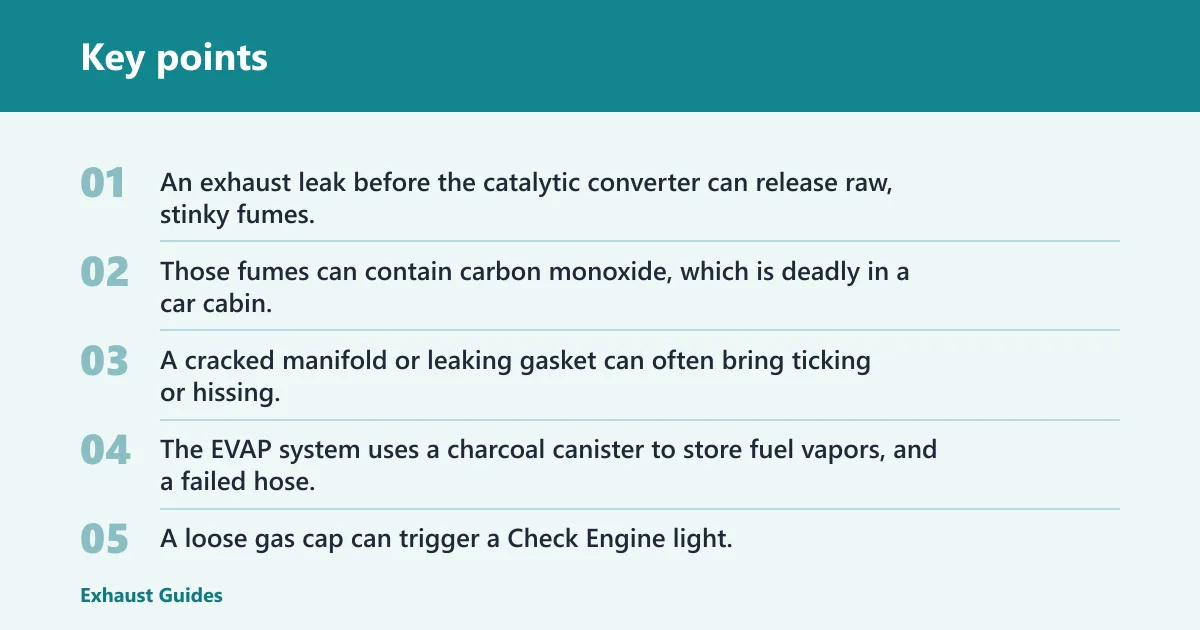
An exhaust leak before the catalytic converter can release raw, stinky fumes. Those fumes can contain carbon monoxide, which is deadly in a car cabin. A cracked manifold or leaking gasket can often bring ticking or hissing, and the odor is often stronger at idle or just after a cold start.
EVAP leak, fuel lines, injector O-rings, or fuel pressure regulator
The EVAP system uses a charcoal canister to store fuel vapors, and a failed hose, canister, or valve can leak vapor into the area around the car. A loose gas cap can trigger a Check Engine light. Fuel injector O-rings can crack and harden with age, and a leaking fuel injector O-ring can create a serious fire hazard.
Fuel lines can crack, rust, or leak pinholes, sending flammable mist or vapor into the engine bay. A bad fuel pressure regulator can leak through its diaphragm and can cause black smoke from the exhaust. Those clues separate fuel issues from exhaust leaks: fuel smell is sharp and raw, often with wet spots or a warning light, while exhaust smell is more sooty and hot.
PCV oil vapor or heater core odor
The PCV system can route oil vapor into the intake, and that can create an oily smell that seems worse with heat or defrost. A heater core leak is a different branch. The heater core is a small radiator that uses engine coolant, and a leaky heater core can cause a smell described as burning rubber or plastic.
Heater-core leaks often leave damp carpet, fogged windows, or a coolant loss clue. A clogged cabin air filter is another proposed cause of heater odors, but it usually does not make a true exhaust smell. A leaking valve cover gasket can also cause smoke coming in from the vents, which can confuse the diagnosis if you only chase the word “exhaust.”
Suppose your SUV smells like fuel only when the defroster is on and the hood open shows a wet stain near an injector rail. That pattern fits a fuel leak branch better than an exhaust leak. If the smell changes to sweet and the passenger-side carpet is damp, the heater-core branch moves up the list.
Heat smell decision matrix
Use this table as a quick triage tool. Start with the odor type, then match fan setting, speed state, and any smoke or warning-light clues. The most likely source is not a final diagnosis, but it gives you the next check to make first.
| Smell type | Fan setting | Speed state | Smoke or warning-light clues | Most likely source | Next check |
|---|---|---|---|---|---|
| Raw exhaust, sooty, stinging | Any, worse on fresh air | Worse at idle | Ticking, hissing, possible headache | Exhaust manifold or gasket leak before the catalytic converter | Check manifold area, gasket line, and nearby soot |
| Gasoline, solvent, sharp fuel | Any, often worse on higher fan | Idle or acceleration | Fuel smell outside too, possible Check Engine light | Fuel lines, injector O-rings, EVAP leak, or fuel pressure regulator | Look for wet spots, cracked hoses, or canister/valve issues |
| Sweet, syrupy, hot-plastic | Any | Any | Windshield fogging, damp carpet, coolant loss | Heater core leak | Check carpet, coolant level, and passenger-side HVAC case area |
| Burnt oil or oily haze | Any, often with defrost | More at idle or after warming up | Smoke from engine bay, possible valve-cover seepage | PCV oil vapor or valve cover gasket leak | Check for oily residue around valve cover, PCV hoses, and exhaust heat sources |
| Burning rubber or plastic | Any | Any | Smoke near belt path or under hood | Worn serpentine belt, heater core leak, or another hot-surface contact | Inspect belt, pulleys, and fluid drips on hot parts |
What should you check in five minutes?
Start with the easiest clues first: smell location, fan setting, and outside-air mode. Then look for smoke, drips, soot, fogging, or a warning light. This short sequence can separate an outside-air intake issue from a leak that needs a tow. If the smell is strong, do not sit parked with the fan on while you investigate.
- Switch between fresh air and recirculation and note whether the smell changes.
- Turn the fan from low to high and note whether the odor gets stronger.
- Check whether the smell appears at idle, only while driving, or mainly under acceleration.
- Look at the dash for a Check Engine light or any overheating warning.
- Open the hood and look for wet fuel, coolant, or oil around the engine bay.
- Check for soot, ticking, or hissing near the exhaust manifold area.
- Inspect the cabin air filter and cowl area for debris, leaves, or obvious leaks.
- Look inside the cabin for damp carpet, fogged glass, or a sweet coolant odor.
A common mistake is to assume the heater core is leaking and overlook a cracked exhaust manifold that only sends fumes into the cabin when the fan is on. If the smell is strongest with the blower on and the odor changes with fan speed, that points back to the outside-air intake path. If the smell is strongest with the hood open and the car idling, the leak is more likely in the engine bay.
When should you stop driving?
Stop driving if the exhaust smell is strong, gives you a headache, or comes with visible smoke, fuel drips, black smoke, rough running, stalling, or a lit Check Engine lamp. Those signs move the problem from nuisance to safety risk. Carbon monoxide exposure and fire risk are the main reasons not to keep driving and “see if it clears.”
Strong exhaust smell or headache symptoms
If the cabin fills with raw exhaust or you start to feel headache, nausea, or dizziness, pull over and shut the car off. Those symptoms are consistent with carbon monoxide risk from an upstream exhaust leak. A smell that grows stronger at idle or in traffic is especially concerning because the cabin can keep drawing in the fumes.
Fuel smell, visible smoke, or black smoke
A fuel smell with visible smoke, wet fuel, or black smoke is a stop-driving condition. A cracked fuel line can spray a fine, super-flammable mist over the engine bay. A bad fuel pressure regulator can cause black smoke from the exhaust. A leaking injector O-ring can create a serious fire hazard, so do not keep the engine running to “test it again.”
Rough running, stalling, or a lit check engine lamp
Rough running, stalling, or a Check Engine lamp changes the odds. An EVAP leak may only mean vapor loss, but rough running plus fuel odor suggests a more active fault. If the car is bucking, misfiring, or stalling while you smell fumes, stop driving and arrange a repair check before the problem spreads to other parts.
Could it be the heater core or another non-exhaust smell?
Yes. A heater-core leak can smell like hot plastic, rubber, or sweet coolant, and it often leaves wet carpet or windshield fogging. Oil and belt smells also travel through the vents and can be mistaken for exhaust. The fastest split is this: exhaust smell tends to be sooty and sharp; coolant is sweet; oil is burnt; belt smell is rubbery.
Sweet coolant odor and damp carpet
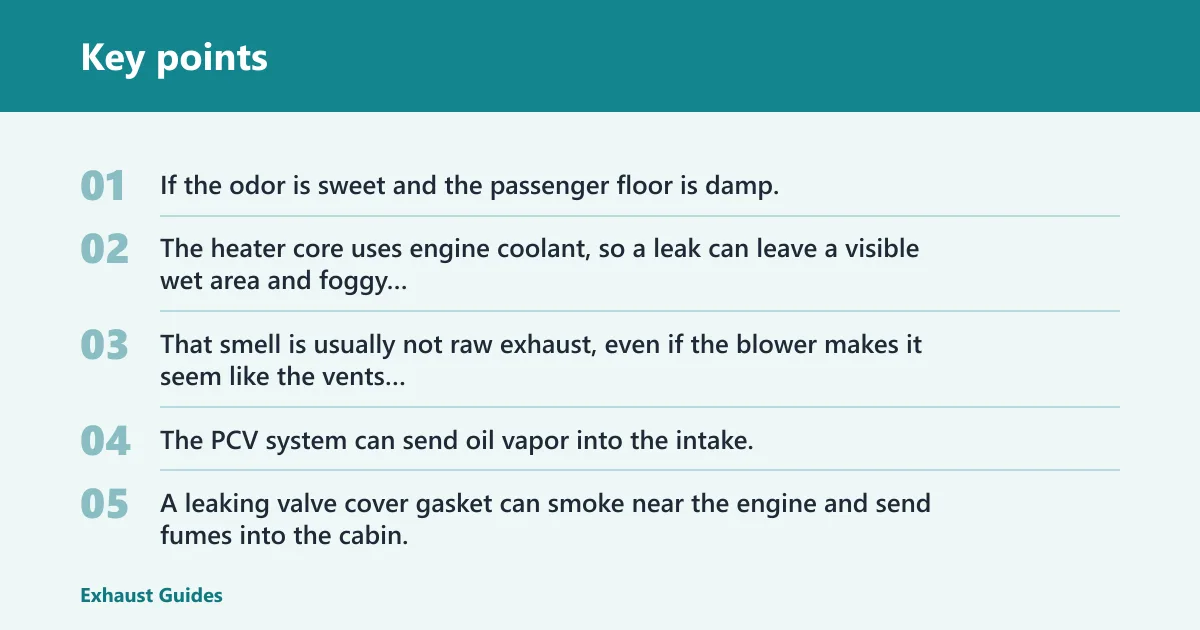
If the odor is sweet and the passenger floor is damp, look hard at the heater core and related hoses. The heater core uses engine coolant, so a leak can leave a visible wet area and foggy windows. That smell is usually not raw exhaust, even if the blower makes it seem like the vents are the source.
Oil, plastic, or rubber smells
The PCV system can send oil vapor into the intake, and that odor can seem worse when the heater or defroster is on. A leaking valve cover gasket can smoke near the engine and send fumes into the cabin. A worn serpentine belt can create a burning rubber smell, and a drive belt can also transfer power to the engine cooling fan and AC, so belt problems can overlap with HVAC use.
How to separate cabin-system odors from exhaust
Exhaust smell usually tracks engine operation and fresh-air intake, and it often gets worse at idle if the leak is upstream of the catalytic converter. Cabin-system odors often come with wet carpet, fogging, or coolant loss. If the smell is only present with heat or defrost and changes a lot with fan speed, the cabin intake path deserves attention first.
Frequently asked questions
Why does my heat smell when I turn it?
Heat can smell when you turn it on because the blower motor moves outside air into the cabin and can pull fumes from the cowl area near the windshield. If the odor is raw exhaust, fuel, oil, or coolant, the heater is usually exposing an existing leak rather than causing one.
Why does my car smell like exhaust when the heater?
If your car smells like exhaust when the heater is on, the most likely path is outside air entering through the cabin air intake cowl and carrying fumes in from near the engine bay. A pre-catalytic exhaust leak, especially at the manifold or gasket, is a common source to check first.
Why does my car smell like exhaust in the vents when the heat?
Exhaust in the vents with heat on usually means the HVAC intake is pulling air from a leak source near the firewall, cowl, or engine bay. If the smell is strongest at idle and sounds like ticking or hissing, an exhaust manifold or gasket leak before the catalytic converter moves higher on the list.
Is it safe to drive if I smell exhaust when the heater?
It is not safe to keep driving if the exhaust smell is strong, gives you a headache, or comes with smoke, rough running, fuel drips, or a warning light. Those signs point to carbon monoxide risk, fire risk, or both. If the smell is mild and temporary, still inspect it before long trips.
Could a heater core cause an exhaust smell in the car?
A heater core usually does not create a true exhaust smell. It more often causes a sweet, hot-plastic, or rubber-like odor, plus damp carpet or windshield fogging. If you smell exhaust with no coolant clues, look first at exhaust leaks, fuel leaks, or the cowl intake path.
Why does the smell get worse at idle when the heater?
Odor that gets worse at idle often points to an exhaust manifold or gasket leak before the catalytic converter, because the leak can be more noticeable when airflow and engine load change. Idle also lets the blower keep drawing outside air through the cowl, which can carry the smell into the cabin more clearly.
How do I tell exhaust fumes from coolant or oil smell?
Exhaust fumes smell sharp, sooty, and stinging. Coolant usually smells sweet and may come with fogged glass or damp carpet. Oil smells burnt or oily and often appears with hot engine parts or valve cover seepage. The source clues matter more than the word “smell,” because each branch points to a different repair path.
What should I check first if my car smells like fumes when I turn on the heater?
Check the fan setting, fresh-air versus recirculation, and whether the smell changes at idle. Then inspect the cowl area, cabin air filter, and engine bay for soot, wet fuel, coolant, or oil. If the odor is strong or the dash shows a warning light, stop driving and inspect the car off the road.
Can the HVAC system pull exhaust into the cabin?
Yes. The fresh-air vent is usually at the base of the windshield above the engine bay, and the blower motor can act like a vacuum and draw air from outside into the cabin. If an exhaust leak sits near that path, the HVAC system can bring the odor inside very quickly.
Why does my truck smell like exhaust when the heater?
Truck layouts can place the intake path, firewall routing, turbo plumbing, and exhaust route in ways that make fumes easier to pull into the cabin. If the smell is raw and stronger at idle, think exhaust manifold or gasket. If it changes mainly with fan speed, inspect the cowl and intake path first.