Cat Back Exhaust vs Muffler
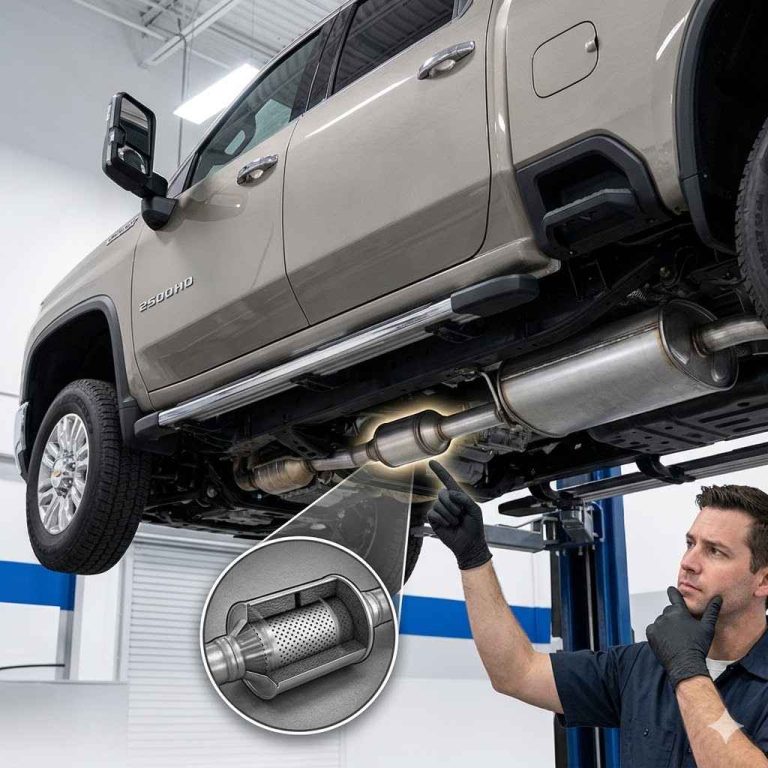
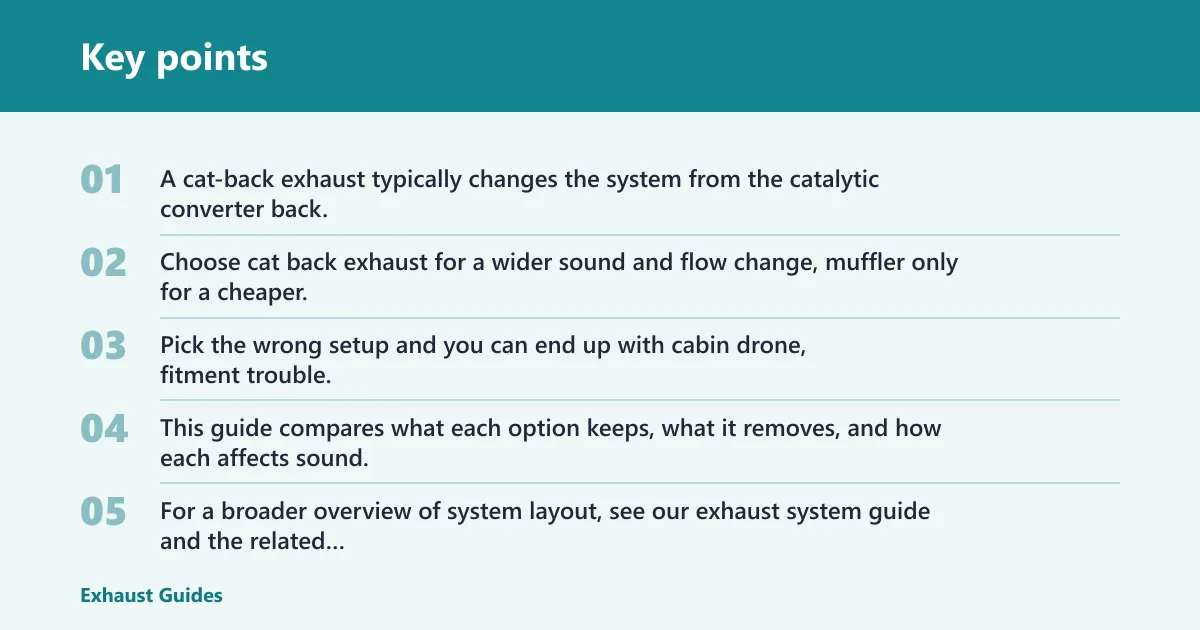
A cat-back exhaust typically changes the system from the catalytic converter back, while a muffler change only swaps the rear silencer. Choose cat back exhaust for a wider sound and flow change, muffler only for a cheaper, smaller adjustment. Pick the wrong setup and you can end up with cabin drone, fitment trouble, or a modification that fails local noise rules. This guide compares what each option keeps, what it removes, and how each affects sound, legality, and daily driving. For a broader overview of system layout, see our exhaust system guide and the related resonator explanation.
Comparison by cost, sound, fitment and performance
| Factor | cat back exhaust | muffler | Winner |
|---|---|---|---|
| Change scope | Starts at the catalytic converter and runs back to the tips, replacing more of the rear exhaust system. | Only swaps the rear silencer area and affects less of the system. | cat back exhaust |
| Sound change | Gives a broader sound change, often fuller and more controlled. | Can be a small to moderate tone change with a stock muffler swap, or louder/rawer with a delete. | cat back exhaust |
| Drone risk | Low to moderate, depending on resonator and engine type. | Low to moderate for a stock muffler swap, but moderate to high for a muffler delete. | Tie |
| Install complexity | Moderate, because it replaces more of the rear system and takes longer to line up. | Low, because it uses fewer parts and less labor. | muffler |
| Budget / cost | A larger investment because it replaces more of the rear system and is usually built for a specific vehicle. | Cheaper and simpler, especially for a straight muffler swap or delete. | muffler |
| Performance potential | The better performance bet; can improve exhaust flow and reduce backpressure, though gains are usually modest. | The article does not describe a performance gain beyond sound changes. | cat back exhaust |
| Daily-driving comfort | Has the edge for commuting because it gives more control over drone, especially with a resonator. | A muffler delete can be sharp, boomy, or tiring at highway speed. | cat back exhaust |
| Fitment / vehicle specificity | Usually built for a specific chassis; pipe routing, hanger locations, and tip clearance matter. | A muffler swap or delete is a narrower rear-section change. | muffler |
| Best-fit use | Best for drivers who want the biggest rear-system change without touching emissions equipment, or want a broader system change and more room for tone control. | Best for drivers who want a mild tone change, the cheapest loudness increase, or a quick and simple rear-only change. | Tie |
| Legality / emissions hardware | Keeps the catalytic converter and emissions hardware in place. | A muffler change does not affect emissions hardware directly, but a delete can fail local noise rules. | cat back exhaust |
| Lifespan | Not discussed in the article. | Not discussed in the article. | Tie |
| Maintenance | Not discussed as maintenance, though the article notes more sections and hangers must line up during installation. | Not discussed as maintenance, though the change is simpler and uses fewer parts. | Tie |
Change scope
Cat back exhaust wins this category because it starts at the catalytic converter, the front boundary for this kind of upgrade, and runs back to the tips. A muffler change only touches the rear silencer area, so it affects less of the system and leaves more of the factory layout in place.
Sound control
Cat back exhaust usually gives you more room to shape tone because it may include the mid-pipe, resonator, muffler, and tips. A muffler change can be quiet if you keep the stock muffler, but a delete often makes the car louder without making the note cleaner.
Budget and install effort
Muffler changes win on price and simplicity. A straight muffler swap or delete uses fewer parts and less labor, while a cat back exhaust is a larger investment because it replaces more of the rear system and is usually built for a specific vehicle.
Daily-driving comfort
Cat back exhaust has the edge for commuting because it gives you more control over drone, especially when the kit includes a resonator. A muffler delete can sound sharp, boomy, or tiring at highway speed, which matters more than loudness once the trip gets long.
Performance potential
Cat back exhaust is the better performance bet, but the gain is usually modest and depends on the car. The main advantage is that it can improve exhaust flow and reduce backpressure; that said, backpressure gets oversimplified a lot, and a louder system is not automatically a faster one.
Cat-back vs muffler: the core trade-off
The real choice is layout, not volume. A cat back exhaust starts at the catalytic converter and replaces more of the system behind it, while a muffler change stays in the rear section and changes only one part of the noise path. That difference shapes sound, fitment, and how much of the factory system stays untouched. For vehicle-specific upgrade examples, see our vehicle-specific exhaust modification guide.
What each change starts
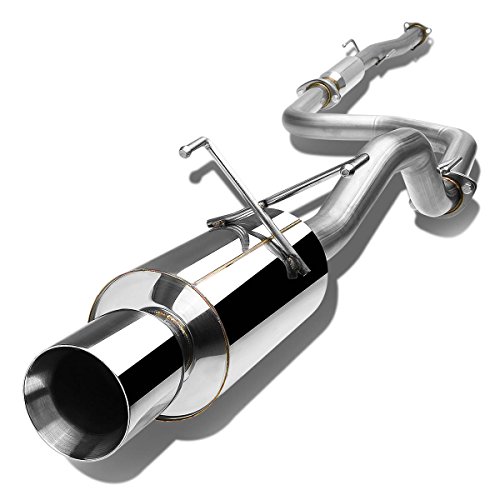
The catalytic converter is the front reference point for a cat back exhaust. From there, the system can include the mid-pipe, resonator, muffler, and tips, depending on the vehicle and kit.
A muffler is usually mounted in the rear section and its job is to reduce exhaust noise. Remove it and you have a muffler delete, which is often one of the cheapest loudness-focused changes but can also sound unfinished on some cars.
What each change keeps in place
A cat back exhaust keeps the catalytic converter and everything ahead of it. That means emissions hardware stays put, while the rear system changes enough to alter tone and flow.
A muffler-based change keeps more of the stock system. A muffler swap still leaves the rest of the exhaust alone, while a muffler delete leaves an empty gap where the silencing hardware used to be.
Why the starting point changes the result
Where the change begins matters because exhaust sound is shaped by the whole path, not one canister at the back. A rear-only change can be enough on some V8 cars, but on many four-cylinder and turbo cars it can leave you with a louder note that is also raspier or dronier.
Say your car already has a factory resonator and a valve in the rear section. A muffler delete may still leave the car quieter than a full cat back at wide-open throttle, yet it can be less refined at cruise because the remaining factory parts were not built to carry that acoustic load alone.
Cat-back vs muffler-based change by goal and setup
This table helps separate the common choices by start point, what stays in place, and how each one tends to behave on the road. The drone column matters most for daily use. The install column matters most if you want the car back on the road quickly.
| Setup | Starting point on the exhaust | Parts kept | Expected sound change | Drone risk | Install complexity | Who should choose it |
|---|---|---|---|---|---|---|
| stock muffler swap | Rear muffler area | Everything except the muffler itself | Small to moderate change, depending on muffler design | Low to moderate | Low | Drivers who want a mild tone change without disturbing the rest of the system |
| muffler delete | Rear muffler area | Most of the stock system, minus the muffler | Louder right away; can sound raw, raspy, or boomy | Moderate to high | Low | Drivers who want the cheapest loudness increase and can tolerate rougher sound |
| axle-back | Rear axle to the tips | Mid-pipe and front sections | Mostly sound-focused, with a cleaner tone than a delete on many cars | Low to moderate | Low | Drivers who want easier installation and a modest sound upgrade |
| cat-back | Catalytic converter back | Front exhaust and catalytic converter | Broader sound change, often fuller and more controlled | Low to moderate, depending on resonator and engine type | Moderate | Drivers who want the biggest rear-system change without touching emissions equipment |
How to read the drone and install columns
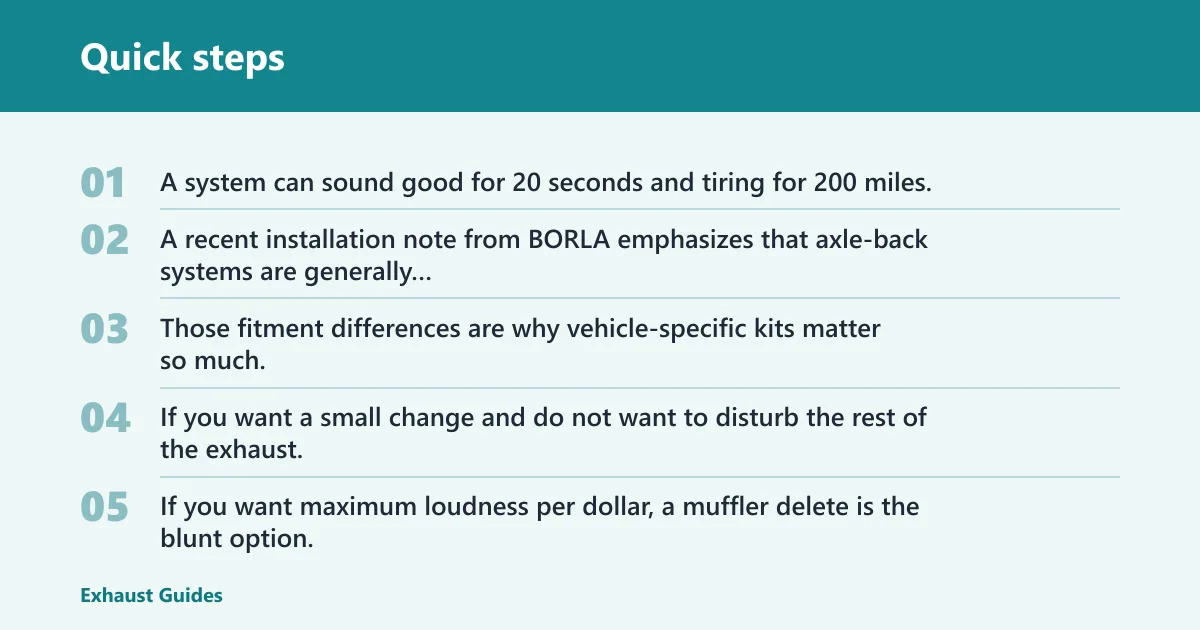
Drone is highway-speed cabin resonance. A system can sound good for 20 seconds and tiring for 200 miles, so a low drone rating matters more than peak loudness for commuting.
A recent installation note from BORLA emphasizes that axle-back systems are generally the simplest bolt-on option, while a cat-back replaces more of the rear exhaust and takes longer because more sections and hangers have to line up. Those fitment differences are why vehicle-specific kits matter so much.
Which setup fits each goal?
If you want a small change and do not want to disturb the rest of the exhaust, a stock muffler swap is the mildest path. If you want maximum loudness per dollar, a muffler delete is the blunt option. If you want a cleaner bolt-on change with less fuss, axle-back makes sense. If you want a broader system change and more room for tone control, cat back exhaust is the stronger pick.
What does a cat-back exhaust change?
A cat back exhaust changes the section from the catalytic converter to the tips, so it affects more than a rear canister swap. That broader reach is why it can change tone, flow, and fitment all at once, instead of only making the car louder at the tail end.
Where a cat-back begins and ends
According to MagnaFlow, a cat-back replaces piping and muffler from the catalytic converter back to the tip, which matches the standard definition used by many performance brands. That boundary is the key terminology point. It tells you what stays stock and what gets replaced.
Typical parts included in a cat-back
Cat back systems can include the mid-pipe, resonator, muffler, and tips. Not every vehicle gets every one of those parts, and some systems omit the resonator entirely. That is why two cat back kits can sound very different on the same engine family.
Why fitment is usually vehicle-specific
Cat back exhaust systems are usually built for a specific chassis, because pipe routing, hanger locations, and tip clearance all matter. That is also why the same kit can fit one trim and miss another, especially if the car has a factory valve or a different rear bumper.
Suppose a turbo four-cylinder sedan gets a cat back with no resonator. The car may gain a louder, sharper note, but the same delete on a V8 coupe may sound deeper and less strained. Engine type changes the result a lot.
What does a muffler change actually do?
A muffler change only affects the rear silencer area, so the result is narrower in scope than a cat back exhaust. A muffler swap can shift tone without going extreme, while a muffler delete removes the part that softens and shapes the note.
Muffler swap versus muffler delete
A muffler reduces exhaust noise. If you replace it with another muffler, you can tune volume and tone while keeping some refinement. If you delete it, you are removing the stock muffler from the exhaust system, which is the cheapest way to raise volume but also the easiest way to make the car sound unfinished.
How the muffler shapes tone and loudness
The muffler affects both loudness and the character of the note. On some cars, a delete can bring out a deeper sound; on others, especially smaller-displacement four-cylinder engines, it can introduce rasp at higher rpm and boom at steady speed.
When the rear section becomes too raw
The failure case matters. A muffler delete can be louder and still sound worse than stock if the rest of the exhaust was tuned around that muffler. Factory resonators and factory valves can soften the blow, but they can also leave you with odd harmonics once the muffler is gone.
How do axle-back and cat-back systems compare?
Axle-back sits between the two in scope. It replaces the rear section from the rear axle to the tips, usually includes only a muffler and exhaust tips, and costs less than a cat back system while changing sound more than outright performance.
Where axle-back starts relative to the rear axle
A well-known vehicle-fitment guide from MagnaFlow describes axle-back systems as replacing only the rear section from the axle back to the tips. That makes them closer to a muffler change than a full cat back exhaust, even if the parts are cleaner and the fitment is more polished than a quick delete.
Why axle-back usually changes sound more than performance
Because axle-back leaves most of the exhaust path untouched, it mostly changes sound character. It may alter the note enough to be worth it for daily driving, but it usually does less for flow than a cat back system that starts farther forward.
Why cat-back usually costs more
Cat back systems are usually a larger investment than axle-back kits or a simple muffler swap because they replace more hardware and are built around vehicle-specific routing. More pipe, more parts, and more engineering all push the price up.
Sound, drone, and daily driving
Daily use should carry more weight than peak loudness. A setup that sounds exciting at idle can be tiring on a 70 mph commute, and drone is the feature that turns an acceptable mod into an annoying one.
Why highway drone matters more than peak loudness
Drone is the steady resonance you hear in the cabin at cruising speed, and a muffler delete is often said to be more likely to create it than a cat-back system with a resonator. It often shows up around the same rpm range every day, which means the annoyance is repetitive. A muffler delete is more likely to create that problem than a cat back system with a resonator.
How a resonator can change the result
Resonators are designed to target certain frequencies, which can reduce boom without making the exhaust silent. That is why a cat back system with a resonator often sounds more refined than one without it.
Why engine type changes the sound profile
Four-cylinder and turbo engines often have a sharper note, so opening the exhaust too far can make them raspy. V6 engines can swing either way, while many V8s accept a freer rear system better because their base tone is already deeper. The same mod does not have the same effect on every engine.
Legality, inspection, and back pressure
Legal risk is not the same everywhere, but the concerns are familiar: muffler laws, noise limits, and emissions equipment. A cat back exhaust often avoids emissions hardware issues because it starts after the catalytic converter, while a muffler delete can run into noise or inspection trouble more easily.
Muffler laws and inspection risk
Some places require a working muffler, and a delete may fail a visual inspection or violate local noise rules. Even where the law is less strict, a louder exhaust can still draw attention if it sounds excessive at idle or cruise.
Why emissions equipment matters
The catalytic converter is the line you do not want to cross in this comparison. A cat back exhaust stays behind it, so it is less likely to affect emissions equipment directly. That does not make every cat back legal everywhere, but it keeps the most sensitive part of the system intact.
How to think about back pressure without oversimplifying it
Back pressure gets used as a catch-all explanation, but the real issue is how the whole exhaust flows. SAE technical literature on exhaust tuning shows that flow, pulse timing, and pressure waves all interact, which is why cat back systems can improve exhaust flow and reduce backpressure without guaranteeing a bigger power gain in every setup. A louder system is not automatically the best choice.
Choose cat back exhaust if… / Choose muffler if…
Choose cat back exhaust if you want a broader system change, care about a more controlled sound, or want the best chance of improving flow without touching emissions equipment. Choose muffler if you want the cheapest change, want to keep most of the stock exhaust, or only need a smaller sound adjustment.
Choose cat back exhaust if…
- You want the change to start at the catalytic converter and replace more than the rear canister.
- You care about tone control and want a better shot at lower drone with a resonator-equipped system.
- You are willing to pay more for vehicle-specific fitment and a larger hardware change.
- You want a mod that can improve flow as well as sound.
Choose muffler if…
- You want the lowest-cost way to change sound.
- You want a simple rear-section swap and do not want to replace piping farther forward.
- You are comfortable with a rougher or louder result if you choose a muffler delete.
- You mainly want a mild tone change from a stock muffler swap.

Frequently asked questions
Cat back exhaust vs muffler delete
Cat back exhaust changes the system from the catalytic converter back, while a muffler delete removes only the muffler from the stock exhaust. Choose cat back exhaust if you want a fuller, more controlled sound and a broader hardware change. Choose a delete only if cost and loudness matter more than refinement.
Cat back exhaust vs muffler swap
A muffler swap keeps the rest of the factory exhaust in place and changes only the rear silencer. A cat back exhaust replaces more of the system, so it usually changes tone, fitment, and flow more noticeably. Pick a swap for mild change. Pick cat back exhaust for a larger step.
Axle back exhaust vs muffler delete
Axle-back replaces the rear section from the rear axle to the tips, usually with a muffler and tips. A muffler delete removes the muffler from the stock system and is usually cheaper, but it can sound less refined. Choose axle-back if you want a cleaner bolt-on solution.
Cat back system vs muffler
A cat back system starts at the catalytic converter and can include the mid-pipe, resonator, muffler, and tips. A muffler-only change stays in the rear silencing section. The cat back path is better if you want more control over tone and a larger change in system layout.
Axle back exhaust vs muffler
An axle-back system is still a rear-section change, but it usually includes its own muffler and tips and is built as a cleaner replacement. A muffler change can be as simple as swapping the stock can or deleting it. Choose axle-back for a neater fit and a milder sound change.
Is a cat back exhaust worth it?
A cat back exhaust is worth it when you want more than a louder tailpipe. It makes sense if you want better tone control, a possible flow improvement, and a lower chance of crude drone than a delete. It is less worth it if your only goal is the cheapest noise increase.
Does cat back exhaust make a difference?
Yes, a cat back exhaust makes a difference, but the size of that difference depends on the engine and the rest of the system. It usually changes sound more clearly than performance, and the result can vary a lot on four-cylinder, turbo, V6, and V8 cars.