How Much Does It Cost to Replace a Diesel Catalytic Converter?
Replacing a diesel catalytic converter usually costs about $700 to $3,500, though some diesel setups can cost more. If the quote is close to a DPF or NOx sensor repair, confirm the failed part before approving work. Misdiagnosis can mean paying for a converter that was never the problem, while the real fault keeps triggering soot loading, warning lights, or limp mode. This guide helps you sort a true catalyst failure from a cheaper sensor, exhaust leak, EGR, or DPF issue.
Cost breakdown and add-on checks


Use this worksheet to split the quote into parts, labor, and diagnosis before you agree to the job. Compare OEM and aftermarket pricing, then note any add-on parts that should be inspected or replaced during the same visit.
| Cost item | Typical range | What changes the price |
|---|---|---|
| Converter part | $250 to $2,200 | Vehicle make, emissions package, OEM vs aftermarket, CARB fitment |
| Labor | $200 to $900 | Rust, seized fasteners, underbody access, shop hourly rate |
| Diagnosis | $100 to $250 | Scan-tool time, smoke test, leak check, sensor testing |
| Total installed cost | $700 to $3,500+ | Vehicle size, diesel aftertreatment layout, parts availability |
| Entry | OEM | Aftermarket |
|---|---|---|
| Parts price | $900 to $2,500+ | $250 to $1,200 |
| Fitment risk | Lowest | Varies by brand and emissions package |
| Warranty | Often stronger dealer coverage | Varies widely by seller |
| Legal compatibility | Usually the safest choice for exact match | Must match EPA or CARB rules for the vehicle |
| Add-on part | Inspect or replace? | Why it matters |
|---|---|---|
| Exhaust gaskets | Inspect, often replace | Leaks can mimic catalyst failure and damage the new seal |
| Clamps and hardware | Inspect, often replace | Rust can prevent a clean reinstall |
| Exhaust temperature sensors | Inspect | Bad readings can create a false catalyst code |
| Flex pipe or manifold section | Inspect | Cracks or leaks can change the quote and the fix |
| DPF and nearby sensors | Inspect | A clogged DPF can look like converter trouble |
How much does replacement cost?
Most diesel catalytic converter replacements land between $700 and $3,500 installed, but heavy-duty pickups, Euro-diesel models, and vehicles with integrated exhaust sections can run higher. The spread comes from part price, labor time, and whether the shop has to replace a larger section of exhaust rather than a single bolt-on component.
Parts cost range
OEM converters usually cost more because they match the original fit, emissions calibration, and hardware more closely. Aftermarket parts can be cheaper, sometimes by several hundred dollars, but the price only helps if the part is legal for your vehicle and matches the emissions package.
Labor cost range
Labor often runs $200 to $900. A simple replacement on a clean, rust-free exhaust may take about 1.5 to 3 hours, while rusted fasteners, broken studs, or a converter that is part of a larger exhaust assembly can push the job longer.
Total installed cost by vehicle type
A light-duty diesel with easy underbody access may stay near the low end. A 3/4-ton or 1-ton pickup, or a Euro-diesel with tightly packaged aftertreatment, often lands in the middle or upper range because the part itself costs more and the labor takes longer.
Why quotes vary so much
Two shops can quote very different numbers for the same symptom. One may be pricing a converter plus sensors and gaskets. Another may be pricing only a code check and a suspected leak repair. Ask for the part number, labor hours, and any diagnosis already performed.
What does a diesel catalytic converter do?
A diesel catalytic converter is an oxidation catalyst in the exhaust stream. It sits downstream of the engine and works with heat and catalyst coating to reduce hydrocarbons and carbon monoxide, while helping the emissions system perform as designed.
Location in the exhaust stream
On many diesel vehicles, the catalyst sits near the engine or immediately after another aftertreatment device. Some systems place it close to the turbo outlet, while others combine it with the DPF or package it in a single assembly. That layout matters because it affects access, labor, and parts cost.
Common failure modes on diesel systems
Diesel catalysts are less likely to wear out on their own than they are to be affected by other faults. Soot loading, oil contamination, exhaust leaks, melted substrate, or wrong-temperature operation can reduce efficiency. On some vehicles, the converter is blamed when the actual issue is upstream.
Is the converter really the problem?
Not every catalyst-efficiency code means the converter is bad. OBD-II data, sensor readings, leak checks, and aftertreatment inspection should point to the root cause before replacement. On diesel vehicles, DPF problems, exhaust leaks, and sensor faults often create the same warning lights and the same quote.
OBD-II codes that matter
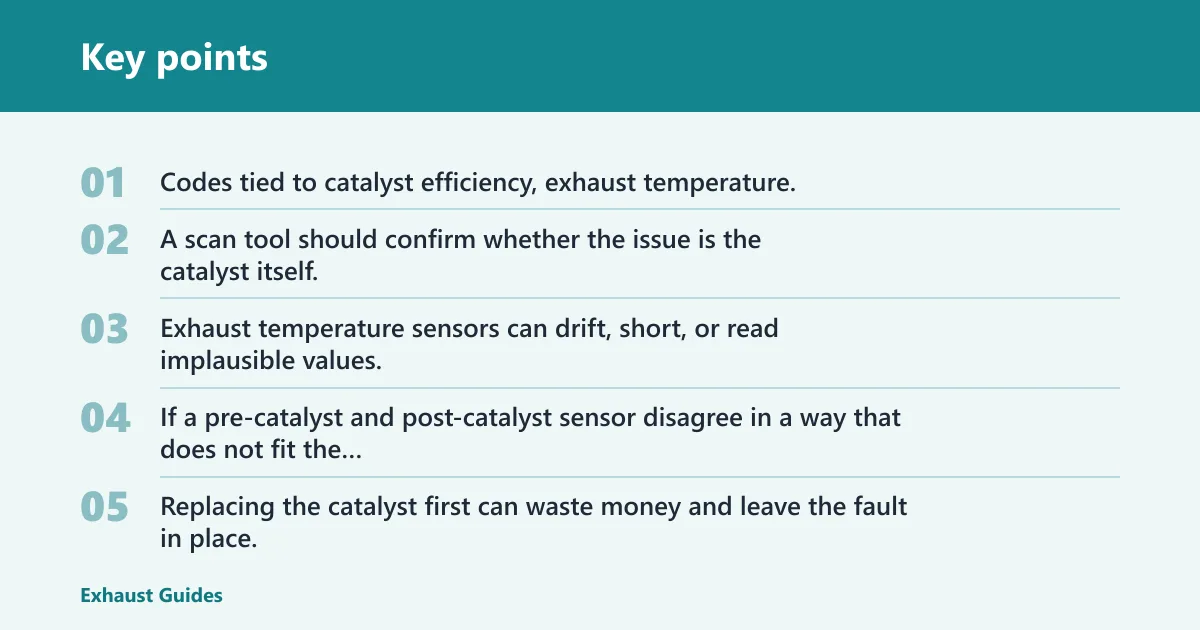
Codes tied to catalyst efficiency, exhaust temperature, or post-treatment performance matter more than a generic warning light alone. A scan tool should confirm whether the issue is the catalyst itself, a temperature sensor reading, or a mismatch between pre- and post-catalyst behavior.
Sensor faults that look like catalyst failure
Exhaust temperature sensors can drift, short, or read implausible values. If a pre-catalyst and post-catalyst sensor disagree in a way that does not fit the engine load or regen history, the converter may be innocent. Replacing the catalyst first can waste money and leave the fault in place.
Exhaust leaks and injector issues
Leaking manifolds, cracked flex pipes, or loose joints can pull in outside air and change the oxygen reading that the engine control module sees. Injector overfueling can add excess soot and unburned fuel, which can damage aftertreatment parts or trigger a false catalyst diagnosis. A leak check should come before replacement.
DPF overlap and regen problems
A clogged DPF can create backpressure, heat issues, and soot buildup that make the catalyst look bad. Failed regeneration can also stack codes and drive the same symptoms. If the vehicle keeps loading soot quickly, the converter may be a secondary casualty rather than the first failure.
Say your 3.0-liter diesel pickup shows a catalyst efficiency code after several short trips in winter. If the scan tool also shows incomplete regeneration and a high differential pressure reading across the DPF, the converter may be reacting to a soot problem, not causing it.
Are aftermarket diesel catalytic converters worth it?
Sometimes, yes. A good aftermarket converter can save money if it is the correct emissions type and the vehicle does not need dealer-only fitment. The risk is that a cheaper part may not match the original packaging, warranty, or legal requirements, which can make the savings disappear.
Dealer pricing and fitment accuracy
OEM converters are usually the safest fit. That matters on diesel vehicles where the converter, DPF, and sensors may be tightly integrated. Dealer parts often cost more, but they reduce the odds of hanger, flange, or sensor-location problems during installation.
Aftermarket price gaps
Aftermarket parts can be much cheaper, especially for older trucks. The gap can be large enough to change the repair decision, but the quote should include whether the part is direct-fit, whether new hardware is included, and whether the emission label matches the vehicle.
EPA and CARB compatibility
Legal fitment matters. Some aftermarket diesel converters are EPA-compliant but may not be CARB-approved for California and other CARB states. If the vehicle is registered in a CARB jurisdiction, the wrong part can create a failed inspection or an illegal repair.
Warranty differences
OEM parts often carry stronger dealer-backed coverage, while aftermarket warranties vary by brand and seller. A long warranty does not make the part legal or correctly matched. Check both the coverage terms and the emissions label before you buy.
How long does the job take?
Most diesel catalytic converter replacements take about 2 to 4 labor hours, though the job can take longer if the exhaust is rusted, the converter is part of a larger assembly, or access is tight. The shop rate then turns those hours into the final labor charge.
Typical labor hours
Direct-fit replacements on a relatively clean system may be straightforward. When the part is buried under shields, crossmembers, or aftertreatment plumbing, the labor estimate rises because the technician has to remove more components to reach the flange and sensors.
Rust and seized fastener impact
Rust is a major cost driver. Broken studs, rounded bolts, and seized clamps can add time quickly and can turn a quoted replacement into a repair that also needs hardware extraction or welding.
Shop rate variation
Labor rates vary by region and shop type. A diesel specialty shop may charge more per hour than a general repair shop, but it may also diagnose the problem more accurately and avoid a repeat visit. That can matter more than the hourly rate alone.
When the exhaust section needs more work
Sometimes the converter is attached to a section that includes the DPF, sensors, or a flex pipe. In that case, the labor quote should reflect the whole section, not just the catalyst shell. Ask whether the estimate covers only the converter or the connected assembly.
Suppose a rust-free 2016 diesel sedan needs a direct-fit converter and two sensors. The quote may stay near the lower end. The same fault on a salt-belt truck with a seized flange can cost much more, even if the part price is identical.
What else should you replace?
At minimum, inspect the nearby sensors, seals, and clamps. If any part of the exhaust stream is leaking or reading incorrectly, the new converter may not fix the fault. This is also the time to check the DPF side of the system for soot loading or regen history.
Exhaust temperature sensors
Temperature sensors should be tested if the code set includes pre- or post-catalyst heat data. A new converter will not correct a sensor that is drifting, open-circuit, or reading outside its expected range.
Gaskets and clamps
Gaskets and clamps are low-cost parts that can prevent repeat leaks. They are often worth replacing whenever the exhaust joint is opened, especially if the hardware is corroded or shows heat damage.
Flex pipe or manifold leaks
Check the exhaust manifold, turbo outlet, and flex pipe for cracks or pinholes. Even a small leak can affect oxygen readings and create a false catalyst complaint. Fixing the leak first may eliminate the code without touching the converter.
DPF-related checks
Inspect the DPF for ash loading, soot loading, and regen history. If the filter is restricted, the vehicle may still set catalyst-related faults after a new converter is installed. That makes DPF diagnosis part of the same cost decision.
- Read the codes and freeze-frame data before authorizing parts.
- Check pre- and post-catalyst sensor readings with a scan tool.
- Inspect the exhaust for leaks at the manifold, flex pipe, and flange joints.
- Check DPF loading and regeneration history if the vehicle has one.
- Confirm whether the quote is for the converter alone or the full exhaust section.
- Verify OEM, EPA, or CARB fitment before buying an aftermarket part.
Can you drive with a bad diesel catalytic converter?
You may be able to drive short distances, but you should not ignore the fault. If the problem is really a leak, sensor, or DPF restriction, continuing to drive can worsen soot loading, heat stress, or limp mode behavior. A flashing warning, severe power loss, or strong exhaust smell calls for immediate diagnosis.
Will the converter need coding or relearning after replacement?
Usually, a diesel catalytic converter itself does not require coding. Some vehicles do need a scan-tool reset, adaptation clear, or aftertreatment relearn if the repair involved sensors, DPF service, or stored fault data. The shop should check the service procedure for that exact model before reassembly.
Frequently asked questions
How much does it cost to replace a diesel catalytic converter?
Most diesel catalytic converter replacements cost about $700 to $3,500 installed. The number rises with OEM pricing, integrated exhaust designs, rust, and labor time. Some Euro-diesel systems cost more because the converter is packaged with other emissions hardware or uses model-specific fitment.
What causes a diesel catalytic converter to fail?
Common causes include soot buildup, oil contamination, exhaust leaks, injector problems, poor combustion, and repeated temperature stress. On diesel vehicles, the converter often fails because another part of the system is wrong first, which is why diagnosis should include sensor data and leak inspection.
Is a diesel catalytic converter the same as a DPF?
No. The catalyst and the DPF are separate emissions components, though some vehicles package them close together. The catalyst changes exhaust chemistry, while the DPF traps soot. Because the symptoms overlap, a clogged DPF can be mistaken for a failed catalyst.
How long does a diesel catalytic converter replacement take?
Many replacements take 2 to 4 labor hours. Rust, seized fasteners, and tight packaging can add time, and integrated exhaust sections can add more. If the shop also has to replace sensors, gaskets, or adjacent pipes, the job can take longer than the base estimate.
What other parts should be replaced at the same time?
Inspect exhaust gaskets, clamps, temperature sensors, and any nearby flex pipe or manifold section. If the vehicle has a DPF, check for soot loading and regen issues as well. Replacing only the converter while leaving a leak or sensor fault can waste the repair money.