Stainless Steel vs Aluminized Exhaust for Longevity
Stainless exhaust usually lasts 2 to 4 times longer than aluminized steel, especially in wet, salted climates. Aluminized often wins only on upfront cost. Pick the wrong material and you pay in rusted flanges, leaks, noisy joints, and an earlier replacement. This guide compares failure modes, expected lifespan, climate effects, and when aluminized still makes sense.
| Decision factor | Stainless steel | aluminized exhaust for longevity | Winner |
|---|---|---|---|
| Corrosion resistance | Chromium-bearing steel; chromium reacts with oxygen at the surface and forms a thin oxide film that slows rust. | Carbon steel with an aluminum-silicon coating that slows corrosion until the coating is damaged. | Stainless steel |
| Typical service life | Usually longer in every climate, with the biggest gap in winter salt use. | Shorter overall, especially where road salt, wet roads, and trapped moisture are routine. | Stainless steel |
| First failure point | Usually welds, joints, or crevices if fabrication is poor or chloride exposure is heavy. | Muffler shell edges, bends, welds, clamps, and hanger areas where coating damage starts corrosion. | Stainless steel |
| Upfront cost | Higher, especially for 304 stainless. | Lower, which is why many OEM systems use it. | aluminized exhaust for longevity |
| Best fit | Long-term ownership, salted roads, and buyers who want fewer replacements. | Budget repairs, short ownership, or dry-climate cars that see light use. | Depends on use |
Stainless vs aluminized exhaust: the real trade-off
Stainless steel wins on lifespan because it resists rust at the metal surface, while aluminized steel depends on a coating that can be chipped, burned, or worn away. The most expensive part is not always the best buy. If the car lives in a dry climate and is sold soon, aluminized can be the better value.
What longevity means in daily use
Longevity is not just a material label. It means fewer leaks, fewer rattles from thin rusted sections, fewer clamp failures, and less money spent replacing mufflers and pipes before the car itself is done.
Stainless steel contains at least 10.5% chromium, and chromium forms a thin oxide film that blocks further rust better than bare carbon steel. That is why stainless is used in construction, bridges, and buildings, and why it needs no regular painting. Carbon steel depends on coatings for that protection.
Where each material usually fails first
Aluminized systems often fail first where the coating is weakest, such as at welds, bends, clamps, hanger tabs, seams, and muffler edges. Once the coating is breached, you can see surface rust, then pitting corrosion, then holes. Underfilm corrosion can spread under the coating without looking dramatic at first.
Stainless steel can still corrode, but it tends to fail later and more locally. Weld areas, crevices, and badly finished joints are the usual weak points, especially after repeated heat cycling and chloride exposure.
Longevity matrix
| Climate | Use case | Stainless steel | aluminized exhaust for longevity | Buy / repair / replace |
|---|---|---|---|---|
| Dry climate | Daily driver | Often lasts well past a typical ownership cycle; watch welds and clamps. | Can last respectably if the car sees little moisture and no salt. | Buy aluminized for budget repair; buy stainless if you plan to keep the car long term. |
| Dry climate | Short-trip car | Best if the car sees frequent cold starts and condensation in the exhaust. | More vulnerable to internal moisture plus external coating wear. | Repair only if the rest of the system is solid; otherwise replace with stainless. |
| Dry climate | Performance car | Good choice when heat cycling and higher exhaust temperatures are common. | Acceptable for a lower-cost build if the car is not exposed to winter roads. | Use stainless for long-term builds; aluminized for low-cost, fair-weather use. |
| Wet climate | Daily driver | Usually the safer buy because moisture and road spray shorten aluminized life. | Coating wear at bends and welds becomes more likely. | Stainless is the better replacement choice unless the car is near end-of-life. |
| Wet climate | Short-trip car | Strongly preferred because condensation stays in the system longer on short trips. | High chance of early rust at joints and low points. | Replace with stainless if you are tired of repeat muffler work. |
| Wet climate | Performance car | Best if the car sees summer use and occasional spirited driving. | Only reasonable if the car is garaged and used sparingly. | Stainless for a keeper; aluminized only for a temporary or budget setup. |
| Snow and salt | Daily driver | Best long-term value; chloride exposure punishes coating-based systems. | Usually the first to rust at welds, bends, clamps, and seams. | Buy stainless unless you are replacing a car you will soon sell. |
| Snow and salt | Short-trip car | Best option because short trips leave more moisture inside the exhaust. | Very high risk of underfilm corrosion and early perforation. | Repair only if temporary; otherwise replace with stainless. |
| Snow and salt | Performance car | Best if you want the exhaust to survive winter storage gaps and road spray. | Usually poor value unless the car never leaves fair-weather roads. | Stainless is the clear pick for year-round ownership. |
Dry climate outcomes
In dry climates, the life gap narrows. Aluminized steel can hold up reasonably well if the car avoids winter roads and repeated puddle exposure, but welds and clamps still age first. Stainless still wins if you want the longest service life without revisiting the exhaust.
Wet climate outcomes
Humidity, standing water, and road spray shorten aluminized life because the coating gets attacked at edges and damaged spots. Stainless is not immune, but it is more forgiving when moisture lingers around seams and hangers.
Snow and salt outcomes
Road salt and chloride exposure are often a major divider. Chloride speeds corrosion in some steel grades, and the damage shows up first at welds, bends, and clamp points. In winter climates, stainless is usually worth the premium.
Why stainless lasts longer
Stainless steel lasts longer because chromium changes how the surface reacts to oxygen and moisture. The protective oxide film is thin, but it keeps rust from spreading the way it does on bare carbon steel. That is why stainless is low-maintenance and commonly used where durability matters.
304 stainless versus 409 stainless
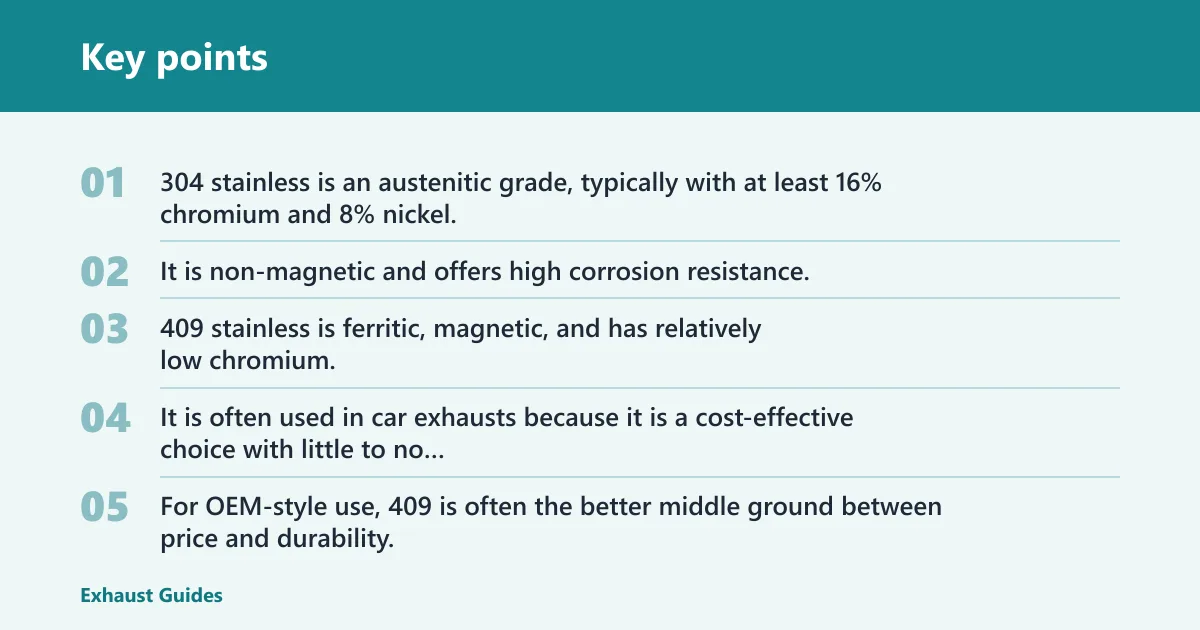
304 stainless is an austenitic grade, typically with at least 16% chromium and 8% nickel. It is non-magnetic and offers high corrosion resistance, which is why it is a common aftermarket exhaust material. It also costs more than aluminized steel.
409 stainless is ferritic, magnetic, and has relatively low chromium, typically under about 16%. It is often used in car exhausts because it is a cost-effective choice with little to no nickel. For OEM-style use, 409 is often the better middle ground between price and durability.
Why weld quality still matters
Good material does not fix bad fabrication. Heat cycling makes exhaust metal expand and contract, which stresses welds and joints over time. If welds are rough, thin, or poorly finished, corrosion can start there first even on stainless systems.
Suppose a 2.5-inch cat-back sees daily winter driving and the installer leaves rough weld toes near the muffler inlet. The pipe may stay bright for years, while the weld area starts to stain, pit, and eventually crack. Material choice matters, but weld finishing decides where the first repair lands.
How aluminized exhausts fail
Aluminized steel is carbon steel with an aluminum-silicon coating. That coating slows corrosion, but it is not a permanent shield. Chips, weld burn, and repeated flexing at bends and joints are where the protection gives up first.
Coating damage at chips and bends
Road debris can chip the coating, and bends are prone to thinning and abrasion during forming. Once the coating is breached, surface rust begins on the exposed steel and can spread under the remaining coating. That underfilm corrosion is why a system can look acceptable from a distance and still fail at a seam.
Welds and joints as first-rust points
Weld-burn damage is common because heat can disturb the coating right beside the weld bead. Clamps and hangers concentrate moisture too, so they often rust before the middle of a straight pipe. On aluminized systems, those are the inspection points that matter most.
Underfilm corrosion and pitting
Once rust creeps under the coating, pitting corrosion can thin the base steel until the pipe leaks or splits. That is why aluminized exhausts often fail at the muffler shell, at bend radii, or around seams before the rest of the pipe looks terrible.
Which grade should you buy?
The best grade depends on how long you keep the car and where you drive it. 304 stainless is the best long-term choice when corrosion resistance is the priority. 409 stainless is often the smarter balance for OEM-style use and moderate budgets. Aluminized steel still makes sense when cost matters most.
When 304 stainless is worth the premium
Pick 304 if the car lives in a salted climate, sees year-round use, or you plan to keep it for a long time. It has the strongest corrosion resistance of the three options here, and it is the safest choice when you want to buy once. It is especially sensible for performance cars that also see street miles.
When 409 stainless is the better fit
Choose 409 when you want better corrosion resistance than aluminized steel without paying full 304 prices. It is widely used in car exhausts for a reason: it is magnetic, durable enough for automotive heat, and cost-effective. For many daily drivers, it is the practical stainless option.
When aluminized steel is enough
Aluminized steel is enough when the car is a budget repair, the climate is dry, and the ownership window is short. It is also reasonable on cars that are not expected to face repeated winter salt exposure. The key is to treat it as the lower-cost, shorter-life choice that it is.
Does climate matter more than material?
Yes. Climate often decides the pace of failure more than the badge on the pipe. A good aluminized system in a dry region can outlast a poorly fabricated stainless system in a salty one. But once chloride exposure is regular, material choice becomes much more important.
Road salt and chloride exposure
Salt spray reaches welds, seams, hangers, and clamp pockets, where it stays wet longer than the rest of the pipe. That is why winter climates punish exhausts first at hidden joints. If the car is driven on salted roads, stainless usually pays off faster.
Heat cycling and short-trip use
Heat cycling stresses every exhaust, regardless of material. Short trips make it worse because condensation does not boil off fully, so moisture stays inside the muffler and pipe. That matters for both stainless and aluminized systems, but it shortens aluminized life faster.
Inspection points for hangers, clamps, and seams
Check hangers, clamps, seams, and low spots near the muffler and over-axle bends. Those are common failure points because moisture collects there and vibration works the metal. If you see flaking rust, swelling at a seam, or soot marks around a joint, a leak is often close behind.
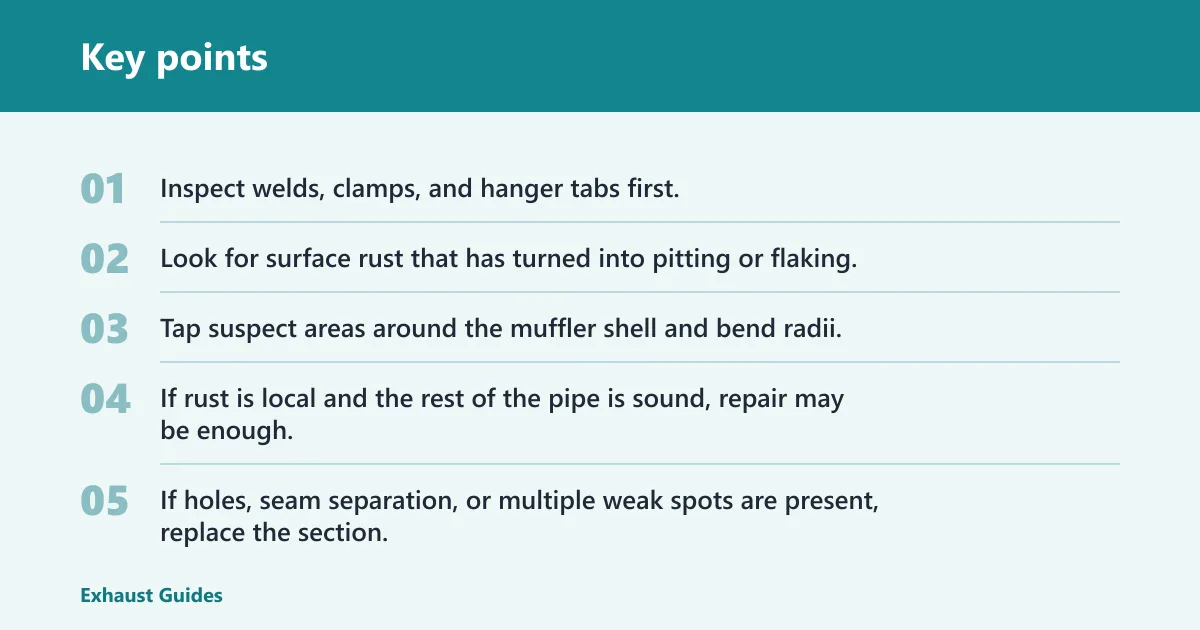
- Inspect welds, clamps, and hanger tabs first.
- Look for surface rust that has turned into pitting or flaking.
- Tap suspect areas around the muffler shell and bend radii.
- If rust is local and the rest of the pipe is sound, repair may be enough.
- If holes, seam separation, or multiple weak spots are present, replace the section.
A common first-timer mistake is replacing only the visibly rusted muffler on a car that has salt damage at the bends and clamp pockets. The new part fixes one leak, then the next weak spot opens a month later. On winter cars, a wider inspection often saves a second labor charge.
Choose Stainless steel if… / Choose aluminized exhaust for longevity if…
Choose Stainless steel if you want the best long-term value, drive in wet or salted climates, keep cars for years, or are building a performance car that will see repeated heat cycling. It is the safer choice when you want fewer rust-related repairs and fewer repeat exhaust jobs.
Choose aluminized exhaust for longevity if the car lives in a dry climate, you need a lower-cost repair, or the vehicle will not be kept long enough to justify the premium. It is a sensible OEM-style solution when you accept a shorter service life in exchange for a lower bill.

Frequently asked questions
Is stainless steel better than aluminized steel for exhaust longevity?
Yes. Stainless steel usually lasts longer because chromium helps it resist corrosion, while aluminized steel depends on a coating that can be damaged. The difference grows in wet or salted climates, where aluminized systems often rust first at welds, bends, clamps, and seams.
How long does a stainless steel exhaust last compared with aluminized?
A stainless exhaust is often reported to last several times longer than an aluminized one under similar climate and use conditions. The gap is widest in winter salt use and shortest in dry regions. Short trips and poor weld quality can narrow the advantage, but stainless still usually wins.
What grade of stainless steel is best for exhaust systems?
304 stainless is the best choice when maximum corrosion resistance matters. 409 stainless is often the practical pick for OEM-style exhausts because it is magnetic, cost-effective, and still durable enough for automotive use. For many daily drivers, 409 is the better value.
Will aluminized exhaust rust faster in winter or road salt?
Yes. Winter driving and road salt shorten aluminized exhaust life sharply because chloride exposure attacks damaged coating, welds, and crevices first. You often see rust at the muffler shell edges, pipe bends, hanger tabs, and clamps long before the rest of the pipe fails.
Is a stainless exhaust worth the extra cost?
It is worth the extra cost if you keep the car long term, drive in salted roads, or want fewer exhaust repairs. If the car is temporary, dry-climate only, or a low-value repair, aluminized steel may be the smarter purchase. Ownership length decides the payback.
Can a stainless exhaust still rust or corrode?
Yes. Stainless resists rust better, but it is not rust-proof. Poor weld finishing, trapped salt, moisture in crevices, and repeated heat cycling can still cause surface rust, pitting, or crevice corrosion. The weakest spots are often welds, joints, and clamp areas.
What are the signs an aluminized exhaust is nearing end of life?
Watch for flaking rust, thin spots around welds, soot trails at seams, loud leaks on cold starts, rattling from broken hangers, and swollen areas where rust is lifting the coating. Once pitting turns into pinholes or multiple sections are weak, replacement is usually the better move.