Are Aftermarket Exhaust Hangers Worth It?
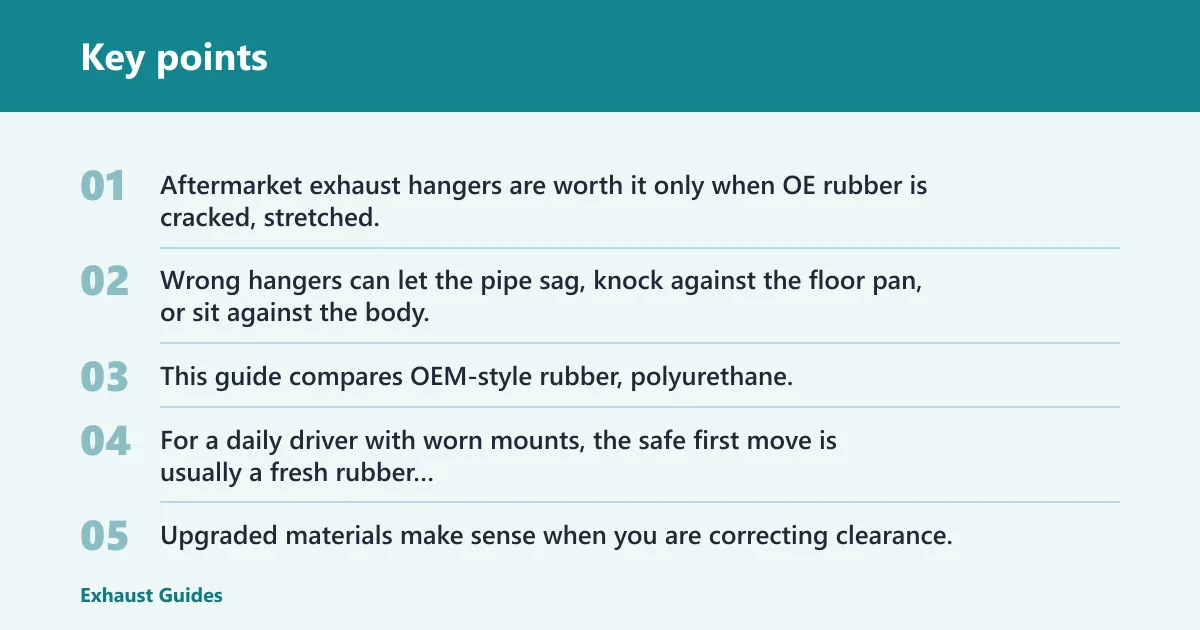
Aftermarket exhaust hangers are worth it only when OE rubber is cracked, stretched, or the exhaust needs a different drop or angle; otherwise, stay with OEM-style rubber. Wrong hangers can let the pipe sag, knock against the floor pan, or sit against the body, which can cook rubber, stress joints, or create cabin noise. This guide compares OEM-style rubber, polyurethane, and stainless or metal-reinforced hangers so you can match the part to the problem.
Verdict

- High-density EPDM rubber for durability
- Adjustable holes for easy height changes
- Endures extreme temperatures -40°F to 248°F
For a daily driver with worn mounts, the safe first move is usually a fresh rubber hanger with the correct shape and hole spacing. Upgraded materials make sense when you are correcting clearance, limiting movement under load, or dealing with heat and corrosion exposure, but stiffer is not automatically better because it can send more vibration into the cabin and into nearby brackets.
Specs at a glance
| Option | Sag control | Vibration isolation | Corrosion resistance | Install difficulty | Best use case |
|---|---|---|---|---|---|
| OEM-style rubber | Moderate | High | Low to moderate | Low | Daily driver, stock exhaust, replacement of worn OE part |
| Polyurethane | High | Moderate to low | Moderate | Moderate | Lowered car, exhaust that contacts the body, movement control |
| Stainless or metal-reinforced | High when paired with the right bracket or isolator | Depends on the isolator used | High | Moderate to high | Exposed underbody areas, performance builds, custom hanger assemblies |
Sonus says its exhaust hangers help keep mufflers and exhaust pipes in place, describes improved compression set, and notes a low ratio between static and dynamic stiffness. Sonus also lists exhaust hangers as a product category and mentions a lower cost insert, which matters because small hanger changes can affect both support and noise transfer.
ZF Aftermarket’s technical info hub is a reminder that fitment and service data matter as much as material choice. A hanger that looks close on paper can still preload a bracket, shift the tailpipe angle, or create a new contact point if the mount geometry is wrong.
Who it
Use an upgraded hanger when the problem is movement, clearance, or corrosion, not when you simply want a firmer feel. A worn exhaust hanger can show up as sagging, clunking, rattling, or a pipe that kisses the floor pan under throttle, braking, or road movement.
It is a better fit for a lowered car, a custom exhaust with nonstandard routing, or a track car that sees higher exhaust motion under load. A stock commuter with no contact issues usually needs a fresh OE-style rubber hanger, not a stiffer part.
If the rubber softens, the rear muffler may hang about 12 mm lower and the pipe may tap the heat shield over speed bumps. A replacement with the right hole spacing can restore clearance without changing the whole exhaust system.
What works
Rubber works when you want OE-style compliance and the best vibration isolation. It absorbs motion, helps protect the cabin from exhaust resonance, and is usually the lowest-risk fix when the original hanger has aged, compressed, or cracked from heat and ozone.
Polyurethane works when the exhaust moves too much under load. Higher durometer material reduces droop and side-to-side swing, so it can help if the pipe is contacting the chassis or if a lowered car needs tighter control near the rear axle or subframe.
Stainless steel works best as part of a hanger or bracket assembly where corrosion is the main concern. It is useful in exposed underbody locations and on performance or custom systems, but the metal piece usually needs a rubber isolator or bracket design to avoid turning every bump into noise.
In practical terms, the material should follow the fault. If the exhaust is just sagging, restore the original compliance. If the pipe is shifting enough to strike something, increase control. If the hanger or rod is rusted, upgrade the exposed metal while keeping the isolation strategy intact.
What does not?
Stiffness alone does not solve every exhaust problem. A harder hanger may reduce movement, but it can also transfer load into the exhaust mount bracket, welds, or flex pipe if the system was already close to its limit.
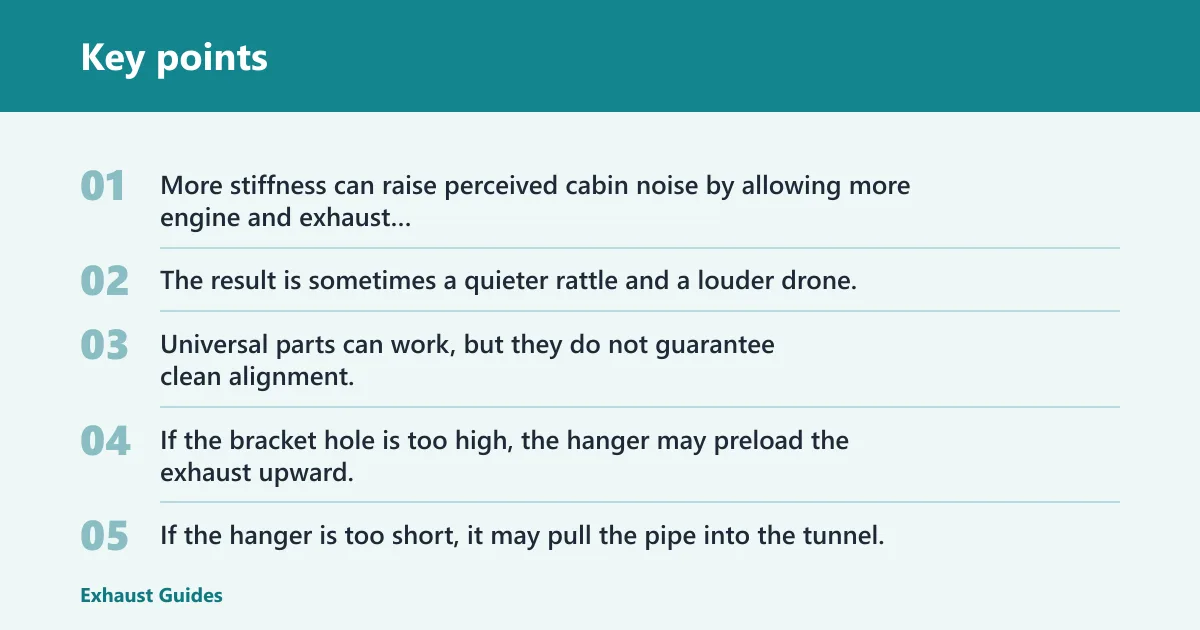
That is where NVH matters. More stiffness can raise perceived cabin noise by allowing more engine and exhaust vibration to pass through the hanger path, and it can shift resonance into a frequency you notice at idle or cruise. The result is sometimes a quieter rattle and a louder drone.
Fitment mistakes are another failure mode. Universal parts can work, but they do not guarantee clean alignment. If the bracket hole is too high, the hanger may preload the exhaust upward. If the hanger is too short, it may pull the pipe into the tunnel. Either mistake can create a new contact point instead of removing one.
A common first-timer mistake is buying a stiffer hanger because the exhaust hangs low, then discovering the real issue is a bent bracket. The new part holds the pipe higher, but the load moves into a weld that was never meant to carry that angle.
Exhaust hanger decision matrix
This table weighs the upgrade paths against the problem you are trying to fix. The best choice depends on exhaust mass, hanger count, clearance, and heat exposure, not on stiffness alone.
| Upgrade path | Sag control | Vibration isolation | Corrosion resistance | Install difficulty | Best use case |
|---|---|---|---|---|---|
| OEM-style rubber | 3/5 | 5/5 | 2/5 | 2/5 | Daily driver, stock exhaust, worn OE replacement |
| Polyurethane | 4/5 | 3/5 | 3/5 | 3/5 | Lowered car, contact issue, movement control |
| Stainless or metal-reinforced | 4/5 | 2/5 to 4/5, depending on the isolator | 5/5 | 3/5 to 4/5 | Custom exhaust, exposed underbody, track use |
Scenario recommendations
Daily driver: Start with OEM-style rubber. That choice gives the best vibration isolation and usually the least cabin noise change. Replace it only if the old hanger is cracked, stretched, or compressed set has lowered the exhaust.
Lowered car: Polyurethane often makes more sense because clearance is usually the issue. The goal is to limit movement under load without making the system so rigid that it transmits every pulse into the body.
Custom exhaust: Use whatever combination corrects the mount geometry first, then pick the material. A custom system often needs a bracket adjustment, a different drop, or a metal-reinforced hanger to stop the pipe from pulling against the wrong angle.
Track use: Stainless or metal-reinforced hardware can pay off when heat and repeated load cycles are high. Even then, the mounting point still needs proper isolation or you may move stress into the flex pipe, welds, or bracket tabs.
Alternatives
Replace worn OEM rubber first
MetVot’s rubber hanger is the closest fit for a simple replacement approach. The brand lists high-density EPDM rubber, adjustable holes for height changes, and an extreme-temperature range from -40°F to 248°F, which supports the case for a direct OE-style swap when the old mount has aged out. The drawback is the same one most rubber hangers share: if the geometry is wrong, rubber alone will not fix it.
Choose polyurethane when movement is the complaint

- Made of strong polyurethane material
- Reduces noise and vibrations effectively
- Prevents muffler from falling downward
PTNHZ RACING’s polyurethane hanger is the better fit when the issue is excessive movement rather than rust. The manufacturer describes strong polyurethane material and notes that it reduces noise and vibrations while helping prevent the muffler from falling downward. The trade-off is stiffness: that same control can send more NVH into the cabin if the exhaust mass is high or the mount points are short and direct.
Use stainless or metal-reinforced hardware for exposed or custom setups
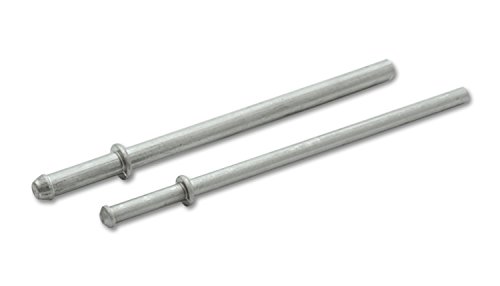
- Vehicle specific fitment for precision
- Manufactured in the United States
- Stable metal construction for longevity
Vibrant Performance’s exhaust hanger rod is the strongest fitment-first option in this group. It is vehicle specific, made in the United States, and uses stable metal construction for longevity. The drawback is that a metal rod by itself is not the full answer to vibration control; it works best as part of a correctly aligned bracket or isolator assembly, not as a cure for a bent mount.
Should you buy it?
Buy aftermarket exhaust hangers when you have a clear reason: sag, contact, misalignment, heat exposure, or corrosion that OE rubber cannot handle well enough. Do not buy a stiffer part just because it sounds performance-oriented. The wrong choice can trade a small clearance problem for a larger NVH problem.
- Check whether the exhaust is sagging because the rubber is worn, or because the bracket is bent.
- Measure the hanger location, hole spacing, and drop before ordering a universal part.
- Look for signs of preload, like a tailpipe that sits hard against one side of the cutout.
- Inspect the flex pipe, welds, and bracket tabs for stress before increasing stiffness.
- Match the material to the problem: rubber for isolation, polyurethane for control, stainless for corrosion and structure.
- Replace the hanger first if the goal is to restore stock behavior.
If the exhaust is quiet enough, clears the body, and the rubber is still healthy, stop at a simple OE-style replacement. If the pipe is moving too much, touching under load, or hanging in a hot and exposed spot, the extra cost can be justified.
Picture a lowered hatchback with a 3-inch cat-back that contacts the rear beam on hard compression. A rubber hanger may restore some height, but a polyurethane part with corrected bracket alignment is the better answer because the problem is movement under load, not just aging rubber.
Frequently asked questions
Are aftermarket exhaust hangers worth it?
They are worth it when the exhaust needs better support, more clearance, or better corrosion resistance than a worn OE rubber hanger can provide. If the system already fits properly and the rubber is in good shape, the upgrade often adds cost and NVH without fixing a real fault.
What is an exhaust hanger?
An exhaust hanger supports the weight of the muffler and exhaust pipe, controls movement, and helps isolate vibration from the body. It is usually rubber or elastomer based, with aftermarket versions that add stiffness, metal reinforcement, or a different bracket shape for fitment.
How do you know if you need aftermarket exhaust hangers?
Look for sagging, rattling, clunking, or pipe contact with the body, heat shield, or axle area. If the issue is a worn rubber mount, replace it first. If the exhaust still moves too much or sits wrong after that, a different material or bracket geometry may be needed.
How do I install exhaust hangers safely?
Support the exhaust before removing any hanger so the pipe cannot drop or twist. Check that the replacement matches the mount spacing, then verify alignment before tightening or welding. The exhaust should sit with clearance at ride height, because a hanger that is too tight can load the bracket or flex pipe.
How do I remove exhaust hangers without damaging the pipe?
Use support under the muffler or pipe, then work the rubber off the rod rather than prying against thin tubing. If the hanger is seized, lubricant and controlled movement are safer than forcing the pipe sideways. The goal is to keep the mount point from bending while you free the isolator.
What should I check before buying bolt-on exhaust hangers?
Check the vehicle-specific fitment, bolt spacing, drop length, and bracket orientation before you buy. A bolt-on hanger can still be wrong if it leaves preload in the system or puts the pipe at the wrong angle. Also consider heat exposure, corrosion, and whether the part needs a separate isolator.