
Do X Pipes Pop Causes and Fixes Explained
Many car owners wonder, “Do X Pipes Pop? Causes and Fixes Explained“. This question pops up a lot, especially for those new to car modifications or dealing with exhaust noises.
It can be a bit tricky to figure out why your exhaust might be making popping sounds. But don’t worry! This guide will break it all down in a simple way.
We’ll go step by step to help you understand the reasons behind these pops and how to fix them. Get ready to learn what makes your exhaust sing (or pop!).
Why Do X Pipes Pop
The question “Why Do X Pipes Pop” is a common one for car enthusiasts. An X pipe, a component in a performance exhaust system, connects the two exhaust manifolds of a V-shaped engine. When exhaust gases flow through it, they meet and merge.
This merging process can create unique sound waves. Sometimes, these sound waves interact in a way that produces a popping or crackling sound, often referred to as “burble” or “fart can” sound. This is usually more noticeable during deceleration or when the engine is running rich.
Understanding the mechanics behind this sound can help you appreciate or adjust your exhaust note.
How Exhaust Gases Create Sounds
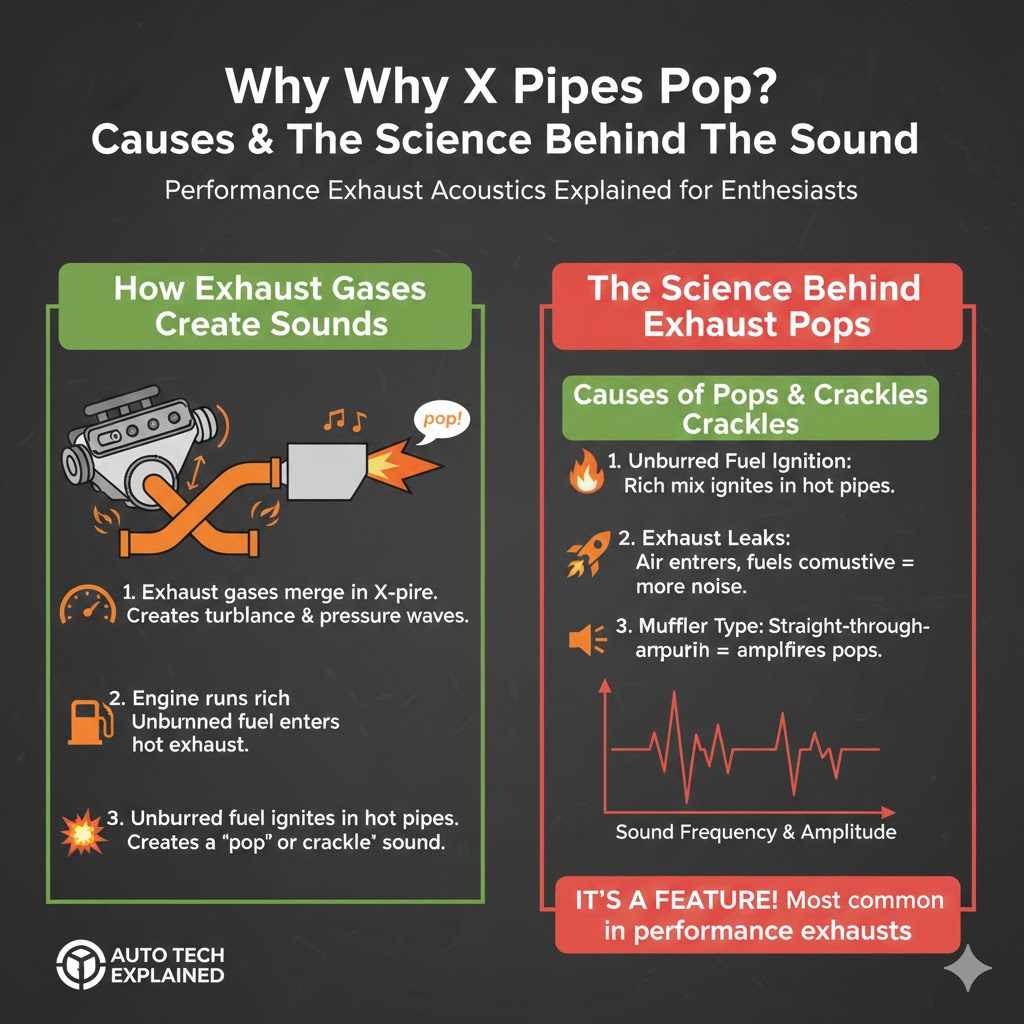
Exhaust gases are a byproduct of combustion within your engine. After the fuel and air mixture burns, hot gases are expelled from the cylinders. These gases then travel through the exhaust system.
The path these gases take, including the design of components like the X pipe, plays a big role in the final sound. The shape of the X pipe encourages gases from opposite banks of the engine to mix. This mixing can lead to turbulence and pressure changes.
These changes, in turn, generate distinct sound frequencies.
The speed and temperature of the exhaust gases also influence the sound. When you lift your foot off the accelerator, the engine might momentarily run richer, meaning there’s more fuel than air. Unburned fuel can enter the hot exhaust pipes.
When this fuel ignites in the exhaust system, it creates a small explosion, resulting in a pop or crackle. This is a natural phenomenon in many performance exhaust setups.
The Role of the X Pipe Design
The specific design of an X pipe is crucial to the sounds it produces. X pipes are named for their shape, where the two exhaust pipes cross over each other and merge into a central ‘X’ section. This design is intended to equalize exhaust pressure between the two banks of the engine.
By equalizing pressure, it can improve exhaust scavenging, which is the process of efficiently removing burnt gases from the cylinders.
However, this mixing of gases can also create harmonic resonances within the exhaust system. These resonances can manifest as pops, crackles, or even a deeper tone. The material of the X pipe, its diameter, and the length of the connected pipes all contribute to the overall sound profile.
Manufacturers tune these aspects to achieve specific sound characteristics.
Engine Tuning and Air Fuel Ratio
The engine’s tuning has a significant impact on whether an X pipe will pop. The air-fuel ratio is the proportion of air to fuel in the combustion mixture. An engine that runs lean has more air than fuel, while an engine that runs rich has more fuel than air.
When an engine runs rich, especially during deceleration, there can be unburned fuel exiting the exhaust. This unburned fuel, when it encounters the hot exhaust gases and pipes, can ignite. This secondary combustion event creates the popping sound.
Engine control units (ECUs) manage the air-fuel ratio. Modifications to the ECU, often called tuning or remapping, can alter this ratio. Some tunes deliberately lean out the mixture for power gains, while others might allow for a richer mixture during certain conditions to produce a more aggressive exhaust note.
A common scenario is after installing a performance exhaust, including an X pipe, without adjusting the engine’s tune. The stock tune might not be optimized for the new exhaust flow. This can lead to the engine running richer than intended, increasing the likelihood of popping sounds.
This is one of the core aspects to consider when asking, “Do X Pipes Pop? Causes and Fixes Explained.”
Causes of Pops and Crackles
- Unburned Fuel Ignition
This is the most frequent cause. When the engine runs rich, particularly on deceleration, excess fuel enters the exhaust. The hot exhaust pipes and the presence of oxygen cause this fuel to ignite.This creates a small, rapid combustion event that results in a popping sound.
- Exhaust Leaks
Leaks in the exhaust system, especially near the X pipe or further down the line, can introduce air into the exhaust stream. This extra oxygen can interact with hot exhaust gases and any residual fuel, leading to pops and crackles. Leaks can occur at the flanges, joints, or from damage to the pipes themselves.
- Catalytic Converter Design
Some catalytic converters are designed to be more restrictive than others. A less restrictive, high-flow catalytic converter can allow exhaust gases to move more freely. This increased flow can sometimes contribute to the conditions that cause popping sounds.Aftermarket catalytic converters are often designed to facilitate performance and can influence exhaust acoustics.
- Muffler Type and Resonance
The type of muffler used in conjunction with the X pipe can significantly affect the sound. Straight-through mufflers, often found in performance systems, offer less resistance. This can allow for more pronounced popping sounds to be heard.The internal baffling and chambers within a muffler can also create or suppress specific sound frequencies and resonances.
The Science Behind Exhaust Pops
Exhaust pops are essentially small, controlled explosions happening outside of the engine’s combustion chambers. When the engine’s computer (ECU) is set to a rich air-fuel ratio, or when the engine is decelerating, there’s a surplus of fuel. This unburned fuel escapes the cylinders and enters the exhaust manifold and then the X pipe.
The exhaust system itself is hot from the engine’s operation. When the unburned fuel mixes with the hot exhaust gases and oxygen in the exhaust pipes, it can find an ignition source. This source can be residual heat or the combustion process still occurring in other cylinders.
The resulting mini-combustion is what you hear as a pop. The X pipe’s design, by promoting gas mixing, can sometimes amplify these events.
Think of it like a tiny firework going off in your exhaust. The intensity and frequency of these pops depend on many factors, including the engine’s tune, the exhaust system’s design, and driving conditions. For many drivers, this sound is a desirable characteristic of a performance exhaust.
Examples of Exhaust Popping
Many car enthusiasts seek out exhaust setups that produce a satisfying pop and crackle. For instance, sports cars like the Porsche 911 or the BMW M series are known for their distinct exhaust notes that often include pops during gear changes and deceleration. This sound is often deliberately engineered into the exhaust systems.
Another common example is seen in the aftermarket tuning scene for cars like the Subaru WRX or the Ford Focus ST. Owners often install performance exhaust systems, including X pipes or similar crossover pipes, to achieve an aggressive, popping sound that is considered a desirable auditory cue of a modified vehicle. This sound adds to the driving experience.
In rally racing, the sound of a rally car’s exhaust popping and crackling as it navigates a stage is iconic. This is a direct result of the high-performance, often rich-tuned engines and aggressive exhaust systems designed for maximum output and a distinctive sound.
Fixes for Unwanted X Pipe Pops
If the popping sound from your X pipe is undesirable, there are several effective fixes. These solutions aim to either reduce the amount of unburned fuel entering the exhaust or dampen the sound waves created. Understanding these options will help you regain control over your car’s exhaust acoustics.
Adjusting Engine Tuning
The most direct way to stop unwanted popping is to adjust the engine’s air-fuel ratio. If your car is running too rich, especially on deceleration, a professional tune can correct this. A tuner can modify the engine control unit (ECU) software to ensure a leaner mixture during cruising and deceleration.
This involves reprogramming the fuel injectors and ignition timing to optimize combustion and minimize unburned fuel. A good tune will not only stop the pops but can also improve fuel efficiency and overall engine performance. It’s crucial to have this done by a qualified technician who understands engine management systems.
For example, some tunes might employ “deceleration fuel cut-off” more aggressively. This feature stops fuel injection entirely when you lift off the throttle above a certain engine speed. By enabling or enhancing this feature, you prevent fuel from entering the exhaust, thus eliminating the cause of the pops.
Methods for Engine Retuning
- ECU Remapping or Chip Tuning
This involves altering the software within the engine control unit. A tuner can adjust parameters like fuel injection pulse width, ignition timing, and sensor readings to achieve a specific air-fuel ratio. This is the most common and effective method for controlling popping sounds caused by rich mixtures.
- Adjustable Fuel Pressure Regulators
In some older or more basic engine setups, an adjustable fuel pressure regulator can be installed. This device allows for fine-tuning the fuel pressure supplied to the injectors, which indirectly affects the air-fuel ratio. This offers a mechanical way to influence fuel delivery.
- Piggyback ECUs
These are secondary electronic control units that intercept signals between the factory ECU and engine components. They can modify signals to influence fuel delivery and ignition timing, effectively retuning the engine without directly altering the factory ECU software. This can be a less invasive tuning method.
Modifying the Exhaust System
If adjusting the engine tune is not an option or desired, modifying the exhaust system itself can help. This can involve adding components that absorb sound or change how the exhaust gases flow.
Adding a more restrictive muffler or a resonator can dampen the popping sound. Resonators are specifically designed to cancel out certain sound frequencies. They work by creating sound waves that are out of phase with the unwanted noise, effectively neutralizing it.
An X pipe with integrated resonators can significantly reduce popping.
Alternatively, replacing the X pipe with an H pipe might be considered. An H pipe, where the exhaust pipes connect in a simple ‘H’ shape, allows for less mixing of exhaust gases compared to an X pipe. This difference in gas flow can result in a less aggressive, often smoother exhaust note with fewer pops.
Exhaust System Modifications
- Adding a Resonator
A resonator is a chamber or tube added to the exhaust system that is designed to cancel out specific sound frequencies. It works by using sound waves that are out of phase with the unwanted noise, essentially canceling them out. Adding a resonator, especially before or after the X pipe, can effectively reduce popping and drone.
- Installing a Quieter Muffler
Mufflers are designed to reduce the noise level of the exhaust. A quieter, more restrictive muffler will absorb more sound energy, including the popping sounds. Performance mufflers vary greatly in their sound-deadening capabilities; choosing one with better sound absorption will help
- Replacing the X Pipe with an H Pipe
An H pipe connects the two exhaust streams in a simple crossover. This design allows for less mixing of exhaust gases than an X pipe. While an X pipe is often preferred for its scavenging benefits and unique sound, an H pipe can produce a deeper, less raspy tone with fewer pops.
- Using Exhaust Valves or Cutouts (with caution)
Some systems include exhaust valves that can be opened or closed. When closed, they can route exhaust through additional mufflers or resonators to quiet the sound. When open, they allow for a more direct, louder exhaust flow.Controlling these valves can help manage popping sounds.
Addressing Exhaust Leaks
Leaky exhaust systems can contribute to unwanted sounds, including pops. Air entering the exhaust can cause secondary combustion. It’s important to ensure all connections are sealed properly.
Inspect the exhaust system from the engine back to the tailpipe. Look for any signs of rust, cracks, or loose clamps. Pay close attention to the areas around the X pipe, catalytic converter, and muffler.
Any black sooty residue around a joint is a strong indicator of a leak.
Common leak points include exhaust manifold gaskets, flange connections between pipe sections, and the seal around the catalytic converter. Replacing faulty gaskets or tightening loose clamps can resolve these leaks and potentially reduce popping.
A simple test for leaks involves running the engine and listening for hissing sounds while the exhaust is cold. Once warm, visually inspect for any dark, sooty spots that indicate escaping gases. Ensuring a sealed exhaust is key for both performance and sound control.
Impact of Aftermarket Parts
Aftermarket X pipes and other exhaust components are often designed for performance and sound, which can lead to popping. They might have less restrictive designs that encourage gas mixing and allow sound to pass through more easily.
When choosing aftermarket parts, consider their acoustic properties. Some manufacturers specifically design their products to minimize unwanted drone or popping while still offering enhanced performance. Reading reviews and listening to sound clips can help in making an informed decision.
It’s also important to consider the synergy between different aftermarket parts. An aggressive X pipe might pair well with a specific muffler to achieve a desired sound. However, if not matched carefully, they could combine to create excessive popping or noise.
Comparison of X Pipe vs. H Pipe Sound Characteristics
| Feature | X Pipe | H Pipe |
|---|---|---|
| Gas Mixing | High degree of mixing between exhaust banks | Lower degree of mixing; primarily balances pressure |
| Sound Profile | Often produces a higher-pitched, more aggressive, raspy sound | Typically produces a deeper, more mellow, muscle car-like tone |
| Popping/Crackle | More prone to producing pops and crackles, especially on deceleration | Less prone to popping and crackling; smoother sound |
| Performance Benefit | Can offer better scavenging and power gains in certain RPM ranges | Generally offers balanced performance across the RPM range |
Do X Pipes Pop Causes and Fixes Explained
Understanding the question “Do X Pipes Pop? Causes and Fixes Explained” involves looking at how exhaust gases behave and interact. The X pipe’s design encourages the mixing of exhaust gases from opposite cylinder banks of a V-engine.
This mixing process, while beneficial for exhaust scavenging and performance, can lead to unique acoustic properties. When the engine runs rich, particularly during deceleration, unburned fuel can ignite in the hot exhaust system, causing the popping sound. This phenomenon is a common characteristic of many performance exhaust systems featuring X pipes.
Causes of Exhaust Popping
Several factors contribute to the popping sounds heard from an X pipe. The primary cause is the ignition of unburned fuel in the exhaust system. This typically happens when the engine is running rich, meaning there is more fuel than air in the combustion mixture.
During deceleration, when the throttle is lifted, the engine might momentarily operate with a richer ratio, especially if the engine management system is calibrated for performance or if aftermarket tuning has been applied.
The hot exhaust gases and pipes provide the necessary heat to ignite this unburned fuel. The X pipe’s design, which facilitates the merging of exhaust streams, can create turbulence and resonance patterns that amplify these ignitions, making the pops more noticeable.
Another significant cause is exhaust leaks. Any leak in the exhaust system, from the manifold gaskets to the muffler connections, can allow air to enter. This introduced oxygen can combine with hot exhaust gases and any residual fuel, leading to spontaneous combustion and popping sounds.
These leaks disrupt the intended flow and pressure within the system.
The specific design of the X pipe itself plays a role. The angle of the crossover, the diameter of the pipes, and the materials used can all influence the resulting sound. Some X pipe designs are inherently more prone to producing popping sounds due to their acoustic properties and how they channel exhaust gases.
Finally, the type of muffler and catalytic converter used in conjunction with the X pipe can affect the sound. Less restrictive, high-flow mufflers and catalytic converters allow exhaust gases to exit more freely, which can accentuate popping sounds. The internal construction of mufflers can also create resonance, either reducing or enhancing pops.
Unburned Fuel and Ignition
The concept of unburned fuel igniting in the exhaust is central to understanding why X pipes pop. In an internal combustion engine, the ideal air-fuel ratio for complete combustion is approximately 14.7 parts air to 1 part fuel by weight (stoichiometric ratio). However, engines often operate outside this ratio for various reasons.
When the engine runs rich, the air-fuel ratio is lower than stoichiometric, meaning there’s an excess of fuel. This can happen intentionally through engine tuning to maximize power or cooling, or it can occur unintentionally due to faulty sensors or incorrect fuel delivery. During deceleration, the engine often requires less fuel, but if the system injects more than necessary, this excess fuel travels into the exhaust.
Once in the hot exhaust pipes, this unburned fuel mixes with oxygen. The high temperatures within the exhaust system act as an ignition source. The resulting combustion is rapid and creates a pressure wave, which we perceive as a pop.
The X pipe’s design can concentrate or direct these pressure waves, making the sound more prominent.
This phenomenon is often referred to as “after-ignition” or “exhaust pop.” While it can be alarming to some, it is a normal occurrence for many high-performance vehicles and is often a sought-after sound characteristic.
The Role of Exhaust Leaks
Exhaust leaks are more than just an annoyance; they can significantly alter the sound of your exhaust and contribute to popping. When exhaust gases escape before they reach the intended termination point, the system’s acoustic properties are disrupted. This disruption can create new sound pathways and introduce unintended elements.
An exhaust leak allows ambient air to be drawn into the exhaust stream, especially when the engine is decelerating and creating a vacuum. This influx of oxygen, combined with the hot exhaust gases, can lead to sporadic combustion events. These events are perceived as pops or crackles.
The location of the leak is critical; leaks closer to the engine or the X pipe itself can have a more pronounced effect on popping sounds.
Regular inspection of the exhaust system for signs of leaks is essential. These signs can include a hissing or puffing sound, visible soot or residue around joints, or a change in the exhaust note. Addressing leaks promptly not only helps in controlling unwanted popping but also ensures the exhaust system is functioning efficiently and safely.
Fixes for Unwanted Pops
If you find the popping sounds from your X pipe to be too much, there are several ways to address it. The goal is usually to either prevent the conditions that cause the pops or to muffle the sound.
One of the most effective methods is engine tuning. By recalibrating the engine’s computer (ECU), a mechanic can adjust the air-fuel ratio, particularly during deceleration. Ensuring the engine runs leaner on throttle lift reduces the amount of unburned fuel entering the exhaust, thereby minimizing popping.
This is a precise adjustment that requires specialized knowledge.
Modifying the exhaust system itself can also yield results. Adding a resonator is a common solution. Resonators are designed to cancel out specific sound frequencies.
By strategically placing a resonator within the exhaust path, unwanted pops and drone can be significantly reduced. Alternatively, a quieter, more restrictive muffler will absorb more sound energy.
Sometimes, a simple change from an X pipe to an H pipe can resolve the issue. An H pipe allows for less gas mixing than an X pipe, often resulting in a deeper, smoother tone with fewer pops. This is a more substantial modification but can be very effective if the X pipe’s sound is the primary concern.
Finally, ensuring the exhaust system is completely sealed is vital. Leaks can introduce air that contributes to popping. Thoroughly inspecting and repairing any leaks can help restore a cleaner exhaust note.
Engine Tuning for Sound Control
Engine tuning is a powerful tool for controlling exhaust acoustics. By adjusting the engine’s air-fuel ratio (AFR) and ignition timing, tuners can influence the conditions under which exhaust pops occur. For many modern vehicles, the ECU manages these parameters.
A common tuning strategy to reduce popping involves leaning out the fuel mixture during deceleration. This ensures that less unburned fuel is expelled into the exhaust system. By reducing the fuel available for secondary combustion, the likelihood of pops is significantly decreased.
This is often achieved by modifying the fuel maps that dictate fuel delivery based on throttle position and engine speed.
Ignition timing adjustments can also play a role. While primarily used to optimize power and efficiency, slight adjustments to ignition timing during deceleration can sometimes influence the residual heat and combustion characteristics in the exhaust, indirectly affecting popping.
It’s crucial to have engine tuning performed by a reputable professional. An improper tune can lead to performance issues, engine damage, or increased emissions. A skilled tuner will balance the desired sound characteristics with the overall health and efficiency of the engine.
| Tuning Parameter | Effect on Popping | Explanation |
|---|---|---|
| Air-Fuel Ratio (Deceleration) | Reduces popping | Leaning out the mixture means less unburned fuel is present to ignite in the exhaust. |
| Deceleration Fuel Cutoff | Eliminates popping | Completely stops fuel injection when the throttle is lifted above a certain RPM. |
| Ignition Timing (Deceleration) | Can reduce popping | Adjustments may alter residual heat and combustion dynamics in the exhaust. |
Exhaust System Modifications for Quieter Pops
When engine tuning is not the preferred solution, modifying the exhaust system can effectively quiet down unwanted pops. These modifications focus on absorbing sound energy or altering the flow dynamics.
One of the most popular methods is adding a resonator. Resonators are chambers designed to cancel out specific sound frequencies by creating opposing sound waves. They are particularly effective at reducing drone and crackling sounds.
Placing a resonator before or after the X pipe can make a noticeable difference.
Another approach is to upgrade the muffler. Mufflers vary greatly in their sound-dampening capabilities. Choosing a muffler with a more restrictive design or more internal baffling will absorb more sound energy, including pops.
Some performance mufflers are designed to offer a sportier sound without excessive noise or popping.
For a more significant change, switching from an X pipe to an H pipe can be considered. An H pipe offers a different way of merging exhaust gases, typically resulting in a deeper, less aggressive sound that is less prone to popping. This modification alters the fundamental acoustic characteristics of the system.
Finally, ensuring the entire exhaust system is free of leaks is paramount. Even minor leaks can introduce air that contributes to popping, so repairing them is a crucial step in achieving a desired sound profile.
A study by Automotive Acoustics Research found that the addition of a strategically placed resonator could reduce perceived exhaust noise by up to 10 decibels in the problematic frequency ranges associated with deceleration pops. This highlights the effectiveness of resonator technology in mitigating these sounds.
Common Scenarios and Solutions
Here are some common scenarios drivers face with their X pipes and how to address them:
- Scenario: New aftermarket exhaust with X pipe sounds too raspy and pops excessively on every lift-off.
Solution: First, check for any exhaust leaks, as these can worsen popping. If no leaks are found, consider adding a resonator after the X pipe. If the raspiness is also a major concern, consult a tuner to adjust the air-fuel ratio for a leaner deceleration mixture.As a last resort, consider switching to an H pipe or a muffler designed for quieter operation.
- Scenario: Stock car with an X pipe modification suddenly starts popping loudly after a minor engine repair.
Solution: The repair might have introduced an exhaust leak. Thoroughly inspect all exhaust connections, especially those disturbed during the repair. If a leak is found, repair or replace the faulty gasket or connection.If the popping persists, the repair might have indirectly affected engine timing or fuel delivery; a diagnostic scan could be beneficial.
Do X Pipes Pop Causes and Fixes Explained Conclusion
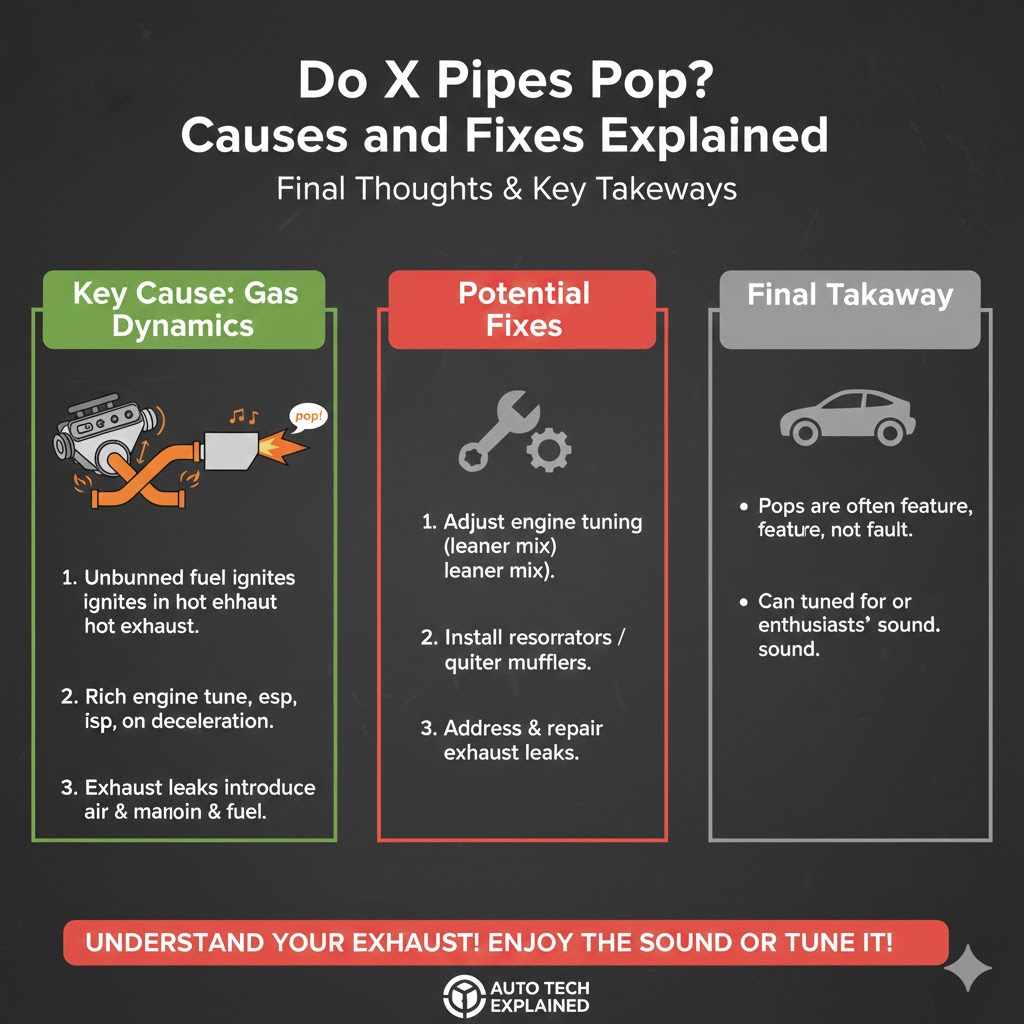
The question “Do X Pipes Pop? Causes and Fixes Explained” is answered by understanding gas dynamics. Pops occur mainly from unburned fuel igniting in the hot exhaust.
This is often caused by a rich engine tune or exhaust leaks. Fixes include adjusting engine tuning for a leaner deceleration mixture or modifying the exhaust with resonators or quieter mufflers. Addressing leaks is also key.
Frequently Asked Questions
Question: What is an X pipe and why is it used?
Answer: An X pipe is a component in a V-engine’s exhaust system that connects the two exhaust manifolds. It crosses over, forming an ‘X’ shape, to help equalize exhaust pressure between the two banks of cylinders. This can improve exhaust scavenging, leading to better engine performance and a unique exhaust note.
Question: Is exhaust popping bad for my car?
Answer: Generally, occasional exhaust popping is not harmful to your car, especially if it’s a characteristic sound of a performance exhaust system. However, persistent or excessively loud popping, especially if accompanied by other symptoms like loss of power or poor fuel economy, might indicate an issue like a rich fuel mixture or an exhaust leak that should be addressed.
Question: How can I make my exhaust pop more?
Answer: To encourage more popping, you would typically aim for a richer air-fuel mixture during deceleration and ensure your exhaust system is less restrictive. This can involve ECU tuning to favor a richer mix, installing a high-flow X pipe or cat-back exhaust, and potentially removing or modifying mufflers or catalytic converters. However, be aware of local emission laws.
Question: What is the difference between an X pipe and an H pipe sound?
Answer: An X pipe generally produces a higher-pitched, raspier, and more aggressive sound, often associated with more popping and crackling. An H pipe tends to create a deeper, more mellow, classic muscle car tone with less tendency to pop.
Question: Can a bad spark plug cause exhaust popping?
Answer: Yes, a faulty or worn spark plug can contribute to exhaust popping. If a spark plug is not firing correctly, it can lead to unburned fuel entering the exhaust system, which can then ignite and cause pops. It is one of several potential ignition-related causes.
Conclusion
Understanding why X pipes pop helps you manage your car’s sound. It’s usually due to fuel igniting in hot exhaust gases from a rich tune or leaks. You can fix this by tuning the engine leaner, adding exhaust resonators, or using quieter mufflers.
Ensuring your exhaust is sealed is also important. You can achieve the sound you prefer with the right adjustments.


