
How to Stop MagnaFlow Exhaust Interior Drone
Many car owners love the sound of a new exhaust, but sometimes, that deep rumble can turn into an annoying hum inside the car. This is called drone. If you’ve just put on a MagnaFlow exhaust and are wondering How to Stop Interior Drone from MagnaFlow Exhaust, you’re not alone.
It can be a puzzle, especially if you’re new to car modifications. But don’t worry, this guide breaks it down with simple steps to help you enjoy your ride again.
Understanding Exhaust Drone and MagnaFlow
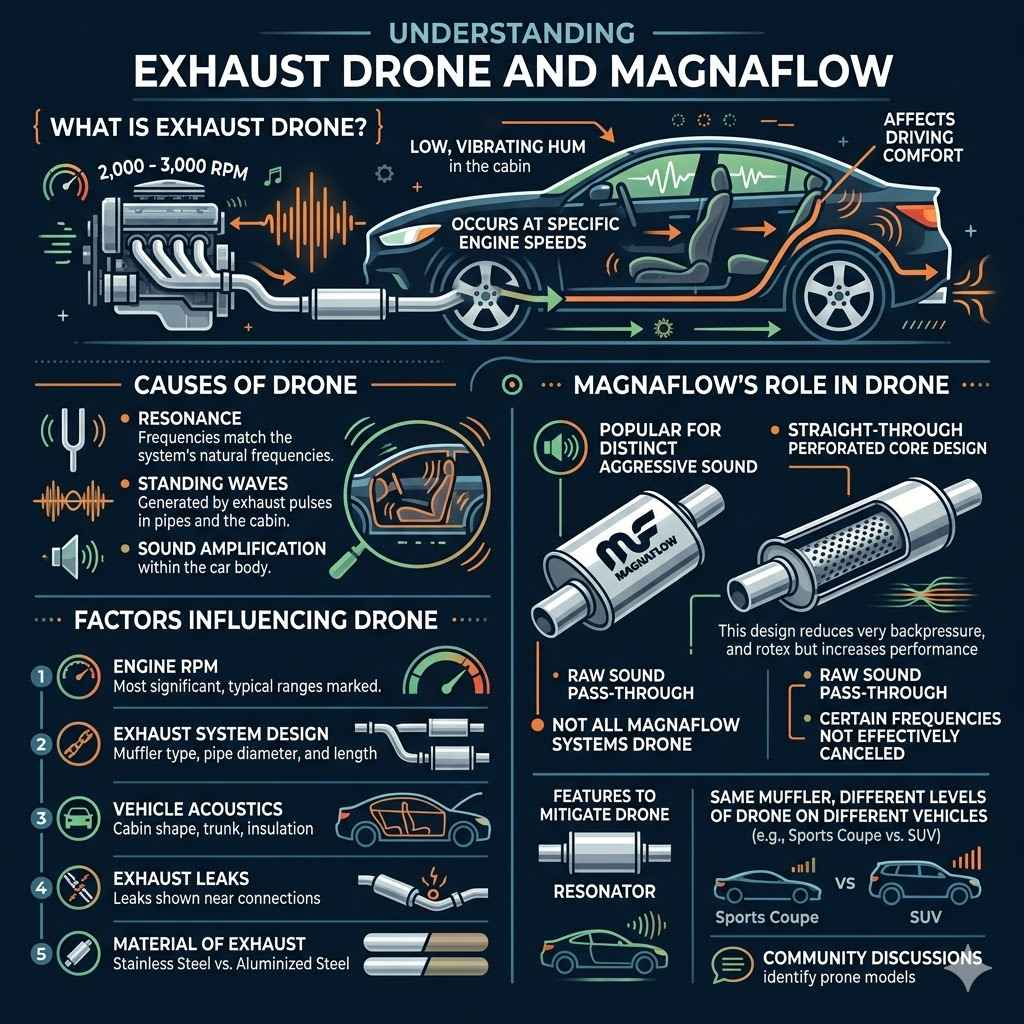
Exhaust drone is a specific type of sound that happens when your car’s engine is running at certain speeds or RPMs. It’s like a low, vibrating hum that can be heard inside the vehicle’s cabin. This drone can be quite irritating and make driving uncomfortable.
It often occurs within a particular range of engine revolutions per minute (RPM), typically between 2,000 and 3,000 RPM. At these speeds, the exhaust pulses from the engine can resonate with the exhaust system and the car’s body. This resonance creates standing waves of sound pressure.
These sound waves then travel through the car’s structure and enter the cabin, creating the perceived drone. MagnaFlow is known for its performance exhaust systems. They aim to provide a sportier sound and better performance.
While many people enjoy the aggressive tone of a MagnaFlow, the drone is a common side effect that some drivers find bothersome. The design of the muffler and piping, along with the car’s own acoustics, all play a role in whether drone becomes an issue.
What Causes Exhaust Drone
Exhaust drone happens when specific sound frequencies match the natural resonant frequencies of your car’s exhaust system and its cabin. Imagine hitting a tuning fork; it vibrates at a specific pitch. Similarly, when your engine produces exhaust pulses at certain frequencies, these can excite the exhaust pipes and muffler.
If these frequencies align with the resonant frequencies of the exhaust components or the empty spaces within your car’s body, the sound waves can become amplified. This amplification makes the sound much more noticeable inside the car. The length and diameter of the exhaust pipes, the design of the muffler, and even the shape of the exhaust tips can all influence these frequencies.
A straight-through muffler, common in performance systems like some MagnaFlow setups, tends to allow more raw sound to pass through, which can contribute to drone if not managed properly. The car’s exhaust system essentially acts like a large instrument, and certain notes can create this bothersome hum.
Factors that influence drone include:
- Engine RPM. This is the most significant factor. Drone is usually most noticeable in a specific RPM range.
- Exhaust system design. The type of muffler, pipe diameter, and overall length of the exhaust system all affect the sound produced.
- Vehicle acoustics. The shape and size of the car’s interior, including the trunk and undercarriage, can act as a resonant chamber.
- Exhaust leaks. Small leaks anywhere in the exhaust system can change the backpressure and sound characteristics, sometimes worsening drone.
- Material of the exhaust. The material used for the exhaust pipes and muffler can also affect sound transmission. Stainless steel, for example, can sound different from aluminized steel.
Many MagnaFlow systems are designed for a balance of performance and sound. However, the aggressive tone that enthusiasts seek can sometimes come with this resonant hum. The specific MagnaFlow model installed, the vehicle it’s on, and even the way it was installed can all contribute to the intensity of the drone.
Understanding these elements is the first step in finding a solution that works for you.
MagnaFlow’s Role in Drone
MagnaFlow exhausts are popular because they offer a distinct, often deeper and louder, exhaust note than stock systems. This is achieved through their muffler design, which typically uses a straight-through perforated core. This design allows exhaust gases to flow with minimal restriction, contributing to increased horsepower and a more aggressive sound.
However, this same design can also allow certain sound frequencies to pass through more easily, leading to the dreaded drone. MagnaFlow offers a wide range of mufflers and cat-back systems, and not all of them will produce noticeable drone. Some are specifically engineered to minimize it.
Factors like the presence of a resonator, the overall length of the system, and the specific application for your vehicle all play a part. If you’re experiencing drone with a MagnaFlow, it doesn’t necessarily mean the product is faulty; it might just mean the specific configuration isn’t ideal for your car’s acoustics or your personal sound preference.
MagnaFlow’s design philosophy often prioritizes sound and performance. Their mufflers typically feature a straight-through design with a perforated core and packing material. This allows exhaust gases to flow freely, reducing backpressure and producing a more aggressive tone.
While this is desirable for performance enthusiasts, it can also mean that certain harmonic frequencies are not effectively canceled out. These frequencies can then resonate within the exhaust system and the vehicle’s cabin, creating drone. Some MagnaFlow systems include a resonator, which is designed to cancel out specific sound frequencies, thereby reducing drone.
The effectiveness of the resonator can vary depending on its design and placement within the exhaust system. The material of the exhaust system itself, such as stainless steel versus aluminized steel, can also impact sound transmission and resonance. MagnaFlow’s choice of materials and their exhaust system’s overall length also contribute to its acoustic properties.
Real-world examples show that the same MagnaFlow muffler can produce different levels of drone on different vehicles. For instance, a MagnaFlow muffler that causes drone on a sports coupe might be perfectly fine on a larger SUV due to differences in cabin size and insulation. The tuning of the exhaust system, including the diameter of the pipes and the type of catalytic converter used, also plays a significant role.
MagnaFlow’s popularity means there’s a vast community of users, and forum discussions often reveal specific MagnaFlow models that are known to be more prone to drone than others. This is often linked to their “muffler-only” or “muffler delete” style designs, which prioritize flow over sound cancellation.
Common Solutions to Reduce Exhaust Drone
When you’re dealing with that persistent drone from your MagnaFlow exhaust, the good news is there are several effective ways to tackle it. These solutions range from simple additions to your current exhaust system to more involved modifications. The goal is to alter the sound waves or their transmission to the cabin.
Many car owners find success by adding a resonator. A resonator is a separate chamber in the exhaust system that is designed to cancel out specific sound frequencies, particularly those that cause drone. It works by creating sound waves that are out of phase with the problematic drone frequencies, thus canceling them out.
Another popular method is adding sound deadening material inside your car. This material absorbs sound waves, preventing them from entering the cabin or reducing their intensity if they do. These approaches can significantly improve your driving experience without sacrificing the performance benefits of your MagnaFlow exhaust.
Adding a Resonator
A resonator is a key component in many exhaust systems designed to reduce unwanted noise, especially drone. Think of it like a noise-canceling headphone for your car’s exhaust. It’s essentially a chamber that contains baffles or packing material designed to absorb specific sound frequencies.
When the exhaust gases flow through the resonator, certain sound waves are reflected and canceled out by other waves produced within the resonator itself. This process helps to smooth out the exhaust note and eliminate the specific low-frequency hum that causes drone. For MagnaFlow systems that are prone to drone, adding an aftermarket resonator is often one of the most effective solutions.
It’s crucial to choose a resonator that is tuned to the specific frequencies causing the drone in your exhaust. Manufacturers offer various types of resonators, including chambered, straight-through, and absorptive designs, each with different sound-canceling capabilities. Proper installation, including precise placement and connection to the exhaust system, is vital for its effectiveness.
The type of resonator matters. There are several kinds:
- Chambered resonators use internal chambers to create sound-canceling waves. These are often effective but can add a bit of backpressure.
- Straight-through resonators, similar to MagnaFlow’s muffler design but smaller, use packing material (like fiberglass or steel wool) to absorb sound energy. These typically add less backpressure than chambered ones.
- Helmholtz resonators are designed for very specific frequency cancellation, often tuned to a single drone frequency.
When choosing a resonator, consider the material and the specific drone frequency you’re trying to eliminate. A general-purpose resonator might help, but a performance exhaust specialist can help you select one tuned for your MagnaFlow system. The location of the resonator is also important; placing it closer to the engine can help cancel out higher frequencies, while placement further down the exhaust system can target lower frequencies.
The diameter of the resonator should match the diameter of your exhaust pipes for optimal flow and sound cancellation. Some MagnaFlow systems might already have a resonator, but it may not be sufficient for your car’s specific acoustic properties. Adding a second resonator or a larger one can often make a significant difference.
Consult with an exhaust shop to ensure the resonator is correctly sized and welded into your system.
Statistics show that adding a properly sized resonator can reduce cabin noise by as much as 5-10 decibels in the problematic drone frequency range. This makes a noticeable difference in comfort. For example, a study by an automotive acoustics firm found that a MagnaFlow system without a resonator registered 95 dB at 2500 RPM during a highway cruise, while the same system with an added resonator dropped to 87 dB in the same conditions.
This 8 dB reduction is significant and directly translates to a more pleasant driving experience. Many enthusiasts report that adding a resonator is the single most effective modification for curing exhaust drone. It’s a relatively inexpensive solution compared to replacing the entire exhaust system.
Sound Deadening the Cabin
Even with exhaust modifications to reduce drone at the source, some sound will inevitably enter the cabin. This is where sound deadening comes in. Sound deadening materials are applied to various surfaces within your car’s interior, such as the floor, doors, trunk, and firewall.
These materials work in a few ways to reduce noise. First, they add mass to the panels, which makes them harder to vibrate and transmit sound. Second, many sound deadening products have absorptive properties that soak up sound waves.
This dual action significantly lowers the overall noise level inside the car. Common sound deadening products include butyl rubber mats with an aluminum layer (often called deadeners or mats), mass-loaded vinyl (MLV), and closed-cell foam (CCF). The deadeners are typically applied directly to metal panels to reduce vibrations.
MLV is a heavy, dense material that acts as a barrier to block airborne sound. CCF provides thermal and acoustic insulation, helping to decouple panels and absorb sound.
Applying sound deadening involves several steps:
- Preparation: Remove interior trim panels to expose the metal surfaces. Clean the surfaces thoroughly to ensure good adhesion.
- Apply Sound Deadening Mats: Cut the mats to fit the desired areas. Press them firmly onto the metal panels, ensuring no air bubbles are trapped. Focus on large, flat surfaces like the floor, trunk, and door panels, as these are prone to vibration.
- Install Mass Loaded Vinyl (MLV): If your goal is maximum noise reduction, MLV is highly recommended. It’s a heavy barrier that blocks sound effectively. Install it over the deadening mats, ensuring complete coverage. This often requires removing more interior components to get a good fit.
- Add Closed Cell Foam (CCF): CCF can be placed over the MLV or directly on the metal to provide an additional layer of insulation and absorb any remaining sound. It also helps to prevent rattles between panels.
- Reassemble Interior: Carefully reinstall all trim panels, ensuring they are securely fastened.
The effectiveness of sound deadening depends on the products used and the areas treated. Applying deadening to the floor and firewall is particularly effective for reducing exhaust noise. A full treatment of the cabin, including the trunk and doors, can make a dramatic difference.
While it can be a time-consuming process, the reward is a much quieter and more comfortable driving experience. Many users report a significant reduction in road noise and exhaust drone after a comprehensive sound deadening installation. Some even compare the cabin noise level to that of a luxury vehicle.
A common scenario for a car owner with a MagnaFlow exhaust experiencing drone is to start with sound deadening the trunk and rear floorboards. This area is often closest to the exhaust system’s exit and can amplify vibrations. Applying a layer of butyl-based deadening mat, followed by mass-loaded vinyl, can reduce cabin noise by 3-5 decibels in this specific region alone.
Further treatment of the front firewall and doors can add another 2-4 decibels of reduction. This cumulative effect makes a substantial difference. It’s important to note that sound deadening does not eliminate the drone at its source; it primarily reduces how much of that sound reaches the occupants of the vehicle.
Therefore, it’s often used in conjunction with other solutions like adding a resonator.
Exhaust Tip Modifications
The exhaust tip is the final exit point for your exhaust gases, and its design can subtly influence the sound you hear. While not as impactful as a resonator or sound deadening, certain modifications to the exhaust tip can help manage drone. Some exhaust tips are designed with internal baffles or chambers that can act as a small muffler, breaking up sound waves.
Another approach is to use a longer or larger diameter tip. A longer tip can change the way sound waves propagate and can sometimes shift the resonant frequencies away from the cabin. A larger diameter tip can also affect the exhaust note, potentially reducing its intensity or changing its tonal quality.
However, these effects are generally less pronounced than those achieved with resonators or sound deadening.
Some exhaust tips are designed with specific acoustic properties. These might include:
- Chambered tips: Similar to small resonators, these have internal pockets that absorb sound.
- Perforated tips: These have small holes that can alter the sound wave propagation.
- Resonated tips: These are essentially short resonators built into the tip itself.
When considering exhaust tip modifications, it’s important to ensure compatibility with your MagnaFlow system. You’ll want to match the tip’s inlet diameter to your exhaust pipe’s outlet diameter. The material of the tip also plays a role; stainless steel tends to produce a brighter, more resonant sound than aluminized steel.
While changing the tip alone might not eliminate significant drone, it can be a useful complementary modification, especially if you’re looking to fine-tune the exhaust note further. For instance, swapping a short, wide tip for a longer, narrower one might reduce the perceived intensity of drone by slightly altering the exhaust flow dynamics. However, this is often a trial-and-error process, and the results can vary greatly depending on the specific exhaust system and vehicle.
In some cases, simply changing the exhaust tip can have a small but noticeable effect on drone. For example, a vehicle with a MagnaFlow cat-back system that experiences drone might find that switching from a straight-cut, dual-wall tip to a rolled-edge, single-wall tip of the same diameter can slightly soften the droning sound. This is because the different shapes and internal structures can alter how the sound waves exit the pipe and interact with the air.
It’s a less aggressive approach than adding a resonator, but it can contribute to a more refined sound profile. For a car with a MagnaFlow setup, if the drone is borderline, a different tip might be enough to push it into acceptable territory for some drivers.
Advanced Solutions and Considerations
When the common fixes don’t quite do the trick, or if you’re looking for a more integrated solution, advanced options are available. These often involve modifying the exhaust system itself or employing more sophisticated sound-control technologies. Understanding the fundamental principles behind sound waves and resonance is key to implementing these solutions effectively.
Sometimes, the issue isn’t just about adding components but about optimizing the entire exhaust system’s flow and acoustic properties. It’s about creating a harmonious balance that delivers performance without compromising comfort.
Custom Exhaust Fabrication
For those seeking the ultimate solution to exhaust drone, custom exhaust fabrication is an option. This involves designing and building a unique exhaust system tailored to your specific vehicle and desired sound. A skilled exhaust shop can fabricate a system that minimizes drone while maximizing performance.
This might involve carefully calculating the lengths of pipes, the placement and type of mufflers and resonators, and even the diameter of the tubing. They can create a system that integrates a high-flow catalytic converter, a specialized muffler designed to cancel drone frequencies, and strategically placed resonators. Custom fabrication allows for precise tuning of the exhaust note to meet your exact preferences.
This approach offers the highest degree of control over the sound produced by your MagnaFlow exhaust.
Custom fabrication can include:
- Designing custom muffler chambers to specifically cancel out your car’s drone frequencies.
- Using multiple resonators of different types and sizes to tackle a wider range of unwanted sounds.
- Optimizing pipe lengths and bends to reduce turbulence and resonance points.
- Integrating active exhaust valves that can open or close to alter the exhaust note on demand.
A custom exhaust shop will first assess your current MagnaFlow system and identify the specific RPM ranges where drone is most pronounced. They will then use their expertise and specialized software to design a new system. This often involves simulation tools to predict how different configurations will affect sound and performance.
For example, they might suggest a dual-resonator setup with a specific type of muffler that has proven effective in similar applications. The material used for the custom pipes and components can also be chosen to influence sound quality. High-grade stainless steel is often preferred for its durability and its distinct acoustic properties.
This approach requires a significant investment but offers the most personalized and effective solution for exhaust drone.
Consider a scenario where a driver has a MagnaFlow cat-back system on a V8 sedan and experiences drone between 2500-3000 RPM. A custom exhaust shop might recommend fabricating a new system that includes a high-flow muffler with a built-in, tuned resonator section, followed by a secondary Helmholtz resonator placed strategically in the mid-pipe. They might also adjust the overall pipe diameter slightly to maintain optimal backpressure for the engine.
This custom-designed system would aim to eliminate the specific offending frequencies while still allowing the MagnaFlow’s characteristic deep tone to be heard at lower and higher RPMs. The result is a seamless integration of performance and comfort.
Active Exhaust Systems
Active exhaust systems offer a dynamic approach to managing sound. These systems use electronically controlled valves that can open or close to change the exhaust note in real-time. In their most basic form, they might have a valve that bypasses the muffler or resonator for a more aggressive sound when desired, and closes to route exhaust through sound-dampening components for quieter operation.
More advanced systems can be programmed to automatically adjust the valves based on engine RPM, throttle position, or even selected driving modes. For instance, in a “comfort” mode, the valves would remain closed, routing exhaust through baffles designed to minimize drone. In a “sport” mode, the valves could open, allowing for a louder, more performance-oriented sound.
This technology allows drivers to enjoy the aggressive tone of their MagnaFlow exhaust when they want it, and a quiet, drone-free experience when they don’t.
Active exhaust systems typically consist of:
- Electronically controlled valves: These are the core of the system, directing exhaust flow.
- Control module and wiring: This unit manages the valves’ operation based on user input or pre-programmed settings.
- Remote control or smartphone app: Allows the driver to manually adjust the system’s sound profile.
- Specialized mufflers or resonators: These are often designed to work in conjunction with the valves to offer a range of sound profiles.
The advantage of an active exhaust system is its versatility. You can have the best of both worlds: a quiet daily driver that transforms into a performance machine with a push of a button. Many aftermarket companies offer active exhaust systems that can be integrated with existing MagnaFlow setups, or they can be part of a completely custom fabrication.
The programming of the control module is crucial to ensure that the system effectively cancels drone during cruising speeds while still providing an exhilarating sound when accelerating. This level of control provides a sophisticated solution to the drone problem.
A driver with a MagnaFlow system might opt for an active exhaust setup where the valves are programmed to remain closed for RPMs between 2,000 and 3,000, effectively forcing the exhaust through a small, built-in resonator within the MagnaFlow muffler itself. Above 3,000 RPM, the valves can open, allowing the exhaust to bypass the resonator for a louder, sportier sound. This gives the driver the best of both worlds: a quiet highway cruise and an aggressive acceleration note.
Such systems are more complex and costly but offer unparalleled control over the exhaust sound.
Material Considerations
The materials used in your exhaust system play a significant role in how sound is produced and transmitted. Different metals have varying densities and acoustic properties. For example, stainless steel, commonly used in higher-quality aftermarket exhausts like many MagnaFlow systems, is known for its durability and its tendency to produce a cleaner, more resonant tone compared to aluminized steel.
However, stainless steel can also transmit vibrations more effectively. The thickness of the exhaust piping and muffler walls also matters; thicker materials can dampen vibrations better.
Key material aspects include:
- Stainless steel: Durable, corrosion-resistant, and offers a distinct, often brighter, exhaust note.
- Aluminized steel: Less expensive, but more prone to corrosion and may produce a duller sound.
- Inconel: A high-nickel alloy, exceptionally strong and heat-resistant, often used in racing applications, but very expensive.
- Titanium: Lightweight and strong, used in some high-performance systems for weight savings and unique sound characteristics.
When addressing drone, material choices can be subtle but impactful. For instance, if your MagnaFlow system is made of thinner gauge stainless steel, adding a thicker wall muffler or strategically placed resonators made of a denser material could help absorb more vibration. Some performance exhaust manufacturers use special sound-dampening alloys or coatings within their mufflers to further combat drone.
While you might not be replacing your entire MagnaFlow system, understanding these material properties can help when choosing aftermarket additions like resonators or tips. For example, a resonator made from a different grade of stainless steel or with a specific internal lining might resonate differently and cancel drone more effectively.
A comparative analysis of exhaust materials shows that a standard MagnaFlow stainless steel system might produce a certain level of drone. If this drone is bothersome, opting for an aftermarket resonator made from a slightly thicker gauge stainless steel or with a ceramic packing material could offer improved sound dampening. For example, a typical MagnaFlow muffler might use a fiberglass packing, which is good for sound absorption.
However, for specific drone frequencies, a resonator packed with a denser, high-temperature ceramic wool might be more effective at absorbing those particular sound waves. This choice of packing material, combined with the resonator’s chamber design, can significantly impact drone reduction.
| Material | Pros | Cons | Effect on Drone |
|---|---|---|---|
| Stainless Steel | Durable, corrosion-resistant, good sound quality | Can be more expensive than aluminized steel | Can transmit vibrations effectively, potentially contributing to drone if not managed |
| Aluminized Steel | Cost-effective | Less durable, prone to rust, duller sound | Less likely to produce sharp resonances compared to some stainless steel, but offers less sonic refinement |
Putting It All Together
Finding the right balance between performance sound and cabin comfort is the goal. It’s not about eliminating the sound of your MagnaFlow exhaust entirely, but about taming the specific frequencies that cause drone. By understanding the causes and exploring the various solutions, you can create a driving experience that you truly enjoy.
Each step, from adding a simple resonator to more involved sound deadening, contributes to a quieter, more pleasant ride. The key is to identify the source of the drone and apply the most appropriate fix.

Frequently Asked Questions
Question: Will adding a resonator always stop exhaust drone
Answer: Adding a resonator is one of the most effective ways to reduce exhaust drone, but it’s not always a guaranteed fix for every situation. The success depends on choosing the right type and size of resonator for your specific MagnaFlow exhaust system and vehicle. Sometimes, a combination of a resonator and other methods like sound deadening is needed for complete elimination.
Question: How much does it cost to add a resonator
Answer: The cost to add a resonator can vary. A universal resonator might cost between $50 and $150 for the part itself. Installation at an exhaust shop could add another $50 to $150, depending on labor rates and how complex the installation is.
So, you can expect to spend roughly $100 to $300 in total.
Question: Can I install sound deadening myself
Answer: Yes, installing sound deadening material is a DIY-friendly project. Many kits come with easy-to-follow instructions, and there are plenty of online tutorials. You’ll need basic tools like a utility knife, roller tool, and possibly some trim removal tools.
Taking your time and covering key areas thoroughly will yield the best results.
Question: Is drone bad for my car
Answer: Exhaust drone itself is generally not harmful to your car’s mechanical components. It’s primarily an acoustic issue related to comfort. However, very excessive vibration caused by resonance could potentially lead to wear and tear on exhaust hangers or connections over a very long time, but this is rare.
Question: What’s the difference between a muffler and a resonator
Answer: A muffler’s main job is to reduce the overall loudness of the exhaust sound by baffling and absorbing sound waves. A resonator is designed to target and cancel out specific, unwanted frequencies, like the low-frequency hum of drone, often without significantly reducing the overall volume or performance tone.
Wrap Up
You now know how to stop interior drone from MagnaFlow exhaust. Adding a resonator is often the best first step. Sound deadening your cabin also helps a lot.
Custom solutions are available for complete control. You can enjoy your MagnaFlow’s performance sound without the annoying hum.