Can You Drive Without a Muffler Legally in Most States?
Usually not: many states require an exhaust system with a muffler, and a straight pipe or removed muffler can run afoul of equipment or noise laws even if the car still runs. Driving that way can lead to tickets, repair orders, failed inspection, and repeat stops. This guide breaks down state equipment rules, local noise enforcement, and inspection or emissions risks so you can judge the legal exposure.
Three types of laws apply when you lose your muffler
On public roads, the answer often depends on three separate checks: state equipment law, local noise enforcement, and inspection or emissions rules. A car can pass one check and fail another. That is why “legal” is not a single yes-or-no answer for a missing muffler.
State rules usually focus on required equipment. Local officers and city codes often focus on sound. Inspection programs may reject a car that is obviously modified even if the engine runs cleanly. Public roads are where all three layers matter.
What usually makes the difference
If a state requires a muffler, removing it can be enough to create a violation. If the state rule is broader and only says the exhaust may not be excessively loud, a missing muffler can still draw a stop or citation when the car is clearly louder than allowed. Inspection stations may also fail the car before road use becomes the issue.
Say your coupe keeps the catalytic converter and resonator but loses the muffler. It may still run normally, yet the legal risk can rise because the remaining parts do not always satisfy the state’s equipment rule or the local noise limit. The engine’s condition is separate from road legality.
What a muffler legality matrix shows
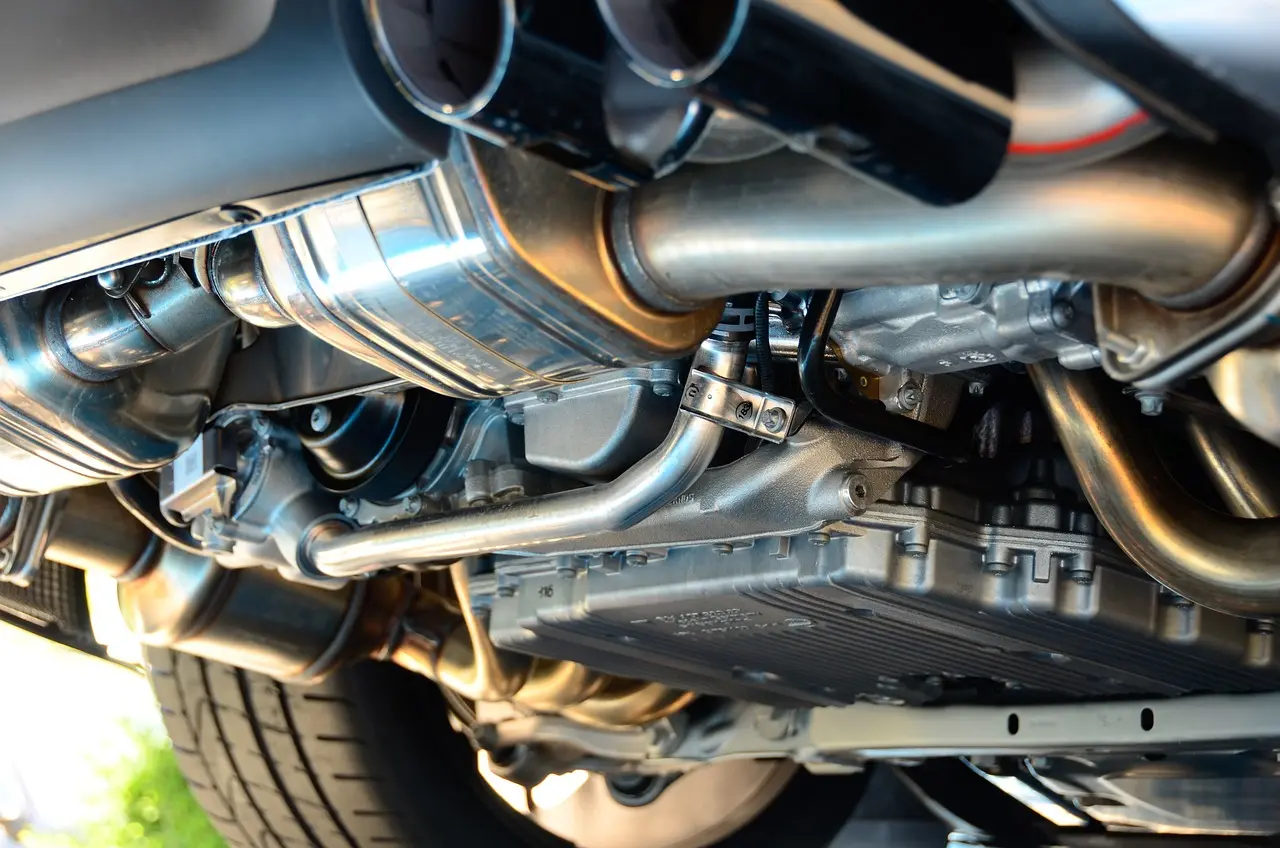
The matrix below compares the three setups that matter most on public roads. It separates state equipment law from inspection risk and noise-enforcement risk, because those are different questions. That split is the practical way to judge real-world exposure.
| Setup | State equipment law | Inspection risk | Noise-enforcement risk |
|---|---|---|---|
| Stock exhaust | Usually the safest fit for public-road rules because the system includes a catalytic converter, resonator, and muffler. | Lowest risk if the rest of the exhaust is intact and unmodified. | Lowest risk because stock systems are built to meet noise regulations. |
| Muffler delete | Risky where a muffler is required for road use. | Moderate to high risk if the inspector checks exhaust equipment or sound. | Moderate to high risk because it is usually louder than stock. |
| Straight pipe | Highest risk because it removes more sound-control hardware. | Highest risk in any program that checks exhaust equipment, sound, or visible modifications. | Highest risk because it is usually the loudest setup. |
Daily driver: stock exhaust is the least risky. Weekend car: a muffler delete can still create inspection and ticket risk if you drive it on public roads. Track-only vehicle: the public-road question changes if the car is trailered and never driven on streets.
Why this matrix matters
The same car can pass a visual glance in one place and fail a roadside stop in another. That is why it helps to judge the setup by use case, not by a single loudness complaint or a single local rule.
What the law usually requires instead

Most public-road rules want some kind of muffler or other sound-control equipment that keeps the exhaust within the allowed noise range. The exact wording varies, but the legal theme is consistent: the vehicle must not be unreasonably loud, and it often must retain the equipment that controls exhaust noise.
How noise rules drive muffler requirements
The reason given for changing the muffler is to meet noise rules, and that is exactly why removal becomes a legal problem. A muffler is a noise-compliance part, and on public roads the driver has to meet the sound limit, not just keep the car mechanically running.
A resonator can soften or clean up the tone, but it does not always replace a muffler. A catalytic converter helps with emissions control, but it does not by itself satisfy a muffler requirement. Those parts do different jobs.
Why a resonator or catalytic converter may not be enough
Keeping a resonator after a muffler delete can reduce harshness, but the car is still missing the muffler itself. Keeping a catalytic converter can help with emissions compliance, but emissions compliance is not the same as exhaust equipment compliance. A car can be clean enough for emissions and still fail a noise or equipment rule.
Picture a sedan that passes an emissions tailpipe check but has a straight pipe from the midsection back. It may still draw attention because the visual exhaust setup no longer matches what road-use rules commonly expect.
Muffler delete vs straight pipe
A muffler delete removes the muffler and leaves the rest of the system in place. A straight pipe removes the muffler and the resonator. That difference matters because the straight-pipe setup usually leaves less sound control, which can raise both inspection risk and roadside enforcement risk.
What changes when the muffler is removed
A muffler delete is usually the milder of the two loud-exhaust options. It is often louder than stock but quieter than a straight pipe. In many setups, the rest of the exhaust remains intact, which means the car can still keep a catalytic converter and, depending on the build, a resonator.
What a straight pipe removes beyond the muffler
A straight pipe removes the muffler and the resonator. That makes it the louder setup and usually the one with the higher legal exposure. If the state or city uses noise as the standard, the extra volume can matter as much as the missing equipment.
Why straight pipe often carries more risk
More missing sound-control hardware means less margin before a stop, citation, or failed inspection. That is why straight pipe is usually riskier than a muffler delete. The difference is not only sound level; it is the amount of equipment left to support compliance.
Will a missing muffler fail inspection?
It often can, but the result depends on the inspection program. Some states or counties focus on visible equipment, some focus on emissions, and some include a separate exhaust-noise or safety check. A car may pass one kind of inspection and fail another.
Inspection rules versus roadside enforcement
Inspection is a gatekeeping process. Roadside enforcement is discretionary and happens after the car is already in traffic. A vehicle with a missing muffler can fail the shop inspection before it ever reaches a police stop, or it can pass one inspection but still be stopped later for noise.
Inspection programs are often where a visible exhaust change matters most. If the program checks required equipment, a missing muffler can trigger failure even if the car is otherwise roadworthy.
Where visual checks matter most
Visual checks matter when the rulebook requires the muffler itself or requires the exhaust to remain in a near-stock condition. They also matter when the state ties road use to required equipment lists. One state may require a muffler for every road-going car, while a nearby state may write the rule around sound level instead. That state-by-state variation is why exhaust equipment rules also differ.
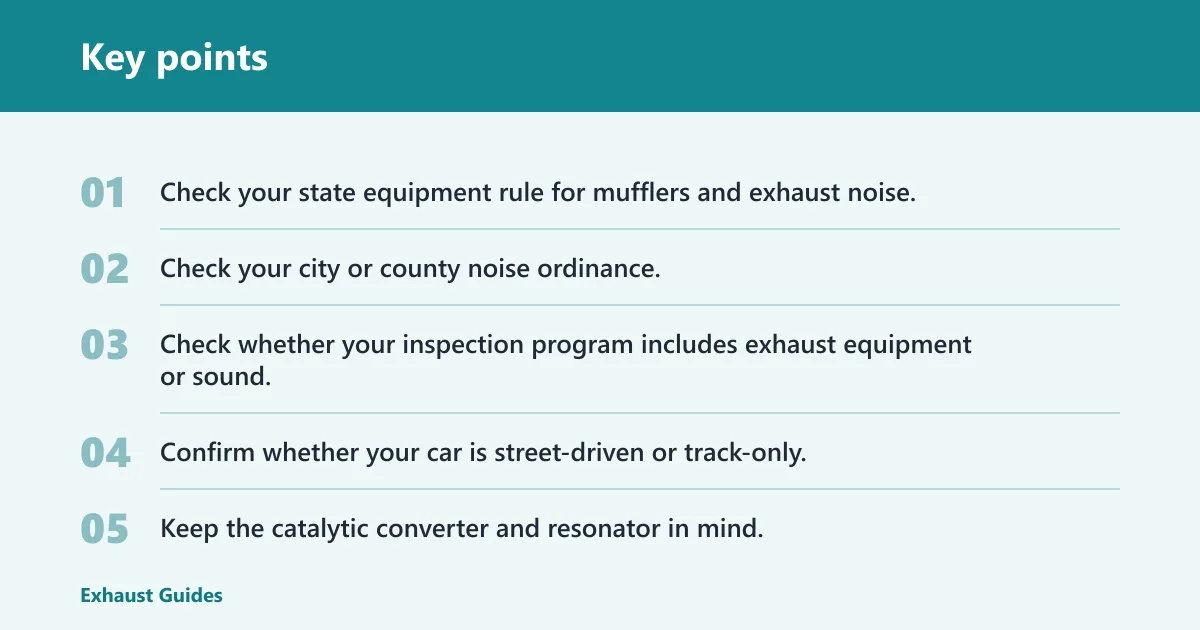
One practical step list:
- Check your state equipment rule for mufflers and exhaust noise.
- Check your city or county noise ordinance.
- Check whether your inspection program includes exhaust equipment or sound.
- Confirm whether your car is street-driven or track-only.
- Keep the catalytic converter and resonator in mind, but do not assume they replace a muffler.
Can turbo cars or UTVs differ?
Turbo cars can still face the same legal and noise limits. A turbo does not remove the need to follow equipment rules, and it does not cancel local noise enforcement. The legal question stays the same: does the vehicle meet the road rules where you drive it?
Turbo cars and exhaust legality
Turbocharged engines can change exhaust note and backpressure behavior, but those mechanical differences do not decide legality by themselves. If the state requires a muffler, a turbo car still needs one or another compliant exhaust setup for public-road use.
Street-legal UTV requirements as a comparison point
Street-legal UTV requirements show how specific public-road compliance can be. The article facts note that a muffler is described as the single most important component for street-legal UTV driving, and that states require different licenses and registrations to drive an off-road vehicle on public roads. That same logic applies to cars: the road legal threshold depends on required parts, not just whether the machine runs.
Use that as a comparison, not a loophole. Off-road use does not make a missing muffler legal on public streets.
Muffler delete risk by use case
The same exhaust setup carries different risk depending on how you drive it. Daily street use is the hardest place to justify a missing muffler. Weekend use lowers exposure only if the car still goes on public roads. Track-only use changes the issue because public-road rules may no longer apply during transport or closed-course driving.
Daily driving
For a daily driver, a muffler delete is the riskiest of the common choices short of a full straight pipe. It can invite attention, fail inspection, and create repeat-stop exposure if the car is obviously loud in traffic.
Weekend cars
Weekend cars often get a pass in owner circles, but the law does not treat them as special if they are on public roads. If the car leaves the garage and hits city streets, the same equipment and noise rules can apply.
Track-only vehicles
Track-only vehicles are different only when they stay off public roads. If the car is trailered, driven only on closed course property, and never used on streets, the public-road muffler question is much less important. Once it goes on a public road, the road rules come back.
A common first-timer mistake is assuming that “it passed emissions” means “it is legal.” Those are different checks. A car can be clean enough for emissions, yet still be noncompliant because the muffler is missing or the exhaust is too loud.
Frequently asked questions
Can you drive without a muffler legally in most states?
Usually no, at least not with confidence. Many states require exhaust equipment that controls noise, and a missing muffler can violate that rule even if the car still runs fine. Local noise enforcement and inspection programs can make the risk higher than the state rule alone.
Is a muffler delete street legal?
Sometimes, but often not for routine public-road driving. A muffler delete removes the muffler and leaves the rest of the system in place, yet the vehicle still may fail state equipment rules or local noise limits. Street legality depends on the exact rule where the car is driven.
What does the law usually require instead of a muffler?
Most road rules require an exhaust system that keeps noise within the legal limit. In practice, that usually means a muffler or equivalent sound-control equipment that satisfies the state’s equipment code. A catalytic converter or resonator may help, but they do not always replace the muffler requirement.
Will removing the muffler make my car fail inspection?
It can, especially if the inspection checks required equipment or exhaust noise. Some programs are visual, some are emissions-based, and some include both. A car may pass one inspection type and fail another, so the result depends on the inspection rules in your area.
Is straight pipe more illegal than a muffler delete?
Usually yes, because it removes more sound-control hardware. A straight pipe removes the muffler and the resonator, while a muffler delete removes only the muffler. That extra removal usually means more noise, more attention, and more legal risk on public roads.
What exhaust parts are still legal if the muffler is removed?
That depends on the state and local rule. A catalytic converter and resonator may still be present, and the car may continue to run normally, but those parts do not guarantee road legality. The key question is whether the vehicle still meets the equipment and noise rules where it is driven.